You finally decide to test an earlier bedtime. Then a tooth appears, the baby feels warm or pulling to stand becomes the only activity they want to practise.
OBubba replaces the start button with “Let’s hold off a few days.” Is the app abandoning the plan just when sleep is hardest?
We traced the current Sleep Consultant, disruption context, coaching ladder and experiment-outcome code for this guide. The hold is not a verdict that the original idea was wrong. It is protection against a bad comparison: if temporary discomfort or development changes the nights, the app cannot fairly judge whether the sleep lever helped.
The principle is simple: hold the experiment, not the care.
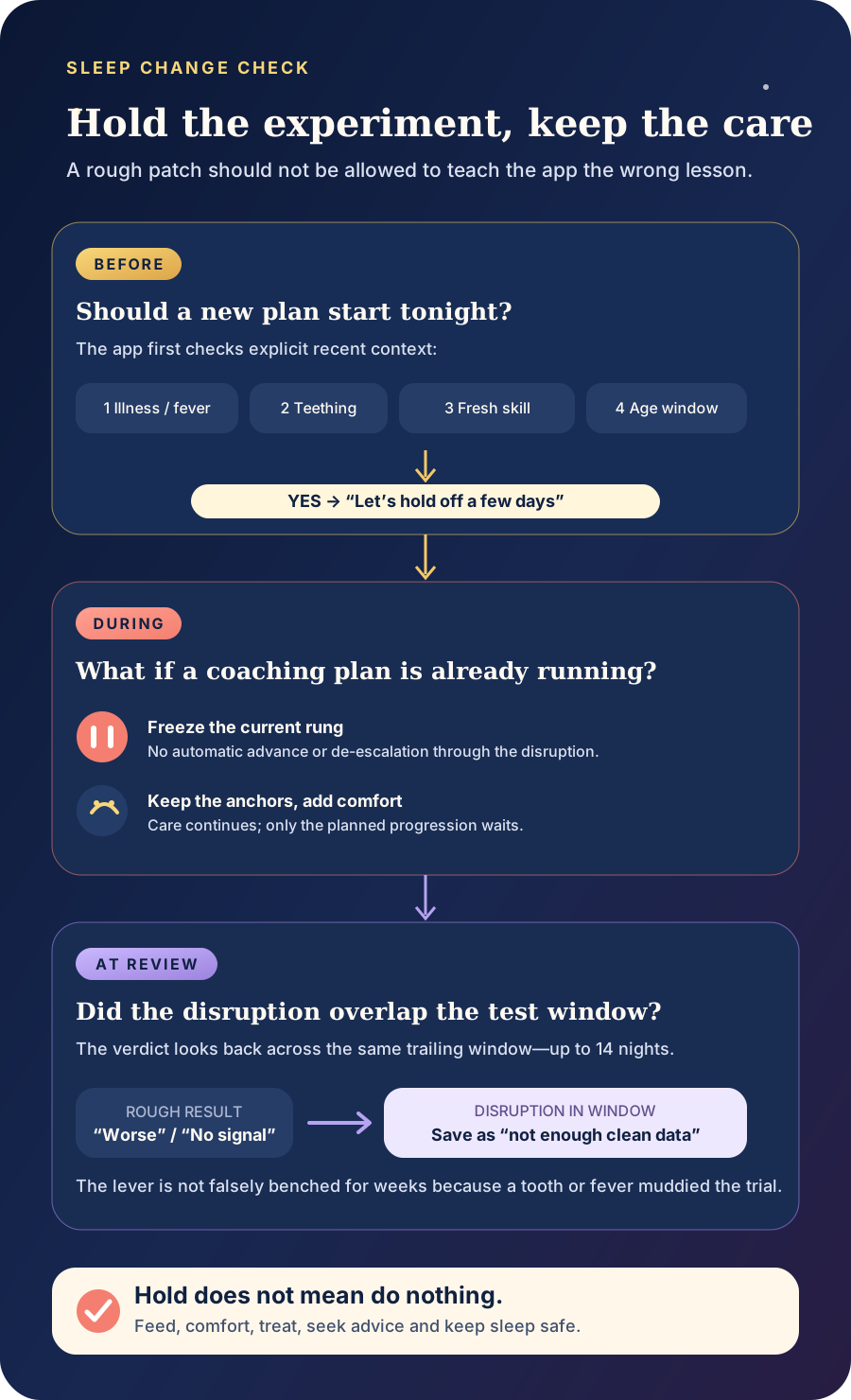
The short answer
OBubba may recommend holding when the current record contains a strong temporary disruptor—such as illness or recent fever, an active teething log, a newly dated movement or thinking milestone, or an age-based sleep-shift window.
That changes three things in the current app:
- a new structured plan is steered towards comfort and a steady routine instead of starting tonight
- an existing coaching ladder does not automatically advance or move backwards through the disruption
- a muddied experiment result is not allowed to teach the app that a potentially useful change “failed”
It does not mean ignoring wakes, withholding feeds, leaving a baby to cry, postponing medical advice or waiting passively for a coloured app window to end.
Why a clean comparison matters
Suppose the seven nights before a test averaged three wakes. You move bedtime 20 minutes earlier. On night two, a tooth begins causing discomfort; nights three to six are unusually unsettled.
If the app compares only the numbers, it may conclude that the earlier bedtime made sleep worse. That conclusion could then enter the child’s outcome history and hold the same lever back for about 60 days.
But the test did not isolate bedtime. It measured bedtime plus a teething week.
This is called confounding: something outside the planned change affects the outcome. Family logs cannot eliminate every confounder, but an app can avoid treating the most visible ones as clean evidence.
OBubba uses two disruption gates
The current app does not rely on one generic “rough week” switch.
| Gate | What it asks | Why both are needed | |---|---|---| | Presence gate | Is an explicitly logged disruption active right now? | A sick or teething baby should not be pushed into a new plan merely because earlier nights happened to look calm. | | Rough-night diagnostic | Have nights already become unusually disrupted, and is a sufficiently strong cause ranked at the top? | A repeated sleep change can provide context even when there is no single current log carrying the whole story. |
The presence gate is protective before a pattern becomes dramatic. The diagnostic gate explains a disturbance already visible in the sleep history.
What counts as an active presence signal
The shared context checks recent logs in a fixed priority order.
1. Illness or fever comes first
The app can hold when the bedtime day or physical night contains a local sick tag, an actual fever reading or a recognised pain/fever medicine entry. A fever from the last two days can also keep the hold active.
The code deliberately does not treat every temperature check as fever, and a routine vitamin D supplement does not become “illness” merely because it was stored in the medicine log.
One current sync limitation is worth knowing: the sick day tag is device-local. A synced fever or recognised medicine entry can contribute on a connected caregiver’s device, but the other phone does not inherit that local tag by itself. If two caregivers see different hold context, compare the underlying health entries rather than assuming one app view is authoritative.
This is context, not diagnosis. The app cannot identify the illness or decide whether care is urgent.
2. An explicit recent teething log
A teething record from the last seven days can hold the plan. If an actual tooth and date were saved, the note may say that a tooth came through a certain number of days ago. If the parent only logged suspected teething without naming a tooth, the app uses softer wording and does not invent an eruption.
That distinction matters. The NHS says teeth may emerge with no discomfort or with mild symptoms lasting a few days; babies can be fretful and sleep less well, but diarrhoea is not established as a teething symptom. Concerning symptoms still need health advice.
3. A fresh dated movement or thinking milestone
The disruption context looks for a motor or cognitive milestone recorded within the last 14 days. It does not treat every social or language first as a sleep-disruptive cause, and an undated milestone cannot produce a “five days ago” claim.
This is a hypothesis that a newly practised skill may be adding load—not proof that the milestone caused a wake. Illness, hunger, discomfort and ordinary sleep variability remain possible.
4. A corrected-age regression window
When none of the more concrete signals wins, the app can use a recognised age window as broad context. Corrected age is used when applicable after premature birth.
An age window is the weakest kind of evidence in this priority chain because it is not a dated event. It should never explain away a baby who seems unwell or a parent’s concern.
What the rough-night diagnostic adds
The separate diagnostic path first needs evidence that sleep really changed. In the current implementation, it can open when at least two of the last five nights contain three or more wakes, or when recent nights show a substantial personal spike over the earlier baseline.
It then ranks possible causes. Confirmed or strongly supported disruption types clear the Sleep Consultant’s hold threshold; a soft keyword-only suspicion does not.
For example, a note that merely contains a teething-like word can produce a gentle possible-teething clue, but that clue scores below the automatic training-hold line. An explicit current teething record is different: the presence gate can hold even before the nights are severe.
The score-based route can also raise a recently introduced common allergen high enough to hold a plan when rough nights are present. That is a reason to stop treating sleep as the main question, not evidence that a food caused the wakes. Hives, facial swelling, repeated vomiting, breathing changes or another suspected reaction need appropriate medical help; an app experiment must not delay it.
The genuine insight surface
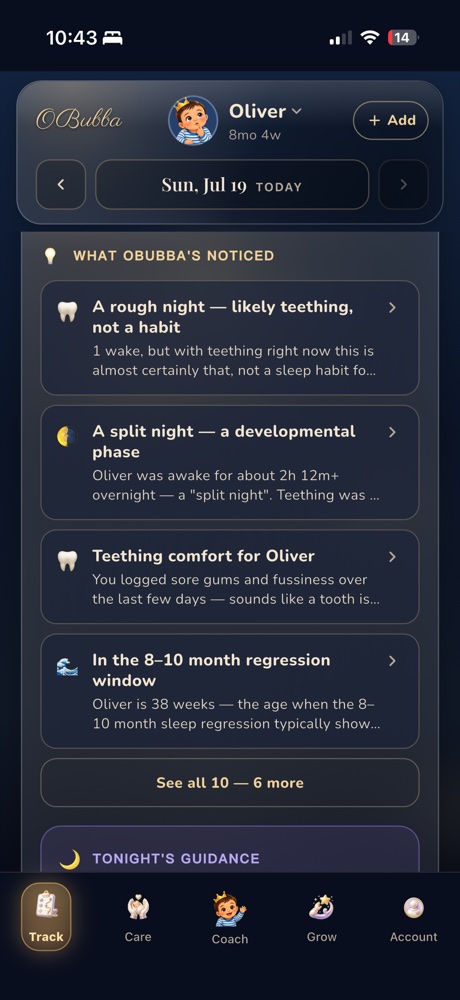
The screen above shows why priority matters. Teething, a long awake stretch and an age window may overlap. They are not interchangeable diagnoses.
OBubba’s current architecture lets each detector build its own clue, then uses the strongest supported context when deciding whether a structured change should start. A single calm message reaches the parent, but the app does not pretend every card came from the same evidence rule.
Before a plan: “Let’s hold off a few days”
When the hold is active, the Sleep Consultant returns a ride-it-out diagnosis with no staged plan. In place of the ordinary start action, the amber card says:
“Let’s hold off a few days.”
It recommends keeping bedtime steady and offering extra comfort rather than asking the parent to work through a new rung against a moving target.
There is still a quiet Start anyway option. That preserves parent choice; an app should not lock a family out of its tools. But the default route is to wait, and a professional feeding, neonatal or healthcare plan always outranks the app’s override.
During a coaching plan: the rung freezes
OBubba’s formal coaching plans use staged rungs. On an ordinary review, the app can advance a rung when the method appears to be working or de-escalate when it appears harder.
During a recognised disruption, the current controller does neither. It keeps the family on the same rung and avoids resetting the baseline because of a tooth, illness, recent skill or regression window.
That is different from erasing the plan. Familiar sleep anchors can continue:
- the same short wind-down
- a recognisable song or phrase
- a safe, clear sleep space
- responsive feeds and comfort
- the settling help the baby needs tonight
The progression waits. Care does not.
During a one-change experiment: the app recommends pausing
A smaller experiment—such as testing an earlier bedtime or different final-nap cap—is stored separately from the formal coaching ladder.
The current app does not silently stop that experiment’s calendar in the background. Instead, its supervisor can surface “Pause the experiment while [name] settles” when a disruption and active test overlap. That distinction is important: a recommendation to pause is not the same as pretending the test never ran.
If the parent stops the experiment while the result says worse or no clear signal, the outcome code checks both:
- whether a disruption is active now, and
- whether a dated fever, illness, tooth or fresh milestone occurred inside the same trailing verdict window
The verdict window is capped at 14 nights. A tooth from 11 days ago may no longer count as active teething today, yet still have contaminated a 14-night test. The historical window catches that case.
How the app protects a possibly useful lever
Normally, a clean worse or no signal result can make OBubba stop proposing the same practical change for roughly 60 days. That prevents nagging a family with a lever they already tried.
When a recognised disruption overlaps the trial, those negative verdicts are stored as missing data instead. The experiment can conclude, so it does not block every future suggestion, but the app does not poison the baby’s learning history with a false failure.
This is one of the more valuable details in the implementation:
uncertain evidence is not negative evidence.
How long should the hold last?
“A few days” is intentionally not a universal countdown.
The current presence rules have different technical windows—recent fever, seven-day teething context, a 14-day fresh milestone and age-based regression ranges—but those are product guards, not instructions to wait exactly that long.
A practical restart needs the child, not just the code:
- baby seems well and any health concern has been addressed
- feeding and hydration are back to the child’s usual pattern
- obvious discomfort is easing
- the family has a few reasonably comparable nights again
- the planned change still solves a real problem
- the parent has the capacity to try it consistently and safely
If sleep is still difficult after the temporary context passes, that may be the right time to rebuild the baseline and test one small lever.
What to do during the hold
Keep one or two anchors
Use the same general bedtime sequence and familiar sleep environment. Do not chase precision when the baby is uncomfortable or needs extra care.
Respond to the reason in front of you
Feed responsively. Offer comfort. Follow age-appropriate teething advice and medicine instructions. Follow the baby’s individual care plan. Ask a pharmacist, GP, health visitor or other qualified professional when unsure.
Keep logs factual and light
Useful entries include the temperature actually measured, medicine and dose, a named tooth only when seen, a concrete milestone and the real sleep start/end. Do not turn “seemed off” into a diagnosis.
Protect the adult from dangerous tiredness
The NHS says it is safest to return a baby to their cot before the adult sleeps. Never fall asleep with a baby on a sofa or armchair. Do not co-sleep when the baby has a fever or signs of illness, or when an adult is extremely tired or affected by alcohol, drugs or sedating medicine.
Seek help when the question is no longer sleep
Get medical advice promptly if a baby is hard to wake, has difficulty breathing, is feeding unusually poorly and you are worried, has drier nappies, has a seizure, has a non-blanching rash, is inconsolable or seems seriously unwell. Call 999 in an emergency.
Try OBubba free → — keep sleep, health, teething, development and one-change experiments in the same family record, so a temporary rough patch does not become a permanent lesson.
Frequently asked questions
Does “hold off” mean sleep training is always wrong during teething?
It means the current moment may be a poor time to start or judge a new structured change. Keep responsive care and familiar anchors. The baby’s comfort, health and family circumstances matter more than completing an app plan.
Why did OBubba hold after a calm night?
The presence gate can respond to an explicit current illness or teething record even before several rough nights accumulate. It is designed not to greenlight a plan for a sick baby just because the earlier baseline looked calm.
Why did a teething note hold the plan but not say a tooth erupted?
An active teething log can be context. The stronger “tooth came through” wording requires an actual tooth entry with a usable date.
Why did a note mentioning drool not hold the plan?
Keyword-only suspicion is deliberately softer than an explicit teething record or actual tooth. The rough-night diagnostic can mention a possibility without automatically blocking every sleep tool.
Does the app automatically pause an active experiment?
The formal coaching ladder freezes its automatic rung decision. A separate one-change experiment is not silently stopped; the supervisor recommends pausing, and the stop/outcome path protects a confounded negative result.
Will the app call the experiment a failure after illness?
A negative result is downgraded to missing data when a recognised active or dated disruption overlaps the verdict window. That prevents the lever being treated as a clean failure.
Can I choose Start anyway?
Yes. The current hold card keeps a quiet override. Use it only when the family understands the context and the change remains safe and appropriate; it never overrides a clinical plan.
Does a regression window prove why my baby is waking?
No. It is age-based context, not a dated cause or medical assessment. Check feeding, health, discomfort, the sleep record and the baby in front of you.
Holding steady is an active decision
Sleep apps are often designed to keep a parent doing something: change another time, advance another rung, collect another verdict.
Sometimes the smarter action is to protect the comparison. OBubba’s current logic can hold a new plan, freeze a coaching rung and refuse to remember a confounded result as failure.
That restraint is useful only if it makes more room for care—not less.
Comfort the baby. Keep sleep safe. Address illness, pain, feeding and hydration. Ask for help when something worries you. Then, when the nights are comparable again, return to the smallest question worth testing.
Sources and further reading
- NHS: Baby teething symptoms
- NHS: Tips for helping your teething baby
- NHS: Is your baby or toddler seriously ill?
- NHS Best Start in Life: Safer sleep advice for babies
- NHS Best Start in Life: Your baby’s sleep patterns
OBubba is a tracking, planning and education tool, not a medical device. Its disruption holds and experiment verdicts are estimates from logged context. They cannot diagnose illness, teething, allergy, pain or the cause of a wake, and they do not replace safer-sleep guidance or professional care.
Ready to try OBubba?
Use OBubba to track feeds, sleep, naps, nappies, growth, milestones and family handovers in one calm baby tracker app.