You add a note after breakfast: “Lots of babble today—baba, dada and a new squeal.” Later, OBubba may surface a gentle card:
> Language is bubbling up
It can feel as though the app heard the conversation. It did not. The current feature reads the words a parent chose to save, checks the child’s corrected-age range and, when the rule fits, turns that observation into a low-pressure invitation to talk, pause and read together.
That distinction matters. This is not speech recognition, a developmental assessment or a prediction of when a first word will arrive. It is a transparent reflection built from the family’s own notes.
Here is the exact live rule, why reading and music make the confidence label stronger but cannot trigger it alone, where the signal appears, how it changes Today’s Play—and what the card cannot know.
The short answer
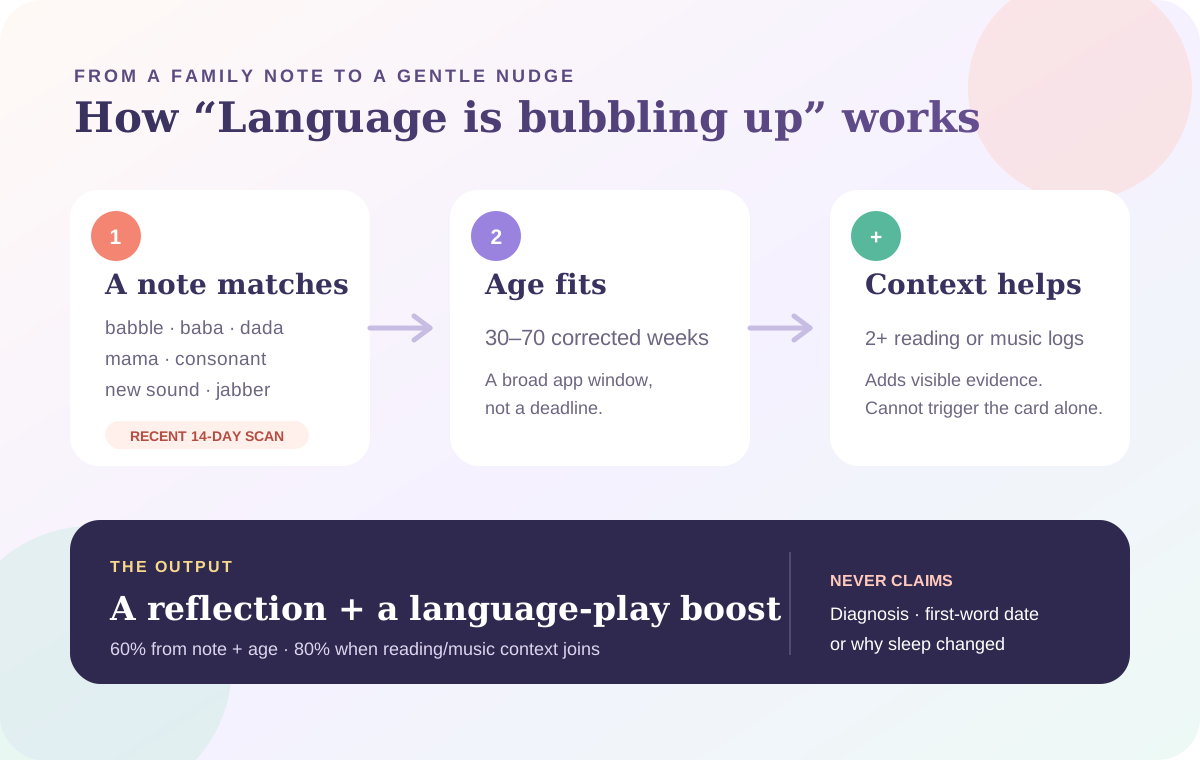
OBubba’s language-burst signal currently needs all three of these conditions:
| Gate | Current rule | |---|---| | Age context | 30–70 corrected weeks, inclusive | | Parent observation | At least one note from the recent 14-day scan contains a recognised babble phrase | | Required note words | `babble`, `baba`, `dada`, `mama`, `consonant`, `new sound` or `jabber` |
If the family also logged at least two reading or music activities in that period, the app adds “all the reading/singing you’ve done” to the visible evidence.
The result is a low-urgency development card. The app says it is 60% sure from a matching note plus age, or 80% sure when the reading/music context is present too. Those numbers are rule-based confidence labels, not measured probabilities that the interpretation is medically correct.
The app reads notes—it does not listen
The adapter scans entries from today and the previous 13 calendar days. Any non-empty note attached to an entry can join the note list. lowercases the text, then looks for one of seven literal fragments:
- babble
- baba
- dada
- mama
- consonant
- new sound
- jabber
The match is substring-based. There is no microphone analysis, audio recording, language model or acoustic classifier in this path. OBubba cannot tell whether a sound was repeated, directed at someone, used meaningfully or captured accurately.
That simplicity has benefits: the parent can see what the feature is responding to, and a private family moment does not need to become an audio file. It also creates rough edges. A note such as “no new sounds today” still contains new sound and can match. A note saying “more chatty” or “copying me” will not match unless it includes one of the recognised fragments.
The safest interpretation is therefore:
> A note in the recent record mentioned a kind of sound this feature recognises.
Not:
> OBubba independently detected a language leap.
Why the age gate is broad
The signal is eligible from 30 through 70 corrected weeks—roughly seven to sixteen months when dividing weeks into calendar months. That is intentionally a wide product window, not a clinical deadline.
For a child born prematurely, the app uses corrected age when the profile supports it. Corrected age can make broad developmental context fairer, but it does not turn a keyword match into an assessment.
Babies communicate long before first words and develop at different rates. NHS guidance describes a progression through listening, cooing, babbling, copying sounds and eventually using words; it also encourages families to speak with a health visitor or GP if they are worried (NHS: Help your baby learn to talk).
OBubba’s 30-week opening does not mean babbling should begin then. Its 70-week closing does not mean a baby has missed a deadline. It only bounds this particular in-app message.
Reading and music strengthen the basis—but never create it
Across the same 14 calendar dates, the adapter counts activity entries such as reading and music. The language branch adds those two counts together.
If the total is at least two, the visible Based on list gains:
> all the reading/singing you’ve done
This raises the rule’s confidence from 60% to 80%. But ten reading sessions with no matching note produce no language-burst card. The observation comes first; activities are supporting context.
That is a good restraint. Reading to a baby is worthwhile without needing to manufacture a “burst”. The NHS suggests looking at books, naming what you both see, singing and repeating the sounds a baby makes. The responsive back-and-forth—not a logged activity streak—is the useful part (NHS: Learning to talk, 6 to 12 months).
What “60% sure” and “80% sure” actually mean
starts this development detector at 40% and adds 20 percentage points for every counted supporting signal. For this branch:
| Evidence shown | Rule-based confidence | |---|---:| | Parent note about new sounds + child’s age | 60% | | Parent note + reading/music context + age | 80% |
Age appears in the Based on list but the code subtracts that baseline before counting the confidence additions. The recognised note supplies one signal; reading/music supplies another.
These are not probabilities from a validated study. “80% sure” does not mean an 80% chance that a language explosion is underway, that a first word is close or that development is typical. It means more of this deterministic rule’s own evidence fields were present.
That label is most useful as a quick comparison of how much logged context supported the card, not as a clinical score.
Where the signal can appear in OBubba
The same development engine feeds several real surfaces.
Development Map
The top signal can appear beneath LIVE, FROM YOUR LOGS, with its confidence and a visible line such as:
> Based on: your notes about new sounds · all the reading/singing you’ve done · Maya’s age
That evidence line is the feature’s most important trust mechanism. It lets a parent correct the underlying mental model: the app read a note; it did not hear the baby.
Behaviour Explained
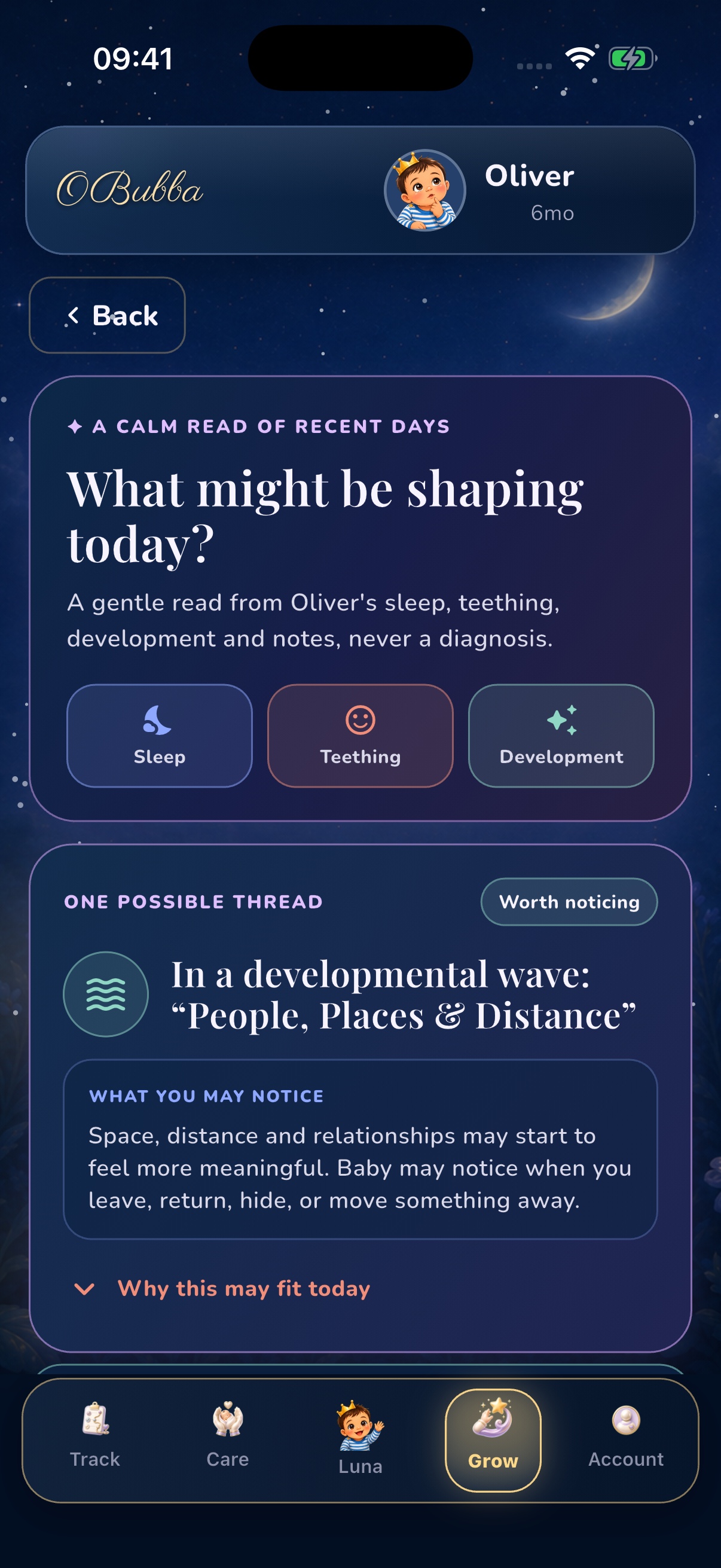
The What might be shaping today? screen can show the signal as one possible thread. Opening Why this may fit today reveals the recommendation and its evidence chips.
The main Brain
The Brain asks the development engine for its ranked signals and adds only the top one. A medium-urgency separation-anxiety clue can outrank this low-urgency language card. Another low-urgency clue with stronger confidence can also come first.
Silence does not mean the app missed a required milestone. It may mean the note did not match, the child is outside this message’s range or another current signal ranked higher.
A 10am development nudge
When development nudges are enabled and the daily slot has not passed, the reminder planner can reuse the top signal for one calm mid-morning note. It does not schedule a language alert at bedtime or wake a parent overnight.
How it changes Today’s Play
The subtle product connection happens after detection. OBubba maps a language-burst signal to the language activity category. The Today’s Play recommender then adds a 0.25 scoring boost to age-eligible activities in that category.
The recommender still considers:
- corrected-age fit;
- the family’s recent activity mix;
- skills emerging in the broad current development phase;
- recently logged milestones that may be consolidating; and
- stable tie-breaking when scores are equal.
So the card does not force one prescribed exercise. It nudges suitable language play higher within a wider ranking system. In the current mapping, reading and music logs are the activity types associated with language.
This closes a thoughtful loop:
> Parent notices a sound → saves it → app reflects the evidence → one relevant play invitation becomes easier to find.
The point is not to accelerate a baby on command. It is to help a tired parent answer, “What tiny thing could we enjoy together today?”
A five-minute response that matches the card
You do not need flashcards, a lesson plan or a special purchase.
- Get face-to-face when the baby is awake and interested.
- Copy one sound they make.
- Pause long enough for a reply.
- Name the object they are looking at or touching.
- Stop when they look away, fuss or need something else.
At a nappy change, that might sound like: “Ba-ba?”—pause—“Yes, bath! Warm bath.” At mealtime, name one food. During a book, talk about the picture instead of trying to finish every printed sentence.
NHS advice likewise recommends repeating a baby’s sounds, taking turns, naming shared objects, singing and talking through ordinary routines. These moments work because another person responds; they do not need to look educational.
Does a language burst explain worse sleep?
Not from this detector.
The language branch does not read night-wake counts, nap length, bedtime resistance or wake mood. A matching note can produce the card even when sleep is unchanged. The card’s appearance therefore does not prove that babbling caused extra waking.
Development and unsettled sleep can overlap in family life, but many other explanations remain possible: hunger, illness, teething, temperature, a schedule mismatch, separation, a noisy environment or ordinary variation. The app’s separate sleep and disruption engines should carry those questions.
If a baby wakes at night happily making sounds, keep the response calm and boring enough for night. Give rich, responsive sound play during the day. Continue to follow safer-sleep guidance for every sleep; a development card does not change the sleep environment.
What this feature does not assess
“Language is bubbling up” cannot determine:
- whether a sound is intentional or has a stable meaning;
- hearing ability;
- understanding of words;
- eye contact, gestures or social reciprocity;
- whether speech and language development is on track;
- whether a first word is imminent;
- the effect of bilingual or multilingual exposure; or
- whether sleep disruption is development-related.
It also does not inspect every possible communication clue. A baby may gesture, point, take conversational turns or understand familiar words without a note containing this detector’s phrases.
If you are worried about communication, hearing or development, do not wait for an app card. Raise the concern with a health visitor or GP. NHS baby reviews cover speech, social development, hearing and vision, and are designed for exactly that broader conversation (NHS: Your baby’s health and development reviews).
How to log the observation more usefully
One precise sentence is more valuable than trying to sound clinical.
Instead of:
> Big language leap.
Try:
> Repeated “ba-ba” during breakfast, paused when I copied it, then started again.
That record preserves what happened without deciding why. You might include:
- the sound or gesture you noticed;
- the situation;
- whether the baby copied or took a turn;
- whether it happened more than once; and
- anything else unusual that day.
The current detector still reduces that rich note to a keyword hit. The richer wording remains useful to the parent, partner, health visitor and future memory book—and gives future product logic something more honest to work with.
What the feature gets right
Most baby-development content starts with a generic age chart. This feature starts with something the parent actually noticed.
It keeps the trigger inspectable. It shows its basis. It uses corrected-age context. It lets reading and music strengthen rather than manufacture the clue. It ranks the result gently, avoids nighttime alerts and connects the observation to a small play idea instead of a performance target.
Its most honest translation is:
> A recent note mentioned new babbling during a broad age window. Here is why that may be interesting, what supported the thought and one pleasant way to respond.
That is not a diagnosis. It is something many trackers never become: a useful bridge between the detail a parent saved and the next warm moment with their baby.
OBubba connects sleep, feeds, development, play, weaning and the family’s own observations—then shows the reasoning instead of hiding it. Explore OBubba when you want one baby app that remembers the detail and helps you decide what matters next.
Ready to try OBubba?
Use OBubba to track feeds, sleep, naps, nappies, growth, milestones and family handovers in one calm baby tracker app.