Some evenings feel as if a switch flips. A baby who was manageable at lunch becomes unsettled at 5pm, feeds little and often, resists being put down, or wakes from the last nap already cross. After several logged days, OBubba may surface:
> A late-afternoon fussy patch > Oliver has had a fussy or unsettled stretch around 5:15pm on 4 of the last 6 days, the classic “witching hour”.
This is one of the app’s gentlest pattern cards. It is trying to answer a humane question: is tonight uniquely difficult, or has the same pressure point been appearing at a similar part of the day?
The current engine does not listen to the baby, rate the sound of a cry or diagnose colic. It scans seven calendar days for two specific things parents chose to record: crying events and naps marked as ending Fussy. The card only appears when that late-day signal repeats across a strict majority of days containing any log.
That can turn a blur of hard evenings into something discussable. But “witching hour” is a description of timing, not a cause—and the app’s older-baby explanation can sound more certain about overtiredness than the data proves.
The short answer
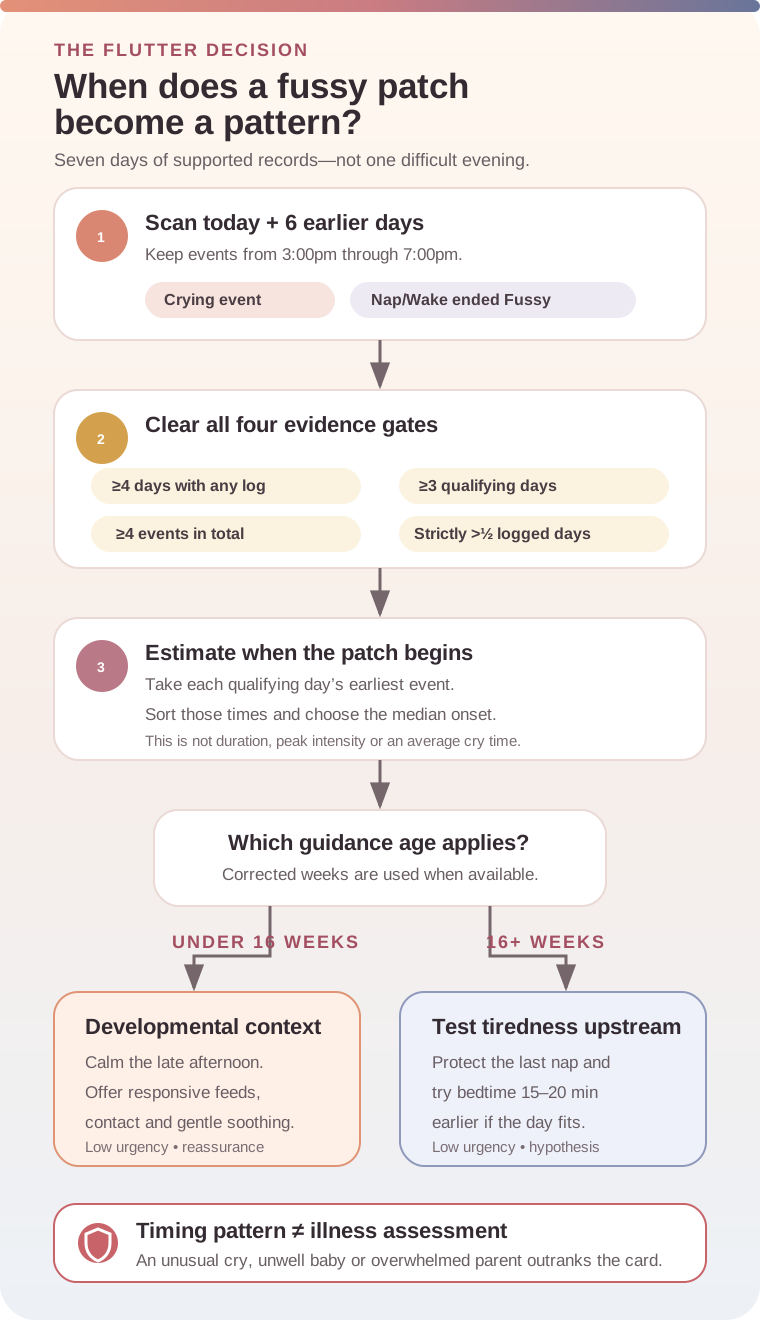
This exact card requires every gate below:
| Gate | Current rule | |---|---:| | Rolling history | Today plus the previous 6 calendar days | | Time window | 3:00pm to 7:00pm, inclusive | | Eligible signals | A Crying event, or a Nap/Wake marked Fussy | | Logged-day evidence | At least 4 days with any entry | | Repeated pattern | At least 3 qualifying days | | Event evidence | At least 4 qualifying events in total | | Majority | Qualifying days must be strictly more than half of logged days |
If the card clears those gates, it reports the median of each qualifying day’s earliest late-afternoon event. It then uses corrected age where available to choose one of two explanations: developmental reassurance under 16 weeks, or a last-nap/earlier-bedtime experiment from 16 weeks onward.
What the app actually counts
OBubba recognises two kinds of evidence.
1. A Crying event
The app’s crying helper lets a parent log a cry at the current clock time as Mild, Moderate or Intense. The record stores:
- type `crying`;
- a minute-of-day timestamp; and
- the selected intensity.
For this particular insight, intensity does not change the count. One mild cry at 5:10pm and one intense cry at 5:10pm each contribute one event. The intensity can support other crying analysis, but the witching-hour predictor only asks whether a timed cry exists inside its window.
2. A nap that ended Fussy
When completing a nap, a parent can optionally record how the baby woke: Happy, Sleepy or Fussy. The predictor counts Fussy.
The timing detail is thoughtful. `wakeMood` describes the end of the nap, so uses the nap’s end time first. A nap that began at 1:30pm and ended with a fussy wake at 4:00pm counts at 4:00pm. It does not incorrectly place the fuss at nap start. For older or simpler records, the engine can fall back to a moment time and then the start time.
A generic Wake record carrying a Fussy mood can count too, although the current nap editor is the normal place that field is written.
Everything else is invisible to this rule. A note saying “hard evening,” a refused feed, repeated dummy replacement, squirming, a difficult bath or fuss that was never logged does not count unless it became one of those two supported signals.
The window is exactly 3pm to 7pm
The detector accepts events from minute 900 through minute 1,140: 15:00 to 19:00, including both endpoints.
- 2:59pm is outside.
- 3:00pm is inside.
- 7:00pm is inside.
- 7:01pm is outside.
That is narrower than many parents’ everyday use of “witching hour.” A baby who reliably melts down from 7:30 to 9pm will not trigger this card. Nor will a newborn whose difficult stretch begins at lunchtime.
The fixed boundary makes the rule reproducible, but it does not define a medical phenomenon. The NHS says afternoon and evening are common times for babies to cry more; it does not say every normal evening fuss belongs inside OBubba’s four-hour product window.
Why one awful evening stays quiet
The app deliberately refuses to turn one memorable night into a pattern.
It first counts days with any logged entry. Empty days are ignored. It then counts days containing at least one qualifying late-afternoon event and totals all qualifying events.
To speak, it needs:
- four or more logged days;
- three or more qualifying days;
- four or more qualifying events; and
- fuss on strictly more than half the logged days.
That last word—strictly—matters:
| Seven-day record | Result | |---|---| | 3 fussy days out of 7 logged days | Silent: not a majority | | 3 out of 6 | Silent: exactly half | | 4 out of 6 | Eligible: strict majority | | 3 out of 4, but only 3 events total | Silent: event floor missed | | 3 out of 4, with 4 events total | Eligible |
The four-event floor stops one Fussy nap wake on each of three days from being enough. At least one qualifying day must contain a second supported event.
These are product confidence thresholds, not clinical cut-offs. Three evenings are not inherently healthy, and two evenings are not inherently concerning.
How “around 5:15pm” is calculated
Within each qualifying day, OBubba keeps only the earliest eligible event for the onset calculation.
Imagine this history:
| Day | Supported events | Daily onset used | |---|---|---:| | Monday | Cry 5:05pm, cry 6:20pm | 5:05pm | | Tuesday | Fussy nap wake 4:50pm | 4:50pm | | Wednesday | Cry 5:15pm, fussy wake 5:40pm | 5:15pm | | Thursday | Cry 5:35pm | 5:35pm |
The daily onsets are sorted, and the middle value is selected. With an even number of values, the implementation takes the upper middle rather than averaging the pair. Here it would report about 5:15pm, not 5:10pm.
That time is best understood as the middle earliest-recorded onset, not the average time the baby was fussiest. The app does not measure crying duration, end time or peak intensity. A two-minute cry and a two-hour unsettled stretch can each establish the day’s onset.
The displayed clock respects the parent’s 12- or 24-hour preference, so the same stored minute may appear as 5:15pm or 17:15.
The explanation changes at 16 weeks
The card title and low urgency remain the same, but the `why` text branches on age.
Under 16 weeks: developmental reassurance
The younger-baby version says evening fussiness in the early months is normal and developmental, commonly peaking around six weeks and easing by three to four months. It suggests a calmer late afternoon, responsive extra feeds and contact, a carrier, gentle movement or white noise.
That broad reassurance has support. The NHS says crying often increases from around two weeks and gradually reduces around three months. South Tees Hospitals’ NHS infant-crying guidance describes a peak around 6–8 weeks, measured from the due date for babies born early.
the app’s general guidance age uses corrected weeks when available. So a premature baby can remain in the developmental branch according to corrected rather than chronological age—a reasonable match for due-date-based crying guidance.
From 16 weeks: an overtiredness experiment
The older-baby version says the evening melt is “usually accumulated tiredness catching up.” It suggests protecting the last nap, reducing late-day stimulation and trying bedtime 15–20 minutes earlier.
This is the part to translate cautiously. The detector has not measured total day sleep, the last wake window, nap quality beyond Fussy, bedtime resistance or the effect of an earlier bedtime. It has found a timing pattern, then attached an age-based hypothesis.
A better reading is:
> “For an older baby, accumulated tiredness is one plausible explanation. If it fits the rest of today, protect the last nap or test a slightly earlier bedtime.”
It is an experiment, not a diagnosis. Hunger, pain, teething, illness, sensory overload, separation, feeding difficulty or a busy family transition can also cluster late in the day.
A worked example
Suppose the seven-day window contains six days with at least one entry. Four have supported signals:
- Monday: Crying at 4:55pm and 6:10pm;
- Tuesday: nap ended Fussy at 5:20pm;
- Thursday: Crying at 5:05pm;
- Saturday: nap ended Fussy at 5:30pm;
- Wednesday and Friday: feeds and nappies logged, but no supported fuss signal;
- Sunday: completely empty, so it is not a logged day.
The result is:
- `daysWithData = 6`;
- `qualifyingDays = 4`;
- `totalEvents = 5`;
- 4 of 6 is a strict majority; and
- the daily onsets 4:55, 5:05, 5:20 and 5:30 yield the upper-middle 5:20pm.
The card can say the patch appeared around 5:20pm on four of the last six logged days.
If Thursday’s cry moves to 7:05pm, it no longer counts. Qualifying days fall to three of six—exactly half—so the card stays quiet.
If Sunday gains a morning nappy record but no late-day fuss, it becomes a seventh logged day. Four of seven remains a strict majority, so the card can still appear.
What “logged days” does—and does not—prove
A day enters the denominator after any entry at all: a feed, nappy, nap, note or another recognised event. The engine does not require proof that crying was tracked consistently that day.
That has two effects.
First, it is conservative when a family logs routine care but rarely records crying. Those days count as non-fussy, so the card is harder to earn.
Second, the current day is included even while it is incomplete. At 10am, a morning feed can make today a logged non-fussy day before the 3–7pm window has happened. That can temporarily suppress a borderline pattern. Later, a supported event may change the ratio. A rolling card can therefore appear, disappear or shift its reported time without the underlying week being “wrong.”
The card’s `sampleSize` is the number of qualifying days, while its body also reveals qualifying days versus all logged days. That is more honest than presenting seven days of complete observation when some were sparse.
Still, the app cannot distinguish “no fuss happened” from “fuss happened but was not recorded.” Tracking should reduce mental load, not demand surveillance. A sparse result is simply less representative.
What the card cannot know
This detector does not establish:
- how long any crying lasted;
- whether the baby could be comforted;
- whether the cry sounded unusual;
- whether Mild, Moderate or Intense was selected;
- feeds, nappies, temperature or vomiting at the time;
- the baby’s exact last wake window or day-sleep total;
- whether the same carer logged each day;
- whether the baby was ill, teething, travelling or recently vaccinated;
- what soothing method helped; or
- whether changing the last nap or bedtime improved anything.
Unlike some OBubba trend engines, this function does not remove illness-, travel- or teething-tagged days before counting. A week of late-day illness-related discomfort can technically meet the same timing gates. That is why “classic witching hour” must never override a change in the baby’s health or behaviour.
There is another age limitation. When the date of birth is unavailable or malformed, the wider Brain defaults general guidance to roughly 26 weeks. This detector can therefore receive the older-baby branch instead of staying silent. Parents should correct the profile age before relying on age-specific wording.
How to log enough—without logging every cry
The Crying helper offers Mild, Moderate and Intense buttons that record the current time with one tap. The nap editor offers Happy, Sleepy and Fussy when a nap ends.
You do not need to document every whimper. A practical approach is:
- Log the moment that feels like the patch begins. That is what drives the onset estimate.
- Mark Fussy when that genuinely describes a nap wake. Do not use it as a score for a short nap.
- Use intensity honestly. This card ignores it, but other support may not.
- Record care first. Soothe, feed or check the baby before reaching for the phone.
- Stop if tracking adds stress. A short written pattern can still help a health visitor or GP.
The NHS specifically notes that recording when and how often a baby cries can help a professional explore possible causes and help a family recognise when they need more support.
The app keeps a safety route beside the pattern
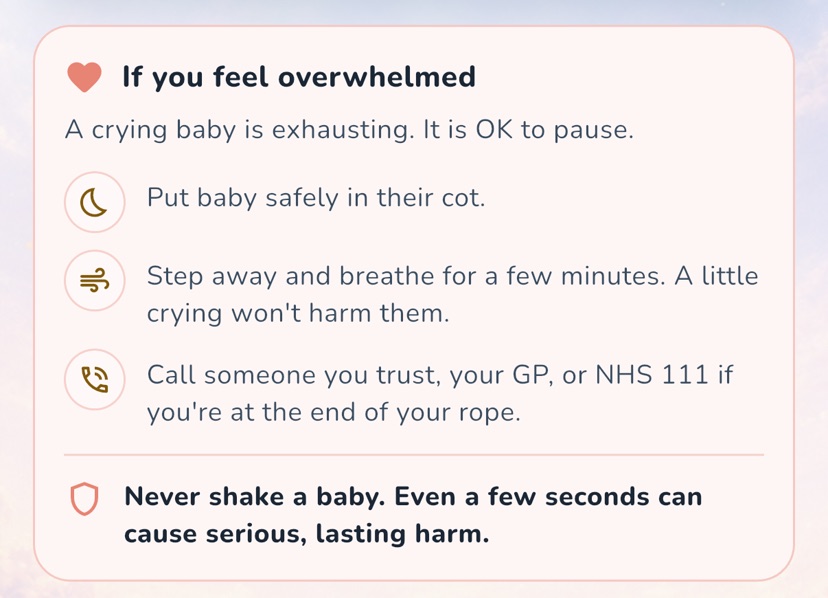
The card is low urgency, but OBubba’s genuine crying helper always shows a red-flag note and an overwhelmed-parent safety panel. That separation is important: a repeated evening shape may be ordinary, while today’s baby or today’s parent can still need help.
The NHS advises seeking medical help when crying is constant and cannot be consoled, sounds unlike the baby’s normal cry, or comes with signs such as feeding poorly, breathing difficulty, abnormal colour, unusual sleepiness, repeated projectile vomiting, fever, a non-fading rash or no wet nappy for eight hours. Call 999 for emergency signs described there. Trust your instincts.
If you feel overwhelmed, put the baby in a safe cot, leave the room briefly to calm down, and contact someone you trust or professional support. Never shake a baby.
A calm way to use the pattern tonight
Before the usual onset
Meet obvious needs and lower the load: feed responsively, change the nappy, reduce noise and brightness, and avoid stacking errands into the hour the pattern usually begins.
For a young baby, extra contact and feeding can be normal. The aim is not to force a schedule or make the crying “fail.”
For an older baby, test one upstream change
If the last nap has repeatedly disappeared and the timing fits, protect it. If the baby is visibly fading before normal bedtime, try the app’s modest 15–20-minute earlier experiment. Change one thing for several comparable days rather than rebuilding the whole routine after one evening.
Keep the outcome honest
Did the patch start later, feel shorter or remain unchanged? The current witching-hour card does not perform that before-and-after test for you. A brief note can preserve the result.
Escalate what does not fit the pattern
A familiar 5pm fuss in a well baby is different from a new high-pitched cry, breathing difficulty, poor feeding, unusual floppiness or a parent feeling unable to cope. Timing familiarity does not make red flags safe.
Why the card may disappear or never show
OBubba stays silent when:
- fewer than four of the last seven calendar days contain any log;
- fewer than three logged days contain a supported late-day signal;
- fewer than four supported events exist in total;
- qualifying days are exactly half, or less than half, of logged days;
- crying happened outside 3–7pm;
- fussiness was written only in notes;
- a nap was not marked Fussy;
- relevant moments were not logged; or
- curation removes the older-baby card because another live insight gives the opposite nap or bedtime direction.
That final point prevents conflicting guidance. The older branch carries both protect day sleep and bedtime earlier directions. If another active card says today’s day sleep is already high or bedtime should move later, reconciles the conflict and keeps the winning direction—giving parents one coherent dial rather than two contradictory instructions.
No card does not mean the evenings are easy or that the app doubts you. It means this exact rule could not responsibly make its claim from the supported records, or another message currently owns the decision.
Why acknowledgement does not become daily nagging
The onset time and day counts can slide whenever the seven-day window moves. If the dismissal key used the whole body, “around 5:10pm on 4 of 6” and “around 5:20pm on 5 of 7” would look like brand-new cards.
Instead, OBubba gives this insight a stable identity by variant. Acknowledging the developmental card keeps that same phase from reappearing every day. The older, actionable version has a different signature, so crossing the 16-week boundary can still surface the new last-nap/bedtime idea.
That is a small but parent-friendly implementation choice: material advice may return; drifting numbers do not create fake novelty.
The bottom line
“A late-afternoon fussy patch” means OBubba found repeated, parent-recorded 3–7pm crying or Fussy nap wakes—not that it diagnosed a witching hour.
The card needs at least four logged days, three qualifying days, four total events and a strict majority. Its reported time is the median of the earliest supported event on each qualifying day. Under 16 corrected weeks it gives developmental reassurance; from 16 weeks it proposes an overtiredness experiment.
Use that pattern to prepare support before the hard hour, explain the week to another carer and test one proportionate change. Keep the limits equally visible: intensity, duration, illness and cause are outside this calculation, and an unusual cry or unwell baby always outranks the pattern.
That is the kind of personalisation worth downloading—not an app pretending to know why a baby cries, but one that remembers when the difficult moments cluster, explains exactly what it counted and keeps human judgement in charge.
Ready to try OBubba?
Use OBubba to track feeds, sleep, naps, nappies, growth, milestones and family handovers in one calm baby tracker app.