The last nap ended at 4:30pm. At 5:15pm your baby looks cheerful, dinner is still happening and OBubba adds a low-key card:
> A late nap may move bedtime
Underneath, it might say bedtime may sit closer to 6:50pm tonight.
That is not the app choosing a new permanent schedule. It is doing one small piece of live time maths: the nap finished at 4:30pm, this baby’s current minimum age-based awake window is 2 hours 20 minutes, and 4:30pm plus 2h 20m is 6:50pm.
The word may matters. The card identifies the earliest plausible edge created by a completed late nap. It does not know exactly when your baby will fall asleep, and it is not identical to the fuller bedtime prediction elsewhere in OBubba.
The exact rule
The current `diagnoseAwakeWindow` function returns this card when all of these conditions are true:
| Live input | requirement | |---|---| | Baby’s state | Awake now, with a real awake-time anchor | | Bedtime | No bedtime sleep logged yet | | Nap plan | The parent has not explicitly selected a zero-nap day | | Last completed nap | Ended at or after 4:00pm | | Current clock | Before 8:00pm | | More pressing live read | No earlier overdue-sleep branch won first |
The output is a low-urgency sleep insight. It appears in today’s guidance rather than OBubba’s longer-term pattern feed, and its dismissal key is specific to that calendar day and title.
The worked example in the test
OBubba’s dedicated unit test creates this day:
- age used by the test: about seven months;
- age-based awake range supplied to the detector: 2h 20m to 3h 20m;
- last nap ended: 4:30pm;
- current time: 5:15pm;
- time awake so far: 45 minutes; and
- two naps completed.
Because 4:30pm is after the 4pm threshold and bedtime has not been logged, the late-nap branch qualifies.
The card’s displayed time uses:
> last nap end + the minimum awake window
So the example becomes:
> 4:30pm + 2h 20m = approximately 6:50pm
For very short age-based ranges, the formula uses a minimum of 60 minutes rather than anything shorter. The displayed clock also honours the parent’s 12-hour or 24-hour setting.
This is deterministic. No language model invents the time or interprets a photograph of a tired face.
Why a different card can appear after the same nap
The live awake-window interpreter returns only its most pressing message. Its order is:
- first nap overdue;
- next sleep overdue after a nap;
- late nap may move bedtime;
- excess day sleep may justify a slightly later bedtime; then
- a day-sleep deficit may justify an earlier bedtime.
That order creates an important boundary.
Before 6pm, if your baby has already been awake for more than the age-based maximum plus 45 minutes, returns Next sleep is getting overdue instead of the late-nap card. The same 4:30pm nap can therefore produce different guidance at 5:15pm and 5:55pm if the age window is short enough.
After 6pm, the “next sleep overdue” branch stops running, while the late-nap branch remains eligible until 8pm. This avoids calling an evening bedtime a missing daytime nap, but it also means the title alone does not reveal the branch order.
The card also stays silent while the baby is asleep, after bedtime has been logged, during an open night-wake pause, when no reliable awake anchor exists, or when an older child’s explicit plan says zero naps.
Four o’clock is a product threshold, not a biological law
The nap-end gate is exactly 4:00pm for every age that can reach this branch. It is not learned from this baby’s usual bedtime, sunset, nursery schedule or family routine.
What does vary is the interval added afterwards. OBubba uses its corrected developmental age where available, looks up the current age-staged wake-window range and applies the family’s awake-tolerance preference. The lower edge of that range becomes the starting interval.
So the product combines:
- a fixed definition of “late nap” at 4pm; with
- an age-adjusted minimum gap before bedtime.
This is simple enough to explain and test. It is not fully personalised.
A baby whose normal bedtime is 9pm may have a 4:05pm nap that is not meaningfully late. A toddler whose bedtime is 6:30pm may have a 3:45pm nap that affects settling even though this particular card never fires. Newborn sleep is especially distributed across day and night, so a universal late-afternoon boundary should be treated gently rather than as a reason to enforce a clock schedule.
The NHS notes that babies’ sleep needs vary and reports average 24-hour sleep including daytime naps, rather than prescribing universal wake-window cut-offs (NHS: Your baby’s sleep patterns). OBubba’s ranges are planning heuristics, not clinical limits.
Why a late nap can move sleep onset
Sleep pressure builds during awake time and eases during sleep. A nap near the end of the day can therefore remove some of the pressure that would otherwise help bedtime arrive.
There is observational evidence in toddlers: an actigraphy study of 50 children around 18 months found later nap timing was associated with later night sleep onset and shorter night sleep duration (Scientific Reports: Daytime nap controls toddlers’ nighttime sleep). The NHS’s general advice for young children also says to avoid long afternoon naps (NHS: Sleep and young children).
Those sources support the direction of the idea. They do not prove that every nap after 4pm delays every baby’s bedtime, and the toddler study should not be stretched into a universal newborn rule.
That is why OBubba says may move, not will ruin.
The card time is not the whole bedtime predictor
The live card uses a deliberately narrow calculation. OBubba’s full bedtime predictor can consider more of the day, including:
- the last completed nap and its duration;
- total day sleep;
- whether day sleep looks meaningfully above or below the age range;
- recent sleep debt;
- the age-aware final wake window;
- selected personal recommendations; and
- a hard latest bound so a very late nap cannot push an absurd bedtime indefinitely.
The day-plan assembler also protects coherence: predicted bedtime cannot appear before the final nap shown in the plan has ended plus a short wind-down. When a genuine late nap pushes bedtime beyond the usual soft age ceiling, the plan is allowed to follow the nap rather than display the impossible sequence “bedtime before nap ends”.
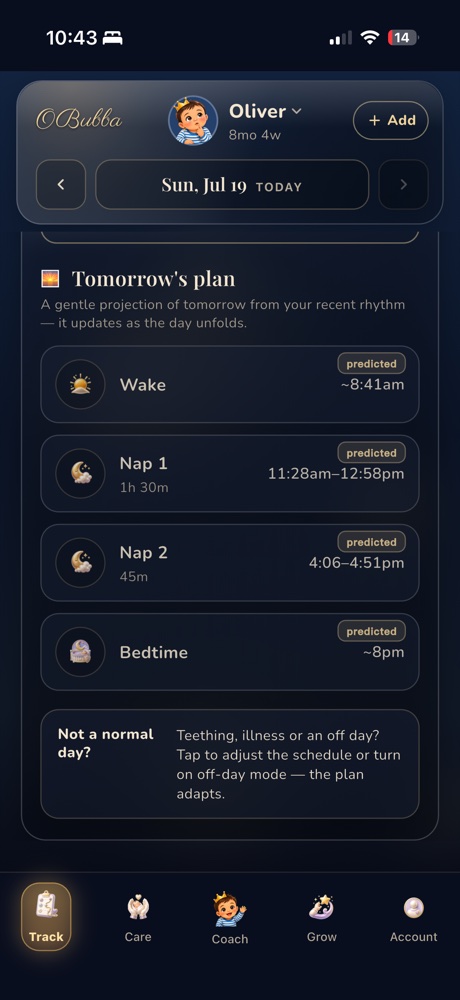
The live card’s “closer to” time is therefore best understood as a transparent minimum-gap explanation. The main clock may later show a different prediction as the day, logs and personal model update.
What OBubba is suggesting for tonight
The card does not tell you to force your baby awake until the displayed minute. It says the recent nap may have shifted the realistic settling zone.
A calm response is:
- Let the nap count. Do not pretend it did not happen and repeatedly attempt the old bedtime from scratch.
- Watch the baby, not only the clock. Sleepy cues, mood, feeding and illness still matter.
- Keep the wind-down familiar. Dim lights and repeat the ordinary bedtime steps; there is no need to create a second elaborate routine.
- If bedtime must remain earlier, change a future nap—not the past. OBubba’s own copy suggests keeping the last nap short and aiming for it to end with enough awake time before bed.
- Do not stretch a distressed or exhausted baby to satisfy an app interval. The card is low urgency because a family can respond flexibly.
Sometimes the best answer is a later bedtime. Sometimes it is a very short bridge nap followed by the usual routine. Sometimes an unexpectedly sleepy baby is unwell and the schedule is no longer the important question.
It is not permission to cut needed day sleep
“Late nap” and “too much day sleep” are separate branches.
This card can appear because of nap timing even when the day-sleep total is ordinary or low. Cutting naps aggressively may replace an under-tired bedtime with an overtired one. The engine’s later surplus branch requires day sleep to exceed the age ceiling by more than 30 minutes before it recommends holding bedtime later and trimming tomorrow.
Likewise, its deficit branch can recommend an earlier bedtime when naps are essentially finished and total day sleep is more than 30 minutes under the age floor.
In plain English:
> A nap can finish late without the baby having slept too much.
That distinction is why the app has separate timing, surplus and deficit cards rather than one universal “cap naps” rule.
The optional seven-night experiment
Because `lateNapBedtime` maps to a testable lever, its expanded insight can offer:
> Try this for 7 nights
The proposed experiment is called Earlier last nap. Its action is to finish the last nap a little earlier each day so more sleep pressure is available by bedtime.
OBubba does not judge that test by bedtime compliance or by whether the parent followed a perfect schedule. It uses the baby’s longest unbroken night stretch. A result can become `working` when the recent average is at least 30 minutes longer than the baseline, provided enough nights are logged. Checkpoints occur at three, seven and fourteen nights.
The experiment is optional and may not appear if another test is active or this lever was recently tried and failed for the same baby. That memory stops the app prescribing the same unsuccessful change on repeat.
One live late nap is enough to earn today’s card; it is not enough to prove a recurring problem. The seven-night test exists for families who want to find out whether moving the last nap actually improves their baby’s nights.
Keep every nap safe
Schedule advice never outranks safer sleep.
The Lullaby Trust recommends placing babies on their back in their own clear, flat, separate sleep space, on a firm flat mattress, and using that safer setup for every sleep, day and night (The Lullaby Trust: Keeping a clear cot).
Do not keep a baby asleep in a car seat after the journey ends merely to preserve the nap or bedtime calculation. Move them to an appropriate flat sleep space when you arrive, following current safer-sleep guidance.
The honest translation
The most accurate version of A late nap may move bedtime is:
> OBubba can see a completed nap ending at or after 4pm. The baby is awake, bedtime is not logged, it is before 8pm and no more pressing overdue-sleep message won first. added at least the current age-based minimum awake interval to the nap end and displayed that clock time as a low-urgency possibility. The 4pm gate is fixed; the interval is age-adjusted; neither is a guarantee of when this baby will sleep.
That is useful information at 5:15pm: specific enough to stop a futile early bedtime battle, modest enough to change when the baby or the evening says otherwise.
OBubba connects live nap timing, corrected-age sleep ranges, coherent day plans, bedtime predictions and optional one-change experiments in the same record. Explore OBubba if you want a tracker that not only moves the clock, but shows you the exact nap that moved it.
Ready to try OBubba?
Use OBubba to track feeds, sleep, naps, nappies, growth, milestones and family handovers in one calm baby tracker app.