It is midday. Your baby last fed at 8:30am after usually asking for milk roughly every two hours. OBubba says:
“A longer gap between feeds than usual.”
Is that a late-feed alarm? Should you wake the baby, make a larger bottle or worry that something is wrong?
Not from the card alone. We traced the current feed-rhythm detector, its caller and the separate next-feed prediction for this guide. The card means: today’s time since the last logged daytime milk feed has stretched well beyond this baby’s own recent average.
It is a low-urgency prompt to look at the baby, the log and the wider care picture—not permission to replace responsive feeding with a clock.
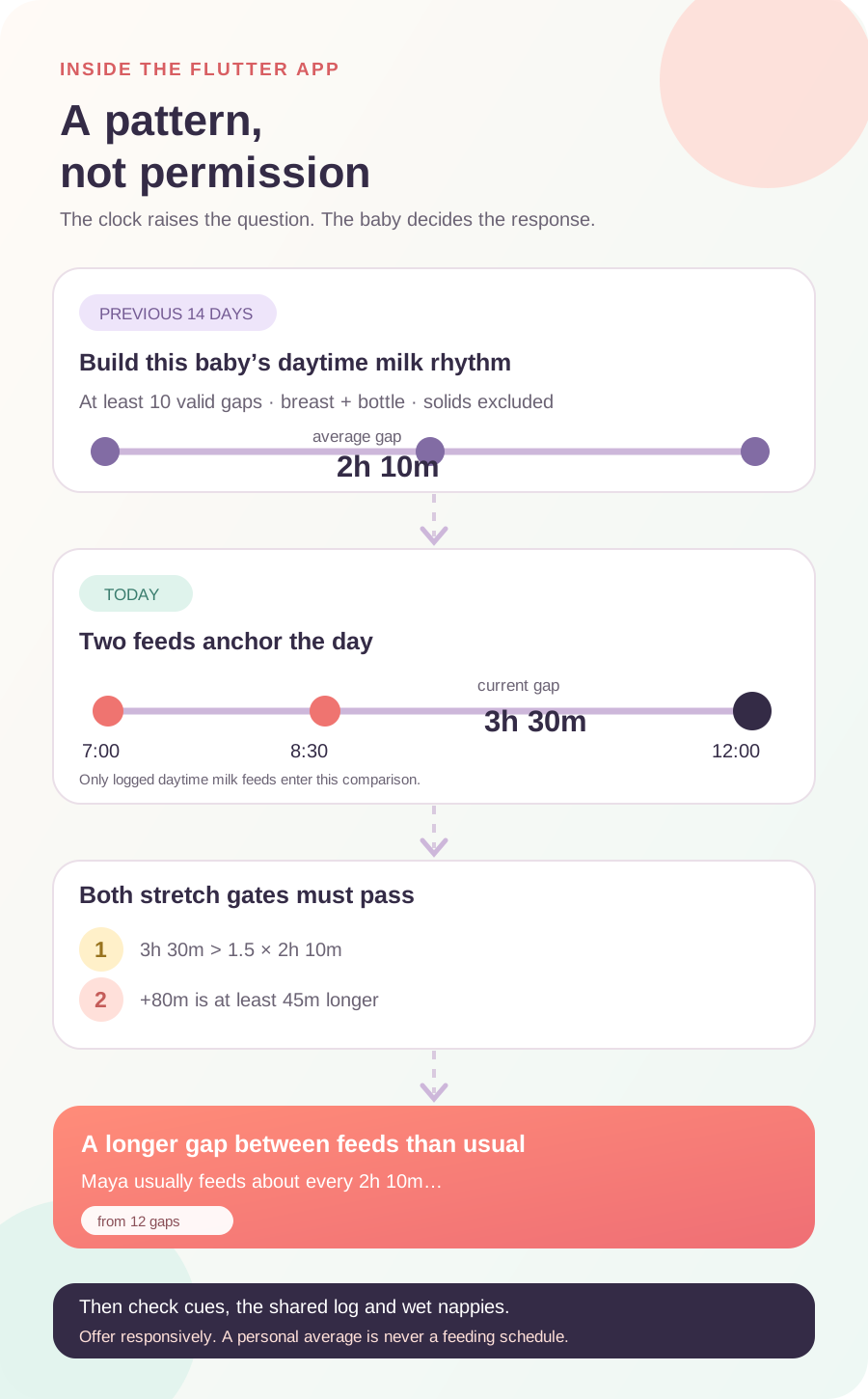
The short answer
The current insight needs all of these conditions:
| Check | Current rule | What it prevents | |---|---:|---| | Personal history | At least 10 valid daytime milk-feed gaps | A conclusion from a few scattered entries | | History window | Previous 14 complete days | Comparing a partial today with complete past days | | Today’s anchor | At least 2 daytime milk feeds logged today | Letting a single early entry define the whole day | | Relative stretch | Current gap is more than 1.5× the average | Flagging ordinary wobble | | Absolute stretch | Current gap is at least 45 minutes longer | Overreacting when the usual gaps are short | | Timing sanity | Last logged feed is not in the future | A broken comparison after a mistimed entry |
The result includes its evidence count. Because the threshold starts at 10, the caption reads “from 10 gaps”, “from 14 gaps” and so on—not a confidence percentage.
A worked example
Suppose the last 14 days contain 12 usable daytime gaps averaging 2 hours 10 minutes.
Today’s daytime milk logs are:
- 7:00am
- 8:30am
At noon, it has been 3 hours 30 minutes since the last logged feed.
The detector asks two questions:
- Is 3h 30m more than 1.5 × 2h 10m? Yes—1.5 × the average is 3h 15m.
- Is it at least 45 minutes longer than 2h 10m? Yes—the difference is 1h 20m.
Both gates pass, so the card can appear.
If the current gap were 3 hours, it would be 50 minutes longer but not more than 1.5× the average. No card. If a baby’s average were one hour and the current gap were 1h 40m, the relative gate would pass but the difference would be only 40 minutes. Again, no card.
The double gate is there to make “unusual” mean something in both proportional and practical terms.
Which feeds count
This insight is about daytime milk timing.
It includes logged breast and bottle feeds with usable times. It excludes:
- solids, because meals follow a different rhythm
- entries marked as night feeds
- pumping sessions, because milk expressed is not milk the baby drank
- gaps of 30 minutes or less
- gaps of 8 hours or more
The valid-gap filter removes duplicate-looking taps, tiny within-feed intervals and overnight-scale gaps from the daytime average. Its bounds are strict: a 30-minute or exactly 8-hour gap is not used.
The calculation reads feed times, not breastfeed duration or bottle volume. That lets it work for breastfeeding, bottle feeding and combination feeding without inventing millilitres from minutes at the breast.
It also means the card cannot tell whether a feed was effective. Ten minutes of active swallowing and ten minutes of sleepy comfort sucking can look identical to a timing-only detector unless the parent adds context.
Why a missed log can create a false card
Imagine another caregiver gave a bottle at 10:30am but it was never synced or recorded. At noon, OBubba sees 3h 30m since 8:30am. The baby has actually gone only 1h 30m.
Before interpreting the insight, check:
- did someone else feed the baby?
- is there an active breastfeeding timer that was not finished?
- was a feed saved under the wrong day or time?
- was a night feed accidentally marked as daytime—or the reverse?
- did the baby have milk that was recorded only in a note?
OBubba can compare the shared record. It cannot observe an unlogged feed.
The forecast and the longer-gap card are different reads
The app also has a passive next-feed prediction. It is related, but not identical.
| Feature | Next-feed forecast | Longer-gap insight | |---|---|---| | Job | Estimate when another milk feed may become likely | Notice when the current gap has become distinctly unusual | | Evidence minimum | 5 valid gaps | 10 valid gaps | | History | Previous 7 days | Previous 14 days | | Time-of-day handling | Uses a matching four-hour block when at least 3 matching gaps exist | Uses one average across valid daytime gaps | | After the estimate passes | The forecast goes quiet | The insight can appear only after both stretch gates pass |
That hand-off is deliberate. A prediction is useful before the expected point. Once it is overdue, repeating “feed due” could sound like a rigid schedule. The separate insight waits for stronger evidence and uses gentler language about a personal change.
One limitation is worth naming: the longer-gap detector’s average is not time-of-day matched. If a baby naturally has wide morning gaps and close evening feeds, the forecast can model that distinction more precisely than this drift card. Treat the number as a broad recent rhythm, not a perfect physiological clock.
Why OBubba does not flag every short gap
This detector only owns the stretching direction.
Feeds moving closer together may be normal responsive feeding, cluster feeding or a growth-spurt pattern. Other insights already examine those possibilities. When a cluster-feed, growth-spurt or comfort-feeding card owns the current feeding story, the longer-gap card is suppressed so the app does not give competing explanations at once.
That does not mean every close feed has a cause the app understands. Babies may feed for hunger, comfort, thirst, regulation or connection. A tracker sees entries, not intention.
The baby outranks the average
The NHS recommends responsive or on-demand feeding: offer milk when a baby shows hunger cues rather than waiting for a strict schedule. Early cues can include rooting, opening and closing the mouth, bringing hands to the mouth, wriggling or becoming more alert. Crying is a late cue.
So when the card appears:
- Look at the baby. If they show hunger cues, offer a feed now. Do not wait for a predicted time.
- Check the record. Correct a missing or mistimed feed before treating the gap as real.
- Consider the day. A longer nap, travel, distraction or a naturally lighter day may explain one gap.
- Feed responsively. For a bottle, let the baby pace and stop; do not compensate by making them finish a larger amount.
- Check nappies and behaviour. The wider picture decides whether a timing change is reassuring.
A larger bottle does not guarantee a longer interval. Do not stretch the next gap to make the pattern look consistent.
The genuine Feeding Check-in
OBubba’s current Care → Feeding view separates the measured and unmeasured parts of a feeding day rather than pretending every family has a complete volume total.
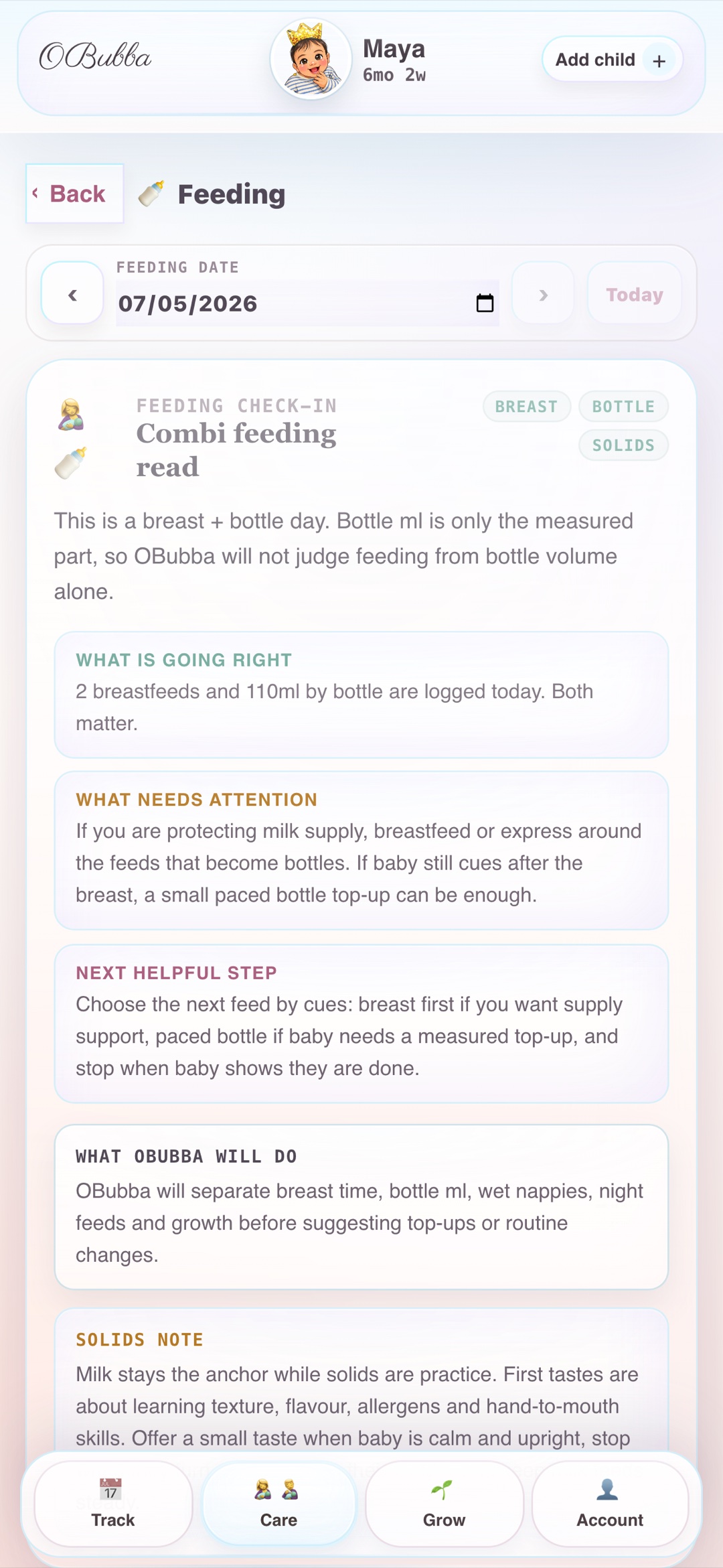
In a combination-feeding example, it says bottle millilitres are only the measured part and explicitly recommends choosing the next feed by cues. That same philosophy belongs behind the longer-gap insight: timing can make a change visible without pretending to measure hunger, milk transfer or hydration.
The app can keep feed time, type, breast side, bottle amount, nappies, growth and carer entries together. It still cannot assess attachment, hear swallowing, examine a baby or know whether an omitted feed happened.
When a long gap needs more than a tracker
One calm longer gap in a well baby may simply reflect a long nap or a changing rhythm. Get advice promptly when the feeding change comes with:
- fewer or much drier wet nappies than usual
- repeated feed refusal or difficulty feeding
- repeated vomiting or an inability to keep milk down
- unusual sleepiness, floppiness or difficulty waking
- breathing difficulty or colour change
- fever, illness or a baby who seems unlike themselves
- concerns about weight gain
Speak to your midwife or health visitor if you are concerned that a baby is not getting enough milk. NHS bottle-feeding guidance says weight gain and wet and dirty nappies help show whether intake is adequate, with around six heavy wet nappies a day expected after the early transition for many babies.
Do not use the app’s average to overrule a clinical feeding plan. A newborn, premature baby, baby with jaundice or baby being monitored for weight gain may need waking and scheduled feeds even without hunger cues. Follow the maternity, neonatal, paediatric or dietetic team’s instructions.
Call 999 if a baby will not wake, is struggling to breathe, is blue or grey, collapses or has another life-threatening symptom. Use NHS 111 or urgent clinical advice when you are unsure how quickly a concerning feeding change needs assessment.
A better way to log for this insight
You do not need perfect tracking. You need enough trustworthy anchors.
| Useful anchor | Why it helps | |---|---| | Actual feed start time | Keeps gaps comparable across caregivers | | Breast, bottle or solids | Prevents a meal from becoming a milk interval | | Day or night classification | Keeps the daytime rhythm from absorbing overnight stretches | | Amount actually taken, when measured | Supports bottle-intake context without inventing breast volume | | Feed quality or refusal note | Explains a timing change that the clock cannot | | Wet nappies | Adds hydration context |
Agree as a household whether a feed time means start or finish, then use that convention consistently. The engine reads the saved time; it cannot infer which convention you chose.
Explore OBubba’s baby feed tracker → — share breast, bottle, pumping, solids and nappy context while keeping predictions transparent and responsive feeding in charge.
Frequently asked questions
Does the card mean my baby has missed a feed?
No. It means the logged gap is substantially longer than the recent personal average. A baby may not be hungry, and an unlogged feed may have happened. Check both the baby and the record.
Is OBubba telling me to wake my baby?
Not by itself. The card says to offer when the baby seems ready. Follow an individual waking plan for newborn, premature, jaundiced or growth-monitored babies; ask your health professional when unsure.
Does a breastfeed and a bottle count in the same rhythm?
Yes. Both are daytime milk feeds for this timing detector. It compares when feeds happened, not their volume, so combination feeding can contribute without converting breastfeeding minutes into millilitres.
Do solids reset the milk clock?
No. The current detector excludes solids because a meal time should not shorten the learned milk-feed interval. Babies under 12 months who seem hungry between meals should generally be offered extra milk rather than snacks, following current guidance and individual advice.
Why did the next-feed estimate disappear?
The passive forecast only returns a future estimated time. Once that time passes, it goes quiet. The longer-gap card uses a larger history and waits until the gap is both more than 1.5× usual and at least 45 minutes longer.
Why is there no card after a long gap?
There may be fewer than 10 valid historical gaps, fewer than two daytime milk feeds today, a missing time, a future-dated last feed, or the gap may pass only one of the two stretch gates. Another feeding insight may also take priority.
Does “usually every 2h 10m” mean I should feed at that interval tomorrow?
No. It is a rounded average of qualifying logged gaps, not a recommended schedule. Feed responsively and follow any clinical plan.
Reliable UK sources
- NHS Best Start in Life: Feeding on demand
- NHS Best Start in Life: Bottle feeding your baby
- NHS Best Start in Life: Feeding your newborn baby
- NHS Best Start in Life: How to start weaning
This article gives general information for UK families. It is not a feeding prescription, hydration assessment or medical advice, and OBubba is not a medical device. Follow your baby’s cues and any individual feeding plan from their healthcare team.
Ready to try OBubba?
Use OBubba to track feeds, sleep, naps, nappies, growth, milestones and family handovers in one calm baby tracker app.