You log egg at breakfast for the third time. A new OBubba card appears:
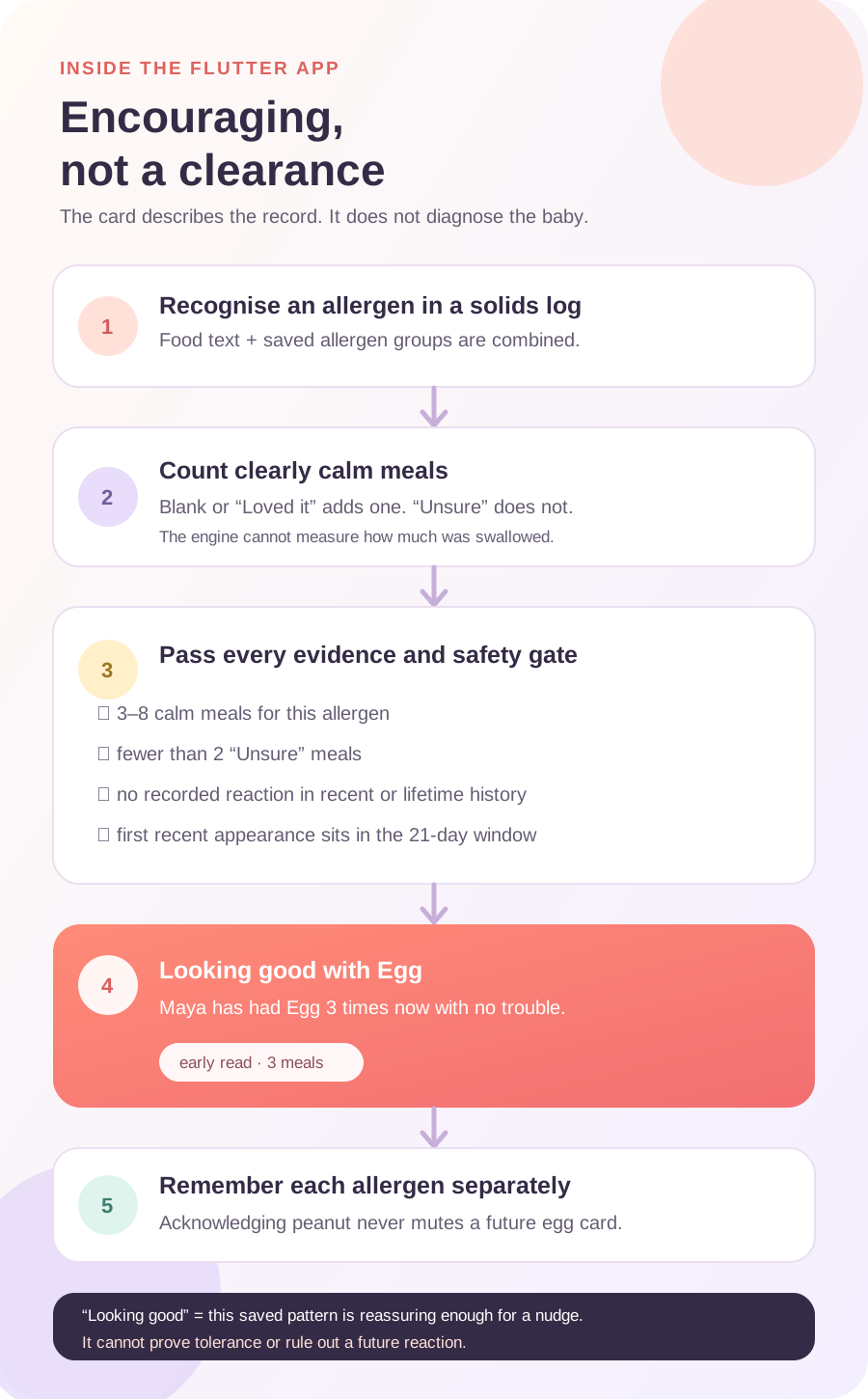
“Looking good with Egg. Maya has had Egg 3 times now with no trouble.”
Is the app saying your baby is not allergic? Has egg been medically cleared? Should you keep serving it even if one meal felt uncertain?
No. We traced the current insight, its 21-day food-history input and its lifetime reaction memory for this guide. The card means something narrower and more useful: the saved record contains enough reassuring repeat meals for a gentle keep-it-familiar nudge, with no recorded reaction that should block it.
It is encouragement from a log—not a diagnosis, food challenge or guarantee about the next meal.
The short answer
In the current app, Looking good with Egg can appear when all of these are true for egg:
| What the engine checks | Current rule | Why it matters | |---|---:|---| | Clearly calm logged meals | 3 to 8 | One taste is too little for the insight; after eight, the introductory nudge has done its job. | | Meals marked Unsure | Fewer than 2 | Repeated ambiguity should not be turned into reassurance. | | Meals marked Reaction | None | Any recorded reaction blocks the card. | | Older reaction memory | None recorded | A reaction is not forgotten when it leaves the recent timeline. | | Introductory timing | First recent appearance is within the app’s 21-day history window | The card is for a newly established food, not a forever badge. |
The card then shows the allergen with the strongest qualifying record. Underneath, the app is transparent about sample size: at three or four meals it says “early read · 3 meals” or “early read · 4 meals”; from five meals it says “from 5 meals.”
Those labels are not confidence percentages. They tell you how much of your own saved history produced the message.
What counts as a calm meal in the app
When a parent logs solids, the sheet asks “How did they take it?” with three optional choices:
- 😋 Loved it
- 😐 Unsure
- ⚠️ Reaction
For this particular insight, an allergen-containing meal counts towards the calm total when the response is left blank or marked Loved it. An Unsure meal does not count as calm. A Reaction meal blocks the card.
That is a software rule, not a clinical interpretation. Loved it describes the parent’s log choice; it does not prove that no delayed symptom occurred. If a symptom becomes apparent later, update the record and seek advice when appropriate instead of treating the earlier card as authoritative.
One Unsure meal does not automatically suppress an otherwise consistent record. Two or more do. That boundary avoids letting one accidental tap or vague mealtime dominate the history, while refusing to describe repeated question marks as “no trouble.”
The old reaction that does not disappear
The visible insight reads recent meals, but its safety memory is longer.
OBubba stores a lifetime set of allergens linked to meals marked Reaction. The caller passes that set into the confidence check after canonicalising the allergen names. So an egg reaction logged 25 days or several months ago still blocks a new Looking good with Egg card, even though that individual meal is no longer inside the 21-day working window.
That is an important difference between “recent evidence” and “safety memory”:
- recent meals decide whether there is enough repeat evidence for the card
- lifetime reaction history decides whether reassurance is allowed at all
The safeguard is only as accurate as the record. OBubba cannot know about an unlogged reaction, a symptom entered only in another app, or a meal whose ingredients were described too vaguely.
The real Allergen Journey
The current Care → Weaning screen keeps an Allergen Journey across the major groups it recognises or the parent marks manually. It distinguishes introduced groups from those still to try and can offer a next-up idea in a suitable form.
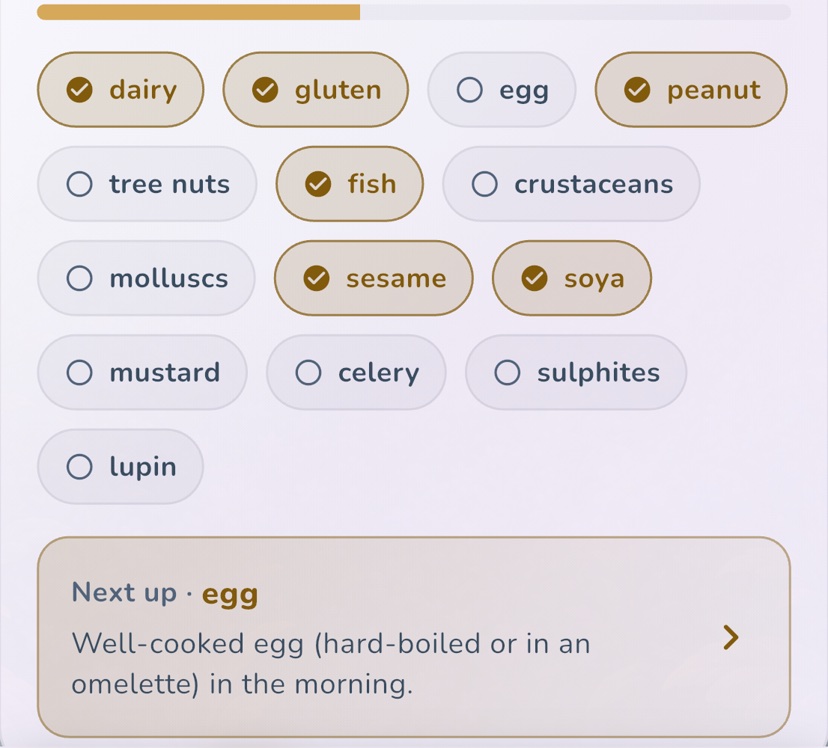
Food text is re-checked when the recent history is assembled. A log such as “scrambled egg and toast” can therefore contribute recognised egg and gluten groups; allergens stored directly on a synced entry are included too.
Recognition is helpful, not infallible. “Yellow breakfast” gives the engine nothing to identify. A packaged dish may contain ingredients the name does not reveal. Always read the label, record the actual components and correct the allergen selection when needed.
Why three meals—and why the card stops after eight
Three is a product threshold, not a medical threshold.
It prevents a celebration after one encounter and gives the app a small repeated pattern to describe. It does not mean three exposures are the universal number required to establish tolerance, nor does it replace advice given for a higher-risk baby.
The upper limit is equally revealing. Once the current 21-day record contains more than eight calm meals for an allergen, this introductory card no longer qualifies. That disappearance does not mean OBubba has become less confident. It means the food looks established enough that the “newly going well” nudge is no longer useful.
The insight is deliberately temporary. The Allergen Journey remains the longer-lived record.
Why you may have three egg logs but no card
The common explanations are:
- One meal was marked Reaction. Any current or lifetime recorded egg reaction blocks it.
- Two meals were marked Unsure. They are not counted as clean evidence.
- The food name was not recognised as egg. Check the saved allergen groups.
- The meals fall outside the recent 21-day collection. The insight is not a lifetime tally.
- There are more than eight calm egg meals in the window. Egg has moved beyond the introductory-card stage.
- Another allergen has a stronger qualifying total. The engine shows one leading confidence card at a time.
If peanut wins first, tapping Lovely on it does not silence egg forever. Each allergen has its own insight identity, so egg can appear separately when it becomes the leading qualifying food.
A mixed meal can strengthen the record—but not identify a culprit
Suppose you log “scrambled egg on toast” three times. If both egg and gluten are recognised and the response is calm, the same meals can contribute once to each allergen’s tally.
That is reasonable for recording established foods. It is weaker for interpreting a new reaction: the meal alone cannot show whether egg, wheat, another ingredient or something unrelated caused the symptom.
The NHS advises introducing foods that can trigger allergy one at a time and in very small amounts so a reaction is easier to spot. Once a food has been introduced and tolerated, it should remain part of the baby’s usual diet. That is why simple first introductions and ordinary mixed repeat meals serve different purposes.
“Keep it in rotation” is a planning prompt
The card’s current explanatory copy suggests offering a tolerated allergen about twice a week. Treat that as a practical reminder, not a universal prescription or a dose.
NHS guidance is broader: after introduction and tolerance, keep offering the food as part of the baby’s usual diet. It does not set one exact frequency or amount for every allergen, baby and risk history.
Use your baby’s clinical plan instead when they have diagnosed allergy, significant or persistent eczema, a previous symptom, or advice from a GP, health visitor, dietitian or allergy team. Never increase a portion or repeat a suspected food at home merely to make the app’s evidence count rise.
The green card and reaction analysis are different systems
OBubba also has a separate reaction-confidence engine. It can examine a logged reaction alongside prior tolerance, other same-day changes and repeat reactions across foods in the same allergen group.
That system may use cautious language such as “A possible pattern with Dairy.” It never converts one reaction into a fake probability, and meals marked Unsure do not become clean counter-evidence.
The distinction is intentional:
- Looking good with Egg asks whether recent repeat logs are reassuring enough for a routine reminder.
- Reaction confidence asks what context belongs beside a concern that has already been logged.
Neither can inspect the baby, diagnose an allergy or decide that reintroduction is safe.
What to do if a later meal is not calm
Possible food-allergy symptoms can include swelling of the lips or face, an itchy rash, vomiting or diarrhoea, cough, wheeze or breathing change. The NHS says immediate reactions commonly happen within minutes but can take up to two hours; some allergies can have delayed symptoms.
Stop the suspected food and seek medical advice rather than offering it again to test the old card. Call 999 for signs of anaphylaxis, including breathing difficulty or swelling of the throat or tongue, and follow any prescribed allergy action plan immediately.
When it is safe to record details, save:
- the exact food and brand or recipe
- every ingredient and allergen you know was present
- how much was eaten, approximately
- when the meal started and when symptoms appeared
- the symptoms and how they changed
- a photograph, if safe and useful
- illness, medicines and other foods that day
That history can support a clinician. It cannot replace one.
A tiny log that earns honest wording
| Day | Food recorded | Response | What egg evidence becomes | |---|---|---|---:| | Monday | Well-cooked omelette strip | Loved it | 1 calm meal | | Thursday | Mashed hard-boiled egg | Blank | 2 calm meals | | Sunday | Scrambled egg | Loved it | 3 calm meals → card may qualify |
Change Sunday to Unsure and the calm total stays at two. Add a later calm egg meal and one Unsure still does not block the card. Mark any egg meal Reaction, and the card must not appear.
This is what trustworthy personalisation looks like at small scale: not “OBubba knows egg is safe,” but “OBubba can show exactly which saved pattern allowed this sentence.”
Explore OBubba’s baby weaning tracker → — keep first tastes, recognised allergens, reactions, textures, milk and the rest of the day in one record, with the evidence count visible when the app offers an insight.
Frequently asked questions
Does “Looking good with Egg” mean my baby is not allergic?
No. It reports a reassuring pattern in the meals you logged. It cannot diagnose allergy, verify how much egg was eaten, rule out delayed symptoms or guarantee the next exposure.
Does a lick count as one of the three meals?
The engine counts the logged meal when egg is associated with it and the response is blank or Loved it; it does not measure the swallowed dose. Record tiny tastes honestly. Do not inflate a lick into a portion, and follow individual clinical advice where a specific amount matters.
Why did the card disappear after I kept serving egg?
The confidence nudge is limited to three through eight calm meals in the recent window. More than eight means the introductory card retires by design; it does not mean the record has become concerning.
Can an old reaction really block it forever?
The current lifetime reaction memory continues to block this reassuring card. That is a safety boundary, not a medical conclusion that the allergy is permanent. Only a qualified professional should guide assessment or reintroduction after a suspected reaction.
If my baby loved the food, should I always choose Loved it?
Use Loved it for how the meal went, but do not let enthusiasm hide a symptom. If you are uncertain, choose Unsure, add a useful note and seek advice when needed.
Does dismissing the peanut card dismiss egg too?
No. The current insight has a separate identity for each allergen. Acknowledging peanut does not permanently mute a future egg card.
Reliable UK sources
- NHS: Food allergies in babies and young children
- NHS Best Start in Life: Baby food allergies
- NHS: Foods to avoid giving babies and young children
- NHS: Food allergy
This article gives general information for UK families. It is not allergy diagnosis, treatment or an individual reintroduction plan, and OBubba is not a medical device. Follow advice from your baby’s own healthcare or allergy team.
Ready to try OBubba?
Use OBubba to track feeds, sleep, naps, nappies, growth, milestones and family handovers in one calm baby tracker app.