The night was broken. One nap went beautifully. Another lasted 28 minutes. You logged four feeds, forgot a nappy and spent the afternoon wondering whether anything worked.
Then OBubba's Today's review says:
> A mixed day, wins and a few tweaks
That headline is not a mood score and it is not the app grading your parenting.
The current Day Review reads the night that ended today plus today's completed logs. It creates separate lists of grounded wins and possible improvements, then chooses the headline from the balance between those lists. If there is not enough logged evidence, it does not invent a story.
What the four headlines actually mean
The headline is a simple summary of which lists contain something:
| Headline | condition | |---|---| | Not much logged yet today | No grounded wins or improvements | | A solid day ✨ | One or more wins and no improvements | | A tougher day, here's what helps | One or more improvements and no wins | | A mixed day, wins and a few tweaks | Both lists contain something |
“Mixed” therefore does not mean half good, half bad. One meaningful win plus one small adjustment is enough. The app does not turn the day into a percentage or compare your family with another baby's score.
What goes into Today's review
The review joins two timeframes that parents naturally think about together:
- the night that ended today: bedtime, morning wake, night wakes, longest stretch, false starts and logged resettles
- today so far: completed naps, actual daytime sleep, milk feeds and wet nappies—when those categories are enabled
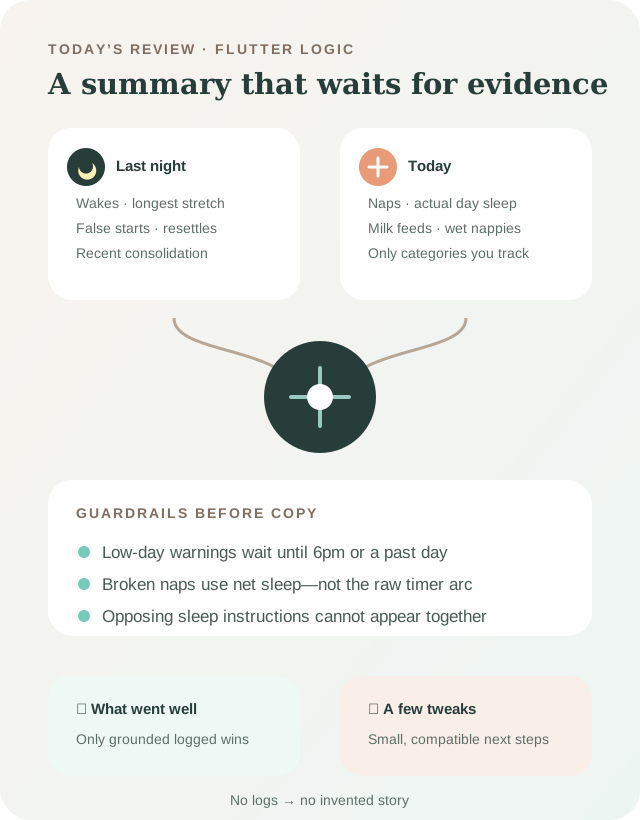
The overnight resolver crosses midnight first, so a 2am wake belongs to the physical night rather than becoming a disconnected event merely because the date changed.
Why the app waits until 6pm for deficit warnings
At 9:30am, a baby may have completed only one short nap and two feeds. That does not mean day sleep or feeding “ran low”; the day is still happening.
The current engine treats a day as complete when either:
- it is a past calendar day, or
- the local time has reached 6pm
Only then can deficit-style reads such as low day sleep or too few logged daytime feeds appear. This prevents an anxious morning card about events that have not had time to happen.
The guard is deliberately specific. A clearly high day-sleep total can be visible once it already exists; the app does not need to wait until evening to know that logged sleep has passed the upper comparison band.
How sleep becomes a win or a tweak
Last night
If a reconstructable bedtime exists, the current review can add:
- no logged night wakes as a win
- one or two wakes as a relatively settled-night win
- more than two wakes as an improvement line
- a longest unbroken stretch of at least five hours as a win
- a false start soon after bedtime as a possible bedtime-environment or timing tweak
- de-duplicated self-settled wakes as a win
These are app rules, not universal definitions of a “good baby”. A newborn waking to feed can be normal; an older baby can have a difficult night with only one long wake. The NHS notes that babies vary widely in how much and how continuously they sleep.
Today’s naps
For babies aged eight weeks or more, OBubba compares logged day sleep with its age-based range:
- inside the range can become a win
- more than 20 minutes above the upper bound can suggest capping the final nap
- more than 20 minutes below the lower bound can suggest an earlier bedtime—but only after the day-over gate
Newborns under eight weeks do not receive the over/under day-sleep verdict because the engine deliberately treats that range as too unreliable for the early weeks.
The comparison is guidance, not a sleep requirement or diagnosis. A baby's own needs, health and the completeness of the log matter.
A broken nap is not called consolidated
Suppose the timer spans 1:00–2:30pm, but the baby was logged awake for 30 minutes in the middle.
The Day Review uses 60 minutes of net sleep, not the raw 90-minute timer arc. It can call that “a good long nap”, but it does not call it an unbroken consolidated nap.
An uninterrupted 90-minute nap can receive the consolidated wording.
That distinction keeps the win consistent with the same actual-sleep total used elsewhere in OBubba. A parent should not see “1h 30m consolidated” beside a daily total that correctly counted only one hour.
How OBubba avoids opposing advice
This is one of the strongest details in the implementation.
High day sleep plus a broken night
If day sleep is already high, the night-wakes line does not also tell the parent to protect naps. It keeps the calm, dark resettling advice while the separate day-sleep line can suggest capping the last nap.
Low day sleep plus a false start
If day sleep ran low and the review recommends an earlier bedtime, the false-start line does not simultaneously offer a later bedtime. The calmer, darker bedtime advice remains, but the opposing timing direction is removed.
A long list of individually plausible tips is not useful if two of them pull the family in opposite directions. The review resolves the conflict before the copy reaches the screen.
What counts as a daytime feed
For the Day Review's feeding rhythm, a daytime milk feed counts. The engine excludes:
- solids meals
- pumping sessions
- dream feeds
- night feeds
That prevents “four feeds” from becoming “six” merely because a pump and a solids entry were recorded too.
When feed tracking is enabled, four or more logged daytime milk feeds can become a steady-rhythm win. For a baby under 26 weeks, one or two logged daytime feeds can create an evening improvement line.
This is a logging summary, not a feeding assessment. Feed responsively and use the baby's age, weight, clinical context, feeding effectiveness and nappies together. Missing logs do not prove missing feeds.
What the wet-nappy line can—and cannot—say
When nappy tracking is enabled, five or more qualifying wet-nappy entries can create a positive line in the current review.
Do not use that line as a medical clearance. Nappy expectations vary in the first days after birth and with feeding. The NHS says nappies that are drier than usual can be a sign of dehydration and advises getting medical help when a baby is not feeding normally or seems seriously unwell. See the NHS guidance on signs that a baby may be seriously ill.
If the timeline is incomplete, the review knows only what was logged. A reassuring line should never override a real concern about feeding, alertness or output.
Preferences are respected
Not every parent wants to track everything.
If Feeds is switched off, the Day Review suppresses both feed totals and “too few feeds” nudges. If Nappies is switched off, it suppresses the wet-nappy win. One disabled category does not hide the others.
This matters because choosing not to track a category should not make the app shame the parent for missing data.
When the review starts learning this baby
The single-day review can also include a recent-night consolidation line, but only after the adaptive profile is genuinely personalised.
That requires at least five usable nights and sufficient confidence. Only nights with both a reconstructable bedtime and morning wake feed the observed average. A logged fever can exclude an illness day from this baseline; the current Day Review call does not pass separate travel or daycare tags into that adaptive calculation, so it should not claim those contexts were removed.
The result is about the baby's longest stretch trajectory, not a demand for more total sleep. With thin history, the line stays absent.
The real Track timeline underneath it
The review is not a separate diary. It reads the same timeline parents use for live sleep, wakes, naps, feeds and care events.
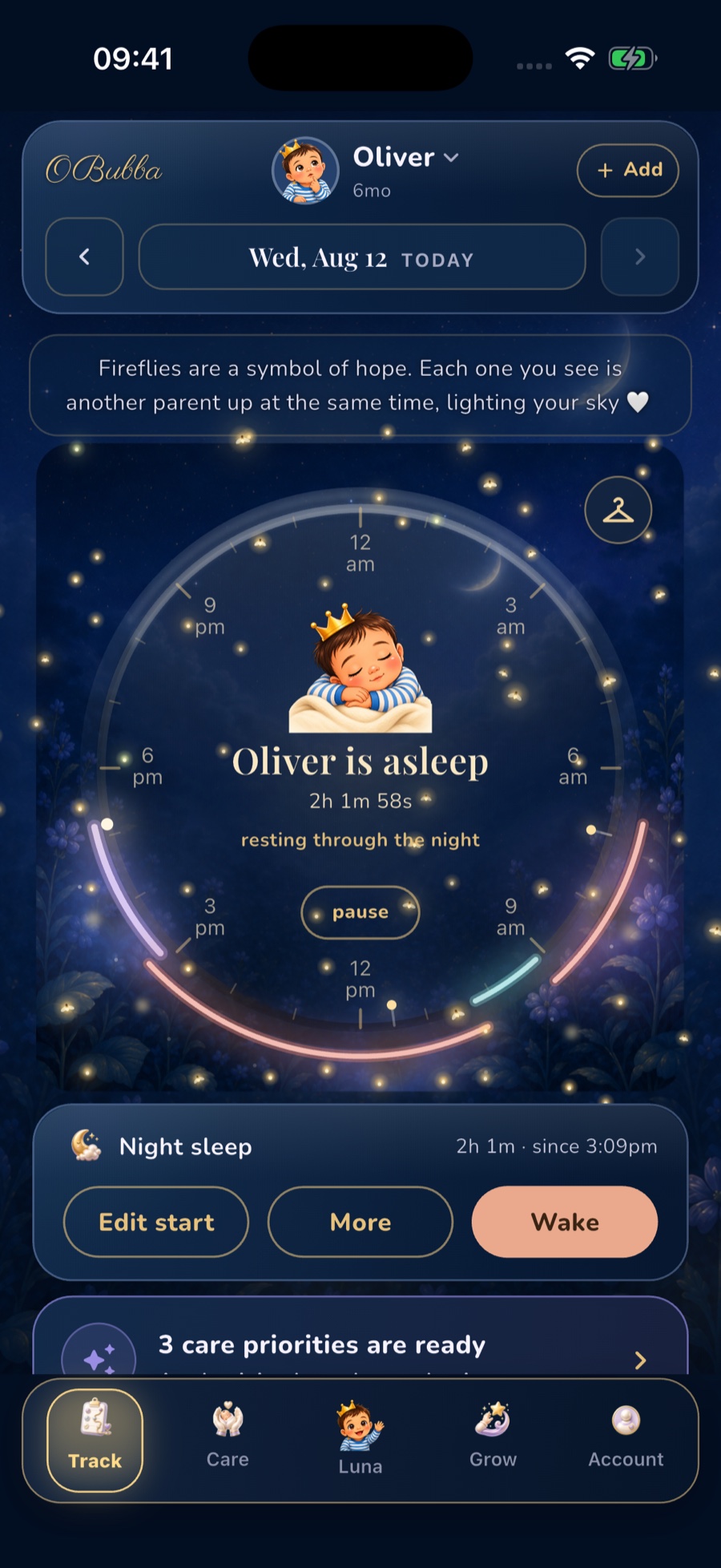
The review itself appears in the Guidance library, under Little wins worth keeping. When at least one win exists, Share today opens a share-card sheet; nothing is posted automatically.
The value is not another chart. It is translation: “What does this day suggest, and what does not need fixing?”
Use the review without letting it grade you
Try this five-minute evening habit:
- Correct only obvious logging mistakes.
- Read What went well before the tweaks.
- Choose at most one practical change for tomorrow.
- Ignore a line built from incomplete data.
- Respond to the baby in front of you, not the headline.
A mixed day is still full of care. A solid day is not a promise that tonight will be easy. A tougher day is not evidence that the parent failed.
Try OBubba free → — track the care once, then let Today's review separate real wins from one or two compatible next steps.
Quick answers
Why does the review say “mixed”?
Because it has at least one grounded win and at least one improvement. It is not calculating a mood score or percentage.
Why did low day sleep not appear this morning?
Deficit reads wait until 6pm on the current day, or appear when reviewing a past day. The app does not judge a day before it has unfolded.
Does a 90-minute nap with a 30-minute stir count as 90 minutes?
No. The current Day Review uses the net 60 minutes and does not call the stir-broken nap consolidated.
Can it tell me to cap naps and protect naps at the same time?
The tested implementation removes that contradiction. When day sleep is high, the night-wakes line drops the protect-naps clause.
What happens when I turn feed tracking off?
Feed totals and low-feed nudges disappear from the review. The same principle applies to the wet-nappy win when nappy tracking is off.
Is Today's review medical advice?
No. It is a summary of logged care and sleep signals. Health, feeding or hydration concerns should be assessed from the baby and appropriate professional guidance, not from a daily tracker headline.
Ready to try OBubba?
Use OBubba to track feeds, sleep, naps, nappies, growth, milestones and family handovers in one calm baby tracker app.