Your newborn sleeps generously while daylight fills the room. Then midnight arrives and the longest stretch is barely two hours. By 4am, you have fed, changed and resettled them again—and the baby looks ready to socialise.
OBubba may say:
> Days and nights look a little mixed up
This is not the app diagnosing a sleep problem, and it is not saying your newborn should sleep through.
The current engine shows this low-urgency insight only for babies aged 2–12 weeks when it has a real logged night, at least six hours of logged daytime sleep, a longest night stretch under 2½ hours and at least three night wakes. Every gate has to be true.
The card is OBubba's way of translating one recognisable pattern into one gentle idea: make day and night feel different while continuing to feed and respond to the baby.
The exact five-gate rule
Imagine yesterday contained 6 hours 25 minutes of completed day sleep. The night ending this morning had a reconstructable bedtime, four wakes and a longest unbroken stretch of 1 hour 50 minutes.
For a six-week-old, that clears all five gates:
| Evidence gate | Current requirement | |---|---:| | Baby's age | 2–12 weeks inclusive | | Night evidence | A real bedtime/night record exists | | Logged day sleep | At least 6 hours | | Longest night stretch | Under 2 hours 30 minutes | | Logged night wakes | At least 3 |
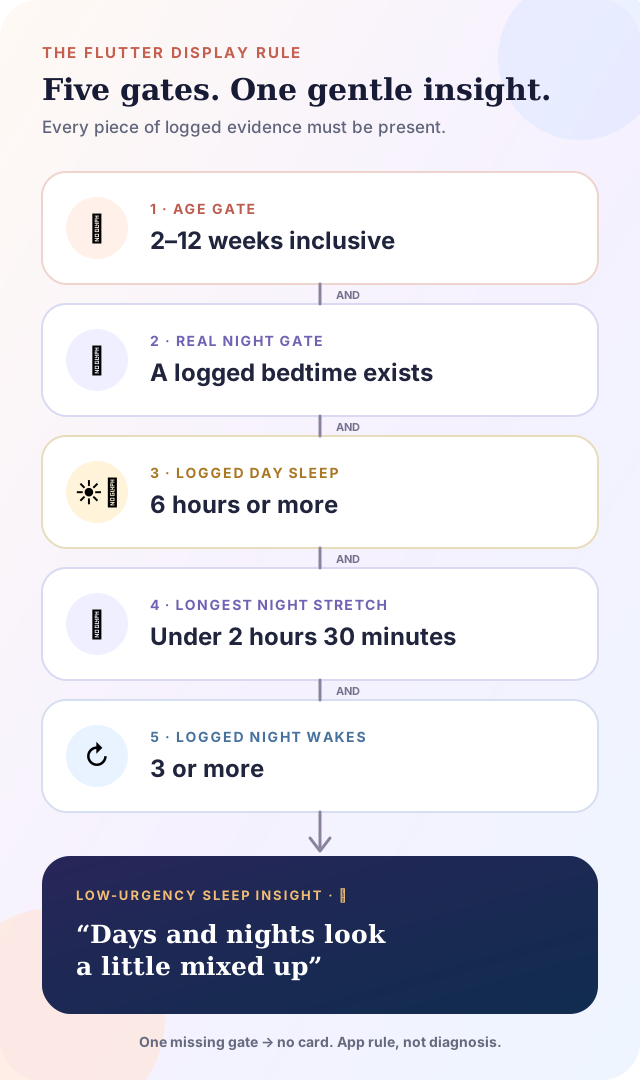
These are app display thresholds, not a medical definition of day/night confusion and not sleep targets for a newborn. They exist to stop a gentle pattern card appearing from thin or one-sided evidence.
Why one rough night does not trigger it
OBubba requires both halves of the pattern:
- generous logged sleep by day
- a short, fragmented logged night
If daytime sleep totals four hours, the card stays quiet even after a broken night. If the baby's longest night stretch reaches three hours, it stays quiet. If there is only one wake, it stays quiet. If no bedtime was logged, it stays quiet rather than manufacturing a night from a few disconnected events.
The age gate matters too. A one-week-old is handled by OBubba's broader fourth-trimester reassurance, not this detector. After 12 weeks, the card no longer appears because the same night shape may need a different, age-appropriate interpretation.
That restraint is a product promise: missing evidence is not evidence, and normal newborn waking should not be converted into an alarming score.
Which day and night does OBubba compare?
The engine reads completed daytime sleep from the previous calendar day and compares it with the resolved physical night ending this morning.
That overnight resolver matters because midnight is not the end of a baby's night. A 10pm bedtime, 1am wake, 3:20am wake and 6:30am morning rise belong to one night even though the clock crossed into a new date.
The card uses the same sleep and wake evidence already in Track. It does not listen through the microphone, watch the cot or infer that the baby was asleep just because no one touched the phone.
An incomplete log can therefore change the result. Six hours in the app means six hours logged, not proof that the baby slept exactly that amount.
Is day/night confusion normal in newborns?
The NHS says newborns are not yet tuned into day and night and commonly sleep for only two to three hours at a time because they need to feed little and often. Its sleep-pattern guidance also stresses that some newborns sleep much more than others and may sleep in short or long bursts.
So “mixed up” is descriptive, not blame. A newborn has not learned a schedule badly, and a parent has not created a bad habit by feeding or comforting them at night.
OBubba's card is intentionally low urgency. It recognises that the logged distribution leans toward longer daytime sleep and more fragmented night sleep; it does not claim illness, hunger, a behavioural problem or a guaranteed cause.
What to do during the day
The NHS recommends making daytime recognisably daytime: open the curtains, play and allow normal everyday noise while the baby sleeps.
In practice:
- Bring in ordinary daylight after morning wake. Open curtains and spend alert periods in naturally bright living spaces.
- Talk and interact during awake time. Feeding, changing, eye contact and a little age-appropriate floor time are enough; a newborn does not need entertainment all day.
- Let the home sound normal. You do not need to make daytime naps artificially silent.
- Feed responsively. Offer feeds according to the baby's cues and the feeding plan you have been given.
- Keep naps safe. “Daytime” does not mean unsupervised or improvised sleep.
OBubba's in-app wording suggests trying not to let one daytime nap run too long. Treat that as a gentle prompt, not permission to delay a feed or repeatedly wake a baby who is difficult to rouse. Newborn feeding needs, weight gain, prematurity, jaundice and professional advice take priority. Ask your midwife, health visitor, feeding team or GP if you are unsure whether a sleepy newborn should be woken to feed.
What to do at night
The aim is not to withhold care. It is to keep necessary care calm and boring:
- keep lights low
- speak little and quietly
- feed and change what is needed
- avoid play
- return the baby to their sleep space after care
That closely matches the NHS day-versus-night guidance. Repetition, not perfection, gradually gives the baby different environmental cues.
Do not keep the room so dark that care becomes unsafe. Use enough dim, indirect light to feed, position and assess the baby properly.
Safer sleep still applies in daylight
Circadian cues never replace safer-sleep guidance.
The Lullaby Trust advises placing babies on their back for every sleep, day or night, in a clear, flat, separate sleep space. It also recommends that the baby sleeps in the same room as a parent or carer for the first six months.
That means “open the curtains by day” is about light and ordinary household context—not putting a cot in direct hot sun. “Keep night boring” means low stimulation—not leaving a crying or hungry newborn unattended.
The newborn support around the insight
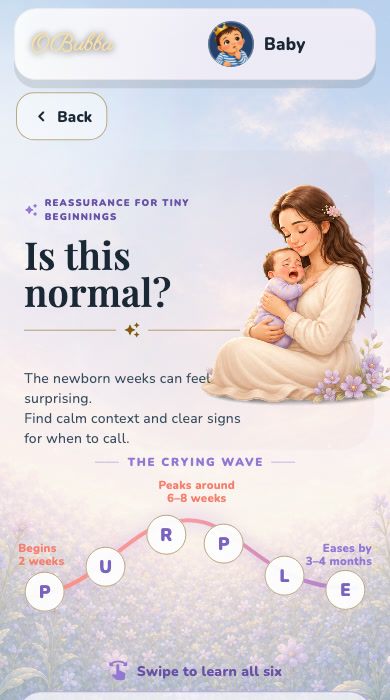
The current app also has a dedicated Is this normal? newborn space. It gives calm context for common early-week questions, a crying-wave explainer and clear signs for when to seek help.
That wider experience matters. A baby awake at night might need feeding, comfort or medical attention; not every wake belongs in a sleep-adjustment story.
Seek appropriate medical advice when a newborn is difficult to wake, not feeding normally, has drier nappies than usual, has breathing difficulty, has a temperature that concerns you or simply seems seriously unwell. A sleep insight cannot assess the baby.
A gentle 24-hour reset—without a schedule
For the next day, try only this:
| When | One useful distinction | |---|---| | Morning | Curtains open and ordinary voices after waking | | Day feeds | Light, interaction and responsive feeding | | Day naps | Safe sleep in the same room; normal household sound | | Evening | Let light and stimulation taper naturally | | Night wakes | Dim, quiet, feed/change/comfort, no play | | Morning again | Repeat the daylight cue |
There is no need to force clock times, stretch wake windows or turn every nap into a training exercise. The baby is learning a contrast, not passing a test.
Why this is more useful than a generic newborn tip
Most baby apps can display an article saying “keep nights dark”. OBubba can wait until the baby's own recent log shows the particular day-heavy, night-fragmented shape the advice is meant for.
It also knows when not to say it:
- outside the 2–12-week window
- without a real logged night
- without the daytime half of the pattern
- when the night already contains a longer stretch
- when wake count is low
That is the difference between a content library and a careful companion. The best insight is not the one that appears most often; it is the one that earns its moment.
Try OBubba free → — track naps and nights once, then get a gentle explanation only when the pattern in the log supports it.
Quick answers
Does the card mean my newborn should sleep through the night?
No. Newborn waking and frequent feeding can be normal. The card describes how logged sleep is distributed between day and night.
Why did OBubba not show it after a terrible night?
It needs every gate: age 2–12 weeks, real night data, at least six logged daytime hours, longest night stretch under 2½ hours and at least three wakes.
Is six hours of day sleep too much?
Not by itself. Six hours is the app's display threshold for this combined pattern, not a universal maximum or diagnosis.
Should I wake my newborn from every long nap?
Not automatically. Responsive feeding, growth, health and any professional feeding plan come first. Ask your care team if you are unsure about waking a sleepy newborn to feed.
Should daytime naps be in a bright cot?
Daytime can include daylight and normal household sound, but all safer-sleep principles still apply. Keep the sleep space clear, flat and away from direct heat or sunlight, with baby on their back.
Is OBubba listening to my baby at night?
No. The detector uses the sleep and wake records in the tracker. Without a reconstructable logged night, it returns no card.
Ready to try OBubba?
Use OBubba to track feeds, sleep, naps, nappies, growth, milestones and family handovers in one calm baby tracker app.