You log a morning wake, two naps and bedtime. OBubba can already show a next-sleep window—but the clock still says it is learning your baby’s rhythm.
That can sound contradictory. If the app is still learning, where did today’s suggestion come from? If the ring reaches 100%, does that mean tomorrow’s nap is guaranteed?
The honest answer is that OBubba uses two layers. It begins with an expert age baseline so a new parent does not face an empty screen. As usable sleep records accumulate, the engine can give this baby’s own pattern more influence. The percentage shows how much history has built the overall sleep model; the confidence on one prediction describes the evidence available for that particular suggestion.
Neither is a score for the baby or the parent. Neither is a promise that sleep will happen on cue.
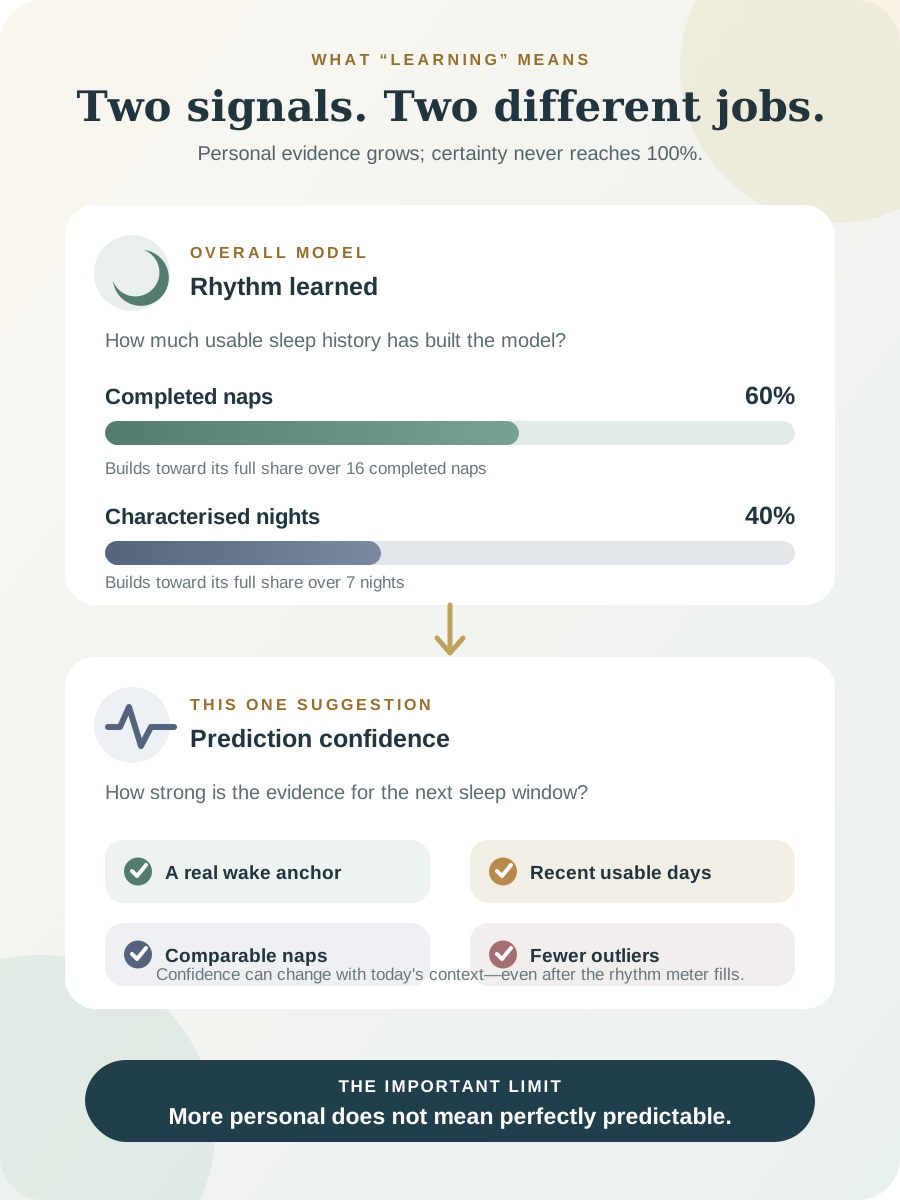
The short answer: “still learning” does not mean “no help yet”
On the first useful day, OBubba can combine the baby’s age with a real wake anchor to offer an Expert age baseline. The current tests explicitly check that this new-user state is not described as a low-confidence failure.
That first window is a starting range, not a claim that every baby of the same age sleeps identically. The NHS notes that babies have their own waking and sleeping patterns, and those patterns change as they grow. Logging lets the app move from a sensible age-aware place to begin toward what repeatedly appears to fit this baby.
Think of it like a new health visitor reading a short handover. They can be helpful on day one. They simply know more after several ordinary days than after one morning.
Three labels that sound similar—but are not
| What you see | What it means | What it does not mean | |---|---|---| | Expert age baseline | the suggestion currently relies mainly on age guidance and today’s wake anchor | the app has learnt this baby’s personal schedule | | Rhythm learned: 47% | usable completed naps and nights have filled about 47% of the overall model’s intended evidence | 47% chance the next nap will happen | | High / still learning / low confidence | the strength of evidence behind this particular prediction | a guarantee, sleep-success grade or parenting score |
This distinction matters. A baby can have a well-developed overall rhythm model while today’s next-nap prediction has weaker confidence because the morning wake is missing or a nap is still running. Conversely, the app can give an age-based starting window on day one before it has much personal history.
What the rhythm learned percentage actually counts
We inspected the current OBubba code and its automated tests for this guide. The raw learning calculation is deliberately simple and visible:
- completed nap samples supply 60% of the meter
- characterised nights supply 40%
- the nap contribution fills progressively across 16 completed naps
- the night contribution fills progressively across 7 nights
- the result is rounded and capped at 100%
For example, eight completed naps contribute 30 percentage points. Three characterised nights contribute about another 17. Together the raw calculation displays 47% rhythm learned.
That is model saturation, not model accuracy. Sixteen naps and seven nights provide enough examples for this progress device to retire; they do not freeze a growing baby’s routine forever.
The visible gauge is also intentionally one-way. Its saved display does not fall simply because an older high-sample day rolls out of the app’s recent window or a parent later tags a day as travel. The underlying learning calculations can still exclude inappropriate days. The ring avoids making a parent feel that the app has somehow “forgotten” their baby.
What counts as useful sleep history?
For the rhythm meter, a nap counts when it has both a start and an end. A night can be characterised by an evening bedtime record or a morning wake.
Different personal insights need different evidence. The deeper night profile only treats a night as a usable observed average when it has both a bedtime and a morning wake. Personal wake-window learning needs completed naps linked to a previous wake or nap end, plus at least one optional outcome detail such as settling, wake mood or quality.
That means there is no single magic log that unlocks every feature. Each question uses the smallest relevant evidence:
- When is the next sleep opportunity? A current wake anchor matters enormously.
- How long do nights usually run? Bedtime and morning wake need to form a complete night.
- Which awake stretch tends to work best? Repeated comparable naps and outcomes are needed.
- Is day sleep changing? Several complete nap-days are more honest than treating unlogged days as zero sleep.
OBubba’s longer-term wake-window learner waits for at least six usable nap examples overall. It compares 15-minute bands only when a band has at least three examples, and it needs at least two bands before choosing a personal best. One lovely nap is encouraging; it is not yet a reliable pattern.
What the app deliberately leaves out
More data is not automatically better data. The current app excludes days tagged with disruptions such as sickness, travel or daycare from relevant baselines, and fever also prevents a day from training the usual pattern.
It also avoids several common false conclusions:
- an ongoing nap with no end is not counted as completed
- an empty day is not assumed to mean the baby took zero naps
- implausible timing pairs are rejected
- unusual outliers can lower the confidence attached to a prediction
- too few matching naps are not presented as a personal rule
This is why tagging an off-day can be more useful than faithfully logging every chaotic minute. Illness is real family history, but it should not automatically redefine the baby’s ordinary wake window.
What prediction confidence is measuring
The confidence label belongs to one calculation now, not to the whole child profile.
The current confidence builder begins from a full evidence score and applies penalties when important context is thin. It asks whether there is a wake anchor, how many recent usable days exist, whether there are enough samples for this nap’s position in the day, whether a nap is still active, and whether outliers or incomplete context are present.
At cold start, age guidance is treated differently: when there is no personal history but there is a wake anchor, the app labels the result Expert age baseline and explains that it is tuned to age while learning the baby’s rhythm. That is more useful than pretending the screen knows nothing—and more honest than calling the result personal.
Once personal history exists, the app can show:
- High confidence when several relevant signals agree
- Still learning your baby when the evidence is useful but incomplete
- Low confidence—log more to sharpen this when key anchors or comparable samples are weak
A high-confidence window can still miss. Babies are not trains. Hunger, stimulation, teething, a new skill, temperature, illness and an unexpectedly good or difficult nap can all change what happens next.
What becomes personal as the history grows
The app’s adaptive sleep profile can combine an age-based population prior with the baby’s own observed nights. It uses a gradual blend: early records influence the result without immediately overpowering the starting guidance, and the baby’s history receives more weight as usable nights accumulate.
Depending on the available logs, OBubba can learn from:
- typical first and later wake windows
- nap duration and position in the day
- bedtime and morning wake
- longest overnight stretch
- night wakes and feeds
- daily sleep and nap count
- optional nap outcomes such as settling, mood and quality
The night profile uses up to 14 recent physical nights. It waits for enough complete nights before making stronger personal claims, and it keeps age priors for day-sleep values until several complete nap-days exist.
That gradual blend is important. One late holiday bedtime should not instantly become “your baby’s bedtime”. Five comparable nights deserve more influence than one.
The genuine screen behind the prediction
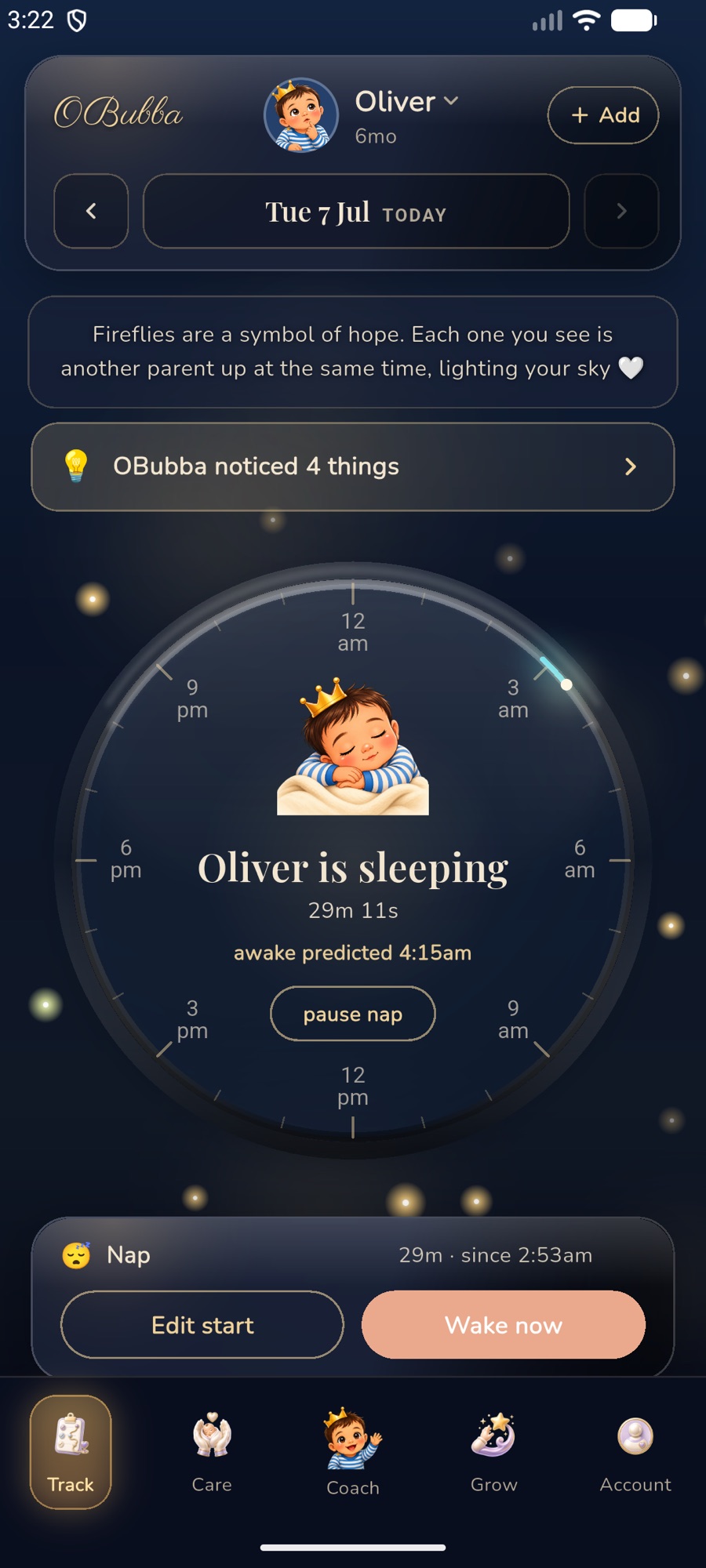
The clock is not a decorative countdown. The same prediction result carries its source label, confidence tier and reasons into the explanation shown to the parent. While the result still comes from the age baseline, the app can say so; once enough personal evidence is available, that baseline state disappears.
The overall learning ring can then retire at 100%, while the live prediction continues to respond to the actual day. Personalisation is a continuing calculation, not a certificate awarded once.
How to help the app learn without tracking your whole life
You do not need perfect logs. Prioritise boundaries that change the next decision.
On a minimal day
Record the morning wake, end each nap at the real time, and record bedtime. Those anchors describe where awake stretches begin and end.
When you are investigating a nap question
Add one consistent review detail—perhaps how baby woke or how long settling took—for several comparable naps. Repeating the same useful observation beats completing every optional field once.
On an unusual day
Use the sick, travel or childcare context where appropriate. Do not force the app to interpret a feverish night as the new normal.
When a timer is still running
Close or edit it to the real end. An unfinished nap is deliberately excluded from learning and leaves the current awake anchor unclear.
Try OBubba free → — get an age-aware starting point from the first useful logs, then let completed naps and nights shape guidance around your baby rather than a generic schedule.
What 100% does—and does not—promise
At 100%, OBubba has filled the rhythm meter with the intended mix of nap and night samples. It means enough history to make the model meaningfully personal, not:
- baby will sleep at the predicted minute
- every future day will resemble the last week
- illness, travel or development can be ignored
- the parent should hold baby awake until a clock says go
- the app has replaced sleepy cues or professional advice
The NHS says all babies change their sleep patterns and that growth spurts, teething and illness can affect sleep. A good prediction tool must therefore keep updating with the real day—even after its welcome-stage progress ring has filled.
Use the window as a prepared moment: dim things down, watch the baby and be ready. If their cues say earlier or later, the baby wins.
Frequently asked questions
Why did the percentage not rise when I logged a feed or nappy?
The ring measures sleep-rhythm evidence. Feeds and nappies are useful elsewhere in OBubba, but they do not count as completed naps or characterised nights.
Why did an ended nap make the ring move?
A nap becomes a usable rhythm sample only when it has both a start and an end. Until then, the app does not know its real duration or the next wake anchor.
Why is the percentage still visible when I already have a nap prediction?
The early prediction can use age guidance plus today’s wake. The percentage tracks the separate journey toward a fuller personal history.
Can my prediction confidence fall after reaching 100% learned?
Yes. The meter reflects overall accumulated history; confidence reflects the context for one prediction. A missing wake, active nap or unusual day can make today’s evidence weaker.
Does 100% mean the app stops learning?
No. The introductory ring retires, but recent usable days continue to shape predictions and insights as the baby grows.
Why did tagging a day sick not make the visible percentage drop?
The display remembers its highest earned percentage so the progress gauge does not visibly regress. Relevant engine calculations still exclude the disrupted day from ordinary baselines.
Do optional nap reviews increase the percentage?
The percentage itself counts completed naps and characterised nights. Optional reviews do not add extra percentage, but they can make a nap useful to deeper outcome-based wake-window learning.
Should I log through illness so OBubba learns it?
Log what helps you care for your baby, but tag the day appropriately. When a baby is unwell, comfort, hydration, prescribed care and medical advice matter more than optimising a routine.
Safer sleep is never a prediction setting
An app suggestion never changes the safer-sleep environment. The NHS advises placing a baby on their back in a clear cot or Moses basket with a firm, flat mattress; for the first six months, the safest place is in the same room as you.
Do not use a predicted window to keep an unwell or unusually sleepy baby awake. If your baby is difficult to wake, breathing unusually, feeding much less, has concerning colour or seems unlike themselves, seek medical help rather than trying to improve the rhythm score.
Useful uncertainty is better than false certainty
“Still learning” is not an apology hidden beneath a prediction. It is the app showing its working.
OBubba can offer an age-aware starting range before it knows your baby well. It can say when repeated personal records have begun to matter. It can distinguish a full history from weak context today. And it can keep the final decision where it belongs—with the parent watching the real baby.
That is what a trustworthy baby app should learn first: personal does not mean perfectly predictable.
Sources and further reading
- NHS: Helping your baby to sleep
- NHS Best Start in Life: Your baby's sleep patterns
- NHS Best Start in Life: Safer sleep advice for babies
OBubba is a tracking, planning and education tool, not medical advice or a medical device. Sleep predictions are estimates, not instructions. Follow current safer-sleep guidance and your baby's individual clinical plan.
Ready to try OBubba?
Use OBubba to track feeds, sleep, naps, nappies, growth, milestones and family handovers in one calm baby tracker app.