Yesterday your baby drifted off after a short cuddle. Today the room is dark, the routine is finished and they are still rolling, humming or looking straight at you. Then OBubba says:
“Taking longer to settle lately.”
Is the app timing every minute? Has it decided your baby is overtired? Does it mean you need to start every nap 15 minutes earlier?
Not quite.
We traced the current detector, the nap logger that supplies it, its 10-day caller and its tests. The card compares the three most recent logged nap-settle days with the older logged days inside a 10-day window. It can identify a real change in the record; it cannot identify the cause from settling time alone.
That final distinction matters. A baby may take longer to fall asleep because the wake window was too long, too short or simply different. Discomfort, noise, a developmental change, a new settling method or one unusually stimulating morning can all change the same number.
The short answer
| Question | Current behaviour | |---|---| | What does the detector read? | Completed daytime naps with a logged Time to fall asleep value | | How far back does it look? | Today plus the previous 9 calendar days | | Does it use exact stopwatch minutes? | No. The four logger choices are stored as representative values: 3, 10, 22 or 40 minutes | | How many logged days are needed? | At least 4 days containing qualifying settle data | | What is “recent”? | The 3 most recent logged days, not automatically the last 3 calendar days | | What is “before”? | Every older qualifying day remaining in that 10-day window | | When does “taking longer” appear? | Recent average is at least 3 minutes higher, plus two step-by-step rises across calendar-adjacent days | | When does “getting easier” appear? | Recent average is at least 3 minutes lower than the older average | | Does it prove overtiredness? | No. The current advice leans earlier, but the measured trend does not establish direction | | Where does the insight live? | As a longer-term pattern in What OBubba noticed, rather than only a one-day prompt |
First: what did you actually log?
When a parent logs or edits a nap, OBubba offers a Time to fall asleep row with four choices:
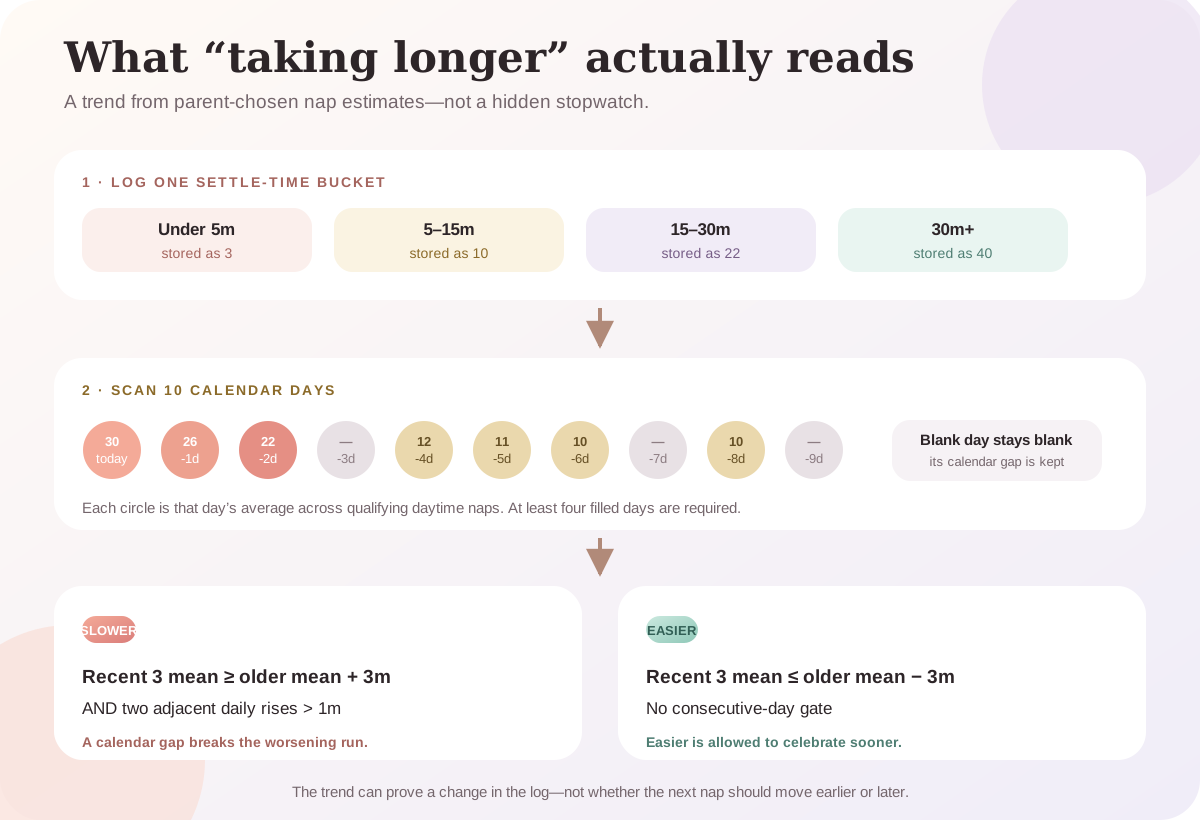
| What the button says | Value stored for the detector | |---|---:| | Under 5m | 3 minutes | | 5–15m | 10 minutes | | 15–30m | 22 minutes | | 30m+ | 40 minutes |
Those are category representatives, not a hidden stopwatch.
If you choose 30m+, the engine does not know whether settling took 33 minutes or 75. Both are represented by 40. If you choose 5–15m, it reads 10. This keeps logging quick, but it means the resulting averages should be read as a direction, not laboratory precision.
The settle-time field is also separate from How baby settled. “Rocked” describes the method. “15–30m” describes the estimated time. This detector uses only the latter.
It ignores:
- naps with no settle-time selection
- night sleep and bedtime entries
- night-wake resettling duration
- zero or negative values
- any imported or malformed settle value above 120 minutes
That makes the title narrower than it first sounds. It means daytime nap onset has taken longer in the qualifying record, not “all sleep is getting worse.”
How the 10-day comparison works
The caller examines 10 calendar dates, starting with today. For each date, it collects qualifying daytime naps and calculates that day’s average settle value.
If two naps on Monday were logged as 10 and 22 minutes, Monday contributes one daily average of 16. A day with three naps does not automatically outweigh a day with one; the trend compares daily averages.
Days with no qualifying settle data are skipped—but their calendar positions are retained. That detail protects the worsening detector from calling separated observations a continuous run.
The function then divides the available daily averages:
- recent: first 3 qualifying days, most recent first
- older: every remaining qualifying day in the window
Because at least four daily averages are required, the smallest possible comparison is three recent days against one older day. With fuller logging, it could be three against seven.
The exact “taking longer” gate
The worsening card needs two different forms of evidence.
Gate 1: the recent average moved by at least 3 minutes
The mean of the three recent daily averages must be at least three minutes above the older mean.
For example:
- recent daily averages: 30, 26 and 22
- older daily averages: 12, 11 and 10
- recent mean: 26
- older mean: 11
- difference: +15
That clears the size gate.
Gate 2: two consecutive day-to-day rises
Starting at the most recent day, each of the first two comparisons must be more than one minute worse than the day before it:
- today 30 vs yesterday 26
- yesterday 26 vs the previous day 22
Those dates must be calendar-adjacent. If today is 30, the next qualifying record is two days ago at 26 and yesterday has no settle data, the run breaks. The detector stays quiet even if the broad recent average looks worse.
That is a sensible anti-noise choice: scattered hard naps do not become a streak simply because the blank days disappeared from a list.
The “settling is getting easier” gate is different
The improving version is simpler. It appears when the recent three-day mean is at least three minutes below the older mean.
It does not require two calendar-consecutive improvements.
That asymmetry makes the detector deliberately more demanding before it warns than before it celebrates. A gap can block “taking longer” while the same kind of gap does not block “getting easier.”
The positive body says settling times are down and suggests that whatever changed may be working. That is warm, but still observational. The app does not know which change mattered unless the surrounding record provides more context.
Why the current advice needs a careful translation
When the worsening card fires, its current `why` text says rising settle times often mean wake windows need a tweak and suggests pulling the next window in by 10–15 minutes.
An earlier attempt may help when the baby reached the nap overtired: frantic crying, repeated jolting awake, a very short previous nap or a pattern of exhausted false starts may support that interpretation.
But longer settling can also mean the opposite. A calm baby rolling, chatting or practising a skill for 25 minutes may not yet have enough sleep pressure. Starting 15 minutes earlier could lengthen the struggle.
The honest translation is therefore:
> “The last three logged settle days are meaningfully slower than the earlier days in this window. Check the context before choosing whether to move the nap earlier, later or not at all.”
The number is the signal. The direction of the fix remains a hypothesis.
Earlier, later or hold steady?
Use the next two or three opportunities as a small observation, not a sweeping schedule overhaul.
| What you see before and during settling | A reasonable hypothesis | Small test | |---|---|---| | Fussy, rubbing eyes, escalating quickly, previous nap short | Overtired or the wind-down started late | Begin the routine 10 minutes earlier once | | Calm, playful, chatting, repeatedly standing or rolling without distress | Not sleepy enough yet | Start 10 minutes later once | | Settling changed after illness, travel, nursery or a new skill | Temporary disruption | Keep the anchor steady while the disruption settles | | One particular nap is hard but the others are unchanged | Nap-position effect | Review that nap separately rather than moving the whole day | | The routine itself became longer | Measurement changed, not necessarily sleep pressure | Time from genuine sleep attempt, not from the first bath or book |
Change one thing at a time. If you alter the window, room, song and settling method together, a better nap will not tell you which lever helped.
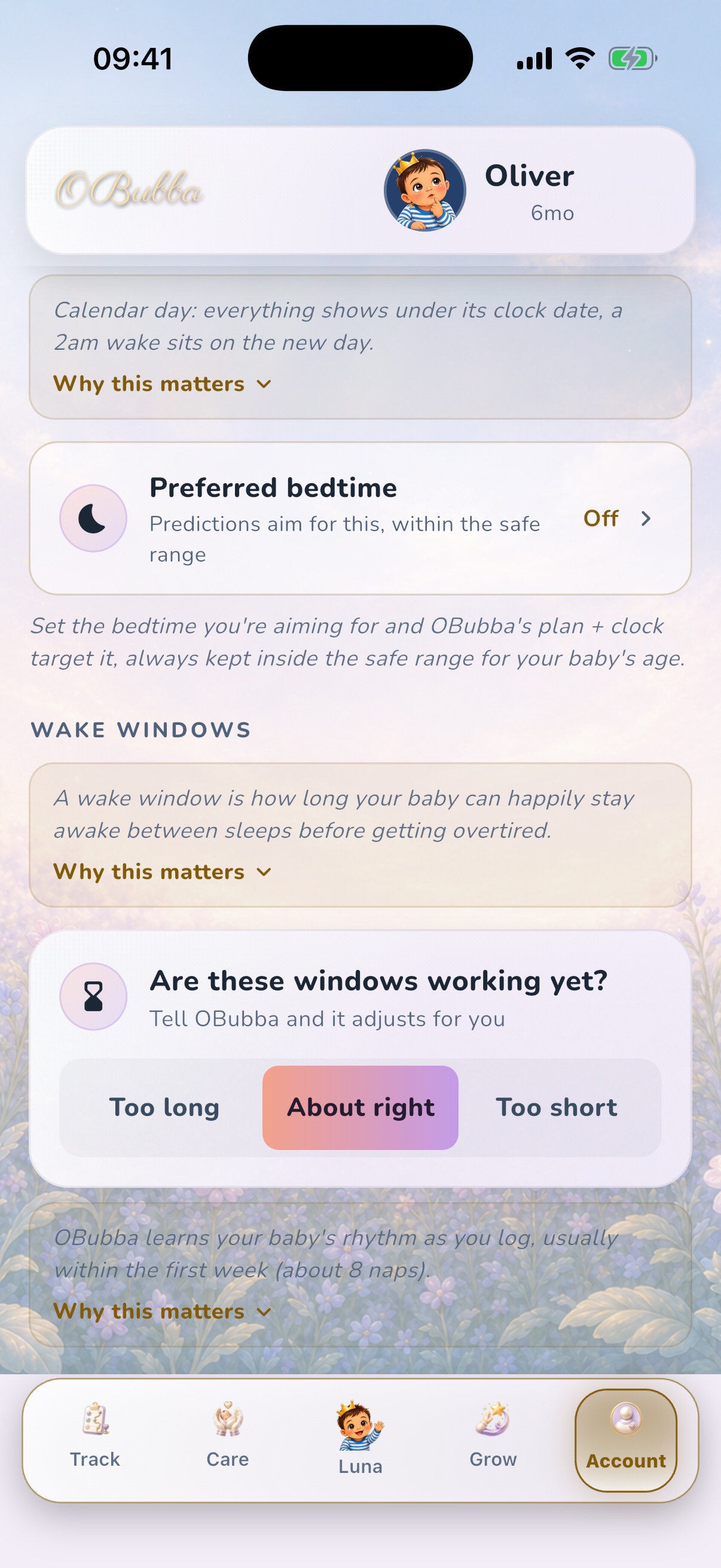
OBubba’s own Preferences screen lets a parent say whether the wake windows feel Too long, About right or Too short. That feedback is valuable precisely because a trend detector cannot see the baby’s demeanour.
Make the input consistent enough to learn from
You do not need to log every nap forever. You do need the same answer to mean roughly the same thing from day to day.
Choose a consistent start point for “time to fall asleep.” A useful one is the moment you genuinely begin the final sleep attempt—not when lunch ends, not when the bath starts and not when you first think “they look tired.”
Then pick the nearest bucket without trying to make the day look good.
Avoid these common distortions:
- selecting Under 5m because baby was drowsy during the feed, even though cot settling took another 20 minutes
- including a long calm pre-nap routine one day but excluding it the next
- recording only difficult naps, which makes the history look slower than ordinary life
- recording only successful cot naps and leaving contact or pram naps blank
- treating 30m+ as exact 40-minute data
The detector can only compare the convention you give it.
Today can influence the card before the day is complete
The 10-day scan includes today. As soon as today has one qualifying nap, today contributes a daily average—even if two more naps are still to come.
That creates a partial-day edge case. A difficult first nap can temporarily make today look like a 40-minute day. Later easier naps may pull the same day’s average back down.
So if the insight appears after nap one, do not treat it as a final verdict on the entire day. Reopen What OBubba noticed later and interpret the trend alongside the complete nap pattern.
This is different from some feed trend detectors in the app, which explicitly exclude today because partial intake would bias the comparison. The settle trend does not currently make that exclusion.
What the card does not know
The settle detector receives only daily average values, their day indices and the baby’s name. It does not receive:
- the baby’s age
- the actual wake-window lengths
- nap number or position
- room light, temperature or noise
- how the baby settled
- whether they were calm, crying or practising a skill
- illness, teething, travel or nursery context
- the previous nap’s length
- the parent’s wake-window preference
Other OBubba insights can read some of those signals separately. This function cannot quietly use them when it says “taking longer.”
That is why it belongs in the longer-term What OBubba noticed feed: it is one useful pattern to combine with the rest of the story, not a command that should override the baby in front of you.
A better version of the card
The current detector is strong at identifying a worsening run conservatively. Its explanation could be more balanced.
A more transparent card would say:
> Nap settling has been slower for three logged days > Recent estimate: 26m · Earlier estimate: 11m > This can happen when a window is too long or too short. Were these settles upset and exhausted, or calm and not-yet-sleepy?
Then offer two actions:
- Try 10m earlier
- Try 10m later
The parent’s choice could feed the existing wake-window preference rather than the app assuming “earlier” from the same number every time.
That would make OBubba more compelling, not less decisive: the app would show exactly what it measured, ask for the piece only a present adult can see, and turn both into a better next experiment.
Keep sleep safety separate from timing experiments
Changing a nap by 10 minutes should never mean changing the sleep surface to force a result. The Lullaby Trust advises placing babies on their back for every sleep and keeping the cot clear; its current safer-sleep information explains the firm, flat, separate sleep-space basics.
The NHS also emphasises that babies differ and sleep patterns change as they grow. Its baby sleep-pattern guidance is a useful antidote to comparing one baby’s settle time with somebody else’s.
The purpose of this insight is to notice this baby’s change against their own recent record. It is not a contest for the fastest possible sleep onset.
The useful takeaway
“Taking longer to settle lately” is not a generic wake-window notification. It is built from your daytime nap entries, using a conservative worsening run across the last 10 calendar days.
That is the valuable part: the app remembers a change that is hard to see while living through each nap separately.
Use it as a prompt to look closer. Was the baby distressed or content? Was today complete? Did one nap drive the number? Did your logging convention change? Then test the smallest plausible timing adjustment and watch what happens.
Good personalisation does not pretend a timestamp can see a baby’s face. It combines the pattern OBubba can calculate with the context only you can provide.
Try OBubba free to log sleep in seconds, notice settling changes across real days and turn them into calm, testable next steps instead of another rigid schedule.
Frequently asked questions
How many days make OBubba say “Taking longer to settle lately”?
At least four days inside the latest 10-day window must contain qualifying nap-settle data. The worsening version then compares the three most recent logged days with the older qualifying days and requires two calendar-consecutive rises.
Does OBubba time how long my baby takes to fall asleep automatically?
No. The parent chooses one of four estimates while logging or editing the nap: Under 5m, 5–15m, 15–30m or 30m+. The detector uses stored representative values of 3, 10, 22 and 40 minutes.
Do bedtime settling times count?
The logger can store a settle estimate on bedtime, but this particular trend caller filters for daytime `nap` entries only. Night sleep and night-wake resettling do not enter this calculation.
Does a longer settle mean the wake window was too long?
Not by itself. Overtiredness is one possibility; insufficient sleep pressure is another. Use the baby’s behaviour, preceding sleep and wider context before choosing an earlier or later test.
Why did the card not appear after several hard naps?
Possible reasons include missing settle-time selections, fewer than four qualifying days, a calendar gap breaking the consecutive worsening run, a recent-average change under three minutes or the hard naps being averaged with easier naps on the same day.
Can “Settling is getting easier” appear with gaps in my log?
Yes. The improving path requires a recent average at least three minutes lower than the older average, but it does not apply the calendar-consecutive run gate used by the worsening path.
What should I change first?
Choose one small hypothesis. Try the routine around 10 minutes earlier if the baby looked overtired, or around 10 minutes later if they were calm and not yet sleepy. Hold everything else steady long enough to learn from the result.
Should a baby always fall asleep in under 15 minutes?
No single settle time is a universal target for every baby and every nap. OBubba’s detector looks for change against the baby’s own recent pattern rather than declaring one bucket “good” for everybody.
Ready to try OBubba?
Use OBubba to track feeds, sleep, naps, nappies, growth, milestones and family handovers in one calm baby tracker app.