You log sore gums on Tuesday, fussiness on Thursday and disturbed sleep on Saturday. OBubba then shows:
“Teething comfort for Maya.”
Has the app diagnosed a tooth? Did one bad night trigger the card? Will every dribbly day now create another alert?
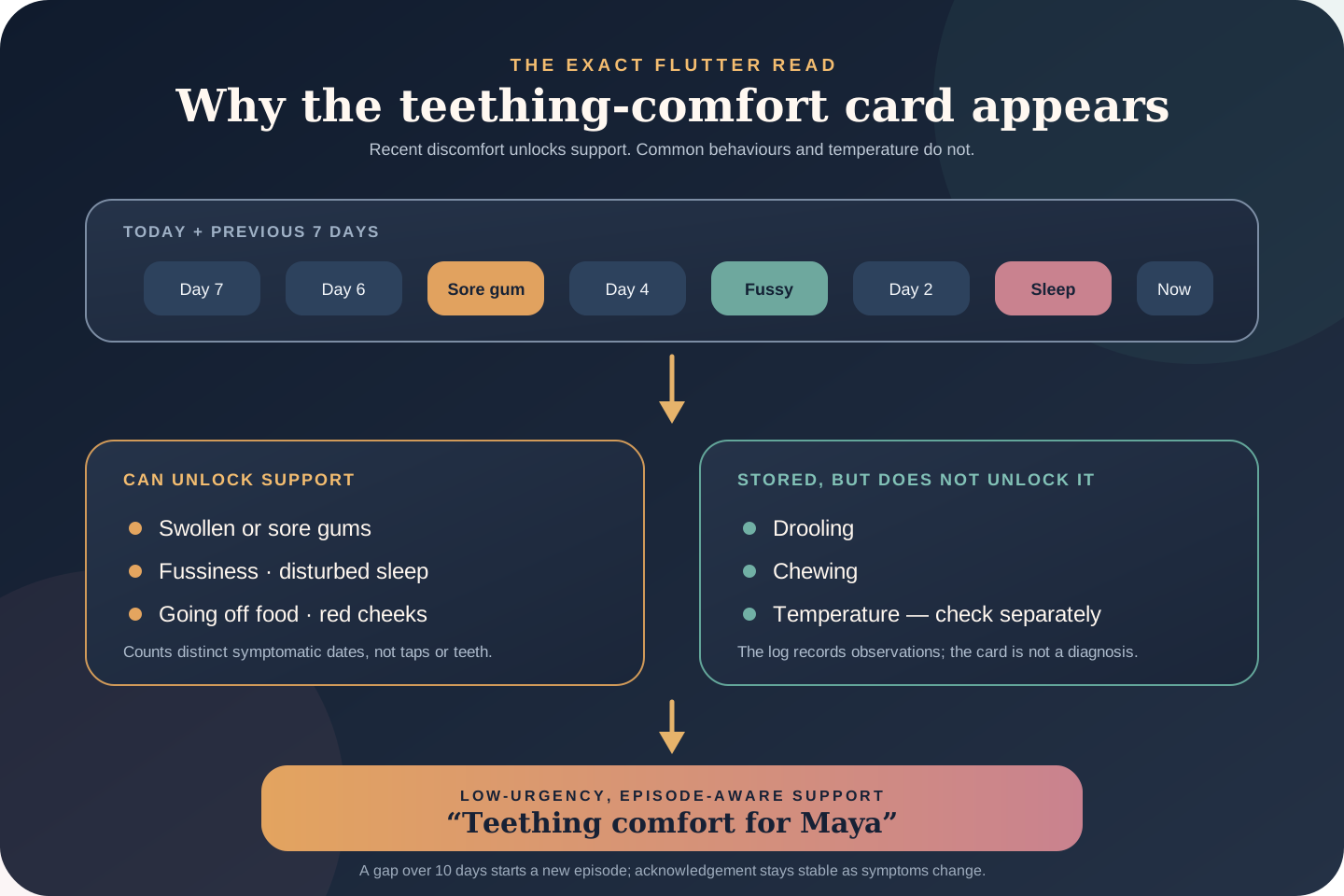
No. We traced the current detector, the Teeth logger, the shared comfort library and the dismissal logic. The insight appears only when at least one of five discomfort markers was logged during the latest seven days. Drooling, chewing and temperature do not unlock it.
That is a thoughtful distinction. Dribbling and chewing are common around this age but do not necessarily mean distress. A temperature needs its own check rather than being explained away as “just teething”. The card is designed to respond to discomfort without pretending the app has made a diagnosis.
There is still room to be more precise. The sentence “sounds like a tooth is on the move” is warmer than a clinical label, but the same pattern can have other explanations. The most honest translation is:
> “You recently logged signs that can fit teething discomfort. Here are a few low-risk comfort options, while you continue to watch how your baby is.”
The short answer
| Question | Current behaviour | |---|---| | What unlocks the card? | At least one logged discomfort marker in the latest seven days | | Which markers count? | Swollen gums, fussiness, disturbed sleep, going off food or red cheeks | | Do drooling and chewing count? | No | | Does “Temperature” count? | No; it is deliberately excluded from this detector | | Must a tooth be selected? | No; a dated, symptom-only note can qualify | | Does OBubba diagnose teething? | No; it reflects the symptoms you selected and offers comfort ideas | | What does “Thanks” do? | It acknowledges this episode so the same evolving symptom cluster does not keep reappearing | | Can the card return? | Yes, after a genuinely separate episode; a gap of more than 10 days starts a new run |
What the detector actually reads
The detector receives the current child record and scans its rich teething history. Each entry can contain:
- a tooth identifier, such as a lower central incisor
- the date it was noticed
- selected symptoms
- an optional note
For the comfort card, only the date and symptom selections matter. The code converts each valid date to a day, ignores future dates, and keeps entries from today through seven days ago.
It then looks for five exact markers:
- Swollen gums → repeated back as “sore gums”
- Fussy → “fussiness”
- Disturbed sleep
- Off food → “going off food”
- Red cheeks
If none of those appears, the function returns nothing. If one or more appears, OBubba combines the markers in a stable, readable order and reports the number of distinct symptomatic days—not the number of taps, teeth or symptoms.
Two entries on the same date therefore count as one symptomatic day. One entry containing three markers still counts as one day. That makes the evidence label useful: “early read · 1 day” describes how much recent history supports the card without inflating the sample.
Why drooling and chewing do not trigger it
The Teeth logger lets a parent record drooling and chewing. The proactive detector intentionally excludes both.
That is sensible product design. A baby may chew toys for exploration, sensory play or hunger. Dribbling can increase for reasons unrelated to an erupting tooth. Those observations are worth keeping in the history, but they do not automatically mean the baby needs a discomfort intervention.
The app draws a line between:
| Observation | Stored in the Teeth history? | Unlocks this comfort card? | |---|---:|---:| | Drooling | Yes | No | | Chewing | Yes | No | | Swollen gums | Yes | Yes | | Fussiness | Yes | Yes | | Disturbed sleep | Yes | Yes | | Going off food | Yes | Yes | | Red cheeks | Yes | Yes | | Temperature | Yes | No |
The card is not asking, “Could a baby this age be teething?” It is asking, “Did this parent recently record a sign the product classifies as genuine discomfort?”
That narrower question reduces noise. It also makes the insight feel earned rather than generated from age alone.
Temperature is stored—but kept out of the inference
“Temperature” appears among the selectable Teeth symptoms, which could look contradictory. The surrounding interface resolves part of that ambiguity: it tells parents that a high temperature, diarrhoea or a baby who seems very unwell is not caused by teething and should be checked separately.
The detector reinforces that boundary by never treating Temperature as evidence for this card. A temperature-only entry returns no teething-comfort insight.
That is important because a label inside a tracker can influence what a tired parent does next. If “Temperature” silently strengthened a teething diagnosis, the app could encourage somebody to dismiss illness. Here it remains a record of what the parent noticed, not proof of the cause.
The NHS says a high temperature is usually 38°C or above. If you think your baby has a temperature, use a digital thermometer rather than judging from cheeks alone. Babies under 3 months with a temperature of 38°C or more need urgent medical advice; follow NHS guidance for other ages and any baby who seems unusually unwell.
What comfort the card offers
The current insight selects three items from OBubba’s wider teething-comfort library:
- Something cool to chew. A chilled—not frozen—teething ring is the clearest option.
- Gentle gum massage. A clean finger and slow pressure may soothe a tender area.
- Age-appropriate pain-relief advice. The wording defers to the local health-service guidance instead of hard-coding one medicine or dose.
These are comfort measures, not tests. If a chilled ring helps, that does not prove a tooth caused the discomfort. If it does not help, that does not rule teething out.
The wider Teeth screen also contains suggestions about cool soft foods for babies already weaning and keeping dribble from irritating the skin. The proactive card stays shorter so a tired parent gets a small, usable set rather than a wall of tips.
NHS guidance similarly recommends a safely chilled teething ring, never a frozen one, and says gently rubbing the gums with a clean finger may help. Always follow the ring’s instructions and never tie one around a baby’s neck.
A fridge-cool ring, not a freezer-hard one
Cold can feel soothing, but “colder” is not automatically “better”. A frozen teething ring can become hard enough to damage gums. Put a suitable ring in the fridge for the time stated by its manufacturer.
A useful setup is deliberately boring:
- one solid, age-appropriate ring
- clean hands
- the baby awake and supervised
- no cord, necklace or clip around the neck
- no cracked, leaking or damaged product
Amber teething jewellery is not a safer or more natural substitute. Necklaces and bracelets can create choking or strangulation risks, and they should not be used for sleep.
Does disturbed sleep prove teething?
No. Disturbed sleep is one qualifying marker, but it is still something the parent selected in the Teeth logger. OBubba does not independently establish that gum pain woke the baby.
A rough night can overlap with:
- hunger or a feeding change
- illness
- a room or schedule change
- a new motor skill
- separation awareness
- an uncomfortable nappy
- ordinary night-to-night variation
The app’s separate night-disruption tools may also use recent teething context when ranking possible explanations. That is a different surface with a different purpose. The comfort insight says, “Here is support for the discomfort you logged.” It should not become, “Every wake this week was caused by teeth.”
Keep the normal safer-sleep setup unchanged. Comfort the baby, then return them to a clear, flat sleep space on their back. Do not add a necklace, loose cloth, toy, cooling product or teething ring to the cot.
“Off food” needs context
Going off food can fit a tender-mouth day, but it is not specific to teething. For a baby starting solids, appetite can vary from meal to meal. Milk remains important during the first year, and a sore baby may prefer familiar milk feeds or softer, cooler foods.
Watch the whole baby rather than chasing one rejected spoon:
- Are milk feeds continuing?
- Are wet nappies broadly as expected?
- Is the baby alert between unsettled periods?
- Can they swallow comfortably?
- Are there vomiting, diarrhoea, breathing or rash symptoms?
- Does the baby seem much less responsive than usual?
If intake drops substantially, wet nappies reduce, swallowing looks painful or the baby seems unwell, seek professional advice rather than recording another teething symptom and waiting for the card.
Why the insight does not keep changing its identity
Symptom clusters evolve. Tuesday may contain sore gums; Thursday adds fussiness; Saturday adds disturbed sleep. If the dismissal key were based on the sentence shown to the parent, every new marker would produce a different key and the acknowledged card could return repeatedly.
The current code avoids that. It builds a stable episode identity from the earliest day in the current symptomatic run.
To find that start, it scans older discomfort entries and walks backwards until it encounters a gap greater than 10 days. Entries separated by 10 days or fewer remain one continuous run. There is deliberately no 30-day cap, because an arbitrary moving boundary previously allowed a long episode’s identity to slide forward and re-nag the parent.
This creates two separate windows:
- Seven days: whether there is enough recent discomfort for the card to appear now
- Ten-day gap rule: whether the current markers belong to the same dismissible episode
That distinction is subtle and good. Recency controls relevance; the episode anchor controls notification respect.
What “Thanks” and snooze do
The card’s acknowledgement reads “Thanks”. Pressing it marks the episode-specific insight as seen for this child. If a new marker joins the same episode, the body can change without reviving the card.
The generic advice component also offers “Don’t show this for a week”. That is a temporary snooze. It does not erase the Teeth history or permanently dismiss all future teething support.
A genuinely separate episode can generate a new identity after a gap of more than 10 days. This is preferable to either extreme: daily nagging or a single lifetime dismissal that silences support when later molars arrive.
What the app cannot know
Even with careful trigger rules, OBubba cannot see the gum, take a temperature, assess hydration, examine an ear or judge whether a baby is behaving normally.
It cannot determine:
- that a tooth is definitely erupting
- which tooth is responsible when no tooth was selected
- that red cheeks are caused by teething
- that a sleep change is pain rather than routine variation
- whether pain relief is suitable for this baby
- whether a temperature or rash needs medical review
This is why the feature is best understood as log-responsive comfort, not diagnosis.
How to use the Teeth log without turning it into homework
You do not need to record every chew or every dribble. Log when the information could help future-you:
- Open Grow → Teeth.
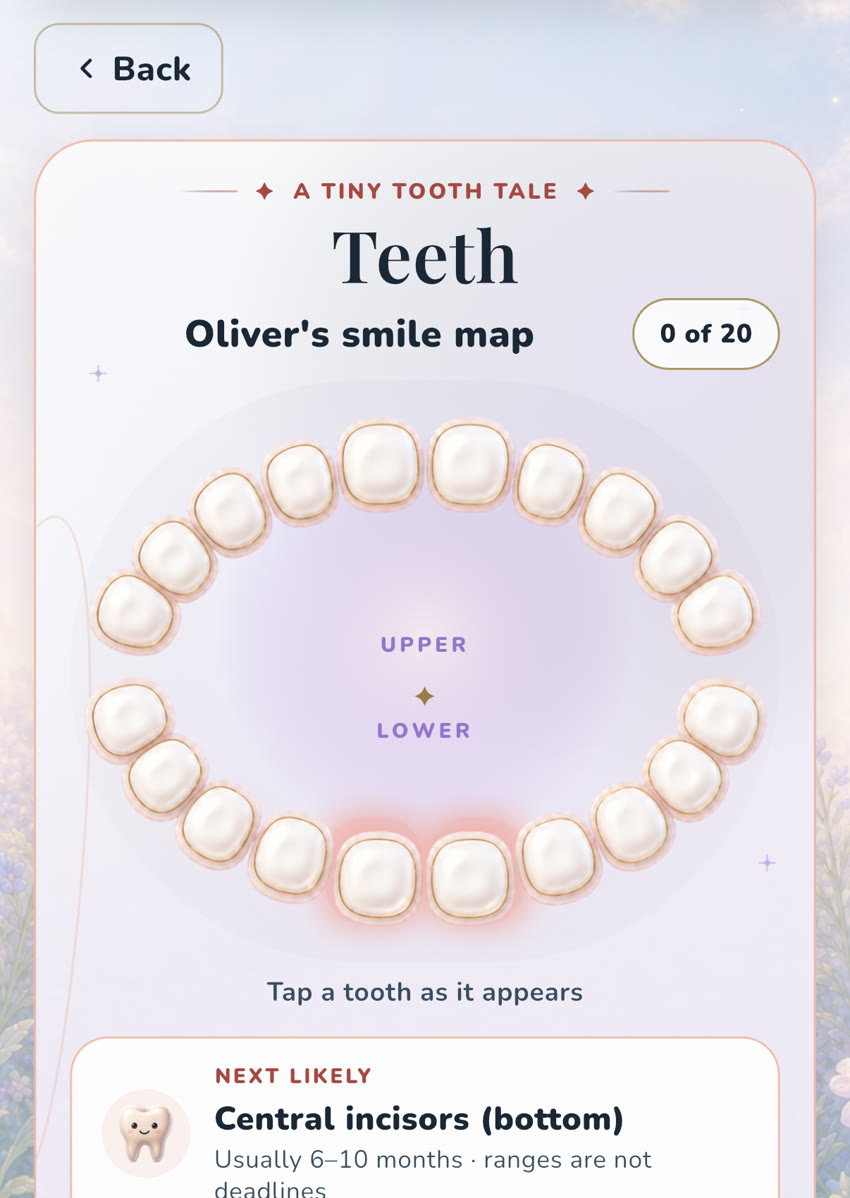
- Tap the tooth if you can see or feel where it is emerging—or use a symptom-only note when you cannot.
- Add the date you noticed it.
- Select only what you genuinely observed.
- Add a short note if context matters: “settled after chilled ring”, “milk fine, refused lumpy tea”, or “temperature checked separately”.
Avoid writing a conclusion as if it were an observation. “Woke three times; gums looked swollen” preserves more useful information than “teething caused a terrible night”.
If symptoms change, update the record. If the baby becomes unwell, move from tracking to appropriate medical advice.
What this feature should improve next
The detector shows strong restraint, but the product can make that restraint more visible:
- Soften the causal sentence. Replace “sounds like a tooth is on the move” with “these signs can fit teething discomfort”.
- Separate Temperature visually. Keep it available for history, but label it “check separately” inside the logger—not only in explanatory copy elsewhere.
- Deep-link to the Teeth history. Let the card open the relevant entries and comfort library.
- Add a clear illness boundary. A compact “When to get advice” action would be more useful than requiring parents to find another screen.
- Explain the evidence label. “From 2 symptomatic days in the last week” is clearer than a generic sample-size chip.
Those improvements would make the feature feel less like an alert and more like a transparent assistant: it notices what the parent recorded, shows its reasoning, offers proportionate help and knows where its competence ends.
That is the kind of product parents keep—not because it claims certainty, but because it converts a fragmented week into one calm next step.
Try OBubba’s Teeth and symptom tracker → — keep teeth, tender-day notes, sleep, milk, solids and medicines together, so comfort decisions use context instead of memory alone.
Frequently asked questions
Why did the teething-comfort card appear today?
At least one qualifying discomfort marker was logged from today through seven days ago. The card can combine markers across several entries and counts distinct symptomatic dates.
Can drooling alone trigger it?
No. Drooling and chewing are stored in the Teeth history but excluded from this proactive detector.
Can a temperature trigger it?
No. “Temperature” can be recorded, but the detector deliberately ignores it. Check a suspected fever separately with a thermometer and follow NHS advice.
Do I have to select a tooth?
No. A dated symptom-only entry can qualify. That is useful before a tooth is visible, but it also means the card cannot prove a tooth is erupting.
Why does it say “1 day” when I selected several symptoms?
The evidence count is distinct symptomatic days, not symptoms. Several markers on one date still produce a one-day sample.
Will “Thanks” hide every future teething card?
No. It acknowledges the current episode. A later episode separated by more than 10 days can receive a new identity.
Should I put a teething ring in the freezer?
No. NHS guidance says to cool suitable rings in the fridge and never freeze them because a frozen ring could damage the gums.
Does teething cause a high temperature or diarrhoea?
Do not assume so. Check a high temperature, diarrhoea or a baby who seems unwell separately and seek advice when needed.
Reliable UK sources
- NHS: Baby teething symptoms
- NHS: Tips for helping your teething baby
- NHS: How to take your baby’s temperature
- NHS: Medicines for babies and children
This article provides general information for UK families. OBubba cannot diagnose teething or illness, examine a baby, assess hydration, choose a medicine or dose, or replace advice from NHS 111, a pharmacist, dentist, health visitor, GP, paediatrician or emergency service.
Ready to try OBubba?
Use OBubba to track feeds, sleep, naps, nappies, growth, milestones and family handovers in one calm baby tracker app.