You logged banana, carrot purée and apple with pear. OBubba then shows:
> Time for some iron-rich foods
Has the app decided your baby is short of iron? Does it know what was in the spoon? Should you add a supplement?
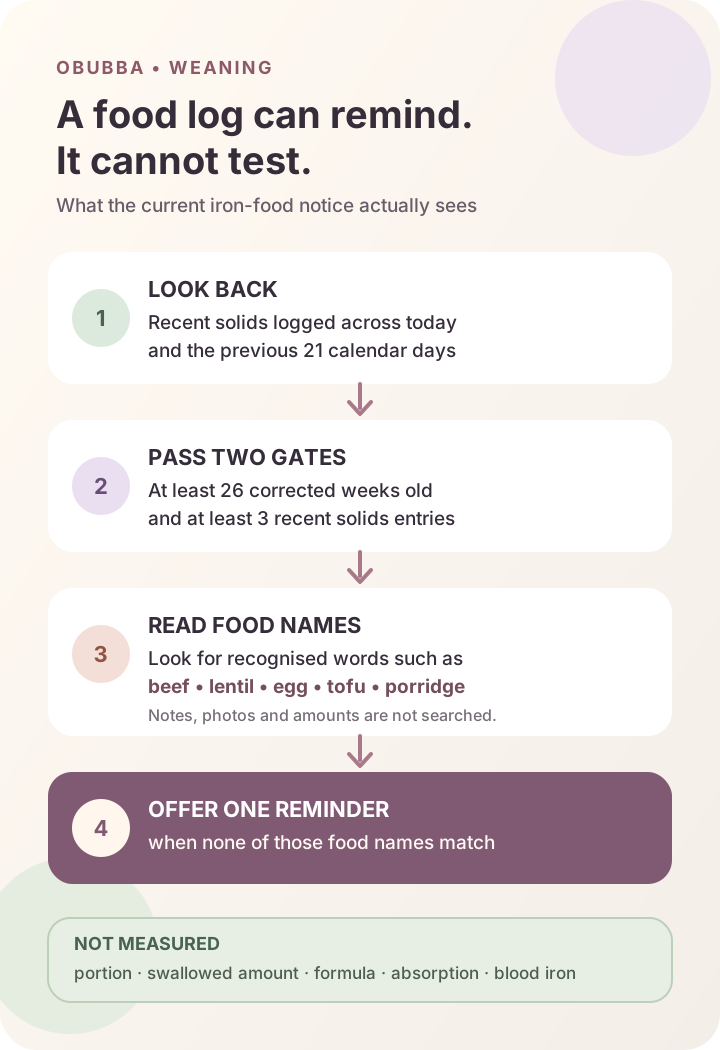
No. The current feature is a food-name reminder, not an iron-status assessment. It appears when a baby is at least around six corrected months old, the recent record contains at least three solids entries, and none of those food names contains one of OBubba’s recognised iron-food words.
The useful response is not panic or pressure. It is a quick check: has an iron-containing food been offered but logged vaguely, or would one fit naturally into an upcoming meal?
The short answer
The current OBubba detector checks four things:
- Age: the baby is at least 26 corrected weeks when corrected age is available.
- Started solids: there are recent solids records rather than an empty weaning history.
- Enough examples: at least three solids entries appear in the latest roughly 22 calendar days.
- No recognised iron word: none of those entries has a food name matching the app’s fixed list.
If all four are true—and a more immediate three-meal refusal pattern has not taken priority—the app may show the notice.
It does not calculate milligrams of iron, inspect ingredients, estimate what was swallowed, read formula volume, diagnose deficiency or decide that a supplement is needed.
Why iron belongs in the weaning conversation
UK guidance recommends beginning complementary food at around six months when the three developmental readiness signs appear together. Milk continues alongside food.
The Scientific Advisory Committee on Nutrition says that after around six months, the iron carried from birth diminishes while demand rises with growth and expanding blood volume. It recommends introducing a varied diet that includes iron-containing foods in an age-appropriate form.
The NHS gives practical examples:
- meat and fish
- fortified breakfast cereals
- dark green vegetables
- beans and lentils
That is a direction for the overall diet, not a reason to judge one bowl. Early portions may be tiny. Food can be touched, mouthed, spat out or eaten in an amount no app can infer.
Breast milk or first infant formula remains the main drink throughout the first year. First infant formula already contains added iron. OBubba’s notice deliberately looks only at the solids names in its recent weaning record, so it does not describe the baby’s total iron intake from milk, food or a prescribed supplement.
The exact trigger
OBubba’s Brain collects solids entries from today back through 21 previous calendar days. In practice, that is a rolling window of up to 22 dates.
Each qualifying entry becomes a small record containing:
- day
- food name
- recognised allergens
- note
- meal response
For the iron check, only the food-name field is searched.
The detector remains silent when:
- corrected age is below 26 weeks;
- fewer than three recent solids entries exist;
- any recent food name matches a recognised iron term; or
- another higher-priority weaning issue, such as a recent run of three refused meals, becomes the single main insight first.
The gate is conservative in one direction and extremely simple in another. It waits for age and three meals, but one matching word is enough to stop the recent-gap notice.
That means the feature answers only:
> “Have I seen a recognisable iron-food label in the recent solids names?”
It does not answer:
> “Is this baby getting enough iron?”
What food words count?
The current code uses a fixed list rather than asking a language model to interpret every recipe.
Recognised terms include:
- meat, beef, lamb, pork, mince, chicken, turkey and liver
- lentil, dahl or dal, bean, chickpea, hummus or houmous
- egg, tofu, spinach and quinoa
- fish, salmon, sardine and mackerel
- oat, oats, porridge, cereal, Weetabix and fortified
- apricot
The app checks whole words with simple plural handling. This prevents accidental substring matches: goat does not count because it contains “oat”, jellybeans does not count because it contains “bean”, and eggplant does not become an egg meal.
That is good defensive code. It is not ingredient intelligence.
| Logged food name | Does the current detector count it? | Why | |---|---:|---| | `Beef and lentil stew` | Yes | contains beef and lentil | | `Egg and avocado mash` | Yes | contains egg | | `Chicken curry` | Yes | contains chicken | | `Baby porridge` | Yes | contains porridge | | `Fish pie` | Yes | contains fish | | `Bolognese` | No | beef or meat is not named | | `Veggie chilli` | No | bean, lentil or another recognised source is not named | | `Breakfast cereal` | Yes | “cereal” matches even if fortification is unknown | | `Goat’s yoghurt` | No | goat does not falsely match oat |
The last examples show both sides of a keyword system. A vague real iron-containing recipe can be missed. A generic cereal name can count even though the app has not checked the packet or confirmed that it is fortified.
Why the note can appear after an iron-containing meal
The detector searches the food name, not the note or a photograph.
These entries contain different evidence:
- `Dinner` with note `lentil dhal with spinach` → likely missed
- `Lentil dhal with spinach` → recognised
- `Pasta sauce` with hidden beef mince → likely missed
- `Beef mince pasta sauce` → recognised
- `Porridge` → recognised, even if the app does not know the brand or fortification
You do not need to write a nutrition label. Name the main ingredients that make the log useful:
> Lentil and sweet-potato mash — fork-mashed; explored two spoons
That supports the iron reminder, texture history and an honest response record without estimating grams swallowed.
If an old entry is clearly vague or wrong, edit it to reflect what was actually served. Do not add a food that was not offered merely to clear the card.
One recognised meal does not prove adequacy
The detector stops after finding any recognised recent food name.
It does not ask:
- how large the portion was;
- how much reached the mouth;
- whether it was swallowed;
- how frequently iron-containing food is offered;
- which kind of iron was present;
- what else was eaten alongside it;
- whether the baby has higher individual requirements; or
- whether a clinician has prescribed iron.
“Egg touched the lips” and “a full bowl of beef-and-lentil stew” can each become one matching solids event. That limitation is why the wording must remain a reminder, not reassurance that nutrition is complete.
The reverse is also true. A blank counter cannot diagnose low intake. A baby might receive iron from first infant formula, a recipe logged under an unrecognised name or an individual supplement plan that this feature does not read.
The notice and the Weaning Progress counter use different windows
OBubba has two iron-related surfaces.
The Brain notice
Time for some iron-rich foods uses the recent 22-date solids window and needs at least three entries. It is designed to answer a current next-step question.
The Weaning Progress counter
The iron-rich meals tile on Care → Weaning analyses the solids history loaded by that screen—currently up to about 120 days. It counts every named meal containing a recognised word.
This means a parent can have several historical iron-rich meals on the progress tile and still receive a recent-gap notice after a newer run of fruit and vegetable entries. That is not necessarily a contradiction:
- the tile says this has appeared in the broader record;
- the notice says it has not appeared in the recent window.
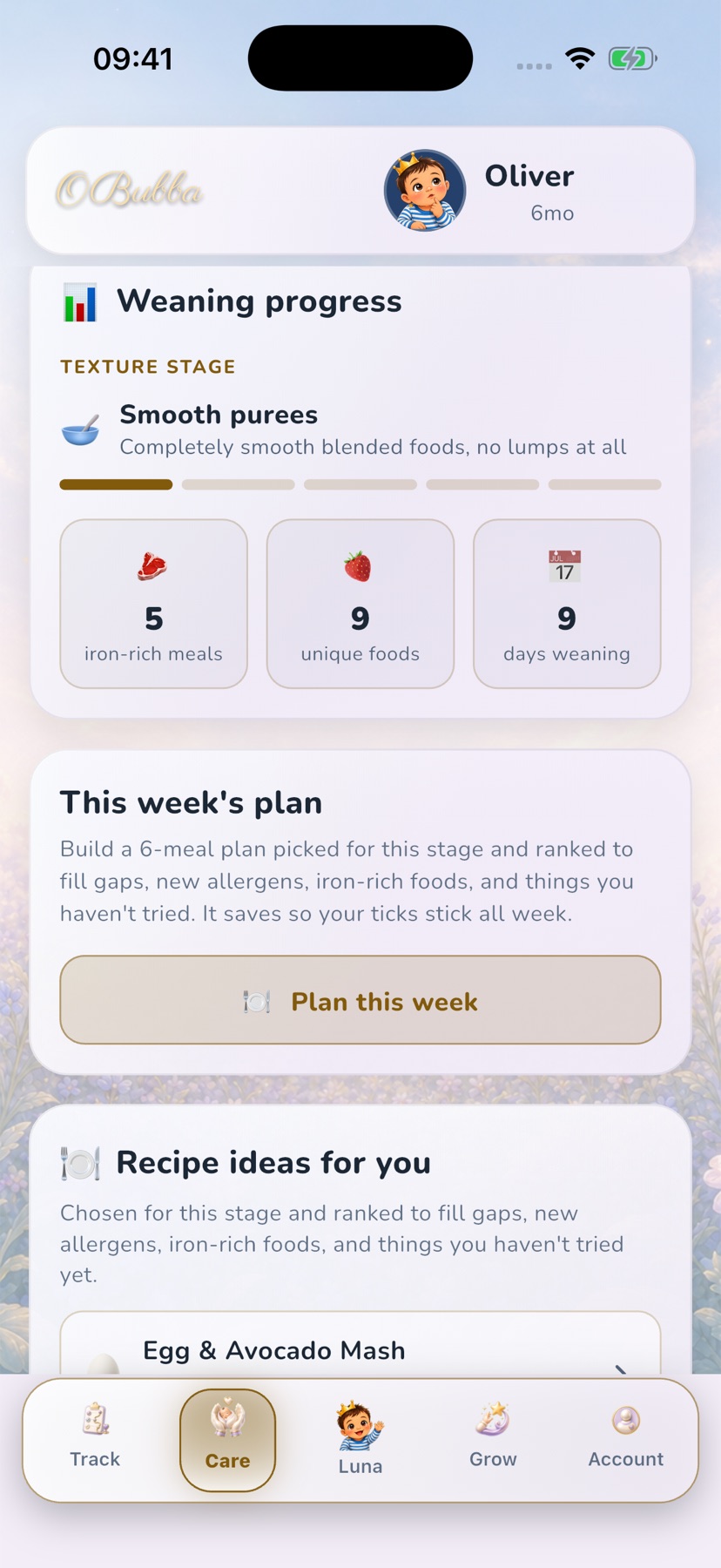
The screen also uses the same iron labels to rank recipe ideas and a six-meal weekly plan. Recipes marked iron-rich can move upward when the engine looks for gaps, new allergens and variety.
That creates a useful loop:
notice a gap → choose a suitable idea → prepare it safely → log what actually happened → let the record update
It still leaves the feeding decision with the parent.
A no-pressure iron rhythm
You do not need an iron target on every spoon. Aim for regular opportunities across a varied week.
Animal-source ideas
- very tender shredded or finely minced beef, lamb, pork, chicken or turkey
- well-cooked egg in a texture the baby manages
- thoroughly cooked, carefully deboned fish
Plant-source ideas
- soft lentil dhal
- mashed beans or chickpeas
- thin hummus without excess salt
- tofu prepared in a manageable texture
- fortified infant cereal or suitable fortified breakfast cereal
- dark green vegetables alongside other foods
Iron from meat and fish is generally more easily absorbed than iron from plant foods. Vitamin C can help the body absorb iron; NHS examples include peppers, tomatoes, broccoli, strawberries, kiwi and oranges.
Pairing can be simple:
- lentil dhal with soft-cooked tomato
- bean mash with broccoli
- fortified porridge with soft fruit
- minced beef with sweet potato and pepper
Do not turn pairing into another rule that makes a meal fail. Variety across the diet matters more than engineering every bite.
Safe preparation matters more than the badge
An “iron-rich” label does not certify that the food is safe for the baby in front of you.
Always:
- seat the baby upright and secure the highchair harness;
- stay within arm’s reach and actively supervise;
- cook meat, fish and eggs appropriately;
- remove every fish bone;
- make beans and lentils soft;
- adjust texture and shape to the baby’s current skills;
- avoid whole nuts and thick spoonfuls of nut butter;
- read product labels for salt, sugar, ingredients and allergens; and
- follow any individual feeding or allergy plan.
Egg and fish are also major allergens. Introduce allergenic foods according to current guidance and the baby’s clinical plan. An iron reminder does not override reaction history.
What if my baby refuses the iron-rich food?
Do not withhold milk or force another spoon to satisfy the app.
Use a tiny amount, pair it with something familiar and offer it again on another day. The NHS notes that a new food may need ten or more offers before acceptance.
Change the route when useful:
- blend lentils into a familiar mash;
- offer a soft strip of omelette for self-feeding;
- spread a thin bean mash on toast fingers;
- use tender minced meat in a familiar sauce; or
- try tofu in a soft, graspable form.
A look, touch or lick can be part of learning even when it is not a meaningful iron intake. Log the response honestly rather than upgrading “explored” to “ate”.
If the latest three meals are all marked with refusal wording within a recent cluster, OBubba’s current engine gives that pattern priority. It may show a texture, new-food or general-refusal card instead of the iron reminder. This keeps the immediate feeding difficulty ahead of a nutrient prompt.
Supplements are not an app decision
Do not start an iron supplement because OBubba shows this notice.
Some babies—particularly some babies born prematurely or with specific medical or feeding circumstances—may have an individual supplementation plan. The dose and duration depend on clinical context.
Too much iron can be harmful. Use only a product and dose recommended for the child by an appropriate health professional, and store medicines and supplements securely out of reach.
Speak to a health visitor, GP, dietitian, neonatal team or paediatric clinician if you are worried about the baby’s intake, growth or possible deficiency. The app cannot assess pallor, fatigue, development, blood results or individual requirements.
Frequently asked questions
Why did OBubba count porridge as iron-rich?
The current matcher counts the word “porridge”. It does not inspect the packet or know whether the product is fortified. Check the real ingredients and nutrition label rather than treating the app badge as proof.
Why did OBubba miss my homemade bolognese?
“Bolognese” contains no recognised iron keyword. Log a clearer name such as “beef and lentil bolognese” when that accurately describes the recipe.
Does one bite count as an iron-rich meal?
The software counts a matching logged event, not bites or absorbed iron. Record “explored”, “unsure” or the actual response if little was eaten.
Does formula count in the iron-meal tile?
No. The tile and notice described here analyse solids food names. First infant formula is fortified, but it is part of the wider diet rather than this solids-event counter.
Why did the notice disappear after one entry?
One recognised recent food name makes the current iron-gap detector stay silent. That does not mean the baby’s whole diet has been assessed.
Can OBubba diagnose iron-deficiency anaemia?
No. Diagnosis requires clinical assessment and, when indicated, testing. OBubba is a memory and pattern tool.
Should every meal contain iron?
No single meal needs to carry the whole week. Offer a varied diet with regular iron-containing opportunities and keep milk responsive.
Make the next meal easier—not more anxious
The best interpretation of Time for some iron-rich foods is deliberately small:
> “Nothing recognisable has appeared in the recent solids names. Is the log vague, or would an iron-containing option fit soon?”
That question can save a parent from relying on fruit-and-vegetable first-food lists for weeks. It can also be wrong when a recipe name hides the ingredient.
Use the card as a prompt to look, not a verdict to obey. Name food clearly, offer safely, follow the baby’s cues and ask for individual advice when nutrition or growth concerns you.
Try OBubba’s weaning tracker free → — keep milk, first foods, textures, allergens, reactions and practical meal ideas in one record, while the app shows exactly what it can—and cannot—learn from the log.
Sources and further reading
- NHS: Your baby’s first solid foods
- GOV.UK: SACN report on feeding in the first year of life
- NHS: Vitamins for children
- NHS: What to feed young children
This article gives general information for UK families and describes the OBubba implementation reviewed on 22 March 2027. OBubba cannot measure iron intake, diagnose deficiency, recommend supplements or replace advice from a health professional who knows the child.
Ready to try OBubba?
Use OBubba to track feeds, sleep, naps, nappies, growth, milestones and family handovers in one calm baby tracker app.