Bedtime was 7:05pm on Monday, 8:20pm after nursery, 6:40pm after a missed nap and 9:00pm when family visited. Then OBubba says:
> Why your baby is fighting sleep: an unsettled body clock.
Is it blaming you for ordinary family life? Does every night now have to begin at exactly the same minute?
No. The current app is saying that recent bedtimes were spread widely enough to make timing the leading schedule hypothesis in its whole-baby sleep review. It is not diagnosing a circadian disorder, and the log cannot prove that variable bedtime caused a battle.
The useful response is not clock perfection. It is to protect one repeatable evening range for several reasonably ordinary nights, while keeping feeds, enough sleep, illness care and safer sleep ahead of the schedule.
The short answer
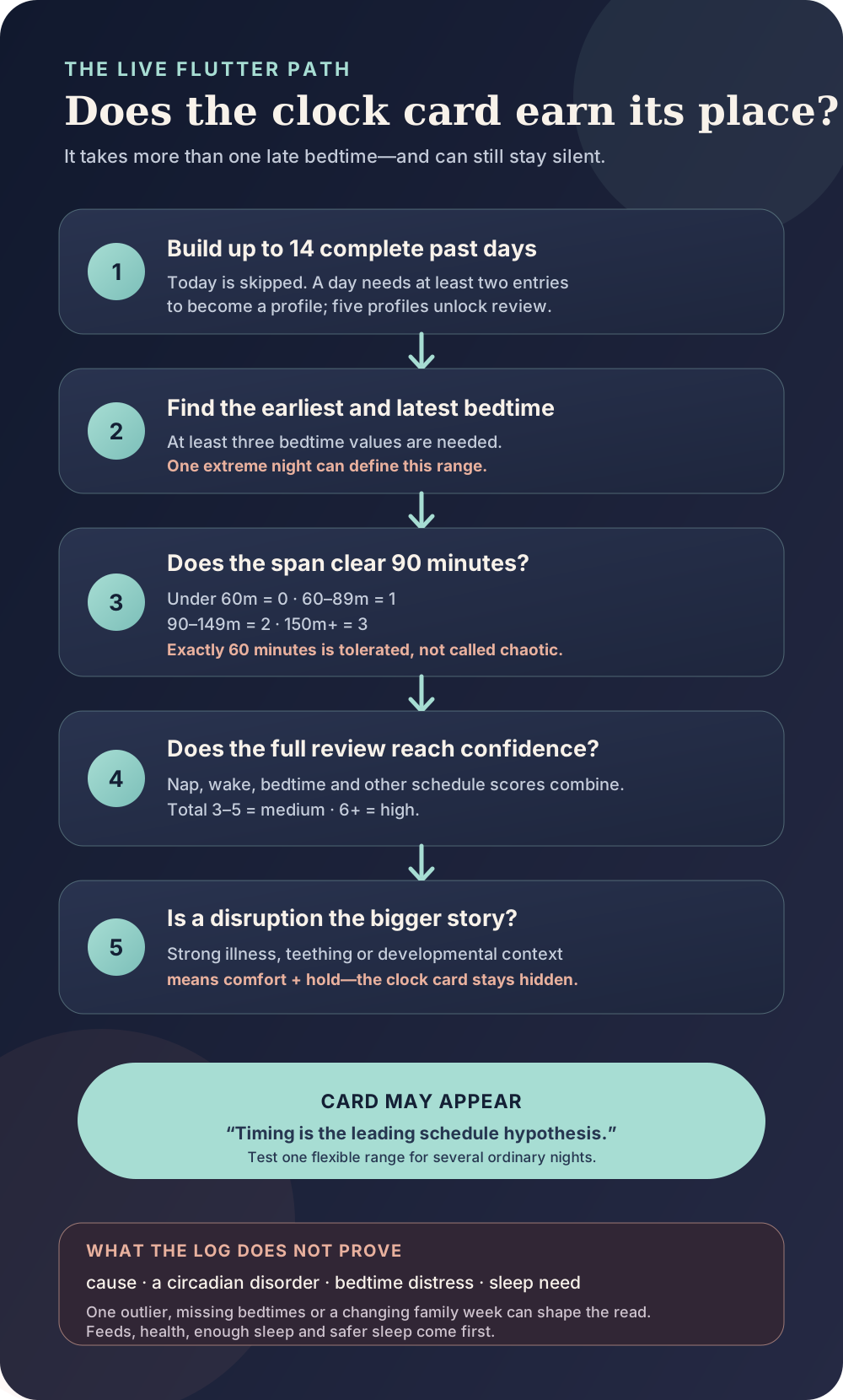
For the specific unsettled body clock card, the live app broadly needs:
| Gate | Current rule | |---|---| | Review window | Up to 14 complete past days; today is skipped while it is still unfolding | | Basic history | At least 5 day profiles, each containing at least 2 logged entries | | Bedtime evidence | At least 3 recorded bedtimes are needed before bedtime range can score | | Meaningful spread | A max-to-min bedtime span of 90 minutes or more enters the “chaotic” band; exactly 60 minutes does not | | Overall confidence | The full consultation must reach medium or high confidence; a 90-minute bedtime span alone is not always enough | | Safety hold | A strong illness, teething or developmental disruption suppresses this schedule card | | Competing explanation | A higher-priority root cause—such as a carefully gated undertired false-start pattern—can win instead |
The result is a hypothesis from logged timing, not a medical assessment and not proof that every difficult settle came from the body clock.
What does “body clock” mean here?
The body clock is the everyday name for circadian timing: biological processes that increasingly help organise sleep and alertness across roughly 24 hours. It develops over infancy rather than arriving fully formed at birth.
Light and darkness, feeding, social activity and repeated sleep timing can all act as time cues. A familiar wind-down also gives a baby a predictable sequence: this happens, then sleep is coming.
That does not mean a baby is a mechanical clock. The NHS emphasises that babies have individual sleep patterns and that some sleep in longer stretches while others sleep in short bursts. Newcastle Hospitals’ infant guidance notes that babies are not born with an established body clock and that night waking remains common through the first year.
OBubba uses “unsettled body clock” as plain-language schedule shorthand. It is not diagnosing delayed sleep phase, insomnia or another circadian condition.
What data enters the whole-baby review?
The engine first builds up to 14 daily profiles. In the live view it deliberately excludes today, because a day at 11am has not yet had its final nap or bedtime.
For each retained day, can collect:
- morning wake;
- bedtime;
- number and total duration of recorded naps;
- end of the final nap and the final wake window;
- night wakes and wake-driven night feeds;
- whether a false start appeared within two hours of bedtime;
- daytime milk-feed count and wet nappies for separate feeding safeguards; and
- optional nap-outcome signals such as settling effort and wake mood.
A day enters the profile list when it contains at least two entries. That is only an activity threshold; it does not guarantee bedtime was logged. Bedtime spread itself needs at least three bedtime values.
The consultation does not require 14 perfect days. It requires at least five profiles before it can run. That makes the feature reachable, but it also means a displayed “medium confidence” label is not the same as 14 complete nights.
The exact bedtime-spread thresholds
The app uses the earliest and latest recorded bedtime from the review window and subtracts one from the other.
| Widest bedtime span | Bedtime severity score | Can it trigger this root cause? | |---:|---:|---| | Under 60 minutes | 0 | No | | 60–89 minutes | 1 | Not as the chaotic-body-clock branch | | 90–149 minutes | 2 | Yes, if the overall consultation also reaches medium confidence | | 150 minutes or more | 3 | Yes; this alone reaches the medium-confidence floor |
The 60-minute boundary was deliberately softened in the current code. A family following “within about 30 minutes” could naturally have one bedtime at 7:00pm and another at 8:00pm. The app no longer calls that exact one-hour span chaotic.
A worked example
Imagine these six recorded bedtimes:
> 7:10 · 7:20 · 7:05 · 7:35 · 8:35 · 7:15
The earliest is 7:05pm and the latest is 8:35pm: a 90-minute range. That gives bedtime severity 2.
But the passive card still requires the complete consultation to reach at least severity 3. If naps, morning wake, final wake window and night-feed dimensions are otherwise quiet, the card can remain hidden. One additional lower-level issue can lift the overall read to medium confidence.
Now change the 8:35pm night to 9:40pm. The 155-minute range gives bedtime severity 3 and can clear the confidence floor by itself.
This is stricter than reacting to one 40-minute drift. It is not statistically robust: one very late wedding, flight or emergency can define the whole max–min range.
Why OBubba does not simply say “go to bed earlier”
Variable and late are different problems.
A baby can have a consistent 8:45pm bedtime. Another can move between 6:30pm and 9:00pm. The second pattern has more spread even though some nights were earlier.
For the unsettled-clock branch, the passive card recommends holding bedtime within about 30 minutes. It specifically says consistent, not later. The safety logic avoids a common mistake: treating every false start as proof that baby needs more awake time and pushing bedtime back.
The deeper diagnosis allows a later, steadier bedtime only when all of these line up:
- false starts happened on multiple nights;
- day sleep repeatedly exceeded the age-aware range;
- the log does not contain an overtired or early-rising night signal; and
- overlapping naps have not made the day-sleep total unreliable.
If even one recent night looks overtired or early-rising, the app downgrades that direction and chooses steadiness rather than a later night.
That is a sensible guard. The same surface behaviour—fighting bedtime or waking after one cycle—can appear when sleep pressure is too low or when a baby is exhausted.
When the card deliberately stays silent
OBubba does not show this passive schedule lesson when its shared disruption check says illness, teething or a developmental change is the bigger factor.
The underlying diagnosis becomes ride it out: comfort the baby, hold the familiar routine and do not start a new schedule change. A difficult fever night should not become evidence that the family needs stricter bedtime discipline.
The card also stays silent when:
- fewer than five day profiles exist;
- fewer than three bedtimes can contribute a range;
- bedtime spread is below 90 minutes;
- total consultation severity remains low;
- the schedule looks steady enough that the consultation finds nothing; or
- another root cause ranks ahead of bedtime variability.
Silence does not mean sleep is perfect. It means this particular explanation did not earn enough support.
What “medium confidence” really means
The label is calculated from total issue severity:
- total severity under 3: low;
- 3–5: medium; and
- 6 or more: high.
It is not a probability that the diagnosis is correct. It does not mean “80% sure”, and it does not scale directly with the number of complete bedtimes.
The card currently says confidence is “from your logged nights”, but the score can include nap totals, nap counts, morning-wake spread, final wake-window timing and older-baby night-feed frequency. A future version should show both the confidence basis and the denominator: for example, 6 profiles, 4 with bedtime.
The largest limitation: the app does not test the claimed cause
The phrase “why your baby is fighting sleep” sounds causal. The detector does not actually compare settling on steady nights with settling on variable nights.
It identifies a wide bedtime range, ranks that against other schedule dimensions and applies a sleep-science explanation. It does not require logged settling latency, distress or bedtime refusal before using the phrase “fighting sleep”.
Several other explanations can travel with a late or early bedtime:
- nursery changed the naps;
- illness changed both bedtime and waking;
- visitors added stimulation;
- a missed nap moved bedtime earlier;
- travel changed light exposure;
- the parent logged the unusual nights more carefully; or
- the baby’s developmental needs were changing during the same fortnight.
So read the card as:
> Timing is the leading schedule hypothesis worth testing.
Do not read it as:
> The app proved your baby has a body-clock problem.
Research supports the value of familiar routines, but it does not turn this individual log into a causal experiment. A prospective observational study of 320 healthy six-month-olds linked routine timing and consistency with objectively measured night-sleep duration and variability; observational association is still not proof that a rigid clock time fixes every baby.
The second limitation: the widest range can overreact to one night
Max–min range uses only two values: the earliest and latest. Four bedtimes clustered around 7:15pm plus one 9:30pm family event can look more variable than the family’s typical rhythm feels.
Before changing anything, open the actual dates and ask:
- Was the extreme time a one-off?
- Was baby ill or travelling?
- Did a nap end unusually late?
- Was the bedtime itself wrong, or only the log?
- Were the other nights already inside a practical range?
If one explainable outlier created the card, restore the ordinary rhythm rather than launching a formal plan.
OBubba’s separate seven-night consistency score uses mean absolute deviation and is therefore a different measure. Two cards can describe the same week differently because one reads overall spread and one reads average distance from the usual time.
Late-night households need extra care interpreting it
The consultation’s bedtime reader only accepts sleep starts from 11:00am onwards. A regular bedtime shortly after midnight can therefore be excluded from these day profiles rather than wrapped correctly onto the clock circle.
The separate consistency engine does use circular time maths, so 11:50pm and 12:05am can be treated as nearby there. The whole-baby consultation does not yet share that behaviour.
If your family normally starts the baby’s night after midnight, this particular root-cause card may have incomplete evidence. Use the raw log and your family’s real day boundary until the consultation adopts the same circular-time handling.
What about newborns?
Young newborn sleep is distributed around feeding and an immature day–night rhythm. A rigid bedtime window is rarely the priority.
The current whole-baby diagnosis uses newborn-aware nap ranges, but the unsettled-clock card itself has no explicit minimum-age gate. If enough variable bedtimes and other findings are logged, it can theoretically appear for a young baby. An unknown date of birth can also fall back to 26 weeks inside this diagnosis path.
That is a product limitation. For a newborn:
- feed responsively and follow any individual clinical plan;
- distinguish day and night gently with light, noise and interaction;
- use a familiar sequence if it helps;
- do not keep an exhausted baby awake to hit an app time; and
- correct missing profile age before interpreting age-aware guidance.
A future version should fail closed on unknown age and soften or withhold this schedule diagnosis during early newborn development.
A gentle seven-night test
If baby is well, old enough for a recognisable evening rhythm and the family wants to test the hypothesis, keep the experiment small.
1. Choose a range, not a minute
Start from the cluster where baby already settles most naturally. A 30-minute window such as 7:00–7:30pm is more humane than aiming for 7:13pm.
2. Protect the sequence
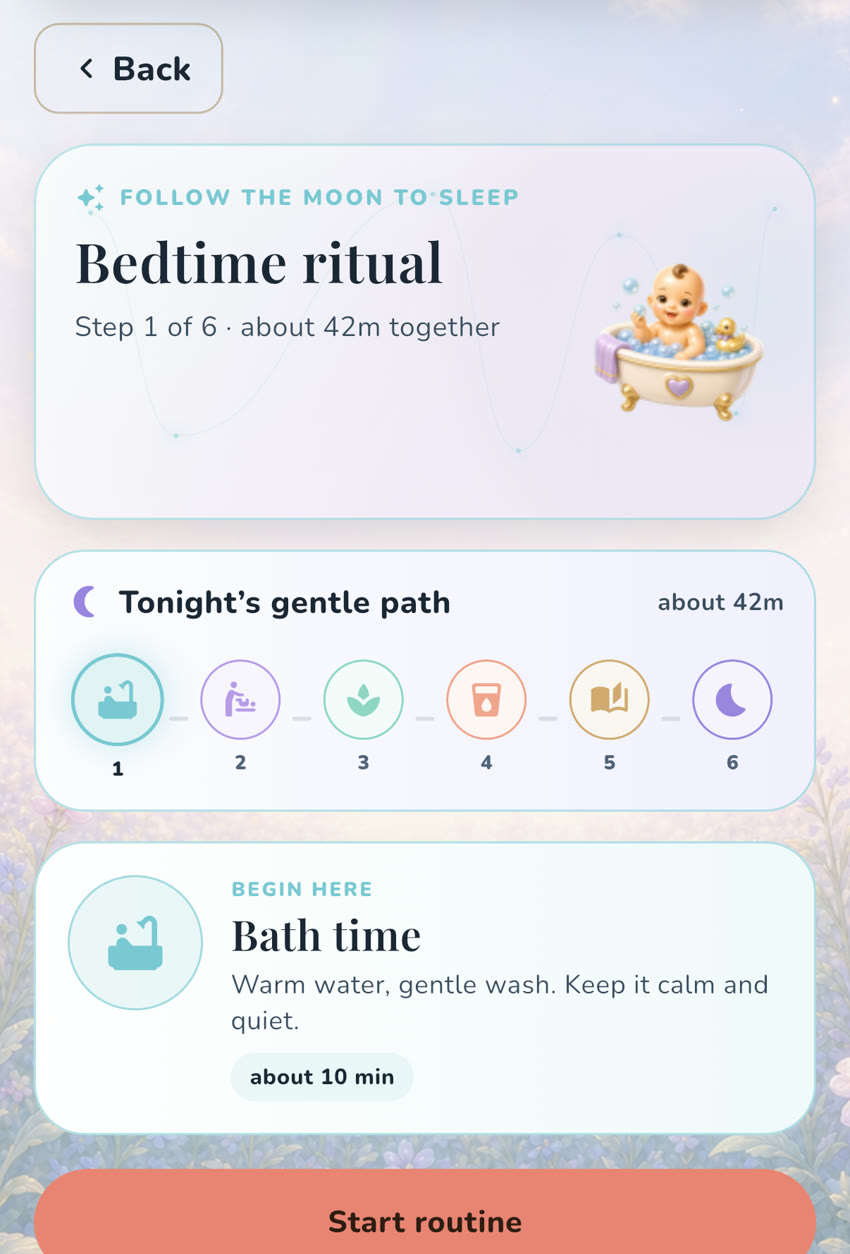
Use the same short order: perhaps nappy, sleepwear, milk, book, cuddle, cot. The sequence can remain familiar even when a late nap moves the clock slightly.
3. Keep enough sleep in the day
Do not cap naps merely to force bedtime into the range. If the final wake window is already long or baby is struggling, earlier bedtime may be kinder.
4. Mark real disruptions
Illness, teething peaks, travel, vaccination and unusual childcare days are context. A test week does not become more scientific by pretending they did not happen.
5. Review outcomes that matter
After seven nights, compare:
- settling latency and distress;
- false starts;
- first unbroken stretch;
- meaningful night wakes;
- morning mood;
- whether parents could actually sustain the range; and
- whether baby remained adequately rested and fed.
If bedtime became calmer, keep the rhythm. If baby became more distressed or overtired, widen or move the range. If nothing changed, timing may not be the useful lever.
Where the insight leads in OBubba
The passive card’s primary action opens the full Care → Sleep Consultant path. That screen uses the same consultation source rather than running a separate marketing quiz.
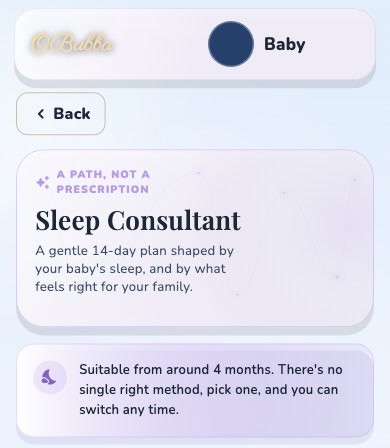
The full plan can show the evidence it found, choose one root cause, build age-aware nap and bedtime targets and review whether the original top finding disappears after several logged days.
That last part matters: if the bedtime finding drops out but another issue remains, the app can move focus rather than declaring the baby “fixed”. If the family stops logging, missing evidence is not counted as a win.
Try OBubba’s personalized Sleep Consultant free → — turn ordinary sleep logs into one cautious hypothesis and one small test, without treating family life as a failed timetable.
Frequently asked questions
Does OBubba require the exact same bedtime every night?
No. The current consultation does not call a span of exactly 60 minutes chaotic. Its passive copy suggests a practical window of about 30 minutes either side of a chosen centre.
Why did one late bedtime trigger the card?
The bedtime score uses the earliest-to-latest range, so one extreme night can define it. Check the raw dates before interpreting the result.
Does the card prove variable bedtime caused night wakes?
No. This detector does not compare wakes or settling between steady and variable bedtime groups. It ranks schedule features and proposes the leading timing hypothesis.
How many nights does it use?
It can build up to 14 complete past-day profiles and needs at least five profiles to run. Bedtime range needs at least three actual bedtimes. The card does not currently print those separate counts.
Why did it disappear while my baby was teething?
A strong shared disruption score routes the diagnosis to comfort and hold rather than surfacing the schedule-teaching card.
Should I wake my baby to preserve bedtime?
Not automatically. Nap decisions depend on age, total sleep, the final wake window and the reason for the long nap. Do not sleep-restrict a young, unwell or already under-rested baby to improve schedule consistency.
Is a later bedtime always bad?
No. Consistency and clock time are separate. The app’s guarded later-bedtime route exists only for a specific false-start-plus-excess-day-sleep pattern with no overtired signal.
What if our normal bedtime is after midnight?
Interpret this card cautiously. The current consultation can exclude after-midnight sleep starts, even though the separate consistency scorer handles times across midnight correctly.
Sources and further reading
- NHS: Helping your baby to sleep
- Newcastle Hospitals: Sleep in infants aged 0–12 months
- Tsai et al.: Bedtime routines and objectively assessed sleep in infants (PubMed)
- Galland et al.: Normal sleep patterns in infants and children, systematic review (PubMed)
- OBubba source reviewed: `sleep_schedule_read.dart`, `sleep_diagnosis.dart`, `sleep_consultation.dart`, `consult_profiles.dart`, `night_analysis.dart`, `adaptive_profile_adapter.dart` and their focused tests
OBubba is a tracking, planning and education tool, not a medical device or circadian assessment. Its unsettled-body-clock card is a deterministic interpretation of parent-entered logs. It cannot diagnose a sleep disorder, prove causation, assess illness or determine how much sleep an individual baby needs. Follow feeding, health and safer-sleep needs before an app schedule, and seek individual professional advice when you are concerned.
Ready to try OBubba?
Use OBubba to track feeds, sleep, naps, nappies, growth, milestones and family handovers in one calm baby tracker app.