You log another night: wake, feed, settle; wake, feed, settle. A few days later OBubba says:
> Your baby’s wakes and night feeds tend to travel together.
Is the app saying your baby is not hungry? Is it telling you to stop feeding at night?
No. The card means that feeds and wakes repeatedly appear together in the nights you logged, while your baby’s longest stretch is shorter than OBubba’s age-aware benchmark. It is a cautious pattern flag—not a diagnosis, a hunger detector or an instruction to withhold milk.
That distinction matters. A baby may wake because they are hungry and then feed. They may wake for another reason and find feeding the easiest route back to sleep. Both may be true on different nights. A parent-entered log can show co-occurrence; it cannot prove which explanation came first.
The short answer
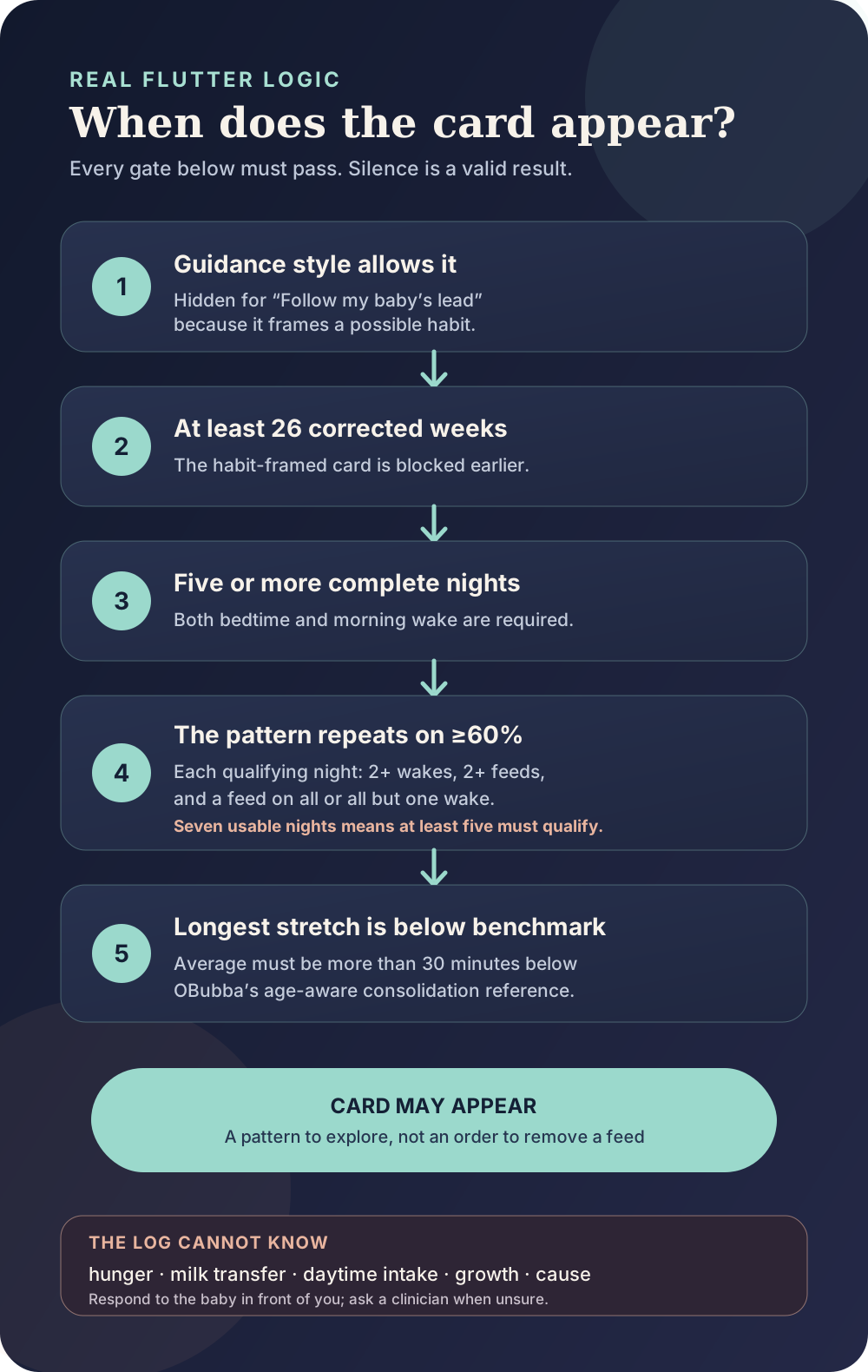
The current app keeps this card hidden unless all of these conditions are met:
| Gate | Current rule | |---|---| | Parenting preference | The card is suppressed for Follow my baby’s lead, the app’s minimal-intervention style | | Age | At least 26 corrected weeks, roughly six months | | Complete data | At least 5 nights have both bedtime and morning wake | | Repeated pattern | On at least 60% of usable nights, there are 2+ wakes, 2+ night feeds and feeds on all or all but one wake | | Consolidation | The average longest stretch is more than 30 minutes below the app’s age-normal benchmark |
The Brain currently checks the latest seven nights, so a card shown there is based on five, six or seven usable nights and is labelled an early signal.
What counts as a “feed-associated night”?
OBubba’s rule is narrower than “there was a night feed”. One night qualifies only when:
- the log contains at least two wakes;
- it contains at least two non-dream night feeds; and
- the feed count is no lower than the wake count minus one.
So these examples qualify:
| Logged wakes | Logged night feeds | Qualifies? | Why | |---:|---:|---|---| | 2 | 2 | Yes | Every recorded wake travels with a feed | | 3 | 2 | Yes | All but one recorded wake travels with a feed | | 4 | 3 | Yes | All but one recorded wake travels with a feed | | 4 | 2 | No | The feeds do not accompany nearly every wake | | 1 | 1 | No | The engine requires a multiple-wake pattern |
Dream feeds and solids are not treated as ordinary night milk feeds in the Night Weaning baseline. The association card receives the reconstructed night summary rather than trying to interpret one isolated log entry.
A worked seven-night example
Suppose all seven nights have a bedtime and morning wake. Sixty per cent of seven is 4.2, and the engine rounds that threshold up, so at least five nights must qualify.
- Qualifying nights: 5 of 7
- Average longest stretch: 5.2 hours
- Corrected age: 30 weeks
- Age benchmark: about 8.2 hours
- Card result: eligible, because 5 of 7 passes and 5.2 hours is below the roughly 7.7-hour cut-off
Change only one thing—make it four qualifying nights—and the card stays silent. Let the average longest stretch rise to within 30 minutes of the benchmark, and the card also stays silent even if feeds still happen. OBubba is designed not to manufacture a problem for a baby who is already consolidating well.
These benchmark hours are app heuristics, not clinical milestones or deadlines. They rise gradually from about 8 hours at 26 weeks to 9.5 hours at one year.
The hidden logging wrinkle: a feed can also become a wake
There is an important implementation detail behind the result.
When the current night engine finds a non-dream night feed that is not already inside a recorded wake interval, it can create a standalone wake event at that feed time. This is useful: a 2:00am feed should not disappear from the night merely because a tired parent forgot to tap “wake” first.
It also means wake count and feed count are partly coupled by the way the app reconstructs the log. The insight is strongest as a description of repeatedly recorded feed-linked waking, not as independent proof that feeding caused the waking.
To make the pattern more informative:
- log bedtime and morning wake consistently;
- log a wake when you notice it, even if you later feed;
- use the wake timer when a long awake spell matters;
- record settling method accurately; and
- do not add a night feed retrospectively just to make the log look complete.
The aim is a faithful memory aid, not a perfect dataset.
What the card can—and cannot—know
From the log, OBubba can know that feeds and wakes were recorded close together across several complete nights. It can calculate frequency, sample size and longest recorded stretch. It can compare that stretch with its corrected-age benchmark.
It cannot know:
- whether your baby was hungry;
- how much milk transferred at the breast;
- whether daytime intake was adequate;
- growth, weight gain or wet-nappy context unless a human assesses them;
- pain, illness, reflux, teething or a developmental disruption;
- whether the feed caused the wake or followed it; or
- whether changing anything would improve sleep.
The phrase “feed-to-sleep association” describes a plausible mechanism, not a verdict. Feeding may be both nourishing and soothing. A baby can also have a familiar route back to sleep and sometimes need night nutrition.
This is why the card says correlation, defers to your health visitor and does not launch a weaning plan by itself.
Why OBubba waits until roughly six months
Night feeds are ordinary nutrition in early infancy. The NHS says young babies commonly wake repeatedly and that some babies aged 6–12 months may no longer need night feeds, but this does not apply to every baby.
OBubba therefore blocks this particular habit-framed insight before 26 corrected weeks. Corrected age is used when available so a baby born early is not pushed ahead by calendar age alone.
There is one data-quality caveat: the insight needs an accurate date of birth. In the current Brain path, an unavailable age can fall back to the six-month boundary. The separate Night Weaning screen is safer here—it leaves the age light off when age is unknown. If the profile age is missing or wrong, correct it before treating this card as age-appropriate.
That is also a sensible product improvement: future app versions should use the same fail-closed age rule in both places.
What the evidence actually supports
OBubba’s repository includes an internal observational analysis of 332 families with at least five usable nights. It found night feeds and night waking moved together across age bands. That analysis is based on self-entered data, is not a randomized experiment and is not peer-reviewed. The project notes themselves say correlation does not establish cause and that clinical framing needs sign-off.
Published observational research points in the same direction without settling the causal question. A large cross-sectional study of 10,321 infants reported more waking and a shorter longest stretch among babies nursed back to sleep; nursing to sleep moderated the association between breastfeeding and waking. A 2023 Norwegian cross-sectional study found both night waking and night breastfeeding remained common from 6 to 12 months.
These studies can support “these behaviours often travel together”. They cannot support “your baby is not hungry” or promise that removing a feed will remove a wake.
What to do when the card appears tonight
First, do nothing automatic. Look at your baby, not only the card.
Feed responsively when there are hunger cues, when you are unsure about intake, when growth or health needs make feeds important, or when your clinician has advised night feeding. The NHS recommends responsive feeding: follow the baby’s cues rather than a rigid schedule.
If your baby is well, at least around six months corrected age, daytime feeding is established and you are comfortable exploring the pattern, OBubba’s linked micro-experiment is deliberately small:
> At the first wake, try one or two minutes of calm reassurance before feeding. If baby remains hungry or unsettled, feed and keep responding.
That is a test of sequence, not an endurance contest. It does not mean leaving a baby to cry, delaying all feeds, cutting calories or trying to night-wean in one night.
Watch the next few nights rather than judging one attempt. The intervention’s success metric is a longer unbroken stretch, not “zero feeds”. Illness, teething, travel or a growth spurt can make any experiment unhelpful; pause it without treating that as failure.
The card and Night Weaning are two different systems
The insight card only identifies a candidate pattern. Care → Night Weaning performs a second readiness check before building a plan.
The current screen shows three green lights:
- AGE: known corrected age of at least 26 weeks;
- DAY: at least three daytime feeds logged on the best of the last five calendar days; and
- NIGHTS: night feeds present on at least two of the last five completed nights, enough to form a baseline.
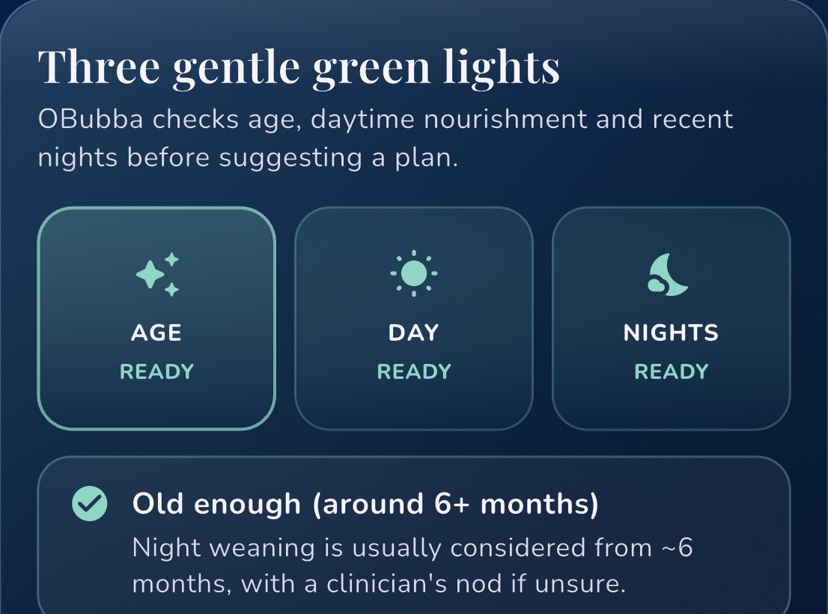
“Daytime feeds are solid” is app wording. Technically, the green light counts logged feeds; it cannot verify milk volume, transfer, calories or growth. If any of those are uncertain, the light is not clinical clearance—ask your health visitor or feeding professional.
When all three lights are green, the plan uses the baby’s real recent baseline. Bottle-fed plans taper logged volume gradually. Breastfed or no-volume plans use time and comfort steps. For babies under 12 months, the volume plan keeps a small feed rather than marching to zero; the screen repeatedly says a feed can still be appropriate.
Why “Follow my baby’s lead” changes the result
In OBubba’s Preferences, parents can choose a guidance style. When Follow my baby’s lead is selected, the Brain suppresses this method-based association card even if the numeric pattern exists.
That does not alter the log. It changes what the app chooses to surface. Parents asking for minimal intervention should not have a habit hypothesis repeatedly pushed at them.
This is a small but meaningful example of personalization: not merely changing the tone of identical advice, but changing whether the advice appears at all.
Where to find the tools in the app
Use Track to record bedtime, morning wake, night wakes and feeds. The Brain can then surface the feed-associated pattern when its gates are met.
Use Care → Night Weaning only if you want to explore a gradual change. The separate readiness lights and seven-night path are there to slow the decision down.
Use Coach to ask about the pattern in plain language, but treat answers as education rather than medical assessment.
Try OBubba’s personalized baby sleep guidance free → — one log can feed the clock, night analysis and gentle care tools without turning normal waking into a scorecard.
Frequently asked questions
Does this card mean I should stop night feeds?
No. It reports a recurring co-recorded pattern after roughly six months. It does not know hunger, intake or growth and does not prescribe dropping a feed.
Why did it appear after five nights?
Five complete nights is the engine’s minimum. Within the latest seven-night window, at least 60% must meet the feed-associated definition and the average longest stretch must remain below the age benchmark cut-off.
Why does the card say “early signal”?
The reusable insight code reserves “strong signal” for ten or more nights, but the current Brain only sends the latest seven nights to this detector. So this live card is currently always an early signal.
Can a night feed count as a wake even if I did not log a wake?
Yes. A standalone non-dream night feed can become a point wake in the reconstructed night. That protects the timeline from a missed wake tap, but it also means the two counts are not fully independent.
Does the daytime green light prove my baby ate enough?
No. It currently means at least three non-night feeds were logged on one recent day. It does not measure breast milk transfer, total calories or growth.
What if my baby was born early?
OBubba uses corrected weeks when the profile supports it. Check the date-of-birth and prematurity details before interpreting any age gate, and use individualized clinical advice.
Is feeding to sleep bad?
No. Feeding is a powerful, normal way to nourish and settle a baby. It becomes a practical question only when the family wants a change and the baby is ready. A logged association is not a parenting failure.
Sources and further reading
- NHS: Helping your baby to sleep
- NHS Best Start in Life: Responsive bottle feeding
- Ramamurthy et al., Journal of Developmental & Behavioral Pediatrics (PubMed)
- Norwegian 6–12-month breastfeeding and sleep study (PubMed)
- OBubba source reviewed: `feed_association.dart`, `brain.dart`, `day_metrics.dart`, `night_analysis.dart`, `adaptive_profile.dart`, `intervention.dart`, `night_weaning.dart`, `night_weaning_screen.dart` and their focused tests
OBubba is a tracking, planning and education tool, not a medical device. Its feed-associated waking insight is a deterministic summary of parent-entered logs. It cannot assess hunger, milk intake, growth, illness or feeding safety. Never withhold a needed feed to improve an app pattern; seek individualized advice when feeding, growth or health is uncertain.
Ready to try OBubba?
Use OBubba to track feeds, sleep, naps, nappies, growth, milestones and family handovers in one calm baby tracker app.