You log Warm at bedtime on several stuffy nights. A week later, OBubba says:
> Warm-room nights have averaged more wakes—a cooler room may help.
That is not a diagnosis, and it is not the app declaring that every wake was caused by heat.
The current app compares temperature-tagged nights from the previous 14 days. It needs at least three nights marked Warm, at least four marked Cool or Just right, and an average difference of 0.5 wakes or more before the insight can appear.
It only surfaces the actionable direction: warm nights looking worse. If warm nights are the same or better, OBubba stays quiet.
The exact rule in one picture
Here is a simple example:
- three Warm nights recorded 3, 4 and 3 wakes—an average of 3.3
- four other tagged nights recorded 1, 1, 2 and 1 wakes—an average of 1.3
- the difference is 2.0 wakes
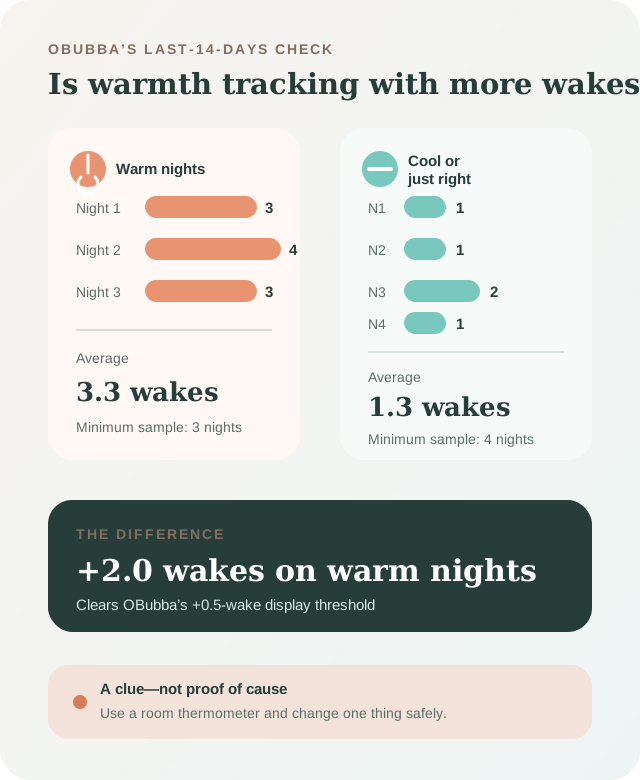
The 2.0-wake gap clears OBubba's minimum 0.5-wake display threshold, so the finding can appear.
The app rounds each group average to one decimal place before presenting the comparison. It does not require every warm night to be bad; it asks whether the groups differ on average.
What counts as a Warm night?
When logging Bedtime in the tracker, parents can optionally record:
- Room temperature: Cool, Just right or Warm
- Light: Dark, Dim or Light
- Noise: Quiet, White noise or Noisy
For this particular detector, OBubba reads the Room temperature tag attached to the night. A night is in the Warm group if its resolved night entries contain a Warm tag. Cool and Just right become the comparison group.
This is a category you selected, not a hidden thermometer reading. OBubba does not measure the nursery, infer a precise temperature from the weather or watch the baby through a sensor. If one parent thinks 21°C feels warm and another selects Just right, that inconsistency affects the comparison.
Use the same household convention. Better still, check a room thermometer and agree what the three tags mean in your home.
Why the app ignores thin data
One rough warm night proves very little. The baby might also have been teething, unwell, overtired, hungry, travelling or learning something new.
OBubba therefore requires:
| Evidence gate | Current requirement | Why it matters | |---|---:|---| | Warm nights | At least 3 | One hot night is not called a pattern | | Other temperature-tagged nights | At least 4 | The baby needs their own comparison group | | Wake difference | Warm average at least 0.5 higher | Tiny variation stays silent | | Look-back | Previous 14 days | The comparison remains recent |
Today is excluded because an in-progress day or night is not a fair comparison with completed nights.
Untagged nights are also excluded from the temperature groups. Missing temperature information is not silently treated as Cool.
It compares the night—not a warm daytime nap
The provider deliberately reads temperature tags from the reconstructed night entries, not every event saved on that calendar day.
That prevents a warm living-room nap from relabelling a cool nursery night as Warm. It also keeps the wake count attached to the physical overnight sleep, even when bedtime and the morning wake sit on opposite sides of midnight.
This is a small implementation detail with a big trust consequence: a correlation is only useful when the exposure and outcome belong to the same night.
Correlation is a clue, not a cause
The card means:
> “In the nights you tagged, warmer nights and more wakes occurred together often enough to be worth a safe check.”
It does not mean:
- heat definitely caused the wakings
- cooling the room will make the baby sleep through
- a specific wake was temperature-related
- the baby is ill or has a fever
- every family should turn the heating down by the same amount
Warm nights may coincide with summer light, travel, different clothing, illness, a later bedtime or ordinary developmental change. The comparison does not randomly assign temperature, so it cannot separate all those influences.
Treat the insight as a small home experiment: measure the room, bring it toward current safer-sleep guidance where practical, keep the rest of bedtime broadly similar and watch several more nights.
What temperature should a baby's room be?
The Lullaby Trust recommends 16–20°C for the room where a baby sleeps and advises using a room thermometer because guessing is difficult. It also warns that babies who become too hot have a higher risk of sudden infant death syndrome.
The NHS gives the same 16–20°C range and advises checking a baby's chest or the back of their neck rather than judging by cool hands or feet. Clothing and bedding should suit the actual room temperature.
This safety guidance stands whether OBubba shows a sleep correlation or not. Do not wait for seven logged nights before correcting an obviously overheated sleep environment.
How to respond tonight
- Measure rather than guess. Place a simple room thermometer near the sleep space, away from direct sun, radiators and draughts.
- Check the baby directly. Feel the chest or back of the neck. Sweating or a hot chest suggests removing a layer; cool hands alone are not a reliable sign that the baby is cold.
- Use appropriate sleepwear. Follow the sleep-bag manufacturer's size and temperature guidance. Do not add a blanket on top of a sleeping bag.
- Keep the cot clear. Temperature changes do not replace the basics: baby on their back in a clear, flat, separate sleep space.
- Log consistently. Choose Cool, Just right or Warm from the measured room—not from the outdoor forecast.
- Change one lever. If the room has genuinely been warm, adjust temperature or layers safely rather than changing bedtime, feeds, white noise and settling all at once.
If the baby seems unwell or has a high body temperature, use appropriate medical guidance. A Warm room tag is not a fever measurement and OBubba's correlation is not a health assessment.
The separate Safe Sleep tool
OBubba also has a genuine Safe Sleep screen. It accepts an actual room-temperature value and offers a sleepwear-oriented room check, alongside safer-sleep essentials.
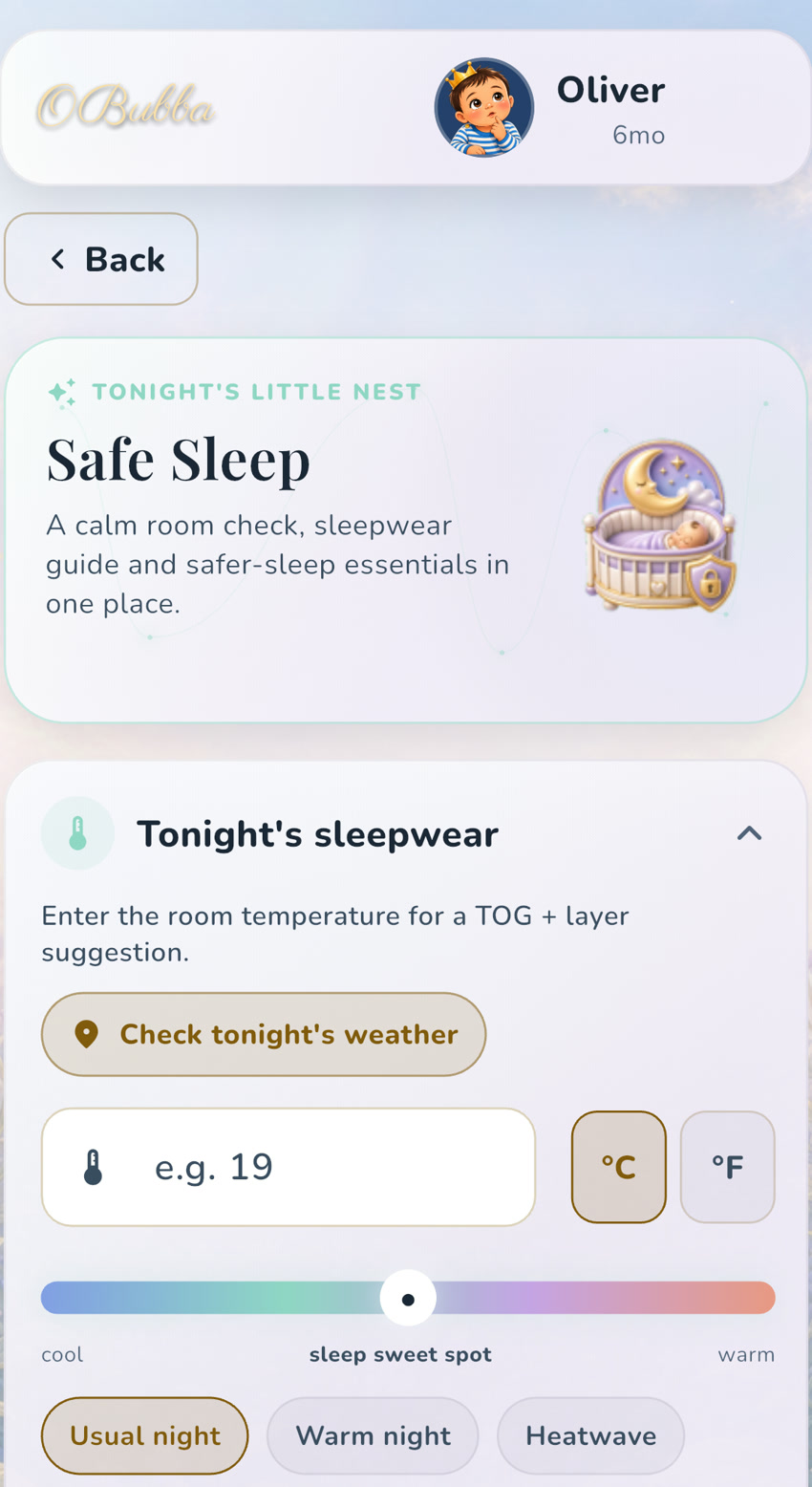
These are related but different features:
| Feature | Input | Purpose | |---|---|---| | Bedtime environment tag | Cool, Just right or Warm | Learn whether this baby's tagged warm nights coincide with more wakes | | Safe Sleep room check | A temperature entered in °C or °F | Help a parent think about sleepwear and the room tonight |
Neither turns a phone into a room thermometer. Measure the room itself.
What about light and noise?
The current bedtime sheet stores Light and Noise alongside Room temperature, but this specific cross-night detector only uses the temperature tag.
OBubba should not claim that white noise, darkness or household noise is changing sleep until a tested detector actually evaluates those fields. Logging them can still preserve useful context for the parent, but the warm-room card is not secretly a combined “sleep environment score”.
That restraint is deliberate. A trustworthy baby app should tell you what it used, what it ignored and how much evidence it required.
A seven-night temperature check
If the card appears, try this simple review:
| Each bedtime | Each morning | |---|---| | Read the room thermometer | Check the resolved wake count | | Log the temperature category consistently | Note illness, travel or an unusual bedtime | | Use clothing appropriate to the room | Avoid judging the night by one wake alone | | Keep the rest of the routine broadly stable | Review the group after several nights |
The goal is not to create a perfect experiment while exhausted. It is to stop guessing whether “the room felt stuffy” and give one safe, plausible lever a fair test.
Try OBubba free → — track the night, add optional room context and get a personal pattern only when the comparison is strong enough to be useful.
Quick answers
How many nights does OBubba need?
At least three Warm nights and four Cool or Just right nights within the previous 14 days.
How much worse do warm nights need to be?
The Warm group must average at least 0.5 more wakes than the comparison group after the averages are rounded to one decimal place.
Will it praise warm nights if the baby wakes less?
No. The current detector only surfaces the actionable “warm nights look worse” direction. Equal, better or insufficient data returns no finding.
Does OBubba measure my baby's room temperature?
No. The correlation uses the category a parent logs. The Safe Sleep tool uses a temperature the parent enters. Use a room thermometer for the actual measurement.
Does the insight mean warmth caused the wakes?
No. It is an association in the baby's own recent logs. Other changes may explain part or all of the difference.
Does OBubba analyse the Dark and White noise tags too?
Not in this detector. The current cross-night comparison uses Room temperature only.
Ready to try OBubba?
Use OBubba to track feeds, sleep, naps, nappies, growth, milestones and family handovers in one calm baby tracker app.