One nap began with a feed and lasted 32 minutes. Another began after rocking and ran for 75. A self-settled nap surprised everyone by crossing an hour. After enough completed naps, OBubba may surface:
> What helps Maya nap longest
The current feature does something genuinely personal: it groups recent naps by the settling method the parent logged and compares their average elapsed duration. It does not apply a universal rule that feeding, rocking or self-settling is best.
But the word helps is stronger than the evidence. The detector finds an association inside the family’s record. It does not randomise nap methods, control for nap position or location, subtract every mid-nap waking, or prove why one group ran longer.
Here is the exact calculation, what happens when you select more than one method, why some apparent winners are suppressed, and how to turn the card into a gentle experiment rather than a new sleep rule.
The short answer
Every basic gate below must pass:
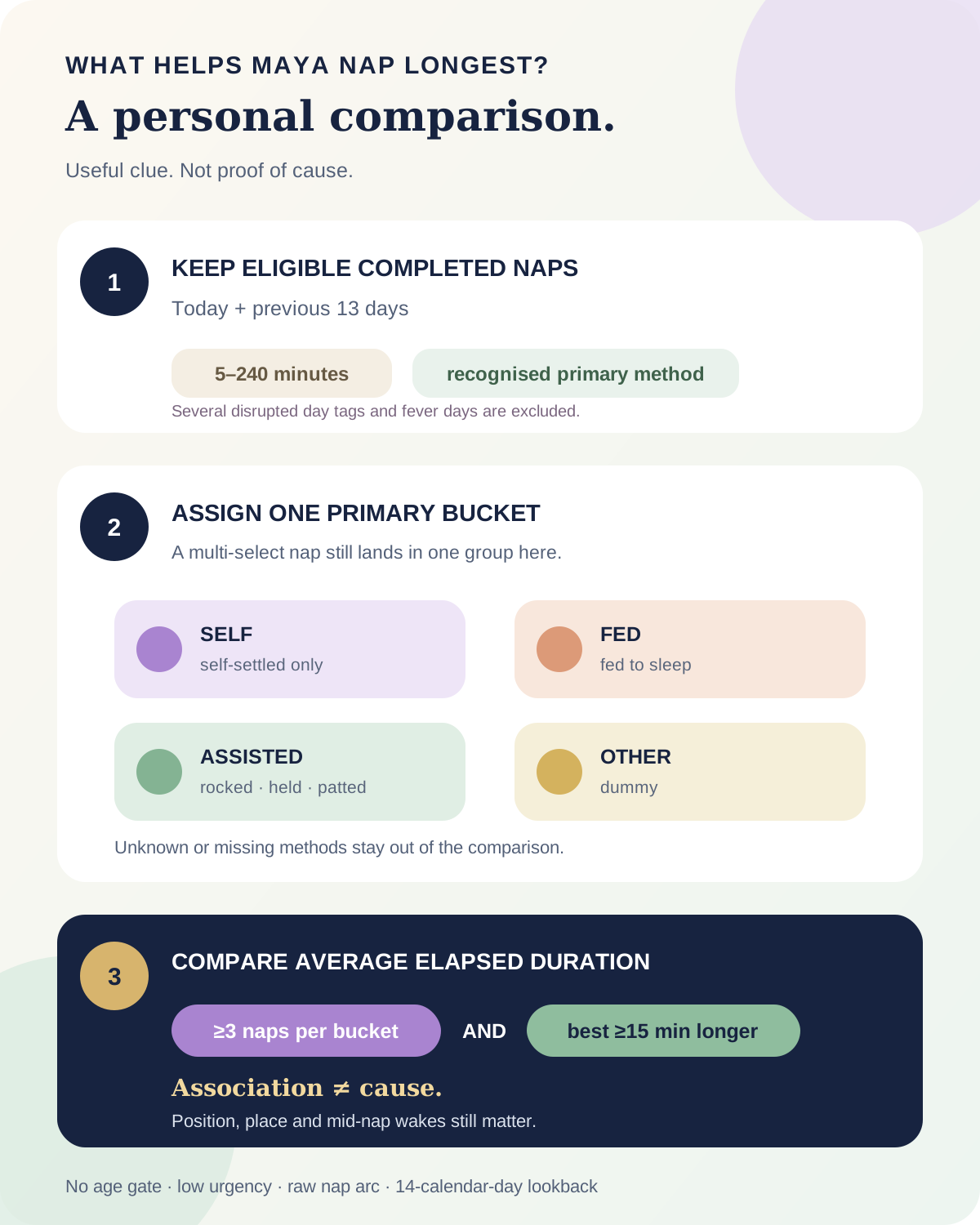
| Gate | Current rule | |---|---| | Lookback | Today plus the previous 13 calendar days | | Excluded days | Sick, travel, daycare, nursery or grandparent day tags; days with a logged fever temperature | | Nap | Daytime `nap` entry with a start, end and recognised primary settling method | | Duration | 5–240 minutes, inclusive | | Comparable methods | At least 2 method buckets | | Samples | At least 3 qualifying naps in each eligible bucket | | Comparison | Arithmetic mean elapsed nap duration for each bucket | | Difference | Best average is at least 15 minutes longer than worst | | Result | Low-urgency What helps [first name] nap longest card |
There is no age gate and no percentage threshold. A 45-minute versus 60-minute comparison qualifies, as does 120 versus 135, even though those changes have very different relative sizes.
First, OBubba turns the log into four buckets
The nap form asks How settled? and offers:
- Self-settled
- Fed to sleep
- Rocked
- Held
- Patted
- Dummy
The detector does not compare all six labels separately. maps the stored primary method into four groups:
| Stored primary method | Comparison bucket | Wording on the card | |---|---|---| | `independent` | `self` | self-settling | | `fed` | `fed` | a feed | | `rocked`, `held`, `patted` | `assisted` | rocking/holding | | `dummy` | `other` | a dummy |
A missing or unfamiliar method is ignored. The classifier does not guess that an unlabelled nap was assisted.
That is a strong honesty boundary. Six unlabelled naps cannot silently become six “rocked” naps and manufacture a result.
The grouping also loses detail. Rocking, holding and patting become one assisted bucket even though a family may experience them very differently. The friendly label says rocking/holding, so a set made mostly from patting can be described without naming the action that actually dominated it.
If you select several methods, only one reaches this detector
The nap form supports multiple settling choices. A parent can record that a baby was fed and rocked, or held and patted.
The stored entry keeps the full list, but it also derives one primary method for older engine consumers. This nap comparison reads that single primary field—not the whole list.
The rule is:
> If any support method was used, the first support method in the saved list becomes primary. Only a lone Self-settled choice counts as self-settling.
The UI makes Self-settled exclusive: choosing it clears the support methods, and choosing a support method removes Self-settled. But two support methods can coexist.
So these two real sequences can land in different buckets:
- select Fed to sleep, then Rocked → primary may be `fed`;
- select Rocked, then Fed to sleep → primary may be `rocked`.
Both entries remember both choices. This detector nevertheless assigns the whole nap to one group. It does not split credit, use the final method or compare combinations such as “fed + rocked” as their own category.
That is one reason to interpret the result as a broad pattern rather than a precise verdict on technique.
Which calendar days are allowed into the comparison?
The Brain collects up to 14 calendar dates, beginning today. Empty dates are skipped. It also excludes dates marked:
- sick;
- travel;
- daycare or nursery; or
- grandparent care.
A date with a recorded fever-level temperature is excluded too.
This attempts to compare ordinary home days rather than letting a nursery timetable, journey or illness crown a settling method. It also means the card is not a complete account of every nap the baby had during the fortnight.
The source comment says illness, teething and travel days are excluded. The executable exclusion function does not directly check teething. A teething day remains eligible unless another recognised day tag or fever rule removes it. That difference between comment and code is worth knowing when a difficult teething week shapes the averages.
What counts as a completed nap?
Inside an eligible day, a record contributes only when all of these are true:
- its type is `nap`;
- it is not marked as night sleep;
- its primary settle method maps to one of the four buckets;
- it has both a start and an end; and
- its calculated duration is from 5 minutes through 4 hours.
An open nap timer cannot contribute yet. A 3-minute start-stop mistake is ignored. A five-minute nap can count. A four-hour nap can count. Anything longer is rejected as implausible for this comparison.
If imported data has an end time numerically earlier than its start, the function adds 24 hours before testing the duration. The current manual nap form normally prevents that shape, but the engine remains tolerant of older or imported records.
“Nap duration” here is elapsed arc—not always sleep minutes
The detector calculates:
> end time − start time
It does not call the app’s more careful daytime-sleep function that can subtract a timed mid-nap waking.
Imagine a nap record runs from 10:00 to 11:20, with a separately logged 25-minute stir in the middle. The settle-method detector uses 80 minutes. Elsewhere, total daytime sleep can deduct the logged awake interval and treat the actual sleep contribution as 55 minutes.
The card may therefore describe an 80-minute nap even when the same app’s day-sleep total reflects less sleep.
Similarly, this loop does not merge overlapping duplicate nap entries before grouping. If two carers accidentally save the same completed nap twice with the same method, that nap can be weighted twice here.
Accurate start and end times help. So does correcting duplicates. The comparison is only as clean as the records it receives.
The minimum sample is three versus three
OBubba builds a duration list for every recognised method bucket. A bucket becomes eligible after three qualifying naps.
The card requires at least two eligible buckets, so the smallest possible result uses six naps:
- three self-settled naps; and
- three fed-to-sleep naps.
Two self-settled naps and ten rocked naps stay silent because only one bucket has reached three. Three self, three fed and two dummy naps compare self with fed; the dummy group is ignored.
If three or four buckets are eligible, compares the highest average with the lowest average. Any middle groups disappear from the sentence, although their naps are included in the from N naps evidence count.
That can make the caption wider than the comparison named in the body. “From 12 naps” might include four self-settled, three fed, three assisted and two ignored dummy naps—or three naps in each of all four eligible buckets. The label gives volume, not the group breakdown.
The 15-minute gate uses arithmetic averages
For every eligible group, adds the raw elapsed durations and divides by the number of naps.
Suppose the recent record contains:
| Method bucket | Durations | Average | |---|---|---:| | Self-settling | 62, 70, 78 min | 70 min | | A feed | 30, 36, 42 min | 36 min |
The gap is:
> 70 − 36 = 34 minutes
That clears the 15-minute threshold. The body says self-settling naps average about 1h 10m, roughly 34 minutes longer than naps after a feed.
Now change the second group to 54, 56 and 58 minutes. Its average is 56. The gap is 14 minutes, so the detector stays silent.
There is no protection against one outlier beyond the 4-hour ceiling. In a three-nap group, one unusually long rescue nap can move the mean substantially. A median would resist that outlier; the current function deliberately uses a mean.
The self-settling-versus-feed branch gives different advice
Most winning combinations receive general copy:
> Naps after [winning method] run longer right now. When you need a solid nap, [method] is the better bet; the others are fine for top-ups.
One exact pairing triggers a special explanation: the best bucket must be self-settling and the worst must be a feed.
Then the app says the baby may look for the feeding sensation at the first roughly 40-minute cycle boundary and suggests finishing the feed 5–10 minutes earlier before putting the baby down sleepy but awake.
The detector did not observe a 40-minute boundary, milk transfer, hunger, the moment feeding ended or what woke the baby. It compared start-to-end arcs. The mechanism in that explanation is therefore a hypothesis—not something proved by this calculation.
It also does not know whether feeding to sleep is welcome, necessary or the family’s preferred way to settle. Responsive feeding should still follow genuine hunger cues; the NHS advises feeding babies according to their cues rather than forcing a strict schedule (NHS: Feeding on demand).
If the family wants to test a gap before sleep, it should be optional and age-appropriate. Do not delay a hungry baby’s feed to improve an app average.
OBubba tries not to give two opposite method messages
The Brain computes related insights before adding this card.
If at least eight located naps exist and 70% or more were contact, pram, carrier or car naps, OBubba can offer the separate Most naps need holding or movement ladder. When method coaching is allowed and that ladder is active, this comparison is suppressed if assisted settling would otherwise win.
Likewise, if at least three wakes from the current night show an 80% feed-to-sleep pattern, the separate sleep-association card can become active. When method coaching is allowed, a fed winner in the nap comparison is suppressed.
Self-settling beating feeding is not suppressed because the engine considers that aligned with reducing feed-to-sleep reliance.
This reconciliation is thoughtful: without it, one part of the app could say “rocking gives the longest naps” while another asks the family to practise less movement.
There is one implementation caveat. The parent’s follow my baby’s lead preference is meant to remove settling-method nudges. The current caller does not gate this nap-comparison card itself on that preference; it uses the preference only when activating the sibling suppression rules. In other words, this method card can still be produced in the minimal style. That is current-code behaviour, not the ideal described by the surrounding comment.
The card compares association, not cause
Several hidden differences can create the winning average:
- self-settled naps may happen mostly as the naturally longer first nap;
- rocking may be used mainly for overtired rescue naps;
- feeding may occur closer to the start of a short late-afternoon nap;
- one method may happen in the cot and another in a pram;
- different carers may use different methods;
- the baby may have matured across the 14-day window; or
- a long mid-nap waking may remain inside the elapsed arc.
The function does not match Nap 1 with Nap 1, hold location constant or adjust for wake-window length. Helps should therefore be read as was associated with longer logged arcs in this sample.
OBubba has separate detectors for nap position, location, wake mood and feed-to-nap spacing. Keeping those questions separate is useful. Combining them mentally is even more useful: if rocking “wins” only because every rocked nap was the first nap in a quiet cot, the method may not be the real lever.
How to use the finding without creating a new rule
Start by asking whether the result describes a choice you actually want.
If the winning method works and is sustainable, the card can simply be useful confirmation. A fed or rocked nap is not a failed nap. The NHS notes that, particularly in the early weeks, babies may fall asleep only in a parent’s arms or with a parent by the cot (NHS: Helping your baby to sleep).
If you want another option, make the smallest useful test:
- Compare the same nap position, ideally the first nap, rather than changing every nap.
- Keep the wake window and location roughly similar.
- Use the new settling approach for several opportunities, not once.
- Log all methods you used, even though the current detector reduces them to one primary.
- Judge more than duration: ease of settling, mood on waking and how the rest of the day went matter too.
Do not keep a baby awake, withhold a feed or continue a settling attempt through escalating distress to make the comparison cleaner. A family experiment should serve the baby and parent—not the other way around.
Safer sleep outranks the winning method
The method card is not a safety endorsement. “Rocking/holding wins” does not mean it is safe for an exhausted adult to fall asleep holding the baby. “A dummy wins” does not alter current guidance on the sleep space.
For the first six months, the NHS says the safest place for a baby to sleep is in a cot or Moses basket, on their back, in the same room as the caregiver. The mattress should be firm and flat and the cot should remain clear. Falling asleep with a baby on a sofa or chair substantially increases risk (NHS safer sleep advice).
Apply safer-sleep guidance to every nap regardless of which method produced the longest average.
Four logging habits improve this comparison
Finish the nap timer accurately
An open nap does not count. An inflated end time inflates the apparent benefit of its method.
Correct duplicates
This detector does not merge partner-sync duplicates before averaging. One duplicated long nap can give a small group too much weight.
Record the full settling story
Select both Fed and Rocked if both happened. The engine’s current primary-field limitation remains, but the full stored list is still valuable for future analysis and honest review.
Add context elsewhere in the log
Record nap position, location, settling time and wake mood when useful. Those fields help you test whether the apparent method winner is really a location or timing story.
What the card gets right
Despite its limits, this feature captures a valuable product idea: sleep advice should begin with the baby’s own history.
It refuses to speak from one dramatic nap. It needs two repeatedly used approaches. It ignores missing method data rather than fabricating a label. It excludes several disrupted day types. It requires a meaningful 15-minute gap. It also attempts to reconcile advice so a support method is not praised while another active card asks the family to reduce it.
The result is far more personal than “all babies should self-settle” or “rocking always creates longer naps.”
Its most honest translation is:
> In the recent ordinary-day log, naps assigned to this settling bucket had the longest average elapsed arc. That is a clue worth checking against timing, place, hunger, mood and what works for your family.
That is enough to make a tired parent’s data useful without pretending it has answered the whole sleep question.
OBubba connects nap timing, settling method, location, wake mood, feeds and the rest of the baby’s day to find patterns generic schedules miss. Explore OBubba when you want a tracker that learns from real family life—and explains exactly what it noticed.
Ready to try OBubba?
Use OBubba to track feeds, sleep, naps, nappies, growth, milestones and family handovers in one calm baby tracker app.