At 2am, almost every settling method feels slow. You may feed, rock, hold, pat, replace a dummy, pause, then forget which part took five minutes and which took twenty. After enough night-wake records, OBubba can surface a card such as:
> What settles Oliver fastest > Self-settling gets Oliver back down in about 8 min, vs ~28 min with rocking/holding.
That sounds unusually personal—and it is. The current app is comparing this baby’s own recorded settling times, not applying a universal sleep-training rule.
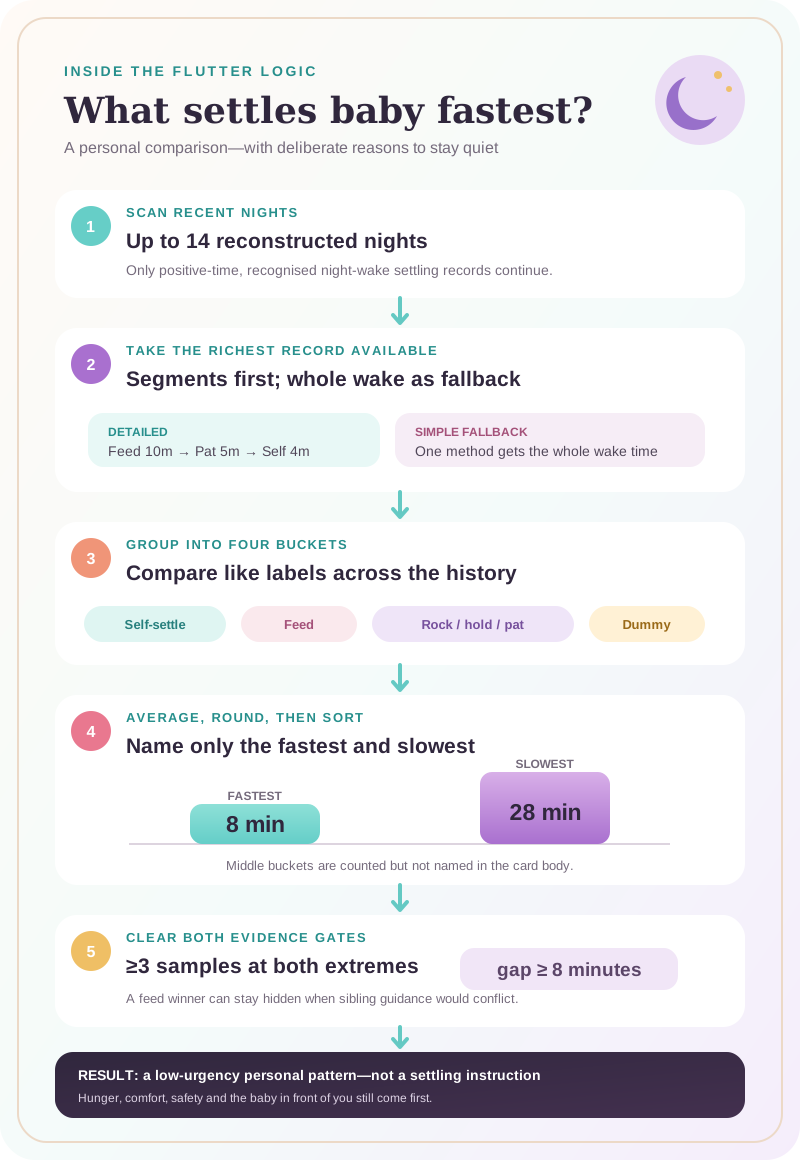
But “fastest” needs careful translation. The calculation can mix per-method segments from detailed records with whole-wake durations from simpler records. It groups rocking, holding and patting together. It compares the quickest bucket with the slowest bucket, and it cannot prove that the winning method caused sleep.
Used in proportion, the card answers a useful question: which recorded route has taken less time in this family’s recent night log? It does not answer which method is best, kindest, safest or appropriate for the next wake.
The short answer
The current insight needs all of the following:
| Gate | rule | Why it matters | |---|---:|---| | Recent history | Up to 14 reconstructed nights | One memorable wake is not enough | | Comparable methods | At least 2 method buckets with positive time | There must be something to compare | | Evidence at both extremes | At least 3 samples in the fastest and slowest buckets | A one-off win cannot become advice | | Meaningful separation | Slowest rounded average minus fastest rounded average is at least 8 minutes | Near-ties stay quiet | | Contradiction guard | A winning feed can be suppressed when a feed-reduction insight is active | The same screen should not give opposite instructions |
The card is low urgency. Its own final sentence says to follow hunger and comfort cues first.
The exact data path
OBubba’s brain scans the latest reconstructed night and up to thirteen earlier nights. It keeps entries that are:
- type Wake;
- marked as a night event; and
- attached to a positive settling time.
The code then takes one of two routes for each wake.
Route 1: a detailed soothe breakdown
The richer night-wake editor can store an ordered sequence such as:
Fed 10 min → Patted 5 min → Self-settle 4 min
When that breakdown exists, each positive segment becomes its own comparison sample:
- Feed receives one 10-minute sample.
- Rocking/holding receives one 5-minute sample, because patting joins the assisted bucket.
- Self-settling receives one 4-minute sample.
One wake can therefore contribute more than one sample.
Route 2: a simple wake record
Older or quicker records may contain a total wake duration and one primary settling method, but no per-method breakdown. In that case, OBubba assigns the whole positive wake duration to the classified primary method.
A 24-minute wake marked Rocked becomes one 24-minute assisted sample. A wake with no recorded method is ignored. A method with no positive duration is also ignored.
This fallback keeps older data useful. It also means the averages can contain two different kinds of measurement: segment minutes and whole-wake minutes.
The four comparison buckets
The app does not compare every button label separately. It maps them into four broader groups:
| What the parent records | Comparison bucket | Wording used on the card | |---|---|---| | Self-settle / Independent | `self` | self-settling | | Fed | `fed` | a feed | | Rocked, Held or Patted | `assisted` | rocking/holding | | Dummy | `other` | a dummy |
That grouping gives each bucket more chance of reaching a usable sample. It also removes detail.
If all three assisted samples were Patted, the current label can still say “rocking/holding”. If holding is quick but rocking is slow, combining them may hide the difference. “Other” currently means dummy rather than every possible alternative.
The card is best read at bucket level: self, feed, hands-on soothing or dummy—not as a precise ranking of every technique.
How the winner is calculated
For every bucket with a positive sample, totals the minutes and divides by the sample count. Each average is rounded to a whole minute.
Imagine the recent records contain:
| Bucket | Samples | Rounded average | |---|---|---:| | Self-settling | 7, 8, 9 min | 8 min | | Feed | 13, 15, 17 min | 15 min | | Rocking/holding | 26, 28, 30 min | 28 min |
The app sorts those averages. It names only the fastest and slowest:
> Self-settling gets Oliver back down in about 8 min, vs ~28 min with rocking/holding.
The 15-minute feed average is not shown in the body. It still contributes to the insight’s sample label.
The gap is 20 minutes, so it clears the eight-minute noise filter. Both named buckets contain three samples, so the evidence gate also clears.
If the averages were 12 and 19 minutes, the seven-minute gap would stay silent. If the fastest bucket contained three samples but the slowest only two, it would also stay silent.
These are product-confidence thresholds, not clinical cut-offs.
“Three samples” does not always mean three wakes
The card’s confidence label adds the counts across every method bucket and describes the total as wakes.
With simple records, one sample usually does correspond to one wake. With detailed breakdowns, a single wake can add a Feed sample, a Pat sample and a Self-settle sample. Three wakes containing those same three steps could contribute nine samples.
So a label such as “9 wakes” may actually be counting nine valid method records rather than nine unique awakenings.
This does not make the comparison useless, but it changes what the number means. A clearer future label would be “9 settling segments across 3 wakes”, with the unique-wake count shown separately.
Why detailed and simple records can tell different stories
Consider two versions of the same 20-minute wake.
Detailed version
Rocked 5 min → Fed 15 min
The app adds:
- 5 minutes to hands-on soothing; and
- 15 minutes to feeding.
Simple version
The parent selects both Rocked and Fed, but the back-compatible primary method becomes the first recognised support in the list. If Feed is primary, the app can add the whole 20 minutes to feeding.
The first record measures time spent using each method. The second attributes the total journey back to sleep to one method. Those are not identical outcomes.
That is the largest limitation behind the confident phrase “gets baby back down”. A five-minute pat segment may be brief because feeding did most of the settling afterwards. A 20-minute feed-labelled wake may include winding, cuddling or quiet time that was not broken out.
For the cleanest comparison, use the same style of night-wake record consistently for a while. Do not add artificial detail at 3am; just understand that mixed logging styles create a rougher estimate.
Why a feed winner can disappear
Suppose feeding averages eight minutes and self-settling averages twenty-eight. On its own, the comparison would call feeding fastest.
The wider Brain run also checks whether an age- and preference-appropriate feed-to-sleep reduction message is active. It looks at two separate patterns:
- one settling crutch dominating the latest night; and
- wakes and feeds repeatedly travelling together across seven nights.
When the parent’s chosen sleep approach allows method guidance and either pattern is active, the fastest-method function receives a suppress feed winner flag. If Feed is fastest, this card stays silent.
That guard prevents a jarring pair of cards:
- “Lean on a feed; it is fastest.”
- “Gently loosen the feed-to-sleep loop.”
If Self-settle is the faster bucket, the card may still appear because that direction does not contradict the sibling plan.
This is thoughtful curation, but silence still does not mean feeding is slow. It may mean another active insight currently owns that decision.
Fastest is not the same as best
A method can be quick and still be wrong for the moment.
- A hungry baby may need a feed even if patting was faster on previous wakes.
- A frightened, ill or uncomfortable baby may need close contact.
- A dummy may work quickly one night and be repeatedly lost on another.
- Self-settling may be appropriate during calm wriggling but not escalating crying.
- Rocking may take longer and still be the support a parent wants to give.
The NHS says babies have individual sleep patterns and notes that, particularly in the early weeks, some only fall asleep in a parent’s arms or with a parent beside the cot. A simple soothing routine may help, but there is no single method every baby must use.
Use the card as a memory aid, not a command:
> “In the situations we logged, this route was shorter on average.”
What the app cannot observe
The comparison does not control for:
- why the baby woke;
- hunger, illness, pain, teething or temperature;
- the baby’s age at each sample;
- which parent or carer responded;
- clock time within the night;
- how upset or calm the baby was;
- whether a feed was nutritionally substantial;
- whether the baby was asleep immediately after a segment;
- which methods happened but were not recorded; or
- several segments coming from the same unusually difficult wake.
It also compares averages, not medians. One very long record can pull a small bucket upward.
The result is a personal association in the log. It is not proof of cause, a measure of attachment or a verdict on parenting quality.
How to record a wake without turning it into homework
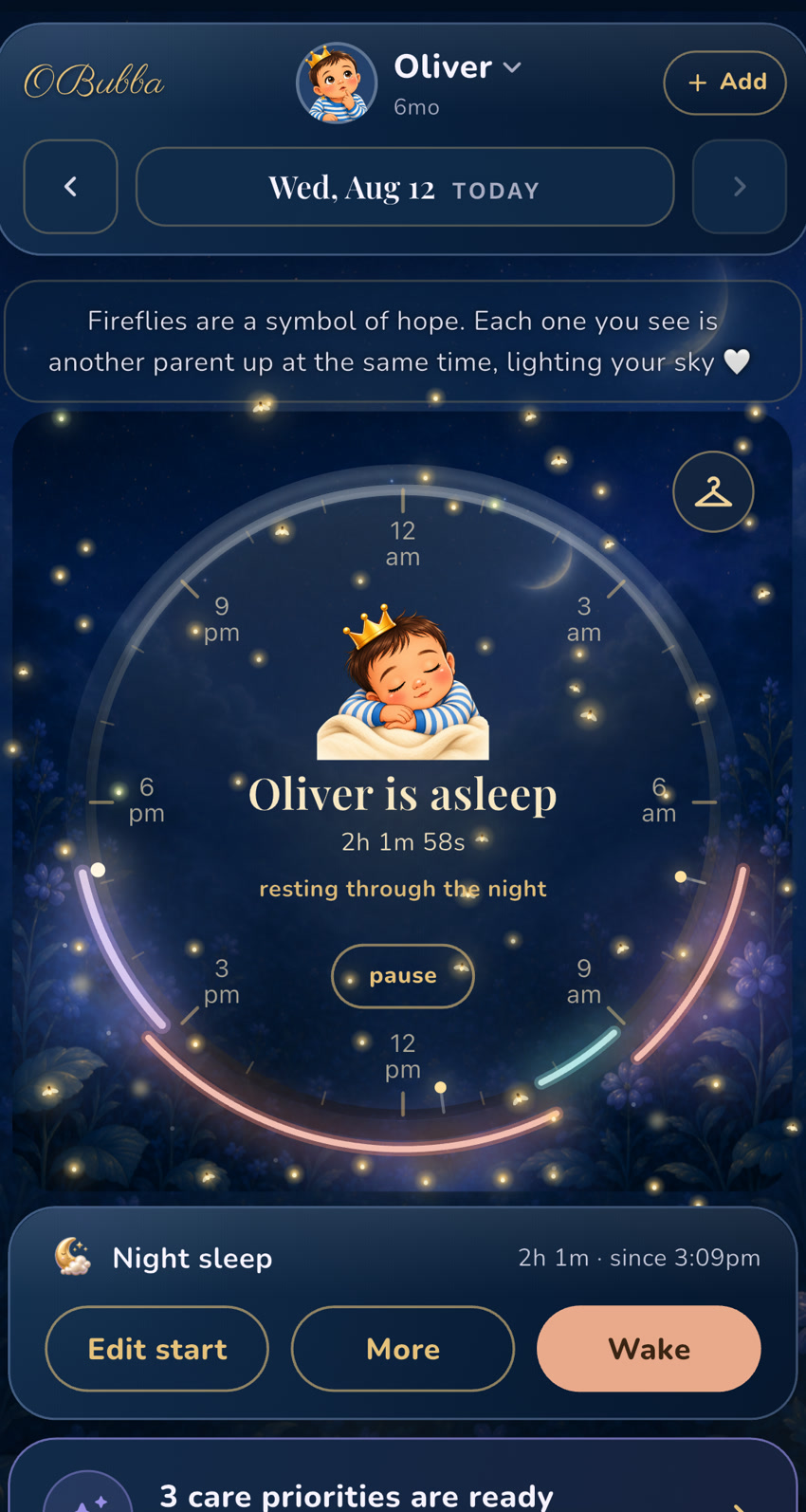
During a running night sleep, tap Pause when the baby is genuinely awake. Respond first. When sleep resumes, record the wake duration and the methods you actually used.
For useful data:
- Choose what really happened. Fed, rocked, held, patted, dummy and self-settle are observations, not grades.
- Use the detailed breakdown when it is easy. Order and per-method minutes make the record more specific.
- Keep simple records honest. A rough whole-wake duration is better than invented precision.
- Do not log calm awake time as Self-settle unless that is genuinely how the recorded sequence ended.
- Do not change care to make the chart prettier. The baby in front of you outranks the average.
The deeper value appears after several ordinary records. OBubba can remember a distinction an exhausted parent cannot reasonably calculate overnight.
A responsive way to use the result tonight
Start with the reason for the wake
Check feeding cues, comfort, temperature and anything unusual. If the baby needs care, provide it.
Treat the fastest method as an option
If the baby is calm and the method fits, it can be a reasonable first thing to try. It is not a required sequence and there is no penalty for switching.
Keep the night low-key
The NHS suggests low lights, a quiet voice and little stimulation at night. That environmental consistency can matter whichever settling method you use.
Return to safer sleep
Once the baby is ready to sleep, place them on their back in a clear, flat, separate sleep space with a firm mattress. The Lullaby Trust’s clear-cot guidance applies to every method and every sleep.
Review the pattern, not one difficult wake
If the ranking changes after illness, travel or a developmental phase, that is useful information. Personalisation should be allowed to evolve.
Why the card may not appear
You may never see this insight when:
- fewer than two recognised method buckets have positive time;
- one of the extreme buckets has fewer than three samples;
- the rounded averages are fewer than eight minutes apart;
- settle methods were left blank;
- wake duration was missing or zero on simple records;
- detailed breakdown segments had no positive minutes;
- only one method is used consistently;
- Feed would win while a compatible feed-reduction insight is active; or
- the pattern is outside the visible or curated insight feed.
No card does not mean the app thinks settling is going badly. It means this particular comparison cannot make a sufficiently distinct claim from the available record—or that another message has priority.
Where the insight lives
classifies Settle method as a longer-term pattern. It belongs in What OBubba noticed, rather than behaving like a one-night warning.
Its dismissal identity is based on the insight title. Because the title includes the baby’s name but not the winning method, a changed ranking can retain the same identity. That reduces repetitive cards, though it can also make a newly changed winner less obvious after the earlier version was marked seen.
The card reports low urgency, a sample size and a confidence label. It is designed to be useful context, not an alarm.
How this could become even more trustworthy
The feature already does several things well: it ignores unknown methods, requires evidence on both sides, filters near-ties and avoids a feed-guidance contradiction.
A stronger next version could:
- compare detailed segments separately from whole-wake fallbacks;
- count and display unique wakes as well as method samples;
- label Patting honestly instead of folding it into “rocking/holding” copy;
- show every qualifying bucket, not only fastest and slowest;
- use medians or show the influence of outliers;
- compare similar wake reasons and similar parts of the night;
- link directly to the contributing records; and
- say “shortest recorded method time” when the evidence is segment-based.
Transparent personalisation is more persuasive than magical personalisation. Parents should be able to see why the app spoke and where uncertainty remains.
Frequently asked questions
Does the card mean I should always use the fastest method?
No. Follow hunger, distress and comfort cues first. The card describes prior records; it does not know what the next wake needs.
Is feeding to sleep treated as bad?
No. Feed is one comparison bucket and can be the fastest. The card is only suppressed when separate, preference-compatible guidance would otherwise contradict a feed winner.
Are rocking, holding and patting compared separately?
No. The current classifier combines them as hands-on assistance. The displayed phrase “rocking/holding” does not name patting even though patting contributes to that bucket.
How many nights does OBubba use?
The caller scans up to 14 recent reconstructed nights. The result depends on qualifying night-wake records inside that window, not simply on having used the app for 14 days.
How many examples does each method need?
The fastest and slowest buckets each need at least three valid samples. A detailed wake can contribute several method samples, so those are not always three unique wakes.
Why is an eight-minute gap required?
It is a product noise filter. If the rounded averages are closer than eight minutes, OBubba treats them as too similar to name a winner.
Does Self-settle mean I left my baby alone?
No. It is a recorded method label. A parent may be beside the cot, and feeding, holding or patting may have happened earlier in the same wake. Read the related guide to how OBubba detects growing Self-settle endings.
What if one method works but is exhausting for me?
Speed is only one outcome. Sustainability, feeding needs, safety and the parent’s wellbeing matter. If a familiar method has become difficult, OBubba’s gradual sleep-song and cot-routine path is an optional, separate decision.
The takeaway
“What settles Oliver fastest” means:
> Across recognised, positive-time settling records from up to fourteen recent nights, the quickest rounded method-bucket average was at least eight minutes below the slowest, with at least three samples at both extremes.
It does not mean the winner is universally best or that slower support should be removed. Respond to the reason for the wake, keep every sleep safe, and use the result as one gentle piece of family memory.
Try OBubba’s baby sleep tracker free → — keep night wakes, feeds, settling paths and the live sleep clock connected, then see the personal patterns a basic timer leaves behind.
Sources
- NHS — Helping your baby to sleep
- UNICEF UK Baby Friendly Initiative — Caring for your baby at night
- The Lullaby Trust — Keeping a clear cot
This article provides general information for UK families. An app cannot assess hunger, illness, pain, breathing, growth or an individual feeding plan from settling times. Respond to your baby and seek advice from a health visitor, GP or other appropriate professional when you are worried.
Ready to try OBubba?
Use OBubba to track feeds, sleep, naps, nappies, growth, milestones and family handovers in one calm baby tracker app.