It is 4:10pm. Two short naps have added up to less than an hour, but your baby’s normal bedtime still feels too far away.
OBubba says: “A short bridge nap could save tonight.”
Does that mean forcing another full nap? Will a late catnap ruin bedtime? And how does the app know that 20–30 minutes is better than simply starting the night early?
We traced the current live insight, bedtime predictor, day-sleep totals and conflict reconciler for this guide. The short answer is: a bridge nap is a small amount of sleep intended to soften an unusually long final awake stretch—not a replacement for the missed sleep and not a promise of a better night.
The short answer
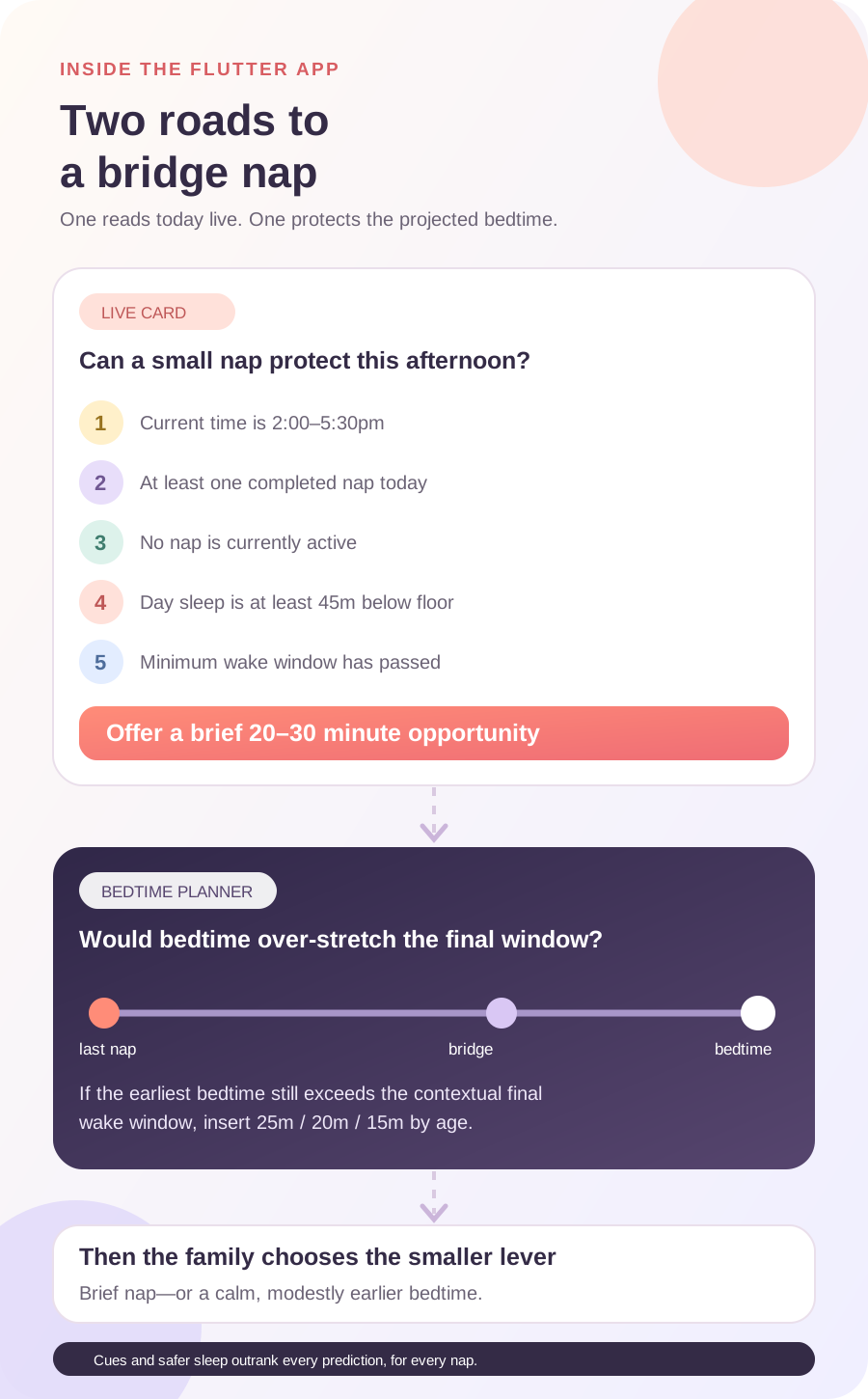
The current live card can appear only when every one of these gates passes:
| Live-card check | Current rule | Why it matters | |---|---:|---| | Time of day | 2:00pm–5:30pm | Keeps the prompt in the afternoon rescue window | | Nap history today | At least 1 completed nap | No first nap yet is a different problem, not a bridge | | Current sleep state | No open nap timer | Avoids duplicating an active nap timer | | Day-sleep deficit | At least 45 minutes below the corrected-age floor | Avoids reacting to a tiny shortfall | | Time awake | At least the corrected-age minimum wake window since the last completed nap | Avoids suggesting sleep before the baby is plausibly tired |
When those gates pass, the body says how far below the age-profile floor today’s completed naps sit, rounded to one decimal hour, and suggests a brief 20–30 minute nap.
This insight has medium urgency and a protect day sleep direction. When reconciles competing advice, that live rescue signal can remove a lower-urgency historical card telling the parent to trim day sleep. The app should not say “add a nap now” and “cap naps” at the same time.
A worked example
Imagine an eight-month-old whose corrected-age profile has a lower day-sleep reference of 2 hours.
Today’s completed naps are:
- 9:20–9:50am: 30 minutes
- 12:35–1:05pm: 30 minutes
At 4:10pm:
- completed day sleep is 60 minutes
- the difference from the 120-minute floor is 60 minutes
- the last nap ended 3h 5m ago
- there is no active nap
- the time is inside the 2:00–5:30pm window
If the current minimum wake window for that age and family preference has passed, the card can appear. It would describe the day as about 1.0h short on day sleep.
The app is not proving the baby is overtired. It is saying that the logged day has enough missing sleep and enough awake time for a small rescue opportunity to be plausible.
What “day sleep” means here
The live calculation uses completed daytime nap minutes today.
It does not count:
- an active nap whose timer is still open
- night sleep
- a nap with missing or invalid start and end times
- the awake minutes inside a logged mid-nap resettle
That last boundary is important. If a nap ran from 12:00 to 1:00 but included a 15-minute awake pause, OBubba’s canonical day total is 45 minutes—not the raw one-hour arc. The bridge detector uses that deducted total so a broken nap cannot look more restorative than the log says it was.
A forgotten nap has the opposite effect. If nursery or another caregiver did not add 40 minutes of sleep, the app may calculate a false deficit and offer an unnecessary bridge. Check the shared timeline before acting.
The age target is a reference floor, not a quota
The detector compares completed naps with the lower edge of OBubba’s corrected-age nap profile. The profile changes across infancy and toddlerhood and uses corrected age when the due-date information supports it.
The NHS emphasises that babies’ sleep patterns vary: some need more sleep and some less, and patterns change as they grow. That is why the app waits for a 45-minute shortfall rather than chasing every missing ten minutes.
Even then, the floor is still a population reference. A happy baby who regularly sleeps less may not need “catch-up” simply because a table says so. An unusually fussy, hard-to-settle or unwell baby may need comfort or health assessment rather than a timing calculation.
Saving an accurate birth date and due date matters. Without trustworthy age information, an age-based nap profile can only be a rough fallback.
The live card does not actually calculate bedtime
This is the most important implementation limit in the wording.
The card says bedtime is “still a way off,” but the live `_bridgeNap` function does not receive a predicted or parent-set bedtime. It infers that bedtime is likely not immediate because the current time sits between 2:00pm and 5:30pm. It also checks for an open nap entry, not an active night-sleep entry. If bedtime has already started, treat the card as stale and dismiss it.
That is often reasonable—but not always. A family with a 6:00pm bedtime seeing the card at 5:25pm may be better served by a calm early night than a nap that starts close to bedtime.
Treat the sentence as an invitation to compare options:
- How close is your baby’s realistic bedtime?
- Are they showing sleepy cues?
- Would a nap begin promptly, or turn into a long struggle?
- Has a late nap recently made bedtime much harder?
- Is an earlier bedtime practical and appropriate tonight?
The app’s live gate narrows the question. The family’s actual evening answers it.
The bedtime planner uses a different bridge calculation
Elsewhere, the app’s bedtime predictor can also mark a bridge as needed. That branch does calculate a bedtime relationship.
After the expected naps are complete, it compares:
- the earliest age-appropriate bedtime boundary
- the last nap end plus the contextual maximum final wake window
If the earliest allowable bedtime would still come after that maximum awake stretch, and no bridge is already scheduled, the planner can insert a short bridge before recomputing bedtime.
Its default bridge duration is age-tuned:
| Corrected age | Planner’s bridge duration | |---|---:| | Under 22 weeks | 25 minutes | | 22–38 weeks | 20 minutes | | 39 weeks and older | 15 minutes |
After the bridge, the planner uses a shorter settling window—at least 30 minutes, or about 65% of the contextual minimum wake window—then checks that the new bedtime is coherent.
These numbers belong to OBubba’s planning model. They are not universal clinical rules and do not mean every baby should be woken at exactly 15, 20 or 25 minutes.
What the real plan shows
OBubba’s current Tomorrow’s plan lays wake time, naps and bedtime on one connected day and labels each item predicted. The plan explicitly says it updates as the day unfolds and offers an off-day adjustment for teething, illness or a day that simply is not normal.
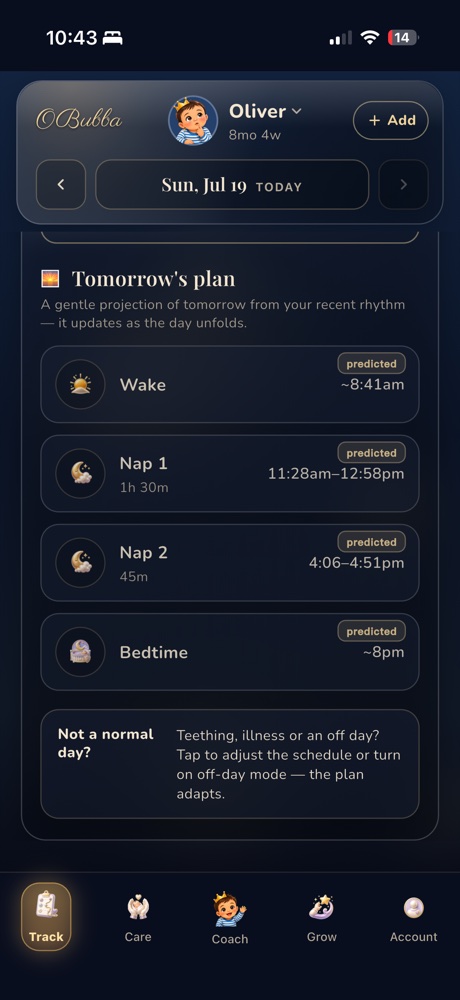
A bridge is not visible in this example because this day’s two naps already connect coherently to bedtime. That absence is useful proof: OBubba does not add a late catnap to every plan. It appears only when the day or final wake-window maths creates a gap that needs crossing.
Bridge nap or earlier bedtime?
Use the smallest intervention that fits the real evening.
| Situation | More plausible option | |---|---| | Bedtime is still several hours away and baby is clearly tired | Offer a brief bridge opportunity | | Bedtime is close enough to reach with calm, low stimulation | Use a modestly earlier bedtime | | Baby has repeatedly rejected the nap for 10–15 calm minutes | Stop turning it into a battle; reset and consider earlier bedtime | | A late nap reliably creates a very long bedtime struggle | Prefer the earlier-night route and review the pattern | | Baby is ill, in pain or unusually unsettled | Comfort and health needs outrank schedule optimisation | | The nap entry is missing or wrong | Correct the log before acting on the deficit |
Do not move bedtime dramatically early after one messy day without considering feeds, family rhythm and the baby’s actual cues. “Earlier” usually means a modest protective adjustment, not declaring 4:30pm to be night.
A bridge nap is deliberately small
The purpose is to take the sharpest edge off tiredness while preserving enough sleep pressure for bedtime.
A bridge may happen in a cot, or occasionally on the go when life requires it, but the method does not make safety optional. For every sleep, day or night, The Lullaby Trust recommends placing a baby on their back in their own clear, flat, firm separate sleep space, in the same room as a caregiver for at least the first six months.
If a baby falls asleep in a car seat while travelling, remove them at the destination and place them on a flat sleep surface. Do not leave a baby sleeping in a stationary car seat, bouncer or other seated product. Never let exhaustion turn a planned contact nap into an accidental sofa or armchair sleep.
The bridge nap should solve a timing problem, not create a safety problem.
Why the card might not appear
The common code-level reasons are:
- It is before 2:00pm or after 5:30pm.
- No completed nap is logged today.
- A nap timer is still open.
- Completed day sleep is less than 45 minutes below the age-profile floor.
- The minimum wake window since the latest completed nap has not passed.
- A nap has a missing or invalid end time, so it cannot anchor the calculation.
- Higher-priority curation keeps a more important safety or health message above it.
The card does not require several historical days and therefore carries no “from N nights” evidence caption. It is a live same-day calculation based on age context and today’s log.
What to log so the suggestion is useful
| Log detail | Why it matters | |---|---| | Actual nap start and end | Creates the completed day-sleep total | | Mid-nap awake pause | Prevents awake time being counted as sleep | | Corrected forgotten nursery nap | Prevents a false deficit | | Morning wake | Gives the wider day plan a reliable anchor | | Real bedtime start | Helps future bedtime prediction | | Illness, teething or off-day context | Stops an unusual day being treated like an ordinary template |
You do not need to record every sleepy blink. Accurate anchors are more valuable than a perfect-looking timeline.
Explore OBubba’s baby sleep tracker → — connect live nap timers, corrected-age context, today’s day-sleep total and a bedtime plan that updates rather than demanding a fixed schedule.
Frequently asked questions
Will a bridge nap ruin bedtime?
It can move bedtime later or make settling harder if it starts too late or runs long. The app suggests a short nap because the aim is to soften the final awake stretch, not refill the whole day. If bedtime is already close, earlier bedtime may fit better.
Why does OBubba say my baby is “1.2h short”?
It subtracts today’s completed, interruption-adjusted nap total from the lower edge of the corrected-age day-sleep profile, then displays the difference to one decimal hour. It is not measuring a biological sleep debt.
Does the live card use my baby’s usual bedtime?
No. The live bridge card uses an afternoon time window, today’s deficit and awake time. The separate bedtime planner uses last nap, contextual final wake window and bedtime boundaries.
Does OBubba use corrected age?
Yes, when the saved birth and due dates make corrected age applicable. That affects the day-sleep floor and minimum wake-window gate.
Should I wake my baby after 20 minutes?
The card’s 20–30 minutes is a planning range, not a medical instruction. Consider age, how close bedtime is, recent response to late naps and any individual advice. Never disturb a baby solely to satisfy an app streak or exact number.
What if my baby refuses the bridge nap?
Do not keep forcing the attempt. Move into a calm evening, protect feeds, reduce stimulation and consider a modestly earlier bedtime. One refused rescue nap does not mean the day or night is ruined.
Is a contact bridge nap safe?
The safest place is the baby’s own clear, flat, firm separate sleep space. If holding a sleeping baby, the adult must remain awake and should never move onto a sofa or armchair where they may fall asleep. Follow current safer-sleep guidance for every nap.
Reliable UK sources
- NHS: Helping your baby to sleep
- NHS Best Start in Life: Your baby’s sleep patterns
- NHS Best Start in Life: Understanding your baby’s cues
- The Lullaby Trust: Safer sleep for babies
- The Lullaby Trust: Keeping a clear cot
This article gives general information for UK families. It is not a sleep prescription or medical advice, and OBubba is not a medical device. Follow safer-sleep guidance, your baby’s cues and any individual advice from your health visitor or clinical team.
Ready to try OBubba?
Use OBubba to track feeds, sleep, naps, nappies, growth, milestones and family handovers in one calm baby tracker app.