You download a baby sleep app because bedtime is taking 90 minutes. You want help with timing, patterns and the relentless mental arithmetic. You do not want an algorithm quietly deciding that feeding, rocking or contact sleep is a problem.
OBubba does not make that decision for you.
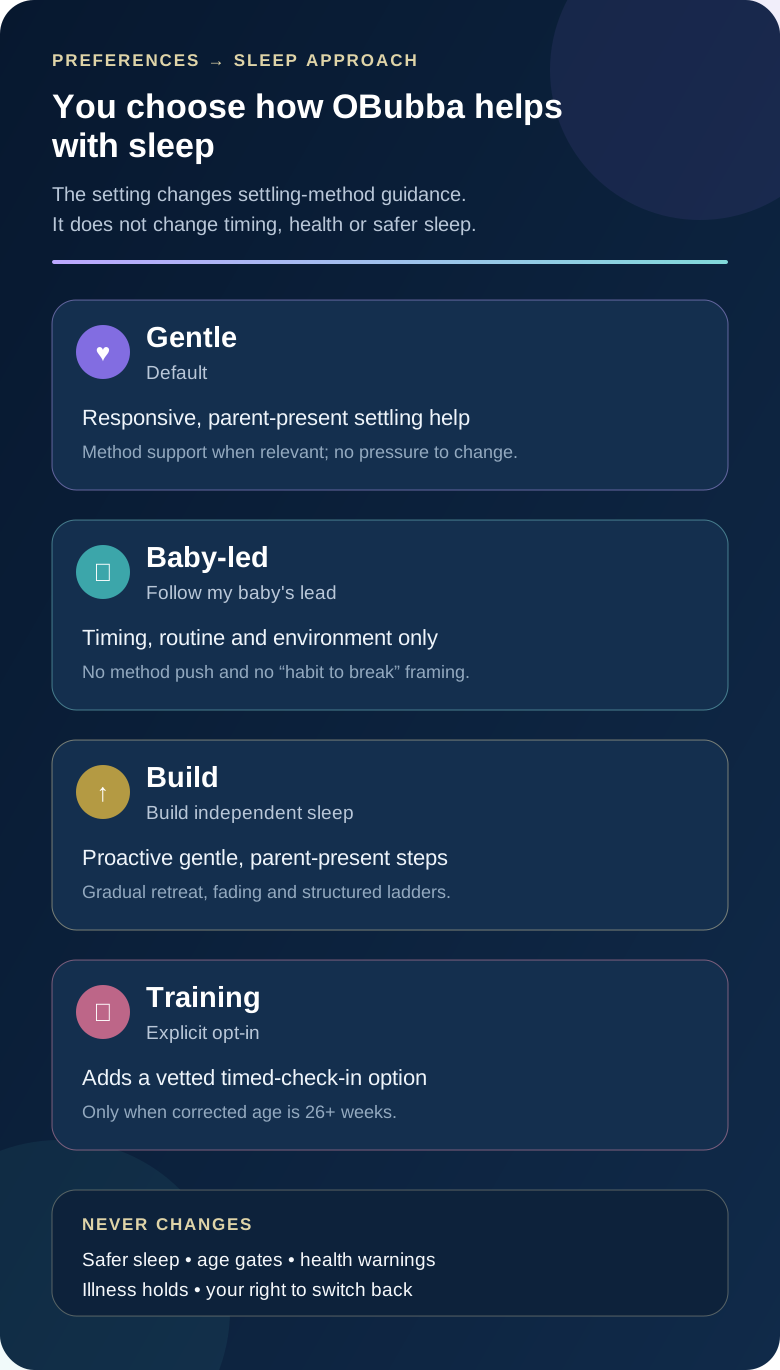
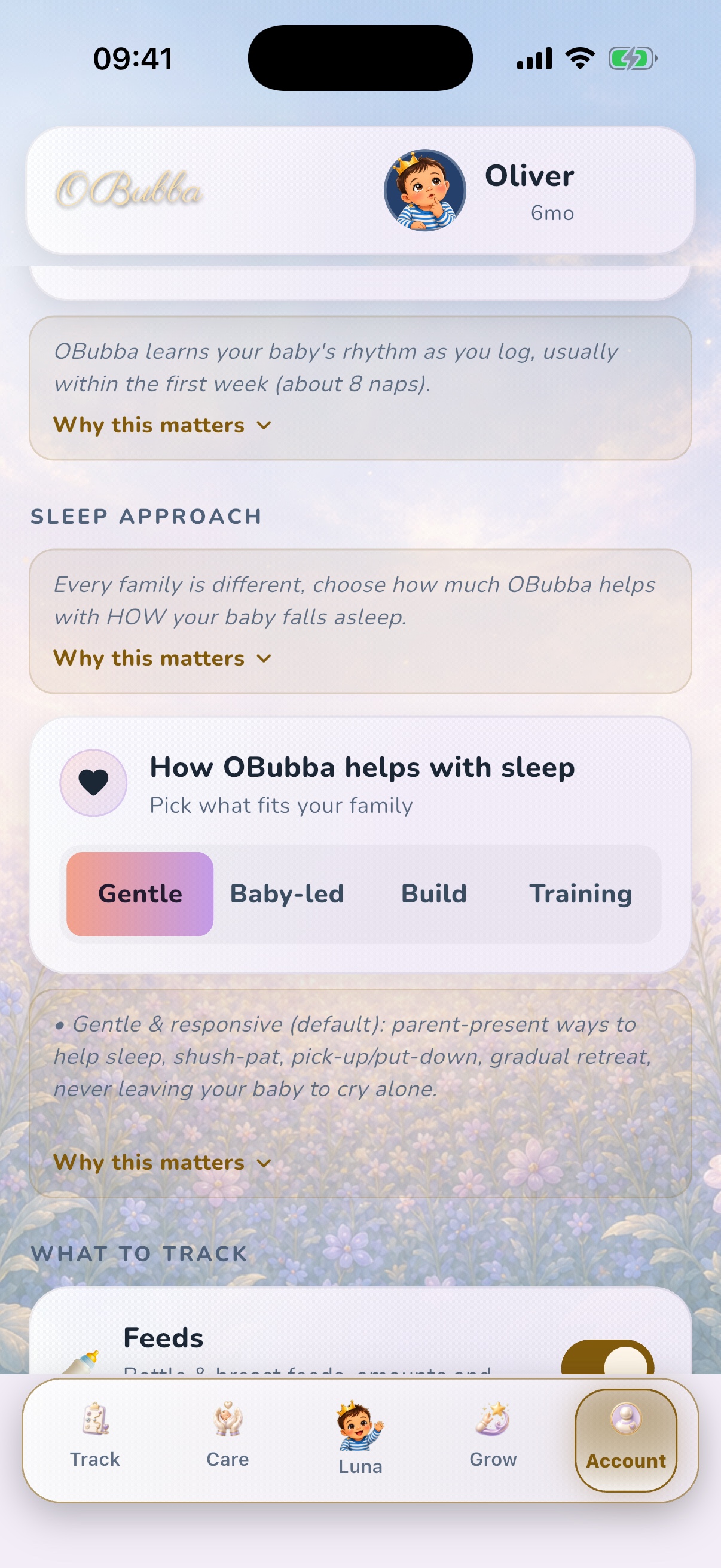
In the current app, Account → Preferences → Sleep approach has four choices: Gentle, Baby-led, Build and Training. The choice changes which settling-method suggestions the app is allowed to offer. It does not switch off safer-sleep guidance, health warnings, age gates, wake-window learning or routine support.
The default is Gentle. Training requires a separate confirmation. Baby-led can suppress method coaching altogether. And you can change your mind.
That is the short answer: OBubba can help you work on sleep, but it should not turn one family’s philosophy into every family’s instruction.
What the setting actually changes
We traced the production Preferences screen, sleep engine, readiness gate, Sleep Consultant and automated parenting-style tests.
The implementation separates two questions that baby-sleep advice often muddles:
- When might sleep work better? This includes wake windows, naps, bedtime timing, routine and the sleep environment.
- How should my baby fall asleep? This includes feeding, rocking, holding, patting, gradual retreat, pick-up/put-down and structured methods.
Your Sleep approach primarily governs the second question.
| Approach in the app | What OBubba is allowed to do | What it should not do | |---|---|---| | Gentle | Offer responsive, parent-present settling help when a pattern makes it relevant | Push a formal method just because your baby is old enough | | Baby-led | Help with timing, naps, bedtime, routine and environment | Frame contact naps, feeding or rocking to sleep as a “habit to break”; proactively suggest a method | | Build | Proactively offer structured but gentle, parent-present steps towards more independent settling | Leave a baby to cry alone or bypass the readiness checks | | Training | Add a vetted graduated timed-check-in option inside the Sleep Consultant when the age gate is met | Unlock it without explicit consent, show it below 26 weeks corrected age or let free-text AI invent the plan |
The underlying sleep records do not change when you move between approaches. A logged feed stays a feed. A rocking settle stays an observation. The preference changes interpretation and coaching—not history.
1. Gentle: the default
Gentle & responsive is the app’s starting position.
OBubba can still notice that one method takes longer, that bedtime timing is fighting the settle or that the same cue appears around repeated wakes. If method help is clearly relevant, it can offer parent-present options such as gradual retreat, pick-up/put-down or fading one layer of help.
The difference is posture. Gentle does not mean “independent sleep is the target and we are starting tonight”. It means the app can explain responsive options while the family remains in charge.
This fits the reality described by the NHS: babies have their own sleep patterns, many young babies fall asleep in a parent’s arms, and a simple soothing bedtime routine may help. Normal closeness is not evidence of failure.
Choose Gentle if you want the app to notice patterns and offer calm options, but you do not want it actively steering a sleep project.
2. Baby-led: timing help without method pressure
The button says Baby-led. The detailed description calls it Follow my baby’s lead.
This is the most important choice for parents who want prediction and routine support without being told to change how sleep begins. In the current engine, it suppresses settling-method coaching, including association swaps and proactive method prompts.
OBubba can still help with:
- the likely next nap and bedtime;
- wake windows and day-sleep balance;
- a repeatable wind-down;
- room and routine observations;
- sleep, feed and health patterns; and
- safer-sleep guidance.
But it should not call contact sleep, feeding to sleep or rocking a habit to break. If a feed settled your baby fastest, that may remain a useful observation instead of being contradicted by a card telling you to remove it.
Baby-led is not “turn intelligence off”. It is a boundary: help me understand the rhythm; do not turn the way I comfort my baby into a project.
3. Build: gentle steps towards independent settling
Choose Build when more flexibility at bedtime is an active family goal.
This tells the engine it can lean in with structured, responsive suggestions. Depending on the recorded pattern, that might mean:
- building a consistent song and cot cue before reducing rocking;
- moving a feed slightly earlier in the wind-down without withholding genuine hunger;
- fading patting one rung at a time;
- using gradual retreat while a parent remains present; or
- trying pick-up/put-down rather than expecting an abrupt unsupported change.
It does not mean every settle must become independent. Nor does the preference itself start a plan. The Sleep Consultant first checks age, whether there are enough logged nights and whether major timing problems should be addressed before a method.
In the current readiness code, formal method work is held below roughly four months. Significant bedtime, wake-time, day-sleep, nap-consistency or last-wake-window findings can produce “Let’s get the timing right first” instead of a start button. The point is to avoid treating an overtired or undertired schedule as a behavioural problem.
Choose Build if you want proactive, step-by-step help but want the work to stay gradual and parent-present.
4. Training: an extra opt-in, not a hidden default
Tapping Training does not silently toggle the setting. The current app opens a confirmation explaining the graduated method and lets the parent choose Not now or Turn it on.
Even after consent, the graduated timed-check-in tile is shown only when the baby’s corrected age is at least 26 weeks. Unknown age stays locked. Switching back to another approach closes the gate again, and a stale method selection is prevented from starting.
The step-by-step version lives inside the vetted Sleep Consultant card. OBubba’s free-text AI coach remains under a separate output guard that rejects cry-it-out and controlled-crying language rather than improvising a timed plan.
This distinction matters. “Open to information about a structured option” is not the same as “please mention it in every difficult-night conversation”. In OBubba, the choice must be deliberate, age-gated and reversible.
Research is not a command. A randomised trial published by the American Academy of Pediatrics found sleep benefits from two behavioural approaches without detected adverse attachment or emotional outcomes at 12-month follow-up; a separate trial's five-year follow-up found no marked long-term positive or negative effects. That does not make a method necessary, suitable for every child or emotionally comfortable for every parent. It supports an informed option—not an app mandate.
If you are considering structured sleep work and your baby was premature, has feeding or growth concerns, is unwell, has a medical condition or the crying feels unusual, get individual professional advice first.
The safeguards sit above your preference
A preference should never be able to vote safety away. The code explicitly keeps these rules above the four approaches:
- Corrected age: age gates use corrected age where available, including the 26-week graduated-method floor.
- Unknown date of birth: uncertainty closes the gate rather than assuming a demo-age baby.
- Not enough history: the consultant asks for more logged nights instead of treating an empty analysis as “ready”.
- Timing blockers: significant schedule findings are addressed before a formal method.
- Illness and disruption: active illness, teething, travel and other holds can pause progression.
- Safer sleep: sleep-position and sleep-space guidance does not bend to a chosen method.
- Health guidance: the setting changes settling coaching, not warning signs or urgent-care boundaries.
Whatever approach you choose, follow current safer-sleep advice. The NHS says the safest place for a baby’s first six months is a clear cot or Moses basket, on their back, in the same room as a parent, using a firm, flat mattress. A method is never a reason to add pillows, positioners, loose bedding or unsafe sleep products.
Which option sounds like your family tonight?
Use this quick decision, not a personality test.
Choose Gentle if…
You want responsive suggestions available, but only when useful. You are open to learning about settling changes without setting independence as the app’s standing goal.
Choose Baby-led if…
Feeding, rocking, holding or contact sleep works for you—or you simply do not want method language. You still want help with timing, routines, patterns and safer sleep.
Choose Build if…
You actively want another route to sleep and would like the app to offer structured gentle steps. You want the parent to remain present and changes to happen one rung at a time.
Choose Training if…
You want the graduated timed-check-in option to become available once the age and readiness gates are met. You understand it remains your choice and can be turned off again.
If none feels perfect, start with Gentle. A preference is not a promise to complete a programme.
How to change it in OBubba
- Open Account.
- Tap Preferences.
- Scroll to Sleep approach.
- Choose Gentle, Baby-led, Build or Training.
- If you choose Training, read the extra confirmation before turning it on.
The change is not retroactive. It does not delete sleep logs or rewrite past insights. It shapes the guidance you see from that point.
What OBubba still cannot decide
No setting can know:
- whether a method feels emotionally right for you;
- whether exhaustion has made tonight unsafe;
- whether crying reflects illness, pain, hunger or another unmet need;
- whether feeding or growth guidance makes night changes inappropriate;
- how much support the caregiving adults realistically have; or
- whether a calm-looking plan on a screen is working for the actual child.
Stop optional sleep work when your baby seems unwell, distressed in an unusual way or has a feeding or breathing concern. Seek professional advice when you are worried. If the parent is so exhausted that they may fall asleep while holding or feeding the baby, prioritise a safer setup and immediate human support over completing any method step.
The real download reason: an app that can hear “no”
Personalisation is often presented as cosmetic: a dark theme, a unit choice, a baby’s name in a sentence. This setting reaches deeper. It constrains the recommendation system.
Parents should not have to accept a hidden ideology to get a useful nap prediction. They should be able to say:
> Help me with the clock, but leave our cuddles alone.
Or:
> We want a gentle plan. Give us the next manageable step.
Or:
> We have considered structured training. Show us the controlled, age-appropriate option—only because we asked.
That is how OBubba earns a place on a tired parent’s phone: it learns the child’s rhythm, explains what it sees and allows the family’s values to set the boundary.
Try OBubba free → — track sleep, feeds and routines, then choose exactly how much settling-method help you want.
Frequently asked questions
Is sleep training the default in OBubba?
No. Gentle & responsive is the default. The graduated timed-check-in option needs a separate Training selection and confirmation.
Can I use nap predictions without changing feeding or rocking to sleep?
Yes. Baby-led keeps timing, routine, environment and pattern support while suppressing method coaching and “habit to break” framing.
Does choosing Build unlock timed check-ins?
No. Build enables proactive gentle, parent-present methods. The graduated timed-check-in tile is reserved for the separate Training opt-in and a corrected age of at least 26 weeks.
What happens if my baby is under six months?
The graduated method remains locked. Other formal method work also has younger-age and readiness gates; the app can focus on routine, timing and responsive support instead.
Can I switch back?
Yes. You can change the Sleep approach in Preferences. The Sleep Consultant rechecks the current choice before starting a persisted graduated selection.
Does the setting change safe-sleep advice?
No. Safer-sleep rules, health warnings and age safeguards remain in force across all four approaches.
Sources and further reading
- NHS: Helping your baby to sleep
- NHS: Safer sleep advice for babies
- American Academy of Pediatrics: Behavioral Interventions for Infant Sleep Problems—a randomized controlled trial
- American Academy of Pediatrics: Five-Year Follow-up of Harms and Benefits of Behavioral Infant Sleep Intervention
OBubba is a tracking and education tool, not a medical service. Sleep approaches are optional and do not replace individual advice from a health visitor, GP or qualified clinician.
Ready to try OBubba?
Use OBubba to track feeds, sleep, naps, nappies, growth, milestones and family handovers in one calm baby tracker app.