The morning was manageable. The afternoon was almost peaceful. Then the light changes, dinner needs making and your baby begins to cry as if an alarm has gone off inside them.
When the same unsettled stretch appears in the late afternoon or evening, parents often call it the witching hour. It may last much longer than an hour. It is not a medical diagnosis, and the name does not explain why a baby is crying.
Tonight, check ordinary needs and warning signs first. Then stop cycling through ten new tricks: choose one calm, repetitive soothing approach, reduce stimulation and share the load if you can. Tomorrow, look at the timing across several days before deciding the cause is colic, hunger, reflux or overtiredness.
What to do during the next evening crying spell
Use this order when your own brain is tired:
- Look at your baby, not the label. Is the cry familiar? Is their colour and breathing normal? Are they responsive?
- Check the basics once. Offer a feed responsively, check the nappy, burp or hold upright if needed, and feel the back of the neck for temperature comfort.
- Lower the sensory load. Dim the room, turn off the television, reduce talking and stop passing baby between several techniques.
- Choose one repetitive soother. Hold close, sway slowly, walk, sing quietly, offer the breast or use another familiar response.
- Give it a few minutes. Rapidly changing from bounce to bath to toy to loud shushing can add stimulation.
- Tag in another safe adult. A fresh pair of arms may help even when the technique is identical.
- Take a safe pause if you are overwhelmed. Put baby on their back in their clear cot, step into another room briefly and return when calmer.
The NHS guidance on soothing a crying baby confirms that afternoon and evening are common times for hard-to-console crying. It also says crying tends to increase from around two weeks and gradually reduce at around three months. That does not mean every baby follows the same curve or that every evening cry is harmless.
What is the baby witching hour?
“Witching hour” is everyday language for a repeated fussy or crying period toward the end of the day. A baby may:
- cry despite being fed and changed
- want to cluster feed or stay at the breast
- settle briefly in arms, then restart
- clench their fists, go red or pull their knees up
- resist being put down
- seem exhausted but fight sleep
- become more upset as the room becomes busier
The pattern is especially familiar in the early months, when regulation, feeding and sleep are still immature. The fact that it happens at a similar time can be reassuring—but timing never cancels a red flag.
Witching hour, colic or something else?
These labels overlap, which is why one evening cannot settle the question.
| Pattern | More consistent with | What to do next | |---|---|---| | Similar fussy spell most evenings; baby otherwise feeds, wakes and behaves as usual | Developmental evening fussiness may fit | Keep evenings calm, record timing and seek advice if worried | | Long, intense, difficult-to-console episodes in a young baby who otherwise appears healthy | Colic may be considered | Discuss with a health visitor or GP; do not self-diagnose or change diet alone | | Crying clusters around feeds, with difficulty attaching, coughing or distress | Feeding technique, flow, wind or reflux may matter | Get a feeding assessment and medical advice when persistent | | Crying follows a series of short naps or an unusually long final awake stretch | Accumulated tiredness may contribute | Protect the final nap or try a modestly earlier bedtime | | Evening feed frequency rises but wet nappies and growth are reassuring | Cluster feeding may fit | Feed responsively; frequency alone does not prove low supply | | Cry is new, weak, high-pitched or unlike normal; baby seems unwell | Illness or pain must be considered | Seek urgent medical advice |
Colic is a description applied to excessive crying in a baby who appears otherwise healthy; its exact cause is uncertain. The NHS colic guidance notes that it commonly begins at a few weeks and usually improves around three or four months.
Do not use a “rule of threes” to reassure yourself when the baby looks ill. Likewise, a difficult hour does not earn a diagnosis simply because it happened three nights in a row.
Why does evening crying happen?
There may be more than one contributor.
Your baby has reached their limit
By evening, a young baby has processed light, voices, movement, feeds, nappy changes and handling. Turning down the environment can help: fewer faces, lower light, one steady voice and slow repetition.
Overstimulation does not mean you played with your baby incorrectly. It means their capacity is still developing.
Feeding becomes more frequent
Young babies often feed in clusters, particularly in the evening. Rooting, hands to mouth and trying to suck are more useful hunger cues than the clock.
If breastfeeding, repeated feeding does not by itself prove your supply is low. Look at attachment, swallowing, wet nappies, weight and professional feeding assessment. Read cluster feeding or low milk supply for a fuller check.
Tiredness has accumulated
An older baby may arrive at 5pm after a missed last nap, several short naps or a much longer final wake window than usual. They can look wired rather than sleepy.
Do not assume tiredness just because the clock says evening. Compare the same days: does the crying start earlier after poor naps and soften after a well-timed final nap? If so, protect that nap or move bedtime 15–20 minutes earlier for several comparable days.
For a newborn, prioritise responsive sleep and feeding rather than trying to engineer wake windows.
Wind or feeding discomfort may contribute
Hold your baby upright after a feed if that helps, make time for burping and check bottle flow or breastfeeding positioning. Persistent crying during or after feeds deserves feeding support rather than endless home experiments.
Normal posseting is common. Repeated pain, feeding refusal, poor growth, blood, green vomit or forceful vomiting needs medical advice. A reflux and colic diary can help you describe the sequence without diagnosing it.
Sometimes there is no fixable reason
That is one of the hardest truths. A baby can be fed, dry, safely held and still cry. Comfort still counts even when it does not immediately stop the sound. You are not failing because your baby is crying in your arms.
Build a low-stimulation evening runway
Do not wait for the crying peak to make the whole household quiet. If a pattern normally begins around 5:30pm, simplify the preceding hour.
Try:
- completing noisy chores earlier when possible
- lowering lights before the usual onset
- offering feeds according to cues rather than delaying for a routine
- keeping one familiar soothing station ready
- using a carrier safely if close movement helps
- protecting the last nap for an older baby
- arranging dinner that requires minimal attention
- agreeing which adult takes the first and second shift
This is not a strict bedtime routine. It is a reduction in demands—for the baby and the adults.
A soothing ladder that avoids frantic switching
Start with the least complicated response and move slowly:
1. Stillness and contact
Hold baby securely against your chest, support their head and breathe slowly. Some babies need less input, not more.
2. Repetitive movement
Walk or sway with a small, steady rhythm. If using a sling or carrier, follow safe babywearing guidance and keep the airway visible.
3. Sucking and feeding
Offer the breast or a feed when cues fit. A dummy may help some babies; follow current safer-sleep and feeding guidance for its use.
4. Simple sound
Use your voice, quiet singing or low steady background sound. More volume is not more soothing. If using white noise, keep it low and away from the baby's head; our white-noise safety guide explains why.
5. A change of scene
A short walk, fresh air or a warm bath helps some babies. A bath activates others. If it consistently worsens the spell, it does not belong in your personal ladder.
The aim is not to complete every rung. Notice which one helps your baby move from intense crying to fussing, or helps you stay regulated while the crying passes.
Track the pattern without documenting every tear
The NHS specifically suggests recording when and how often a baby cries before speaking with a health visitor or GP. Keep it minimal:
- start time and rough end time
- intensity: mild, moderate or intense
- last feed and whether crying happened during or after it
- last nap end and total naps that day
- most recent wet and dirty nappy
- symptoms such as vomiting, fever, rash, cough or unusual sleepiness
- what helped, even if it only helped a little
Do this for four to seven days. Avoid writing “colic” in every note before it has been assessed. Record observations: “cried 5:20–6:10pm; fed twice; calmed while walking.”
How OBubba recognises an evening pattern
In the current app, Track → More logs → Crying opens a ranked list of likely needs and lets you record a cry as Mild, Moderate or Intense. That entry sits beside feeds, naps, wake mood, nappies, temperature and notes from the same day.
OBubba's on-device witching-hour detector only considers crying entries and fussy nap wakes between 3pm and 7pm. It will not label one hard evening as a pattern. It needs:
- at least four days containing some logged data
- evening fuss on at least three days
- at least four qualifying events
- fuss on a strict majority of the logged days
When that evidence exists, the insight gives the median onset time—“around 5:30pm,” for example—and shows how many days support the finding. For a young baby it leads with developmental reassurance. For an older baby it can connect the evening melt with the final nap and bedtime, while keeping the advice gentle.
That threshold matters. A parenting app should not turn one difficult Tuesday into a confident diagnosis.
The Crying Helper learns what works for your baby
Open Care → Crying Helper for a calmer, fuller walkthrough. It begins with a breathing prompt, then uses today's data to show useful context such as:
- when the last feed was logged
- how long baby has been awake
- when the last nappy was logged
- the highest-priority relevant insight from the baby's record
The checklist covers hunger, tiredness, wind, nappy, temperature, overstimulation, teething, illness and the possibility that baby simply needs contact. When something helps, tap it under What helped?
After at least four soothing outcomes have been recorded, OBubba orders the options by what has worked for this baby before and marks the leader. It does not pretend the same technique will work every evening; it gives an exhausted parent a better first option than starting from memory.
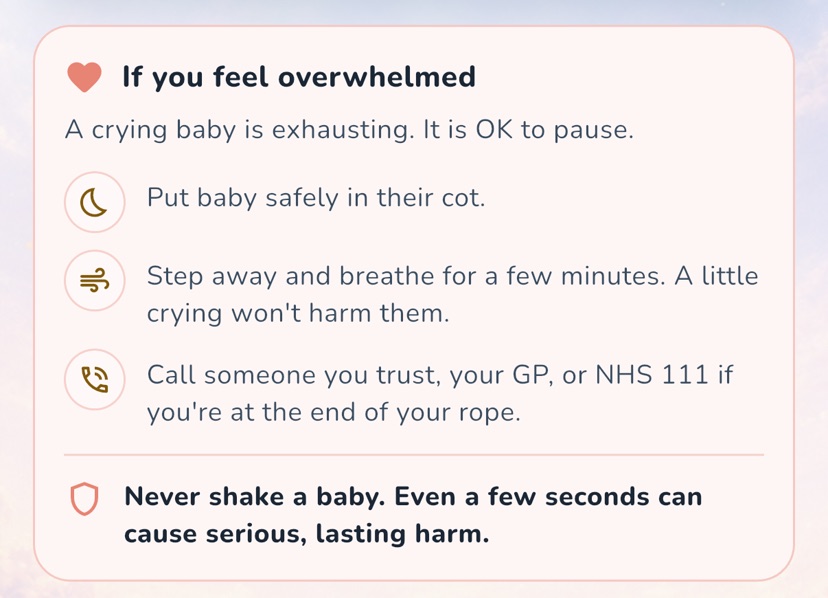
The safety card is always visible. It tells an overwhelmed parent to put baby safely in the cot, step away and breathe for a few minutes, call someone trusted or NHS 111 when needed, and never shake a baby.
OBubba cannot hear the cry, examine your baby or diagnose colic, reflux, allergy or illness. “Most likely” is a data-grounded starting point, not medical clearance.
Crying logs and the Crying Helper, including the safety reset and your family's soothing history, remain available without Premium. The deeper Guidance panel where OBubba surfaces personalised multi-day patterns is a Premium feature. OBubba unlocks Premium during pregnancy and through the first two corrected-age months; plan options follow after that early-free period.
Keep the evening pattern in one calm place → — crying intensity, feeds, naps, nappies, soothing history and a safety reset in one family record.
If you feel the anger rising
Crying is designed to be hard to ignore. Exhaustion can turn concern into panic or anger surprisingly fast.
Put your baby on their back in their clear, safe cot. Leave the room for a few minutes. Breathe, drink water and call someone. Return and check your baby when calmer. A brief period of crying in a safe cot is safer than continuing to hold a baby when you feel out of control.
Never shake a baby. Shaking can cause brain damage and death.
The NHS lists the Cry-sis helpline for parents coping with crying and sleepless babies: 0800 448 0737, open 9am–10pm, seven days a week. If you think you might harm your baby or cannot keep either of you safe, get immediate help from another adult or emergency services.
When evening crying needs medical help
Contact your GP or NHS 111 if the crying is constant and cannot be consoled or distracted, the cry is unlike your baby's normal cry, your baby is not interested in feeding, you are worried or you are finding it hard to cope.
Call 999 if your baby:
- has a seizure
- is blue, grey, very pale or blotchy
- is unresponsive, unusually floppy or hard to wake
- has difficulty breathing, grunts or breathes very fast
- is repeatedly projectile vomiting
- has a high or low temperature
- has a rash that does not fade under pressure
- has had no wet nappy for eight hours
Follow the current NHS crying-baby guidance and trust your instincts. Do not wait for the usual 6pm start time if something feels wrong at 5:45pm.
Frequently asked questions
What age does the witching hour start?
Evening fussiness can appear in the early weeks. NHS guidance says crying often increases from around two weeks and gradually reduces around three months, but there is wide variation.
How long does the baby witching hour last?
It may be minutes or several hours; the name is not a timer. Record the actual start and end rather than assuming every evening contains one hour of crying.
Is witching-hour crying caused by low milk supply?
Not by itself. Evening cluster feeding is common. Assess supply using feeding effectiveness, wet nappies, weight and professional support—not crying frequency alone.
Is the witching hour the same as colic?
No. Witching hour describes timing; colic describes excessive crying in an otherwise healthy baby. They can overlap, but neither label should replace assessment when a baby seems unwell.
Should I bring bedtime earlier?
For an older baby whose evening crying repeatedly follows short naps or a missed final nap, try bedtime 15–20 minutes earlier for several days. For a newborn, feed and settle responsively rather than trying to force a clock-based bedtime.
Why does nothing soothe my baby?
Sometimes comfort does not stop crying immediately. Your holding, voice and presence still support them. If the crying is constant, unusual, accompanied by symptoms or you are worried, contact a health professional.
Can I put my baby down and walk away?
Yes, when crying is overwhelming: place baby safely on their back in their clear cot, step away briefly and return when calmer. Never leave them somewhere unsafe and never shake them.
Ready to try OBubba?
Use OBubba to track feeds, sleep, naps, nappies, growth, milestones and family handovers in one calm baby tracker app.