You prepare the tiny bowl, sit your baby upright and offer the first spoon. Their mouth closes. Their head turns. The carefully mashed lunch lands untouched—or is accepted, examined and pushed straight back out.
It can feel like something has gone wrong. Usually, one refused meal means much less than it feels like in the moment.
The helpful response is not to persuade your baby to take one more bite. End the pressure, check whether timing or texture is getting in the way, and look at the pattern across several meals. Babies learn to eat gradually. Touching, smelling, licking, holding and spitting out food can all be part of that learning.
This guide is for babies who have started complementary foods at around six months and are otherwise well. If your baby is not yet showing the three readiness signs together, has a known feeding condition or was given an individual plan by their clinical team, follow that advice instead.
What to do at the next meal
Keep the next attempt deliberately small:
- Choose a calm time. Aim for awake and interested—not exhausted, frantic with hunger or already full from a milk feed.
- Sit together. Secure your baby upright in a suitable highchair and stay within arm's reach.
- Offer a tiny amount. One familiar food and one learning food are enough. More on the tray does not create more appetite.
- Give your baby some control. Wait for an open mouth before bringing a spoon closer, or place a safely prepared finger food where they can pick it up.
- Respect “finished”. A closed mouth, repeated head turn, pushing the spoon away, throwing food after a brief exploration or becoming upset are good reasons to stop.
- Try again another day. A refusal is information, not a verdict on the food or your parenting.
The NHS advice for fussy eaters is refreshingly calm: do not force rejected food; remove it without a fuss and offer it again another time. Although that page also covers toddlers, the pressure-free principle is useful from the beginning.
Why is my baby refusing solids?
The same head turn can have several explanations. You do not need to diagnose the cause during lunch. Use the rest of the day as evidence.
| What you notice | What may be getting in the way | A gentle next experiment | |---|---|---| | Refusal is worse before naps or late in the day | Tiredness or overstimulation | Move the meal earlier, shorten it and reduce distractions | | Baby recently had a full milk feed | Not hungry yet | Leave a little more space while continuing usual milk feeds | | Baby is crying hard before food arrives | Too hungry or dysregulated | Offer milk responsively if due; try solids when calm another time | | Familiar smooth foods are accepted but lumps are refused | Texture step feels too large | Fork-mash more finely, then increase texture gradually | | Spoon is refused but baby reaches for food | Wants more control | Offer a preloaded spoon or safe finger food alongside | | Food is mouthed, moved around and spat out | Still learning the oral skill or flavour | Count the exploration and re-offer without pressure | | Several new foods are refused but favourites are accepted | Unfamiliarity | Pair one new food with something familiar; keep the portions separate | | Appetite dipped with teething, a cold or constipation | Temporary discomfort | Prioritise comfort and fluids; use manageable foods and seek advice if concerned | | Coughing, choking or wet/gurgly sounds repeat at meals | Possible swallowing difficulty | Stop experimenting alone and seek prompt professional advice |
Change one thing at a time. If you alter the food, texture, chair, timing and portion together, you will not know what helped.
Refusal is not the same as “doesn't like it”
A baby cannot tell you that broccoli is permanently off the menu. They may be surprised by its bitterness, unsure how to move it around their mouth, too tired to explore or simply not interested today.
Repeated exposure is not repeated pressure. It means allowing the same food to appear again on another day, prepared safely and in a manageable texture, without making acceptance the price of ending the meal. The NHS notes that some foods take many attempts before a child accepts them.
Progress might look like:
- tolerating the food on the tray
- touching or squashing it
- bringing it to the mouth, then removing it
- licking or taking a tiny taste
- managing one texture but not another
- eating some on one day and none the next
Those are not all nutritionally equal, but they are meaningfully different from a meal filled with distress. Early weaning is a skill-building period as well as a feeding period.
Check the timing before changing the food
The NHS weaning hub recommends introducing a varied diet from around six months alongside usual breast milk or first infant formula. Milk does not suddenly become a mistake when solids begin.
There is no universally perfect number of minutes between milk and food. A baby offered solids immediately after a satisfying feed may not be interested; a baby kept waiting until desperately hungry may be too upset to learn. Try a calm point between those extremes and watch your own baby's cues.
For three days, note:
- when the last milk feed ended
- when solids began
- whether baby was calm, sleepy, upset or alert
- what was offered and how it was prepared
- whether baby loved it, seemed unsure or showed a possible reaction
If refusal clusters at the same tired time each day, a timing experiment is more sensible than buying seven new foods.
Check whether texture is the real sticking point
“Baby refuses food” can hide two opposite texture problems.
The step up may be too large
If a baby manages smooth purées but repeatedly becomes distressed by lumps, reduce the jump. Instead of moving from completely smooth food to distinct chunks, try a thicker blend, a fine fork-mash and then soft, gradually more noticeable texture.
This is a temporary bridge, not a reason to keep every meal completely smooth indefinitely. Babies need opportunities to develop eating skills as they are ready.
The food may offer too little control
A baby who closes their mouth to a spoon may happily grab a soft floret, hold a preloaded spoon or scoop mash with their fingers. That does not prove spoon feeding is wrong. It suggests that participation matters at that meal.
Use a combination if it helps: a little mash on a spoon plus one soft finger food. Test softness before serving, prepare the shape for your baby's current skill and supervise continuously.
Check the feeding dynamic
When we are worried, “one more bite” can creep in almost automatically. The spoon follows the baby's head. A toy is used to distract them into opening their mouth. Praise becomes negotiation.
Pause when you notice that happening. Your job is to provide an appropriate food, a safe place and a calm opportunity. Your baby's job is to decide whether and how much to eat from what is offered.
Helpful mealtime habits include:
- eating with your baby when practical so they can watch you
- keeping screens and frantic entertainment away
- using a small portion, with more available if wanted
- allowing mess and exploration within safe limits
- describing food neutrally: “soft pear” rather than “you love pear”
- ending the meal calmly when your baby has had enough
Do not use a favourite food as a reward for swallowing something else. Familiar foods can sit beside learning foods without becoming a bargaining chip.
A simple three-day reset
If several meals have become tense, simplify the next three days. This is not a medical treatment or a rigid schedule; it is a way to make the pattern visible.
Day 1: remove the performance target
Offer a tiny amount of one familiar, age-appropriate food at a calm time. Let your baby lead the pace. End on the first clear run of refusal cues rather than extending the negotiation.
Record the time, milk context, texture and response. Do not record a guessed number of grams.
Day 2: offer control in two ways
Serve the same food in two safe forms if appropriate—for example, fork-mashed avocado on a preloaded spoon and a soft avocado slice prepared for your baby's stage. The purpose is not to make them eat both. It is to see whether participation changes the response.
Day 3: add one learning food
Keep the familiar option and add a very small amount of one different flavour or texture. If the new food is a major allergen, introduce it according to current guidance and any personalised medical advice; do not combine several new allergens just to complete the reset.
At the end, ask:
- Was baby more comfortable at a different time?
- Did self-feeding create more interest than being fed?
- Was one texture easier?
- Was the refusal only for unfamiliar foods?
- Did anything look like pain, illness, allergy or swallowing difficulty?
You are looking for a direction, not a perfect meal.
Refusal, gagging and allergic reaction are different records
These events need different responses.
Refusal can look like a closed mouth, turning away, pushing food aside or losing interest. It is usually a cue to stop and try another time.
Gagging can happen while a baby learns to manage new texture. It may be noisy and can include tongue thrusting or retching. Stay close, remain calm and never put fingers into the baby's mouth blindly. Read our fuller guide to gagging versus choking.
Choking means the airway is blocked and may be silent. Before starting solids, learn baby first aid from a reputable provider. In an emergency, call 999.
A possible allergic reaction can include swelling of the lips or face, an itchy rash, wheezing or coughing, vomiting, tummy symptoms or worsening eczema. Stop the food and follow appropriate NHS advice; severe breathing difficulty, marked swelling, collapse or unusual floppiness is an emergency. Our baby-allergen guide explains a calmer introduction record.
Do not label “unsure” as “reaction” because a food was spat out. Equally, do not downgrade physical symptoms to fussiness.
What is worth tracking—and what is not
The goal is to make the next decision easier, not create a mealtime spreadsheet.
Track:
- the actual food and preparation: “fine-mashed lentils,” not just “lunch”
- the time and nearby milk feed
- a simple response: loved, unsure or possible reaction
- useful context such as tired, teething, constipated, distracted or unwell
- repeated coughing, gagging, pain or vomiting
Skip:
- estimating every gram from food left on the bib
- deciding your baby “hates” a food after one offer
- comparing intake with a social-media plate
- logging while your baby needs both hands and your attention
Three concise, honest entries are more useful than a week of “ate badly”.
How OBubba uses the pattern
In the current app, open Track → Feed → Solids and type what your baby actually ate or explored. You can choose Loved it, Unsure or Reaction. Recognised food names can also surface allergen and safety information while you log.
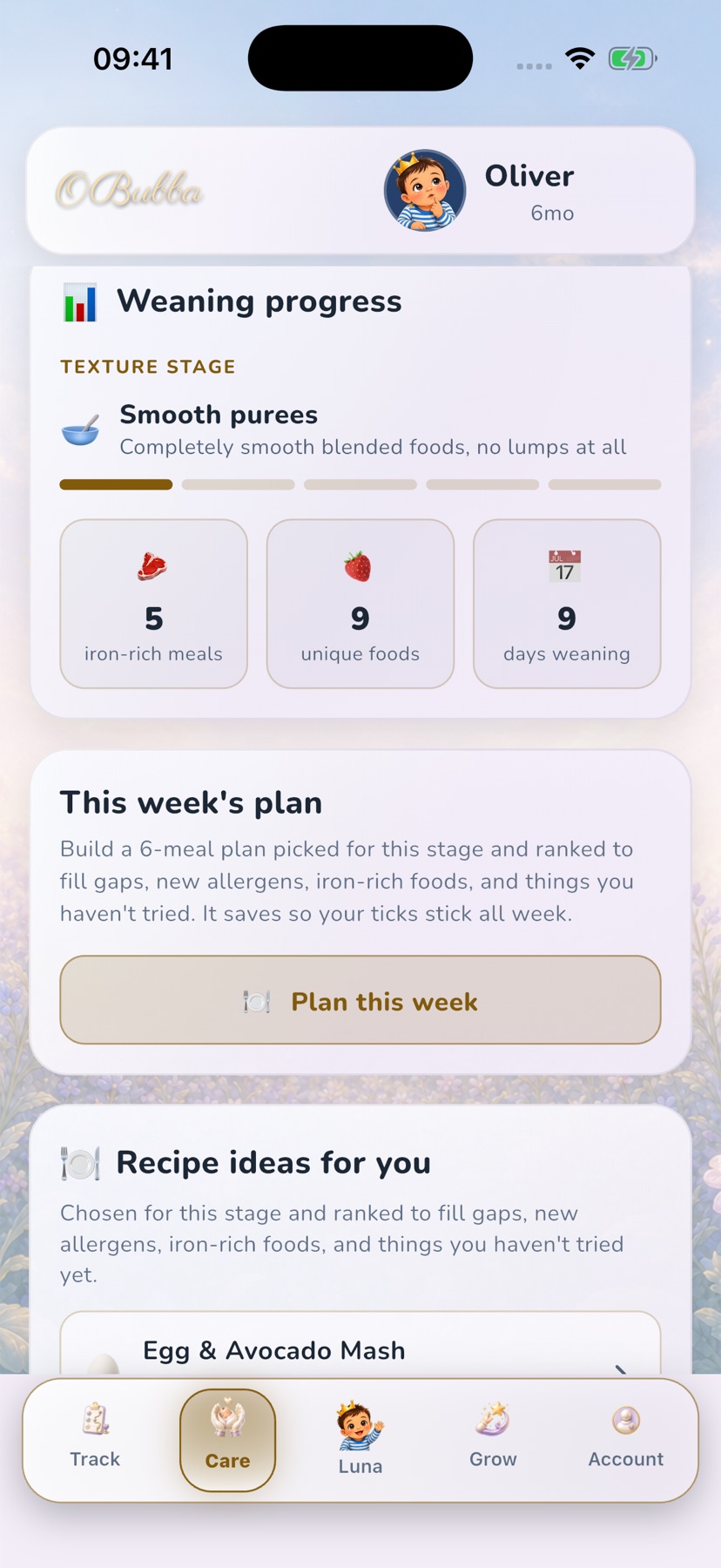
The Care → Weaning area turns those entries into a food journal, allergen journey, texture progress, unique-food count, iron-rich meal count and recipe ideas. Its first-food suggestions prioritise variety and foods not yet logged, while foods linked to a recorded reaction are filtered out rather than casually suggested again.
OBubba also looks for a recent cluster of refusal notes. It waits for three consecutive refused meals logged within about seven days, with the latest no more than four days ago. If the wording points mainly to lumps or gagging, it can surface a texture-focused nudge; if the refused foods are mostly unfamiliar, it can recommend another low-pressure exposure; otherwise it treats the run as a general appetite pattern. That distinction comes from the real log, not a generic daily notification.
The app does not watch your baby swallow, measure nutrients absorbed or diagnose why a meal was refused. It helps you remember what happened, spot a repeatable pattern and arrive at a health-visitor or GP conversation with better evidence.
Solids logging, the food journal, allergen journey and progress summary remain available without Premium. The full recipe collection and deeper personalised pattern guidance are Premium features. OBubba unlocks Premium during pregnancy and through the first two corrected-age months; plan options follow after that early-free period.
Try OBubba free → — milk feeds, solids, textures, allergens, nappies, sleep and gentle pattern support in one shared family timeline.
When to ask for help
Speak to your health visitor or GP if refusal persists, meals are regularly distressing, your baby seems in pain, you are worried about growth, wet nappies reduce, your baby is unusually sleepy or unwell, or you simply feel something is not right.
Ask for urgent advice through your GP or NHS 111 if your baby has difficulty swallowing, repeatedly coughs or chokes while eating or drinking, sounds wet or gurgly after swallowing, becomes short of breath, keeps bringing food or milk back through the nose, or has recurrent chest infections. These are among the warning signs in the NHS dysphagia guidance.
Call 999 for choking, severe breathing difficulty, collapse or signs of a severe allergic reaction.
Frequently asked questions
Should I replace refused solids with milk?
Continue breast milk or first infant formula as your baby's usual milk during the first year and feed responsively. Do not withhold milk to manufacture hunger for solids. If a meal is refused, stay calm and return to the family's normal milk-and-meal rhythm rather than turning the refusal into a contest.
How long should a baby meal last?
There is no magic duration. A short, calm exploration can be more useful than keeping a tired baby in the chair in pursuit of another mouthful. End when your baby repeatedly signals they are finished or becomes distressed.
What if my baby refuses the spoon?
Wait for an open mouth, let them hold a second spoon or offer a preloaded spoon and suitable finger food. Spoon refusal does not necessarily mean food refusal; your baby may want more control.
Should I keep offering a refused food?
Usually, yes—another day, without pressure. Stop and seek advice instead if there was a suspected allergic reaction, repeated swallowing difficulty, pain or specific guidance to avoid the food.
Is spitting food out normal?
It can be part of learning how to move an unfamiliar food or texture around the mouth. Look at the whole pattern. Repeated coughing, choking, wet breathing or voice, significant distress, poor growth or dehydration needs professional assessment.
Can teething cause food refusal?
Sore gums can temporarily reduce appetite or make some textures less comfortable. Offer manageable foods without pressure and watch for signs of illness too; fever or a baby who seems unwell should not automatically be blamed on teething.
When does normal fussiness become a feeding problem?
The threshold is not a particular number of rejected peas. Seek help when the range keeps narrowing, distress is frequent, swallowing looks difficult, intake or hydration is concerning, growth is affected or family meals have become consistently unmanageable. Early advice is appropriate—you do not need to wait for a crisis.
Ready to try OBubba?
Use OBubba to track feeds, sleep, naps, nappies, growth, milestones and family handovers in one calm baby tracker app.