The temperature is normal again. Your baby is feeding more like themselves and the blocked nose is easing. But bedtime still takes an hour, they wake every 90 minutes and the extra cuddles or feeds that helped during the illness now seem essential.
This does not mean you “ruined” sleep by comforting a sick baby. Illness can disturb sleep while it is active, and the temporary way everyone coped can linger after the worst symptoms pass.
While your baby is unwell, prioritise medical advice, hydration, comfort and safer sleep—not sleep training. Once they are genuinely well again, return to the old routine one familiar step at a time. Do not remove every extra comfort on the first better night.
First decide: still ill, recovering or well again?
A normal thermometer reading is useful, but it is not the only sign that a baby is ready for a sleep reset.
| Stage | What you may notice | What bedtime needs | |---|---|---| | Still unwell | Fever, breathing or feeding change, unusual sleepiness, fewer wet nappies, pain or obvious discomfort | Health assessment where needed, close observation, fluids, comfort and the usual safer-sleep space | | Recovering | Temperature has settled but energy, appetite or congestion are not back to normal | Keep the routine recognisable; expect more help and avoid pushing independence | | Back to themselves | Normal alertness, feeds and wet nappies; symptoms have resolved; daytime behaviour looks familiar | Gently reduce temporary help and rebuild the previous settling pattern |
The NHS guide to looking after a sick child says sick children need rest, fluids, company and comfort. It also warns never to fall asleep with a sick baby on a sofa, even when everybody is exhausted.
If you are unsure which column fits, treat that uncertainty as useful information. Stay with comfort and ask your health visitor, pharmacist, GP or NHS 111 for advice rather than using a harder bedtime as a test of whether the illness has passed.
Why sleep can stay difficult after the symptoms ease
Several things may overlap.
The body is still recovering
A baby can be fever-free while congestion, cough, appetite or energy continue to improve. Lying down may still feel different. Day sleep may be longer or more fragmented, changing the pressure for bedtime.
Their rhythm moved
Extra naps, late naps and sleepy feeds are reasonable during illness, but they can shift the timing of the day. When your baby feels better, the old bedtime may temporarily arrive before they are ready—or after they have become overtired.
More help became familiar
During a difficult night you may feed, rock, hold or replace the dummy more often. Those responses were not mistakes. They solved a real problem. A well baby may then protest when the amount of help suddenly changes because the new sequence has become familiar.
Parent vigilance stays high
After monitoring breathing, temperature or intake, it is hard to stop scanning every sound. Parents may respond sooner than before because the night still feels medically charged. That is an understandable nervous-system response, not inconsistency.
It may be something else
Teething, a developmental change, hunger, separation anxiety or a nap transition can arrive during the same week. Timing alone does not prove the illness caused every wake.
The NHS baby sleep guide notes that growth spurts, teething and illnesses can all alter sleep patterns. The useful question is not “How do I make the old schedule happen tonight?” It is “What is still active, and what has become a temporary pattern?”
Safer sleep still applies when baby is congested
Parents understandably want to make breathing feel easier, but illness does not make an inclined or cushioned sleep surface safer.
For every sleep:
- place your baby on their back
- use a firm, flat, waterproof mattress
- keep the cot or Moses basket clear of pillows, nests, bumpers, toys and loose items
- keep your baby in the same room as you for at least the first 6 months
- avoid falling asleep with your baby on a sofa or chair
- do not prop up the cot mattress or use a pillow to elevate the head
The NHS safer-sleep guidance says the safest place for a baby is their own cot or Moses basket, on a firm flat mattress, and says not to co-sleep when a baby has a fever or signs of illness. It also warns that sofa or chair sleep with a baby substantially increases risk.
If you hold your baby upright while awake, move them back to their safe sleep space before you sleep. Plan carer shifts if exhaustion is making that handover difficult.
Do not overdress a feverish baby
A fever is a body temperature of 38°C or above. Use a digital thermometer in the armpit rather than judging from hands or forehead alone.
The NHS fever guidance advises offering fluids, continuing breastfeeding and checking the child regularly, including during the night. It says not to undress or sponge a child down as a fever treatment. NHS clothing guidance also says most unwell or feverish babies do not need extra clothes.
Use the room, sleepwear manufacturer’s instructions and your baby's chest or back—not cold hands—to judge ordinary sleep layers. Do not add a hot-water bottle, electric blanket, hat or heavy bedding.
A gentle reset for the first five well nights
Start only when your baby seems back to their usual health and you are not concerned about feeding, breathing, hydration or alertness. This is a flexible sequence, not a deadline.
Night 1: restore the anchors
Use the familiar bedtime window, dim lights, normal sleepwear and the same short sequence you used before the illness. Keep extra comfort available. The aim is recognition, not independent settling.
If naps drifted during the day, avoid “fixing” them by keeping an exhausted baby awake until the old bedtime. A slightly earlier bedtime may be the kinder bridge.
Night 2: keep the response predictable
Choose one response to the first ordinary wake: for example, pause briefly, offer your usual verbal reassurance, then pick up or feed if needed. A predictable ladder is easier to understand than changing tactics every few minutes.
Do not withhold a feed merely because your baby did not need that feed before becoming ill. Appetite and hydration can take time to normalise. Use age, normal feeding pattern and professional advice—not a sleep goal—to make feeding decisions.
Night 3: reduce one temporary extra
Pick the smallest support that no longer seems necessary. You might shorten the final rocking period, put the dummy back once rather than repeatedly, or settle in the cot after the first cuddle.
Keep everything else the same. Removing feeding, rocking, contact and parental presence together makes it impossible to know which change was too large.
Night 4: repeat before progressing
Repeat the same smaller step. If your baby becomes very distressed, return to the previous level of help and try again later. A reset is not a test your baby can fail.
Night 5: compare with your baby's baseline
Ask:
- Are wakes moving towards the number that was normal before illness?
- Is the longest sleep stretch getting closer to normal?
- Is settling taking less help than on the worst night?
- Are feeds, nappies, alertness and daytime energy back to normal?
Progress may look like four wakes instead of six—not an instant uninterrupted night.
What to track without turning recovery into surveillance
For a few nights, record only the details that answer a decision:
- bedtime and morning wake
- night wakes you actually responded to
- feeds during the night
- naps that meaningfully changed the day
- temperature when you have a reason to check it
- medicine actually given, with name, amount and time
- wet nappies and feeding changes if hydration is a concern
- one short note about symptoms or what helped
Do not wake a sleeping baby simply to create a more complete app record unless a health professional has told you to perform a check. Do not repeatedly take a temperature in a comfortable, recovering baby for the sake of a chart.
A useful note is specific: “No fever today; fed normally; still congested; needed two extra pick-ups.” A label such as “bad night” cannot distinguish recovery from a new problem.
Read what to track when your baby wakes at night for a deliberately lighter logging method.
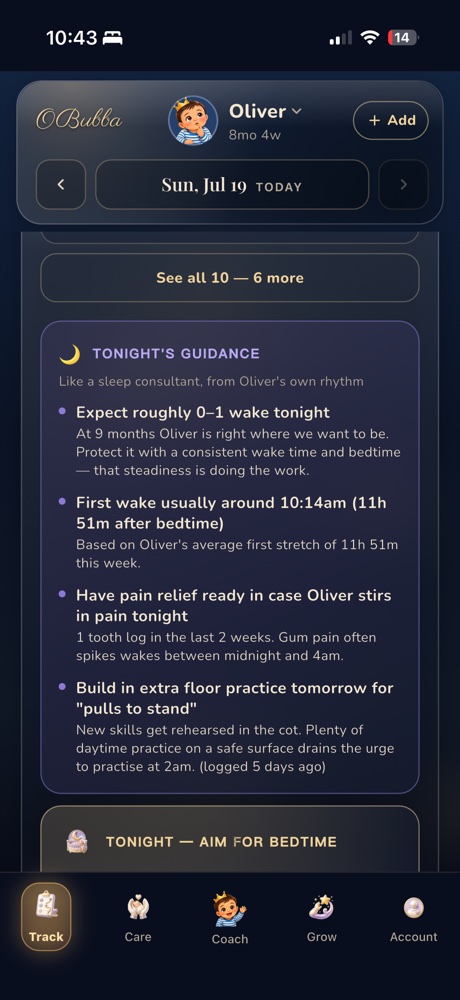
How OBubba handles illness and sleep
The current app does not diagnose a cold, infection or cause of waking. Its illness context is deliberately narrow: it can use a recorded fever, a recognised pain-relief medicine entry and, on the same device, an “illness” disruption tag. A normal temperature check is not treated as proof of illness, and a routine vitamin entry does not place the sleep plan on hold.
When those records show an active illness or very recent fever, the sleep Coach favours comfort and holding the routine over advancing a sleep method. Sleep experiments are also protected from being judged across a disruption window, so a sick week is not presented as evidence that a settling approach failed.
OBubba only offers a “why are nights rough?” comparison when the night record is genuinely different—at least two recent nights with three or more wakes, or a meaningful rise against that baby's earlier pattern. It can then rank recorded context such as fever, teething, a new milestone or an age-related sleep shift without claiming certainty.
If an illness signal is around 5 to 14 days old, no acute fever owns the recent window and nights remain rough, the app can surface a lower-confidence possibility: a lingering post-illness habit. Unlike active illness, that does not freeze the plan. It suggests easing gently back towards the family's usual resettling.
The recovery card needs at least seven recorded nights. It compares the recent rough patch with the median of the earlier nights, tracks the peak wake count and waits for the last two nights to return within one wake of baseline before saying Back to baseline. With insufficient data or no genuine disruption, it stays silent.
This distinction matters:
- Active illness: comfort, safety and health advice lead; do not push sleep changes.
- Recovering: keep the routine recognisable and make fewer demands.
- Well, but wakes linger: gently reduce one temporary support.
- Back to baseline: hold steady instead of introducing another change immediately.
The core Track logs for sleep, feeds, nappies, temperature and medicines are free. Personalised Tonight's Guidance, Insights and the sleep Coach are Premium features that can use the same timeline rather than asking a parent to retell the week from memory. OBubba unlocks Premium during pregnancy and through the first two corrected-age months; plan options follow after that early-free period.
OBubba cannot hear breathing, see skin colour, measure hydration, verify a thermometer reading or decide that a baby is medically well. The app record is context for parents and professionals—not clearance to begin or resume sleep training.
Track recovery without starting over →
Keep the illness night, the recovery nights and your baby's real baseline in one calm timeline that knows when to hold back.
When to seek medical help
Do not assume unusual sleepiness is “catch-up sleep” when a baby seems unwell.
Seek prompt medical advice if your baby:
- is not feeding normally and you are worried
- has nappies that are drier than usual
- is difficult to wake, unusually quiet, floppy or not responding normally
- has breathing difficulty, grunting, very fast breathing or the skin pulling in under the ribs
- has blue, grey, unusually pale or blotchy skin, lips or tongue
- has a rash that does not fade under a glass
- is vomiting repeatedly or has green vomit
- has a temperature that concerns you, especially at a young age
- improves and then becomes clearly worse again
The NHS advises urgent professional assessment for a baby under 3 months with a temperature of 38°C or more, or a child aged 3 to 6 months with a temperature of 39°C or more. Follow the full NHS fever guidance because age, duration and accompanying symptoms change what to do.
Call 999 for severe breathing difficulty, a first febrile seizure, a non-fading rash with serious illness, blue or grey colour, unresponsiveness or another life-threatening emergency. The NHS serious-illness checklist says to trust your instincts—you know what is different from your baby's usual behaviour.
Frequently asked questions
Did I create a bad habit by holding my sick baby?
No. You responded to discomfort and a need for monitoring. Once your baby is well, familiar help may take a few nights to fade. That is a temporary learned sequence, not damage.
How long does post-illness sleep disruption last?
There is no universal number. It depends on the illness, age, feeding, lost sleep and what else is changing. Look for direction across several nights and seek advice if symptoms return or the pattern worries you.
Should I restart sleep training the first fever-free night?
Usually, no. Fever-free does not necessarily mean fully recovered. Wait until feeding, hydration, alertness and daytime behaviour are reassuring, then return gradually. Follow individual medical advice.
Can a congested baby sleep on an incline?
Do not incline the cot or add a pillow, wedge or sleep positioner. Babies should sleep on their back on a firm, flat, clear surface. Ask a health professional how to manage troublesome congestion safely.
Should I wake my baby to check their temperature?
The NHS advises checking a child with fever regularly, including during the night. The right frequency depends on age, symptoms and advice already given. An app cannot set that schedule; ask NHS 111, a GP or another qualified professional if unsure.
Do I need to log every cough and wake?
No. Log enough to answer what changed: sleep timing, meaningful wakes, feeds, nappies, temperatures taken for a reason and medicines actually given. Seek clinical help based on the baby—not on whether the log looks complete.
Why does OBubba sometimes stay silent?
It needs enough reliable history to compare with your baby's own baseline. Silence can mean there are fewer than seven nights for recovery analysis, nights are not meaningfully disrupted, or the app lacks a trustworthy illness signal. It should not invent certainty from sparse data.
The goal is familiar—not perfect
Recovery is not proven by one quiet night, and a noisy night does not mean the illness returned. Rebuild the parts of bedtime your baby recognises, keep comfort available and compare several nights with the pattern that was normal for your family.
The cuddles that carried your baby through being poorly were not a setback. They were care. The reset begins when everyone is ready, and it can be gentle.
Sources
- NHS: Looking after a sick child
- NHS: High temperature (fever) in children
- NHS Best Start in Life: Safer sleep
- NHS: Helping your baby to sleep
- NHS: Is your baby or toddler seriously ill?
OBubba supports records, pattern summaries and educational guidance. It cannot diagnose illness, assess breathing or hydration, verify recovery, prescribe medicine or replace a health visitor, pharmacist, GP, NHS 111 or emergency services.
Ready to try OBubba?
Use OBubba to track feeds, sleep, naps, nappies, growth, milestones and family handovers in one calm baby tracker app.