You put the dummy back in. Your baby closes their eyes. Twenty minutes later it falls out, the crying starts and you cross the landing again. By 3am, you are no longer counting wakes—you are counting re-plugs.
A dummy can be a useful, soothing part of sleep. The problem is not that your baby likes it. The problem is when they wake fully and need an adult to recreate the same condition over and over.
If the dummy falls out and your baby stays asleep, leave it out. If they wake and need it replaced repeatedly, do not rush to remove it—especially in the first six months. First build other predictable sleep cues alongside it, then decide whether the re-plugging is still a problem for your family.
The answer depends on what happens after it falls out
Watch the baby, not the dummy.
| What happens | What it means tonight | What to do | |---|---|---| | Dummy falls out; baby remains asleep | Nothing needs fixing | Leave it where it is | | Baby stirs briefly, then settles | A normal sleep-cycle stir may be passing | Pause and observe before intervening | | Baby wakes and cries; dummy settles them quickly | The dummy is a strong settling cue | Replace if you choose, then look at the multi-night pattern | | Every wake needs an adult re-plug | The cue may be parent-recreated | Build other cues before reducing replacements | | Baby refuses or repeatedly spits it out while awake | They may not want it | Do not force or repeatedly reinsert it | | Waking comes with hunger, pain, fever or breathing difficulty | This is not merely a dummy problem | Meet the need and seek advice when appropriate |
The Lullaby Trust's current dummy guidance says there is no need to put a dummy back in if it falls out during sleep. It also says not to force a baby to take one.
That means a missing dummy is not an emergency. You are responding to the baby's wake, not maintaining an object in their mouth all night.
Are dummies safe for sleep?
The NHS SIDS guidance says parents can consider using a dummy to settle a baby to sleep because some research suggests it may reduce the risk of sudden infant death syndrome (SIDS).
If your family chooses a dummy:
- offer it at the beginning of every sleep rather than only occasionally
- wait until breastfeeding is well established before introducing it—often around four weeks
- do not force it if your baby refuses
- do not put honey, sugar, syrup or anything sweet on it
- never attach it to the neck, clothing, cot or a toy for sleep
- do not use a cord, ribbon, clip or dummy chain in the sleep space
- keep following the rest of safer-sleep guidance
A dummy does not replace the fundamentals. Always place your baby on their back on a firm, flat, clear mattress; keep their cot free of pillows, bumpers, loose bedding, toys, pods and positioners; and room-share for at least the first six months.
If a dummy becomes damaged, sticky, cracked or swollen, replace it. Follow the manufacturer's age and cleaning instructions, and never alter the teat.
When repeated replacement becomes a sleep association
A sleep association is simply something connected with falling asleep. Associations are neutral. A dark room, a familiar song, a feed, rocking, a parent's hand and a dummy can all become sleep cues.
The practical distinction is whether the cue is still available when the baby stirs:
- the cot remains beneath them
- the room stays dark
- a steady background sound continues
- a short routine has already signalled sleep
- a dummy can fall out
- rocking or a feed ends when the parent leaves
Babies naturally surface between sleep cycles. Some move through the stir without help. Others look for the same conditions they had when they fell asleep. If the essential cue has disappeared, they may call for the adult who can recreate it.
That does not prove every wake is caused by the dummy. Hunger, illness, teething, temperature, a wet nappy, a developmental shift or poor sleep timing may produce the same cry. Look for a repeated pattern across ordinary nights rather than blaming the dummy after one difficult night.
Read what to track when your baby wakes at night before making a change.
Under six months: keep the dummy and build other cues
The first response does not need to be dummy removal. Current Lullaby Trust advice recommends gently stopping dummy use between six and 12 months, not during the early months when families may be using it as part of safer-sleep practice.
For a younger baby who needs repeated re-plugs, keep offering the dummy as usual and add cues that cannot fall out:
- Use the same short wind-down in the same order.
- Sing the same quiet sleep song or phrase.
- Place your baby in the same safe sleep space.
- Keep night responses dark and low-key.
- When they stir, pause long enough to see whether they are actually waking.
- If they need you, respond and use the dummy as you normally would.
This is not training a young baby to self-settle. It is making the dummy one part of a recognisable sequence rather than the only signal.
Do not keep a baby crying in order to avoid replacing the dummy. Do not stretch feeds or ignore discomfort because you have decided every wake is “just the dummy”.
Six to 12 months: decide whether you want to change anything
You do not have to remove a dummy simply because somebody else dislikes it. A change is worth considering when:
- repeated replacement is exhausting the family
- your baby cannot return to sleep without adult re-plugging
- dummy use has spread through most of the awake day
- you want to follow guidance to phase it out between six and 12 months
- your health visitor, dentist or another qualified professional has advised a change
The NHS language guide says to offer a dummy only for sleep and aims for complete stopping by 12 months, because a dummy in the mouth reduces opportunities to babble and practise sounds.
Choose a relatively settled week. Delay the change during illness, peak teething discomfort, travel, a major childcare transition or another disruption. A dummy reset is optional sleep work, not an urgent task.
A gradual plan that does not start with cold turkey
Use each stage for several nights. If your baby becomes very distressed, return to the previous stage and move more slowly.
Stage 1: install the new anchors
For at least four nights, change nothing about the dummy. Add the same song, the same short phrase and the same calm cot sequence at every nap and bedtime.
The new cues need time to become familiar while the old one still works.
Stage 2: try the new cue first at one wake
Choose one ordinary wake—not a hungry, painful or unwell wake. Try the sleep phrase, your calm presence and a still reassuring hand first. If your baby does not settle, offer the dummy.
You are testing whether another cue can carry part of the settle, not refusing help.
Stage 3: offer the dummy once at the start of sleep
When the earlier stage feels manageable, offer the dummy as normal at bedtime. If it falls out after your baby is asleep, leave it. At the chosen night wake, start with the other familiar cues.
Continue to respond. “No automatic re-plug” does not mean “no comfort”.
Stage 4: let the routine carry more of the settle
Use the routine, song, cot and parent presence as the main sequence. If your baby finds and uses a plain dummy by themselves, there is no need to turn that into a battle. Never add a clip or cord to make it easier to find in the cot.
Some families stop at Stage 2 because wakes are manageable. Others continue towards no dummy. Success is the smallest sustainable change your family wanted—not a certificate for independent sleep.
What not to do
- Do not remove the dummy and every other comfort on the same night.
- Do not replace a needed milk feed with a dummy.
- Do not assume a cry is manipulation.
- Do not smear the dummy with anything sweet.
- Do not use a damaged or age-inappropriate dummy.
- Do not attach a dummy to clothing, bedding, a toy or the cot during sleep.
- Do not add pillows, nests, positioners or loose comfort objects as replacement cues.
- Do not begin during illness or a clearly disruptive week.
- Do not log dozens of tiny stirs that did not require you.
The aim is not to make a baby stop signalling. It is to give them more than one familiar route back to sleep.
Track the response, not every drop
For three to five ordinary nights, record:
- bedtime
- meaningful night wakes
- whether the wake needed a feed or another care need
- how the baby returned to sleep
- whether the dummy was used
- how long the wake lasted, if known
- naps and bedtime timing when they were notably different
One useful entry might be: “1:40am wake; dummy; asleep in 4 minutes.” Another might be: “4:55am wake; full breastfeed; dummy not relevant.”
Those are different wakes. Collapsing both into “dummy again” can hide genuine hunger.
Do not record every time you notice the dummy outside your sleeping baby's mouth. If the baby did not wake and no care happened, there is no sleep problem to analyse.
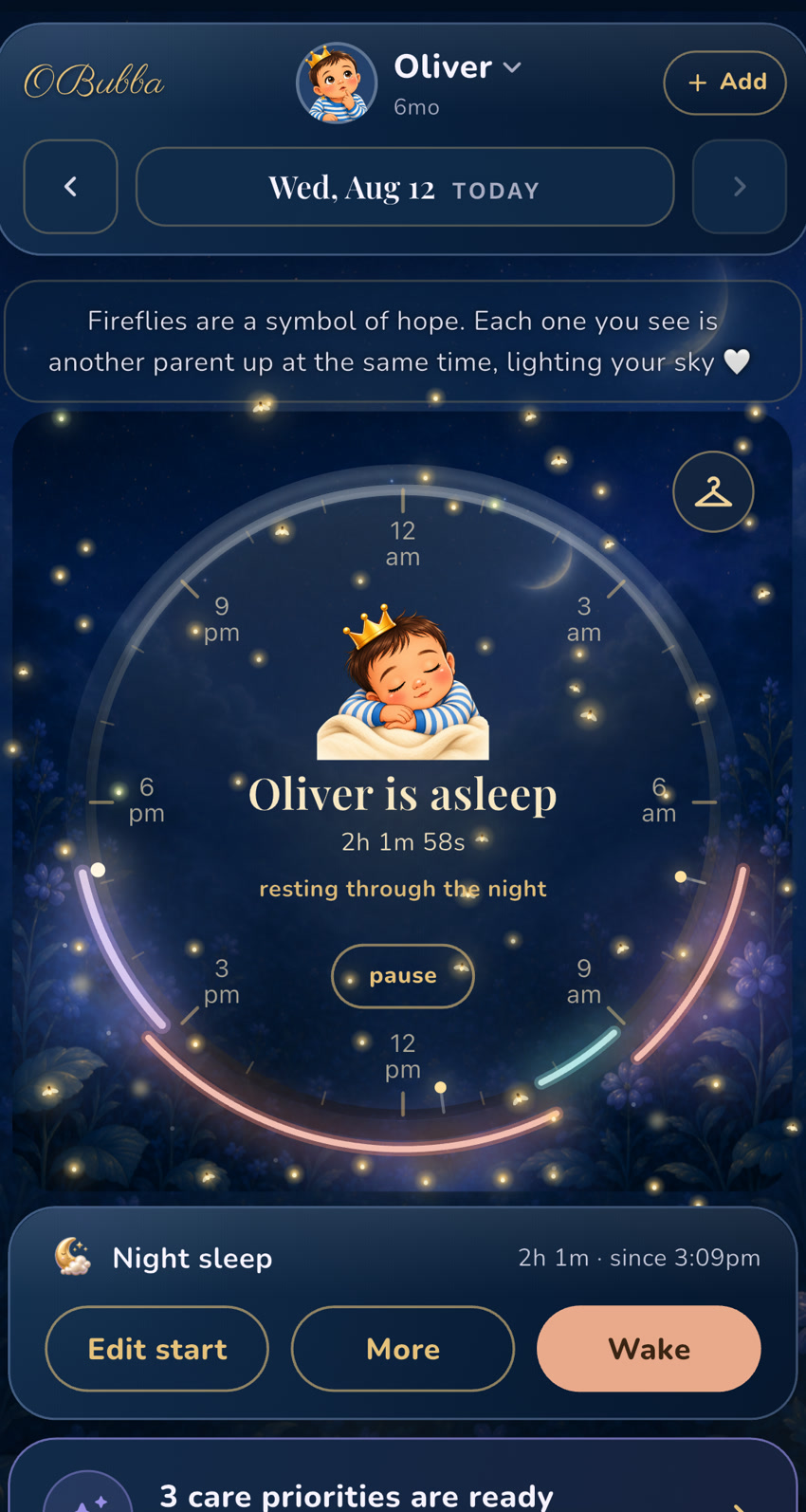
How OBubba recognises a dummy pattern
In the current app, a night wake can record how your baby was resettled, including Dummy, feeding, rocking, holding, patting or self-settling. OBubba analyses the method a parent actually records; it cannot detect when a dummy falls out.
The comfort-dependency insight requires at least three recorded wakes in one night. It only names a single settling association when the same parent-recreated method handled at least 80% of those wakes. Two dummy replacements do not create a diagnosis, and a mixed night should not be reduced to one cause.
The wording is deliberately non-judgemental: a dummy association is normal and only worth changing if the wakes bother your family. Genuine hunger and comfort cues always come first.
For babies from roughly four months, OBubba may offer an association-building insight when the history supports it. If the dominant cue is a dummy and the baby is under roughly six months, the app keeps the dummy and recommends building the song, cot and routine around it. The structured Swap the dummy plan is not offered yet. This reflects current safer-sleep guidance that dummy use during sleep is associated with a lower risk of SIDS; it is not a promise that a dummy prevents SIDS.
From roughly six months, when the app has enough evidence and the family chooses the plan, Care → Sleep Consultant can offer four rungs:
- Build the anchors: keep the dummy and add the same song, cot and routine for at least four nights.
- Re-plug less: try the song and a reassuring hand first; use the dummy if needed.
- Offer once: offer it at settling, then use the other cues at wakes.
- The song carries it: the routine and song become the main cues.
The sleep Coach checks readiness before a plan starts and pauses progression during illness, teething peaks, travel or another recognised disruption. Its verdict also considers whether the family followed the current rung and whether sleep actually improved; it is not merely a calendar counting down.
OBubba cannot verify safer-sleep conditions, determine why a baby is crying, assess feeding needs or know whether dummy withdrawal is appropriate for an individual child. Its pattern is only as reliable as the wakes and methods recorded.
Recording sleep, meaningful wakes and the resettling method in Track is free. The personalised association insight and Care → Sleep Consultant plan are Premium features. OBubba unlocks Premium during pregnancy and through the first two corrected-age months; plan options follow after that early-free period.
See which wakes really need you →
Log the wakes that matter and use a sleep plan that keeps the dummy when it should, builds new cues first and never calls responsive comfort a failure.
When the dummy is probably not the main issue
Step back from the plan if waking changes suddenly or comes with:
- fever or signs of illness
- difficult, noisy or unusually fast breathing
- poor feeding or fewer wet nappies
- repeated vomiting
- obvious pain or inconsolable crying
- unusual sleepiness or difficulty waking
- a new rash or colour change
- snoring, pauses in breathing or persistent mouth breathing
- faltering growth or another concern about wellbeing
Speak to your health visitor, pharmacist, GP or NHS 111 as appropriate. Call 999 for severe breathing difficulty, blue or grey colour, unresponsiveness, a first seizure or another life-threatening emergency.
The dummy can settle a baby who is uncomfortable; that does not prove the underlying need has disappeared.
Frequently asked questions
Should I put the dummy back in after my baby falls asleep?
No. If it falls out and your baby remains asleep, the Lullaby Trust says there is no need to replace it.
Is a dummy a bad sleep association?
No. It is a sleep association, not a moral problem. It becomes inconvenient when an adult must recreate it repeatedly and the family wants that pattern to change.
Can I stop the dummy before six months?
Get individual advice before changing a dummy that is part of your young baby's established sleep routine. UK safer-sleep guidance discusses offering it consistently and gently withdrawing it between six and 12 months.
Should I scatter several dummies around the cot?
Keep the sleep space simple and never attach a dummy to a toy, clip, cord or clothing. This guide does not rely on adding objects to the cot. Follow current safer-sleep and manufacturer guidance.
What if my baby can replace the dummy alone?
You do not need to prevent them using a plain, safe dummy they can independently find. Continue to avoid all attachments and keep the rest of the cot clear.
Will removing the dummy stop all night wakes?
No. Babies wake for many reasons, including hunger, discomfort, development and normal sleep-cycle transitions. A successful change should reduce the wakes that specifically required re-plugging—not promise an uninterrupted night.
How does OBubba know it is a dummy association?
It needs at least three logged wakes and the dummy must account for at least 80% of the recorded resettles that night. It does not use the baby's age or the mere presence of a dummy as proof.
A dummy can be helpful without running the whole night
You do not need to choose between replacing it twelve times forever and throwing it away tonight. Keep it when it is useful, build cues that remain available after it falls out and reduce only the part of the pattern your family wants to change.
If your baby sleeps on, let them sleep. That is one less job for both of you.
Sources
- The Lullaby Trust: Dummies
- NHS: Sudden infant death syndrome (SIDS)
- NHS: Help your baby learn to talk
- NHS: Helping your baby to sleep
OBubba supports sleep records, pattern summaries and educational guidance. It cannot supervise sleep, verify dummy safety, diagnose a cause of waking or replace individual advice from a health visitor, dentist, feeding professional, GP, NHS 111 or emergency services.
Ready to try OBubba?
Use OBubba to track feeds, sleep, naps, nappies, growth, milestones and family handovers in one calm baby tracker app.