Enter age and morning wake time to get a sample day with nap times and an age-appropriate bedtime.
Using Smart Sleep Coach by Pampers? It closes on 30 November 2026. What to do next, including how to ask Pampers for your baby’s full data.
Your baby is finally asleep against your chest. Their hands are loose, their breathing has softened and you begin the slow walk towards the cot. You lower them centimetre by centimetre. The mattress touches their back, and both eyes open.
Why can a baby sleep through conversation, footsteps and a squeaky floorboard, then wake at the exact moment you put them down?
Because the transfer changes several things at once: warmth, pressure, smell, movement, body position and closeness. A young baby may notice that contrast immediately. It is especially common in the newborn weeks and does not prove you have created a bad habit.
Start by making the transfer safe and less abrupt. If it still fails, respond to the baby rather than repeating it until everyone is distressed. One cot attempt can be practice; it does not have to become a battle.
> A baby waking on the mattress is not rejecting the cot, or you. They noticed a big sensory change while sleep was still fragile.
What to try at the next sleep
Use this as an experiment, not a guaranteed formula.
- Prepare the sleep space first. Use a clear cot or Moses basket with a firm, flat mattress. Remove pillows, nests, wedges, toys and loose objects.
- Meet the need that is actually present. Feed a hungry baby, change a necessary nappy and address illness or discomfort before treating the transfer as a technique problem.
- Keep the room calm. Reduce sudden light, noise and conversation, but do not worry about making the whole house silent.
- Move close to the cot before lowering. Hold baby securely against your body so the distance and angle do not change abruptly.
- Lower slowly onto their back. Keep the head and neck supported and the face clear. Many parents find bottom and torso touching before the head makes the change feel less sudden, but this is a practical experiment, not a medical rule.
- Pause with your hands still. A gentle, unweighted hand can remain briefly while baby adjusts. Never press down, restrain the baby or leave any weighted product in the cot.
- Respond if baby wakes. A quiet voice, still hand, patting or picking up may be appropriate. If distress rises, reset rather than repeatedly lifting and dropping.
There is no required number of attempts. If you are becoming frustrated or dangerously sleepy, safety decides the next step.
Why the cot feels so different
In your arms, a baby receives a dense bundle of cues:
- body warmth
- your smell and voice
- pressure around their body
- gentle motion
- a curled, supported posture
- immediate response to small movements
A clear, flat cot is deliberately different. It is firm, still and open because that is the safer sleep environment, not because it perfectly imitates being held.
Trying to recreate your body with soft or weighted objects introduces hazards. Do not add a pillow, sleep positioner, rolled towel, nest, cot bumper, weighted blanket or toy to make the mattress feel more “cuddly”. The Lullaby Trust is explicit: the safest cot is a clear cot with a firm, flat, waterproof mattress and appropriate lightweight bedding.
Is this normal for a newborn?
Very often, yes.
The NHS says it is very common in the early days for a baby to fall asleep while being held and wake when placed in a cot; they want to be near you. It advises families to allow time to adjust rather than worry about what they should already have achieved.
Newborn sleep is immature and spread across day and night. Young babies need frequent feeding, help regulating and plenty of hands-on comfort. “Put them down drowsy but awake” is an option some families practise, not an NHS milestone and not proof of good parenting.
For a baby under roughly four months, the OBubba app does not offer its structured sleep-association swap plan. It keeps the focus on safe sleep, feeding and gentle rhythm rather than treating closeness as a problem to train away.
Which kind of wake is it?
The timing around the transfer changes the likely next step.
| What happens | What may be contributing | What to try |
|---|---|---|
| eyes open the instant the mattress touches | abrupt sensory or positional change | slow the lowering, keep close and pause with still hands |
| arms fling out and baby startles | startle response or sudden loss of support | keep head and body supported throughout; reduce the final drop distance |
| baby settles in the cot with a still hand but cries when it leaves | closeness is still part of settling | fade your touch gradually if and when you want to; there is no need to rush |
| transfer works after some sleeps but not others | sleep depth, timing, hunger and day context vary | compare several similar sleeps before changing the routine |
| baby wakes after 20–60 minutes rather than immediately | a short nap or bedtime false start, not simply the transfer | review the final wake window, day sleep, feeding and discomfort |
| baby arches, coughs, cries in pain or struggles when flat | possible discomfort or illness | seek medical advice rather than repeatedly testing transfer tricks |
| parent is nodding off while holding baby | an urgent safety problem | put baby in the clear cot even if they wake; get another awake adult if available |
The cot transfer may be the final event you see, but not the original cause. A very overtired baby can fall asleep heavily in arms and wake unsettled during any change. A baby with low sleep pressure may become fully alert once movement stops. Hunger, a wet nappy, temperature, reflux symptoms or illness may also matter.
Should I wait until deep sleep?
You can compare an earlier and later transfer, but do not build the whole plan around an exact stopwatch number.
Sleep is not a simple switch from “light” at 7 minutes to “deep” at 20. Babies vary, and the same baby’s state changes from sleep to sleep. Waiting longer may help one transfer and create another problem: the adult becomes increasingly tired, trapped or at risk of falling asleep.
Try two approaches on different, comparable sleeps:
- earlier transfer: settle until calm and drowsy, then let the cot carry the final step
- later transfer: wait until breathing and limbs appear relaxed, then move slowly
Record which was attempted and what happened. Do not conclude that minute 17 is your baby’s biological secret after one success.
Is “drowsy but awake” necessary?
No. It is one gradual-learning approach, not a safety requirement.
Some babies tolerate being placed down calm but awake. Others become more alert and upset. Feeding, rocking, patting or holding to sleep can all be responsive ways to settle a baby. They only need changing when the arrangement is no longer safe, workable or wanted by the family.
If you do want to practise, make the step small:
- keep the familiar routine
- settle almost as much as usual
- place baby down slightly more awake than on the previous successful transfer
- continue support in the cot with voice or a still hand
- pick up and reset if distress escalates
Progress may mean tolerating ten calm seconds on the mattress, not falling asleep independently on night one.
A gentle holding-to-cot ladder
Use one rung for several days if it remains comfortable. Skip the ladder entirely when the current method works for your family.
Rung 1: make the safe transfer predictable
Use the same short phrase or song as you move towards the cot. Keep all other help.
Rung 2: reduce movement before the transfer
Slow rocking to swaying, then still holding. This separates “motion stopped” from “body left” so they do not happen simultaneously.
Rung 3: finish settling with cot-side support
Place baby down calm and continue with your voice, a still unweighted hand or gentle patting.
Rung 4: shorten cot-side help
If baby remains comfortable, make the touch a little lighter or briefer. Keep the song or phrase.
Rung 5: let the repeatable cue do more
The routine, darkened room and familiar song remain while hands-on help reduces.
This is not a promise of no crying. It is permission to respond, step back a rung and pause during illness, teething, a developmental disruption or family exhaustion.
What if cot naps are always short?
First separate transfer failure from nap length.
- waking before you remove your hands is a transfer problem
- waking 10 minutes later may involve fragile sleep or discomfort
- waking around one short sleep cycle may be a short-nap pattern
- waking happy can mean the nap was enough today
- waking fussy and still tired may justify one resettle or a safely supervised contact rescue
If you begin a nap in the cot and finish it as a contact nap, treat it as one continuous sleep with a location change. Splitting it into two separate naps creates a fake wake window between them and can distort the next prediction.
A five-sleep transfer experiment
Choose five ordinary naps or bedtimes. Do not use illness, travel or unusually disrupted days as your clean comparison.
| Record | Why it helps |
|---|---|
| sleep and time | bedtime may behave differently from Nap 1 |
| final awake stretch | shows whether the transfer failures cluster after unusually short or long windows |
| settling methods | “fed + held + rocked” is more honest than forcing one label |
| time to fall asleep | separates a difficult settle from a difficult transfer |
| transfer approach | earlier, later, movement slowed first or cot-side support |
| immediate result | stayed asleep, stirred, opened eyes calmly or cried |
| where the sleep continued | cot, contact or moved from cot to contact |
| wake time and mood | shows whether a successful transfer also produced restorative sleep |
| useful context | hunger, illness, teething, room conditions and noise may explain outliers |
After five sleeps, look for one relationship. If transfers work when the final wake window is ordinary but fail after unusually long stretches, timing may be more useful than practising independent sleep. If every transfer fails but contact sleep is long and settled, location and closeness are the clearer variables.
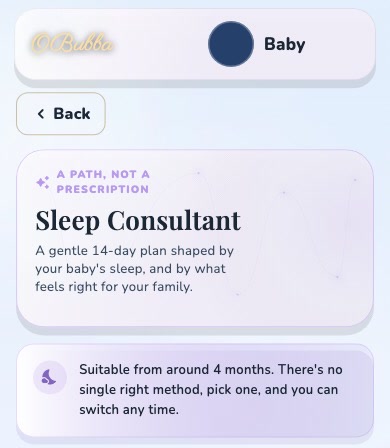
How OBubba handles cot transfers
The app does not claim it can detect a failed transfer from a sleep timestamp. It stores the pieces around the event and waits for an actual pattern.
Settling can be multi-select
For a nap or bedtime, parents can select Self-settled, Fed to sleep, Rocked, Held, Patted and Dummy. Hands-on methods can be combined because a real settle may be fed, rocked and held, not one tidy category. Self-settled is mutually exclusive with hands-on methods so the analysis does not falsely claim independence.
The same log can record time to fall asleep as under 5, 5–15, 15–30 or 30+ minutes. That distinguishes “fell asleep quickly but woke on contact with the mattress” from “needed 40 minutes to settle before the transfer even began”.
Nap location can change without creating a fake nap
Nap logs include Cot, Contact, Pram, Carrier, Car and Other, plus an optional Moved to field. If a nap starts in the cot and is rescued in arms, OBubba stores cot → contact on one nap.
That detail matters. Logging two separate naps would invent a tiny awake gap and could make the next wake-window calculation less trustworthy.
A sleep association needs more than one transfer
OBubba’s comfort-dependency insight only considers a pattern when at least three night wakes have a settling method. The same parent-recreated method must account for at least 80% of those recorded wakes. Independent settling is not called a dependency.
If that pattern exists, the app reviews the dominant hands-on method across seven nights before offering a method-specific plan. Holding, rocking, patting, feeding and dummy use have different ladders.
Structured swaps are age-gated
OBubba does not return a structured association-swap plan below 17 weeks. At or above that age, the plan is an optional gentle offer: add a consistent song and cot routine before fading the hands-on method in small steps. It explicitly says to follow genuine hunger and comfort cues and pause if the baby is unwell or in a disruption.
For dummy use below 26 weeks, the app keeps the dummy and builds other cues rather than suggesting its removal.
Night wakes can record the whole resettle
At a night wake, the current tracker can store an ordered soothe breakdown, such as fed for 10 minutes, held for 6, then self-settled for 4. The app can compare what actually resolved wakes instead of assuming the first method tried did all the work.
What OBubba cannot know
OBubba cannot see the transfer, measure sleep stage, diagnose reflux or pain, verify the cot setup or determine why a baby woke. A timestamp cannot distinguish a creaky floorboard from hunger. The value is in preserving enough honest context to avoid giving every family the same advice.
Try OBubba’s sleep tracker free →, record the settle, location, cot-to-contact rescue and wake outcome in one timeline, then let repeated nights, not one failed transfer, shape the next step.
Safer sleep matters more than a successful transfer
For every sleep:
- place baby on their back
- use a separate cot or Moses basket with a firm, flat, waterproof mattress
- keep the sleep space clear of pillows, duvets, cot bumpers, toys, nests, pods, wedges and positioners
- keep baby’s head uncovered and avoid overheating
- keep the cot in the same room as you for the first six months, day and night
- return baby to their own sleep space before you go to sleep
- never fall asleep with a baby on a sofa or armchair
Do not warm the mattress with an electric blanket or leave a hot-water bottle in the cot. Do not add weight to mimic your hand. A transfer hack is never worth making the sleep surface softer, inclined, padded or restrained.
When waking flat needs medical advice
Most transfer wakes are ordinary. Speak to your health visitor or GP if lying flat repeatedly comes with:
- pain, persistent arching or inconsolable crying
- coughing, choking, wheezing or breathing difficulty
- frequent forceful vomiting, green vomit or blood
- feeding that is painful, markedly reduced or otherwise concerning
- fewer wet nappies, poor weight gain or unusual sleepiness
- a sudden change from the baby’s usual pattern alongside illness signs
Call 999 if your baby has severe breathing difficulty, turns blue or grey, is floppy or difficult to wake, has a seizure, a non-fading rash or another life-threatening symptom. Do not wait for a sleep-tracking pattern.
Frequently asked questions
Why does my baby wake as soon as their back touches the cot?
The change from warm, moving, enclosed arms to a cool, still, open mattress can be noticeable while sleep is fragile. Keep the transfer slow and supported, but remember that immediate waking is common in young babies.
How long should I wait before putting a sleeping baby down?
There is no universal number. Compare an earlier and later transfer across several similar sleeps. Stop waiting if holding the baby is making you dangerously sleepy.
Should I put my baby down awake?
You can practise putting baby down calm or drowsy if it suits your family, but it is not required. Feeding, rocking, patting and holding are not automatically bad habits.
What if my newborn only sleeps in my arms?
This is common in the early weeks. Share awake holding with another adult where possible, keep practising a safe cot without forcing it and never sleep with the baby on a sofa or armchair. Ask your midwife or health visitor for support if exhaustion is making care unsafe.
Can I put something that smells like me in the cot?
Do not leave clothing, muslins, toys or other loose objects in the cot. The safer sleep space is clear. Your voice and a repeated song can provide familiarity without adding an object near the baby’s face.
Does warming the cot help?
Avoid unsafe heating devices and never leave a hot-water bottle or electric blanket in the cot. Babies should not overheat. A normal room and appropriate sleepwear are safer than trying to reproduce body heat on the mattress.
Should I keep trying after every wake?
No. Choose a manageable practice sleep, respond to distress and protect everyone from exhaustion. Consistent small experiments are more informative than ten increasingly tense transfers in one night.
Is a cot-to-contact rescue a failed nap?
No. It can be a practical way to protect rest while cot skills develop, provided the adult stays awake and the contact sleep is safe. Log it as one nap that moved location.
The bottom line
A baby waking when put down has noticed a real change. In the newborn weeks, needing closeness is common and does not need a diagnosis. Make the cot safe, reduce the contrast gently and choose one small experiment at a time.
If you want less hands-on settling later, build repeatable cues before removing the help that works. Track several comparable sleeps, keep cot-to-contact rescues honest and let safety end the experiment whenever the adult is too tired.
Sources
- NHS Best Start in Life: Helping your baby sleep
- NHS Best Start in Life: Safer sleep advice for babies
- NHS: Helping your baby to sleep
- NHS: Sudden infant death syndrome (SIDS)
- The Lullaby Trust: Keeping a clear cot
OBubba is a record, pattern and education tool. It cannot assess breathing, pain, reflux, sleep stage, cot safety or why a baby woke. It does not replace advice from a midwife, health visitor, GP, paediatrician, NHS 111 or emergency services.
Ready to try OBubba?
Use OBubba to track feeds, sleep, naps, nappies, growth, milestones and family handovers in one calm baby tracker app.