The nap timer says 32 minutes. Your baby moves, opens their eyes and makes a noise. You reach for the stop button—and then their eyes close again.
Did the nap end?
Not necessarily. Babies can move, twitch, make brief sounds and even open their eyes during lighter sleep. If your baby settles back without becoming clearly alert, it is reasonable to treat the sleep as one continuing nap. If they become awake and engaged, need a meaningful period of resettling, or stay awake, the nap had an awake interruption—or ended.
There is no universal number of seconds or minutes that turns a stir into an official wake. The most honest question is not “Did an eyelid open?” but “Did baby move into a real awake state, and what happened next?”
> The short answer: pause and observe if it is safe to do so. If baby drifts back quickly, keep one nap. If they are clearly awake but return to sleep, keep one nap with an awake gap. If they remain awake and the day resumes, end the nap at the genuine wake time.
A quick decision guide
| What you see | What it may mean | A practical logging choice | |---|---|---| | Eyelids flutter, face moves, brief squeak, body settles again | Light or active sleep | Keep the nap running | | Eyes open briefly but look glazed; baby lies quietly and closes them again | Drowsy transition | Watch and wait; keep one nap if sleep resumes | | Baby cries or sits up, you resettle for several minutes, then sleep resumes | Real mid-nap waking | Pause, record the awake gap, then resume the same nap | | Bright eyes, looking around, babbling or ready to interact | Clearly awake | End the nap if baby stays awake | | Baby is awake long enough for normal activity, then later sleeps again | Two distinct sleep periods | End the first nap and start another when the next sleep begins |
These are observation labels, not medical tests. Age, temperament and the sleep environment all affect how a transition looks.
Why a sleeping baby can look awake
Sleep is not one completely still state. NHS infant-state guidance describes light sleep as a time when breathing may be less regular, the face or body may move, eyelids may flutter and the eyes can briefly open. A baby may then move into deeper sleep or wake fully.
The Pennine Care NHS baby-state guide recommends learning these states rather than assuming every movement means the baby is awake. South Tees Hospitals similarly notes that a baby in a pre-waking state may fall asleep again, so a short watch-and-wait moment can show which direction they are moving.
This is especially noticeable in young babies, whose active sleep can look surprisingly busy:
- fluttering eyelids or rapid eye movement beneath them
- sucking or chewing motions
- brief smiles, grimaces or frowns
- twitches, startles or small arm and leg movements
- irregular breathing that settles again
- short fussing or crying sounds
Do not rely on one sign alone. Bright, focused eyes, sustained movement, interaction and continued alertness are stronger evidence that the nap has ended than a single noise or eye opening.
The calm 60-second pause
“Wait and see” does not mean ignoring a baby who needs you. It means avoiding an automatic intervention when they may still be asleep.
If baby is breathing normally, looks comfortable and is in a safe sleep space:
- Keep the room and your response quiet.
- Watch for the direction of travel: settling or becoming more alert.
- Avoid switching on bright lights, lifting immediately or beginning cheerful conversation.
- Respond when baby clearly needs comfort, feeding or help.
One minute is an observation tool, not a rule. A distressed cry deserves a response. A baby who is unwell or has an individual medical plan may need you sooner. You know the difference between giving a sleepy wriggle space and leaving your baby unsupported.
When is it still one nap?
It is usually useful to keep one nap when the original sleep period has not meaningfully given way to daytime activity.
Example: the silent transition
- asleep at 9:22am
- eyelids open and one arm moves at 9:54am
- eyes close again at 9:55am
- genuinely awake at 10:31am
For a parent-held log, 9:22–10:31 is a reasonable single nap. Trying to split out one uncertain minute creates precision the parent did not actually observe.
Example: the resettled wake
- asleep at 12:40pm
- awake and crying at 1:12pm
- patted and held briefly
- back asleep at 1:24pm
- awake for the day at 2:03pm
This can remain one nap event with a 12-minute awake interruption. Gross elapsed time is 83 minutes; estimated actual sleep is 71 minutes. Keeping the arc together reflects the fact that the family was still trying to continue the same nap, while subtracting the confirmed awake period prevents the sleep total being inflated.
Example: two naps
- asleep at 1:00pm
- awake, fed and playing from 1:35pm
- falls asleep again at 3:05pm
Those are two naps. The long awake period became part of the day rather than a brief attempt to continue the first sleep.
There is no magic “10-minute rule”
You may see advice saying that under 5, 10 or 15 minutes “does not count.” Those cut-offs can make logs consistent, but they are not a biological switch.
A focused, happy baby awake for eight minutes may be more clearly awake than a drowsy baby with fluttering eyes for 12. Conversely, a baby can need several minutes of patting and still return to the same sleep period.
Use a household convention if it helps, but label it honestly. For example:
> “We keep it as one nap if we are still quietly resettling and the baby returns to sleep; we start a new wake window once the baby is clearly up.”
That rule is easier to apply than pretending every uncertain minute is measurable.
When should the next wake window start?
Start the next wake window from the point baby is genuinely awake and the nap is over.
If baby stirs at 10:00, resettles at 10:08 and sleeps until 10:45, using 10:00 as the new wake anchor makes the next wake window look 45 minutes longer than the baby actually experienced. That can produce an unnecessarily early nap suggestion and make a normal day appear “overtired.”
If the 10:00 wake was sustained and the later sleep was a separate nap, then 10:00 is the correct anchor. The sequence matters more than the first movement.
What if baby needs feeding to continue the nap?
A feed during a mid-nap wake is still a real feed and can be logged. It does not automatically mean the next sleep must become a separate nap.
Consider the whole transition:
- Was the room kept quiet and the family still trying to continue the nap?
- Did baby return to sleep soon after feeding?
- Was there sustained alert play in between?
- Was the feed expected because the previous milk interval was long?
Feeding to resettle is not a tracking mistake or a moral failure. The record should describe what happened without turning the method into a judgement.
What the actual OBubba app does
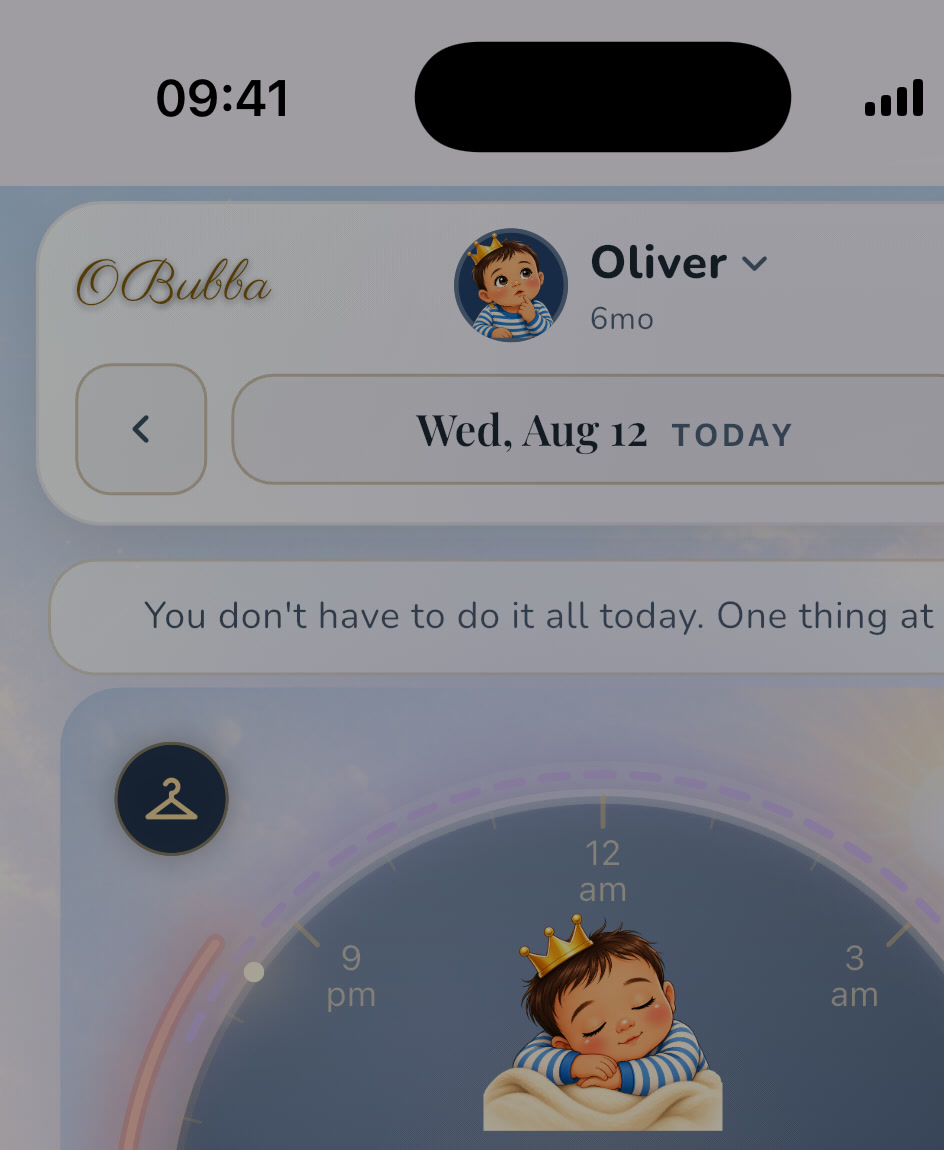
The current app has a specific mid-nap state because a stir, a wake and the end of a nap are not the same event.
While a nap timer is running, the central control says pause nap. Tapping it creates a separate, pending mid-nap wake without ending the nap or starting the next wake window. If baby returns to sleep, resume nap closes that awake interval and lets the parent record how the baby was settled.
Under the hood, OBubba deliberately stores this as a `napwake`, not a normal morning or night wake. That prevents a mid-nap stir from:
- becoming the day's morning-wake anchor
- ending the ongoing nap prematurely
- triggering a next-nap prediction while baby is still being resettled
- appearing as a night wake
- changing the baby's wake-window clock by mistake
Actual sleep, not just elapsed timer time
Suppose the nap runs from 12:40 to 2:03 with a confirmed 12-minute awake interval. OBubba keeps the nap as one continuous event but deducts the 12 awake minutes from total daytime sleep. Its day review also knows the nap was interrupted, so it does not call the full 83-minute arc an unbroken consolidated nap.
If the parent never timed the stir, the engine does not guess a duration. If both carers accidentally log the same stir within a few minutes, the calculation de-duplicates it rather than subtracting the awake time twice.
If the nap does not resume, ending it closes the pending stir safely. Implausibly long forgotten pauses are not blindly baked into sleep totals as if the baby spent hours resettling.
These are small engineering choices, but they protect every result built on the nap record: total day sleep, weekly averages, nap budgets, reports and next-sleep predictions.
When to use each control
| Situation | OBubba control | Result | |---|---|---| | Brief movement while baby still looks asleep | Do nothing | Nap continues | | Baby appears awake and you are trying to resettle | Pause nap | Nap stays open; awake interval starts | | Baby returns to sleep | Resume nap | Same nap continues; awake interval closes | | Baby is clearly up | Wake/end nap | Nap ends and the next awake period begins |
The app cannot see the baby, assess breathing or decide whether a movement was sleep. The parent supplies the observation; OBubba keeps the maths honest afterwards.
Try OBubba free → — time naps, pause real stirs and keep sleep, feeds, nappies, health and development in one calm record without treating every eyelid flutter as a new wake window.
What not to do for a longer nap
Do not add products or unsafe sleep practices in an attempt to prevent stirring.
The NHS safer-sleep guide says the safest place for the first six months is a cot or Moses basket in the same room as you. Place baby on their back on a firm, flat mattress and keep the space clear of pillows, cot bumpers, pods, nests, positioners, toys and loose objects.
Use the same safer-sleep principles for every sleep, day and night. Do not add a weighted product, incline the mattress, prop a dummy in place or cover the cot to join sleep cycles.
If a contact nap is the only sleep happening today, plan around adult tiredness. Never fall asleep holding a baby on a sofa or chair. Our guide to cot, contact, pram, carrier and car naps covers the different safety considerations.
When a stir needs more than sleep tracking
Most movements and brief sounds are ordinary. Seek medical advice when the event is not behaving like a normal sleep transition.
Call 999 if your baby is blue or grey, cannot breathe normally, is unresponsive, has a suspected seizure for the first time, has a seizure lasting five minutes or more, or has another life-threatening symptom. The NHS epilepsy guidance also says to call if the person does not recover as usual or another seizure begins before recovery.
Seek prompt advice from NHS 111 or a clinician if you notice:
- repeated pauses in breathing, gasping or significant breathing difficulty
- unusual colour change
- unusual or repeated movements that concern you but are not happening now
- persistent vomiting, fever or signs baby is acutely unwell
- extreme difficulty waking or behaviour very different from usual
Record a video only if it is safe and another adult can call for help; never delay emergency care to document an event. A tracker cannot diagnose seizures, breathing disorders, reflux or pain.
A three-day nap-stir check
If baby is well but naps keep becoming confusing, collect only a little context.
Day 1: record the transition
Note the nap start, first clear waking sign, whether you intervened, when sleep resumed and the final wake. Avoid guessing when you only saw the baby after the event.
Day 2: protect the handover
When a stir begins, keep light and interaction low for a short observation period. See whether your own intervention is helping, neutral or fully waking the baby.
Day 3: compare outcomes
Look for a repeatable pattern:
- always stirs at a similar elapsed point but often resettles
- needs the same brief support and then sleeps another full block
- becomes bright and ready for the day immediately
- wakes upset because hunger, discomfort or noise is consistently present
Three days do not diagnose a sleep problem. They can reveal whether the first stir is actually the end—or simply the noisy middle.
Frequently asked questions
Does opening their eyes mean my baby is awake?
Not always. NHS baby-state guidance notes that eyes may briefly open during light sleep. Look for sustained alertness, focus, interaction and what happens next.
If baby cries once in their sleep, should I stop the nap timer?
No. A single cry or sound can happen during active sleep. Check that baby is safe and comfortable, then observe. Stop the nap when they are genuinely awake or use a pause if a real resettle begins.
Is a nap with a 10-minute wake still one nap?
It can be. If baby remained in the sleep setting, was quietly resettled and returned to sleep, one nap with a 10-minute awake gap is a clear description. If the day resumed, it may be two separate sleeps.
Should awake time in the middle count as sleep?
No when the awake interval is known. Gross timer duration and actual sleep duration are different. OBubba deducts a timed mid-nap waking while keeping the overall nap event connected.
Does a mid-nap stir restart the wake window?
Not if baby returns to the same nap. Start the next wake window when the nap genuinely ends. If the baby stays awake, use the actual wake time.
Should I resettle every short nap?
No. You may offer a calm chance when it suits your baby and family, but a short nap is not automatically broken. End the attempt if baby is clearly awake or resettling is becoming stressful. See our guide to 30-minute naps.
Why does OBubba keep the nap open during Pause?
Because Pause means “we do not yet know whether this sleep period is over.” Resume confirms that baby returned to the same nap; Wake confirms the nap ended. The app can then preserve the sequence without making the parent decide too early.
Let the next minute answer the question
A twitch is not a wake. Open eyes are not always an ended nap. And a real wake does not always mean the sleep period cannot continue.
Keep the sleep space safe, watch the baby's state, respond when needed and record the sequence you actually observed. The goal is not a perfect graph. It is a truthful answer to a simple question: did baby go back to sleep, or did the day begin again?
This article provides general sleep-tracking information, not medical advice. Seek qualified help for concerns about breathing, unusual movements, illness, development or sleep, and follow your baby's individual clinical plan.
Ready to try OBubba?
Use OBubba to track feeds, sleep, naps, nappies, growth, milestones and family handovers in one calm baby tracker app.