You darken the room, settle your baby and finally begin the thing you could not do while they were awake. Thirty minutes later, the monitor lights up.
Again.
A short nap can be frustrating, especially when your baby still seems tired and the rest of the day now feels impossible. But a 30-minute nap does not automatically mean the wake window was wrong, your baby has a “bad habit” or you must teach them to link sleep cycles.
First look at how your baby woke and what happened before the nap. A happy baby after a quick nap needs a different response from a fussy baby who fell asleep instantly after a very long awake stretch. The clock matters, but it is not the whole diagnosis.
What should I do when my baby wakes after 30 minutes?
Use this decision in the moment:
- If your baby is only stirring, pause briefly. Grunting, rolling, opening the eyes and making one sound do not always mean the nap is over.
- If they are calm but awake, give them a short opportunity to resettle. You might wait quietly or use the same responsive support that helped them fall asleep.
- If they are becoming upset, respond. Pick them up, feed if they show hunger cues or offer comfort. A nap is not a test they have to pass.
- If resettling is clearly not happening, end the nap. Open the curtains, record the real end time and plan from the baby you now have.
- Adjust the next step—not the entire week. A slightly earlier next nap, a slightly later one, a rescue nap or an earlier bedtime may each be right in different circumstances.
Do not leave a distressed baby alone for a fixed “crib hour” simply because an internet schedule says a nap should be longer. Equally, you do not have to rush in at the first tiny sound if your baby is safe and content.
Is a 30-minute nap normal?
It can be. The NHS explains that babies have individual sleep patterns: some sleep for long periods and others in short bursts. Sleep also changes with growth, teething and illness.
Young babies commonly have irregular sleep spread across day and night. Their naps may be brief, feeding-led and unpredictable. Trying to force a newborn into a precise nap timetable can create more stress than sleep.
For an older baby, repeated 25–40 minute naps may still be normal for a period, but they are more useful to investigate when:
- your baby wakes tired or very upset
- short naps repeatedly create an exhausted late afternoon
- the same nap shortened after a schedule change
- settling has become unusually difficult
- total sleep has dropped noticeably from your baby's own pattern
- your baby seems uncomfortable, unwell or hungry
One short nap is an event. Several similar naps across comparable days may be a pattern.
The most useful clue: how did your baby wake?
Nap duration alone cannot tell you what to do next. Wake mood helps.
| How the nap ended | What it may suggest | Sensible next move | |---|---|---| | Calm, bright-eyed and ready to engage | The nap may have been enough, or sleep pressure was low | Get up; do not automatically shorten the next wake window | | Happy after a late-afternoon catnap | The short nap may have done its job as a bridge | Keep bedtime near the earlier end of its usual range | | Fussy, rubbing eyes or difficult to soothe | Baby may still be tired | Consider an earlier next sleep or one supported rescue nap | | Fell asleep almost instantly, then woke crying | The previous awake stretch may have been too long | Try the comparable nap 10–15 minutes earlier next time | | Took a long time to settle, then woke cheerful | There may not have been enough sleep pressure | Try the comparable nap 10–15 minutes later next time | | Woke coughing, crying sharply or arching | Discomfort may matter more than timing | Check ordinary needs and seek advice if symptoms persist |
These are clues, not guarantees. A fussy wake does not prove overtiredness, and a cheerful wake does not prove your baby has completed an ideal amount of sleep.
Undertired and overtired can both produce short naps
This is why generic advice often sends parents in circles. If you shorten every wake window after every short nap, an undertired baby may be put down earlier and earlier. If you keep stretching time awake because the baby “didn't sleep enough”, an overtired baby may become increasingly wired.
For a young baby, especially under about five months, short and irregular naps are often part of normal sleep development. Keep responding to feeding and tired cues rather than treating every short nap as a timing problem. The small timing experiments below are more useful for an older baby with a repeated, comparable pattern.
Clues the wake window was too short
- settling took much longer than usual
- baby played, rolled or chatted before sleep
- the nap began much earlier than recent successful naps
- baby woke calm and alert
- the same short nap repeats after consistently brief awake periods
Try adding 10–15 minutes before that same nap for two or three comparable days. Keep the wind-down and sleep environment steady so you can judge the timing change.
Clues the wake window was too long
- baby became frantic, clingy or hard to soothe before the nap
- they fell asleep unusually fast
- the previous nap was short and the next awake period was not adjusted
- they woke crying, sleepy or rough
- several short naps have compounded across the day
Try offering the next comparable nap 10–15 minutes earlier. Large schedule jumps make the result harder to read.
Clues the wake window was probably reasonable
Sometimes the nap was simply short. Your baby may be learning a new skill, teething, adapting to nursery, sleeping in a different place or passing through a developmental change. Keep the next wake window near its recent usual range and gather another day of evidence.
Read wake windows without the stress if the clock is starting to feel like a countdown rather than a guide.
Should I try to extend the nap?
You can try, but you do not have to turn every short nap into a resettling project.
A brief extension attempt is most worthwhile when:
- your baby wakes clearly tired
- this was meant to be a restorative early or midday nap
- the afternoon would otherwise contain an unmanageably long stretch
- the same responsive method has extended naps before
- you are calm enough to try without making the cot feel like a battle
Keep the room dark, stimulation low and the response boring. Use a hand on the chest, shushing, holding, rocking or feeding if that is what your baby genuinely needs. Responding does not spoil a baby.
Stop the attempt when your baby is fully awake, increasingly upset or clearly ready to get up. Twenty angry minutes do not become restorative merely because they happened in a dark room.
When a rescue nap helps
A rescue nap is a supported nap used to prevent the rest of the day unravelling. It might happen in a carrier, pram or an awake adult's arms. It is a practical tool, not a new rule.
Consider one when:
- several naps have been short
- your baby is already showing tired cues well before the next planned nap
- bedtime is still too far away for an early night
- practising another cot nap would leave everyone distressed
Use the safest option available and follow the equipment manufacturer's guidance. A carrier must keep the baby's airway visible and position secure. A contact nap requires the adult to remain awake. If you might fall asleep, move your baby to their own safer sleep space.
You do not need to rescue every nap. One reliable nap can protect the day while you experiment with another.
When an earlier bedtime is better than another catnap
Late rescue naps are useful when they bridge a genuinely long gap. They can also push bedtime later and leave too little sleep pressure for the night.
If the missed nap was the final nap and bedtime is already close, try calm low-stimulation time and move bedtime about 20–30 minutes earlier rather than forcing a late sleep. This is especially reasonable when a catnap would end inside the baby's usual final wake window.
An early bedtime is not a punishment for bad naps. It is one way to stop an unusually fragmented day becoming an extremely long one.
If bedtime then produces a wake 30–60 minutes later, use our separate guide to bedtime false starts. A short daytime nap and an early-evening false start may share timing clues, but they are not the same event.
A five-day experiment for repeated short naps
Do not overhaul every nap at once. Choose the nap that happens most consistently—often the first nap—and test one hypothesis.
Days 1–2: record the baseline
Keep your usual approach and record:
- when the previous sleep ended
- when settling began and sleep actually started
- nap end time
- how long settling took
- wake mood: happy, sleepy or fussy
- sleep quality: good, okay or rough
- location and settling method
Days 3–5: change one variable
If the evidence points to low sleep pressure, move that nap 10–15 minutes later. If it points to overtiredness, move it 10–15 minutes earlier. Keep the room and settling approach as similar as family life allows.
Judge the outcome using more than duration:
- Did settling become easier?
- Did your baby wake in a better mood?
- Did the next nap or bedtime become calmer?
- Did total daytime sleep recover?
A 38-minute nap with a happy wake and an easier evening may be a better outcome than a 55-minute nap followed by a distressed day.
The sleep environment still matters
Timing cannot compensate for an unsafe or uncomfortable sleep space. For every nap, place your baby on their back in a clear, firm, flat sleep space. The Lullaby Trust recommends back sleeping for every sleep, day and night, and advises keeping the cot free of pillows, duvets, bumpers, nests, toys and positioners.
For the first six months, the NHS advises that baby sleeps in the same room as you, day and night.
A reasonably dark room and consistent sound may make transitions between sleep stages less stimulating. White noise is optional, not a treatment; keep it farther away and at a low level. Read our safer white-noise guide before turning it up to drown out household life.
How OBubba handles a 30-minute nap
In the current app, a nap is not reduced to “too short”. When you stop the nap timer, you can record:
- actual start and end time
- how long settling took
- whether baby woke happy, sleepy or fussy
- whether the nap felt good, okay or rough
- where and how baby slept
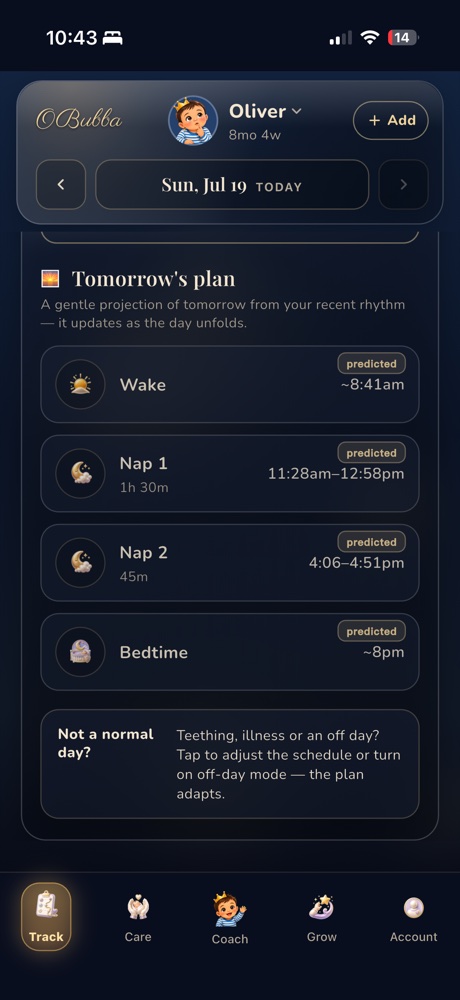
OBubba compares the nap with the awake stretch before it and the baby's age-aware range. A short nap after too little awake time can nudge the next predicted nap later. A short nap after an overly long wake window can nudge it earlier. Wake mood, settling time and quality can refine that shift, so duration does not make the decision alone.
The app is also deliberately cautious about confidence. A single short-nap insight is labelled “this nap”. A multi-day catnapping pattern needs at least three qualifying days among the last seven days examined. On each qualifying day, at least two completed naps must have been logged and every one must have been under 45 minutes. OBubba gives reassurance rather than a timing protocol when the baby is under about 22 weeks.
If a predicted nap is not happening and its window has passed, the Track screen can show four live choices:
- Reset and retry after 15 calm minutes
- Rescue the nap with supported sleep when overtiredness or sleep debt is building
- Take 20 minutes of quiet cot rest without pressure
- Skip and protect an earlier bedtime when this is the last nap and bedtime is close
The on-device engine highlights the option that best fits the current day, but all four remain available because a parent can see and hold the baby. OBubba cannot know whether your baby's cry means pain, hunger or “I am completely done with this nap attempt”.
Nap logging, including start and end time, wake mood, sleep quality, location and settling method, remains available without Premium. Personalised countdowns, deeper sleep insights and tomorrow planning are Premium features. OBubba unlocks Premium during pregnancy and through the first two corrected-age months; plan options follow after that early-free period.
Try OBubba free → — keep the real nap history together, then let OBubba use it to build the next useful picture when personalised features are unlocked.
What not to do after one short nap
- Do not move every nap earlier immediately.
- Do not keep your baby awake for an extra hour to “wear them out”.
- Do not assume feeding or rocking caused the wake.
- Do not hold a contact nap if you may fall asleep.
- Do not add pillows, wedges, nests or weighted products to make the cot feel cosier.
- Do not compare one 30-minute nap with another baby's two-hour screenshot.
The smallest useful change is usually 10–15 minutes applied to the same nap for a few days.
When to speak to a health professional
Short naps alone are usually a sleep-pattern question, not a medical emergency. Speak to your health visitor or GP if sleep changed suddenly alongside illness, pain, feeding problems, poor weight gain, breathing concerns, unusual sleepiness or a baby who seems unlike themselves.
Seek urgent help if your baby is difficult to wake, has breathing difficulty, turns blue or pale, has a seizure, is unusually floppy or you believe they are seriously unwell. Trust your instincts.
Also ask for support if sleep deprivation is making it hard for you to cope safely. The NHS guidance on parental tiredness encourages sharing care and asking friends or relatives for practical help. If you feel you may fall asleep holding your baby, put them down in their safe sleep space first.
Frequently asked questions
Why does my baby wake after exactly 30 minutes?
The timing may coincide with a transition in their sleep, but the clock alone cannot identify the cause. Look at age, the previous awake stretch, settling time, wake mood and what happens across several days.
Are 30-minute naps bad for development?
One short nap is not evidence of harm. Babies vary widely in how sleep is distributed. Look at total sleep, feeding, mood, development and growth with your health visitor if you are concerned.
Should the next wake window be shorter after a short nap?
Often—but not always. Shorten it slightly when baby woke tired or the previous window looked too long. If the short nap followed too little awake time and baby woke cheerful, making the next window even shorter can repeat the problem.
Should I feed my baby back to sleep for a longer nap?
You can respond with a feed when your baby shows hunger cues or feeding is the practical way they resettle. Feeding to sleep is not automatically a bad habit. If every nap consistently ends at the first transition and the method no longer works for your family, experiment gently with changing one part of settling.
Do blackout blinds lengthen naps?
A darker room can reduce stimulation, but it cannot guarantee a longer nap or fix the wrong timing. Make sure blind cords are completely out of reach and never add anything unsafe to the cot.
At what age do short naps get longer?
There is no dependable birthday. Sleep organisation changes rapidly in the first year, but babies develop at different rates. Track your baby's trend rather than waiting for a promised week when every nap should consolidate.
Is a 30-minute last nap worth having?
It can be an effective bridge when bedtime is still a long way off. If bedtime is close, quiet time and a modestly earlier night may protect sleep better than forcing a late catnap.
Ready to try OBubba?
Use OBubba to track feeds, sleep, naps, nappies, growth, milestones and family handovers in one calm baby tracker app.