You finish the feed, repeat the bedtime routine, lower your baby into the cot and finally exhale. Thirty or forty-five minutes later, their eyes are open and bedtime appears to have been cancelled.
Parents often call this a false start: a baby falls asleep for the night, then wakes again during the first part of the evening. It is not a formal diagnosis, and one early wake does not mean you have created a bad habit.
The useful question is not “How do I stop the wake?” but “Was my baby too tired, not tired enough, hungry or uncomfortable when bedtime began?” Those causes can look remarkably similar, but the timing changes are opposite.
What counts as a bedtime false start?
In everyday baby-sleep language, a false start usually means waking roughly 30–60 minutes after falling asleep at bedtime. Some families use the term more broadly for any wake in the first one or two hours.
OBubba's overnight summary marks a wake within about 45 minutes of bedtime as a false start. Its longer sleep consultation also reviews early wakes within the first two hours alongside feeds, day sleep and the final wake window. The wider view helps avoid pretending that every 48-minute wake has a completely different cause from a 42-minute one.
A false start is different from:
- bedtime resistance: baby does not fall asleep in the first place
- a normal brief stir: baby moves or makes noise, then returns to sleep without fully waking
- a split night: a long awake period in the middle of the night
- an early morning wake: the night ends much earlier than the family expects
- a newborn's ordinary waking: young babies commonly sleep in short stretches and wake to feed
The label is only useful if it points you towards the right next check.
What to do when your baby wakes tonight
Keep the wake in “night mode”. Leave the room dim, keep your voice quiet and avoid play. The NHS baby-sleep guidance recommends low lights and low interaction at night, as well as a simple, soothing bedtime routine.
Then respond to the baby in front of you:
- Pause for a few seconds if they are only stirring. A small sound or movement is not always a full wake.
- Check ordinary needs. Hunger cues, a dirty nappy, temperature, illness and discomfort matter more than any sleep theory.
- Resettle calmly. Use the same support you used at bedtime—holding, patting, rocking, feeding if genuinely hungry or another responsive method that works for your family.
- Do not “restart the day”. Keep stimulation low even if baby seems surprisingly alert.
- Record the actual time. Tomorrow's pattern is clearer when you know the difference between 20 minutes and two hours.
Always return baby to a safer sleep space: on their back in a clear cot or Moses basket with a firm, flat mattress. The Lullaby Trust's clear-cot guidance applies to every sleep; a false start is not a reason to add a pillow, wedge, nest or positioner.
Overtired or undertired? Use the day as evidence
Both an overtired and an undertired baby can wake shortly after bedtime. Both may also fight settling, cry and seem “wired”. Their day usually separates them better than their behaviour in one minute.
| Pattern before bedtime | More consistent with | First experiment | |---|---|---| | Missed or very short naps; final awake stretch was longer than usual; frantic or hard-to-soothe evening | Overtired | Bring bedtime about 10–15 minutes earlier next time | | Last nap ended late; final awake stretch was unusually short; baby played or chatted before sleep | Undertired | Let a little more awake time build before bedtime | | Day sleep was repeatedly above your baby's usual range | Not enough sleep pressure | Adjust the long or late nap gently—not every nap at once | | Day sleep was very low and baby crashed instantly | Overtired | Protect naps and shorten the final stretch | | Strong feeding cues or clearly lower daytime intake | Hunger may contribute | Feed responsively; review daytime opportunities later | | Crying with feeding difficulty, repeated vomiting or obvious discomfort | Discomfort or illness | Address comfort and seek health advice when needed | | Timing looks appropriate but the room or routine changed | Environment or transition | Restore the familiar calm, dark wind-down |
These are clues, not a remote diagnosis. One false start can be random. Look for the same relationship across several comparable nights before moving the whole schedule.
Signs of an overtired false start
Overtired does not always look sleepy. A baby who has stayed awake beyond what they can comfortably manage may become frantic, silly, clingy, tearful or unusually difficult to settle.
The day may show:
- a missed last nap
- several short naps
- a final wake window longer than the baby's recent good nights
- late crying or a “second wind”
- falling asleep extremely quickly, then waking upset soon afterwards
- a rough or fussy wake from the final nap
If that pattern repeats, try bedtime 10–15 minutes earlier for a few nights. Do not move it an hour in one jump. A very early bedtime can create a new undertired problem, especially after a normal nap day.
The aim is to reduce the final awake stretch slightly, not to chase every yawn with an immediate cot transfer.
Signs of an undertired false start
An undertired baby has not built enough sleep pressure for a long first stretch. They may still fall asleep because the routine is soothing, then wake once that first stretch ends.
Look for:
- a long or late final nap
- substantially more daytime sleep than usual
- a final wake window shorter than recent settled nights
- happy babbling, rolling or playing before sleep
- a long, calm bedtime settle rather than distressed exhaustion
- waking bright-eyed and ready to interact
If that is the repeated pattern, a bedtime 10–15 minutes later may help. Alternatively, adjust the last nap so it ends a little earlier. Change only one lever; moving the nap and bedtime together makes it impossible to tell what helped.
Do not cap daytime sleep merely because one early wake occurred. For a baby who is already underslept, taking away more sleep can intensify overtiredness.
Could the wake be hunger?
It can be. This matters particularly for newborns, young babies, growth spurts and days when feeds were unusually small, distracted or widely spaced.
Use the baby's cues and feeding history rather than an age-based internet rule. If your baby wakes rooting, searching, sucking urgently or taking a meaningful feed, feed them. A responsive feed is not a failed sleep intervention.
Then review the day without blame:
- were normal feeding opportunities available?
- was the bedtime feed unusually short or interrupted?
- did solids accidentally displace milk for a baby who still relies on milk nutrition?
- were there fewer wet nappies or any feeding concerns?
Do not delay a needed feed to test whether the wake is a “habit”. Night-weaning decisions need to consider age, growth, milk intake, health and family context; see is my baby ready to night wean?.
Could it be reflux, pain or illness?
Timing is not always the answer. A baby who becomes distressed soon after a bedtime feed may be uncomfortable rather than over- or undertired.
Notice whether false starts cluster with:
- repeated vomiting or bringing up milk with distress
- coughing, gulping or difficulty feeding
- crying that is markedly different from the usual bedtime protest
- fever or signs of illness
- fewer wet nappies
- breathing or colour changes
- poor feeding or poor weight gain
The NHS reflux guidance advises speaking to a pharmacist, GP or health visitor when a baby has feeding difficulty, repeatedly brings milk back up and appears uncomfortable. Keep reflux sleep safe: baby should still sleep flat on their back, and the head of the cot should not be raised.
If breathing, colour, feeding or responsiveness concerns make you think your baby may be seriously unwell, use current NHS urgent-illness guidance rather than waiting to collect more sleep data.
Check the sleep environment—but do not buy a “fix”
A sudden change in light, sound or temperature can make it harder for a baby to move through an early-night stir. Check simple conditions:
- Is the room still dark when the baby wakes?
- Did white noise or another familiar sound switch off after they fell asleep?
- Is the room noticeably warmer or colder than on settled nights?
- Did bedtime happen in a different place?
- Is household noise unusually sharp or unpredictable?
Consistency is more useful than silence. The NHS notes that babies can get used to ordinary daytime household noise; at night, low light and quiet interaction help mark the difference.
Do not add padded products, weighted bedding or sleep positioners. No product can “link sleep cycles”, and extra items can make the cot unsafe.
Track six facts, not the whole evening
For three to seven nights, record:
- actual sleep onset—not when the routine started
- first full wake time
- how long the wake lasted
- last nap end time and total daytime sleep
- whether the wake looked like hunger, discomfort or a simple resettle
- how baby returned to sleep
That is enough to distinguish many common patterns. A note such as “bed 7:25, awake 8:03, calm, rocked 8 min, last nap ended 4:35” is far more useful than “terrible bedtime”.
In OBubba, bedtime, night wakes, feeds, wake duration and settling method sit on the same overnight timeline. The app can calculate the actual final wake window from the last nap and compare false-start nights with the baby's age range and recent pattern.
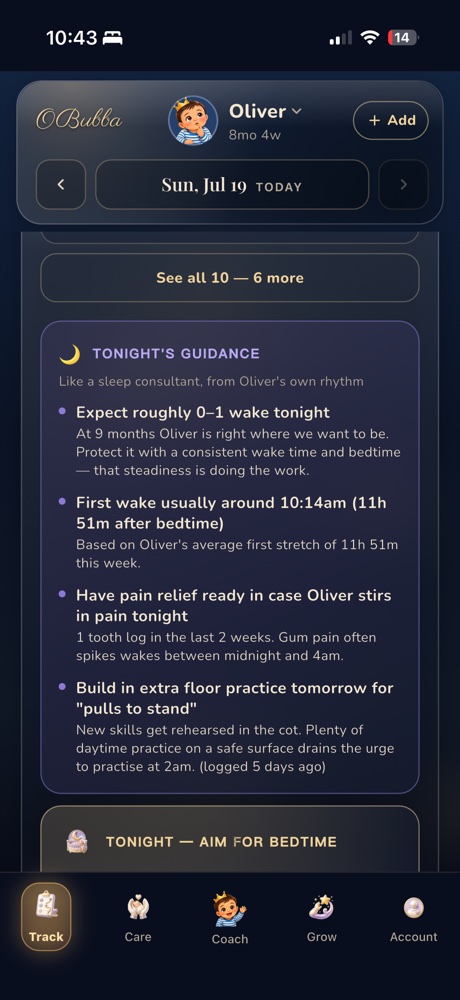
The important part is that OBubba does not give every false start the same fix:
- a clearly long final wake window produces an overtired read and an earlier-bedtime experiment
- a clearly short final wake window produces an undertired read and a later-bedtime experiment
- repeated excess day sleep can support a gentle nap adjustment
- hunger tags, early feeds and reflux notes keep timing from swallowing a more important explanation
- a long middle-of-the-night wake stays a split night, not merely a bedtime false start
OBubba waits for three recent false-start nights before treating the issue as a repeated pattern and offering a seven-night plan. The purpose of the week is consistency and comparison—not a promise that every baby will be “fixed” in seven days.
A gentle seven-night experiment
Choose the branch that best matches the evidence. Do not combine every suggestion.
If the pattern looks overtired
- Keep the morning wake anchor broadly steady.
- Protect the final nap rather than deliberately skipping it.
- Begin the wind-down 10–15 minutes earlier.
- Compare the first stretch for several nights.
If the pattern looks undertired
- Keep the same short bedtime routine.
- Let bedtime move 10–15 minutes later, or end the final nap a little earlier.
- Do not change both on the same night.
- Watch whether settling becomes easier and the first stretch lengthens.
If timing is mixed
- Hold the routine and morning anchor steady.
- Record actual sleep onset, not planned bedtime.
- Fix obvious hunger, discomfort or environment issues first.
- Wait for a clearer pattern before moving bedtime.
Review after the week:
- How many nights had an early wake?
- When did the first stretch usually end?
- Was the baby calm, hungry or distressed?
- Which timing produced the easiest settle?
- Did the first stretch lengthen without making naps or mornings worse?
Keep a change only if the whole pattern improves—not because one night happened to be quiet.
Common false-start mistakes
Moving bedtime earlier every time
Earlier helps an overtired baby. It can worsen an undertired pattern by shortening the final wake window further.
Cutting every nap
If day sleep is genuinely excessive across repeated days, a small targeted adjustment can help. Cutting every nap after one false start can create an overtired cycle.
Treating every sound as a wake
Babies can grunt, move and briefly call out in sleep. Give a small stir a moment before intervening, while responding promptly when baby is clearly awake or needs you.
Changing the settling method and schedule together
If you move bedtime, remove feeding to sleep, change the room and cap naps in the same week, you will not know which change helped—and your baby faces four unfamiliar things at once.
Assuming a feed is always a bad association
A young or hungry baby may need milk. Respond first; interpret patterns later. Feeding to sleep is common and not automatically a problem.
Buying an unsafe sleep product
A wedge, nest or padded insert does not solve timing and can make the sleep space less safe. Keep the cot clear, firm and flat.
When false starts are normal enough to watch
One or two early wakes during teething, travel, illness, a nap transition or a developmental change may settle without a schedule overhaul. Newborns in particular wake frequently and do not need a seven-night timing project.
It is reasonable to keep responding, log only what is useful and wait when:
- your baby is otherwise well and feeding normally
- the false start is occasional rather than repeated
- the day was obviously unusual
- you are in the first weeks and sleep remains naturally fragmented
- your current response is safe and workable
The NHS emphasises that babies have individual sleep patterns and that those patterns change as they grow. A false start is information, not a verdict on your parenting.
Quick answers
Why does my baby wake exactly 30 minutes after bedtime?
That is often the first obvious transition in the evening, but timing alone does not reveal the cause. Check the final wake window, last nap, day sleep, feeding and discomfort before changing bedtime.
Does a false start mean bedtime is too early?
Sometimes—but not always. A short final wake window and a late nap support undertiredness. A missed nap and a long final wake window support overtiredness, which needs an earlier bedtime instead.
Should I feed after a false start?
Feed if your baby shows genuine hunger cues or needs a feed for their age and situation. If daytime intake was reassuring and the same wake is repeatedly settled with a very small feed, track the pattern and discuss night-weaning readiness separately rather than withholding milk abruptly.
Is waking 90 minutes after bedtime still a false start?
Some parents and sleep professionals use the term for wakes anywhere in the first one or two hours. The label matters less than recording the actual gap and checking what preceded bedtime.
Should I leave my baby to cry through a false start?
No. You can respond and resettle with the level of support your baby needs. Timing improvements do not require leaving a baby alone in distress.
How many nights should I track?
Three nights can reveal repetition; seven gives a better comparison across ordinary family life. Longer is not automatically better if the baby is unwell or the pattern is clearly changing.
Can white noise prevent false starts?
Steady low sound may make the environment more consistent, but it cannot correct hunger, pain or a mistimed final wake window. Follow safe volume and placement guidance; see is white noise safe for babies?.
Try OBubba free → — log bedtime, the first wake and the final nap, then let the app distinguish an overtired night from an undertired one before you move the schedule in the wrong direction.
Related guides
- Baby wake windows without the stress
- Wake windows by age
- What to track when your baby wakes at night
- Why won't my baby sleep?
- Is my baby ready to drop a nap?
- A simple baby bedtime routine
- Is my baby ready to night wean?
Sources and further reading
- NHS: Helping your baby to sleep
- NHS Best Start in Life: Helping your baby sleep
- NHS Best Start in Life: Reflux
- NHS: Is your baby or toddler seriously ill?
- The Lullaby Trust: Keeping a clear cot
Ready to try OBubba?
Use OBubba to track feeds, sleep, naps, nappies, growth, milestones and family handovers in one calm baby tracker app.