One evening bedtime is 7:05pm. The next it is 7:42pm because the last nap ran late. By Friday you are wondering whether every small drift has “ruined the routine”.
The short answer: many older babies benefit from a similar bedtime rhythm, but they do not need to fall asleep at the exact same minute every night. Aim for a familiar wind-down and a realistic bedtime window, then flex for naps, feeds, illness and your baby's signals. Newborn sleep is spread across day and night, so feeding and responding matter more than enforcing a clock-based bedtime.
Consistency should make family life feel more predictable, not turn the evening into a deadline.
Bedtime clock time and bedtime routine are different
There are two kinds of consistency:
- Timing consistency: bedtime happens in a broadly similar part of the evening.
- Sequence consistency: the same calm steps happen in the same order, perhaps feed, fresh nappy, sleepsuit, dim lights, book, cuddle and bed.
The sequence can stay recognisable even when the clock moves. NHS guidance recommends a simple, soothing bedtime routine for babies and a calming, predictable routine at a similar time for young children. It also stresses that babies have individual sleep patterns and that routines need to change as they grow.
If a nap ended at 5:30pm instead of 4:30pm, forcing the usual bedtime may mean asking a wide-awake baby to sleep. If every evening is completely different, however, it can become harder for both baby and parent to anticipate the transition.
The useful middle ground is a repeatable rhythm with room to respond.
What counts as a consistent bedtime?
There is no NHS rule that every baby must be asleep within a particular number of minutes. A practical starting point for a baby whose day has developed a clearer rhythm is to notice the natural cluster of successful bedtimes, then treat that as a window rather than a single target.
For example:
| What the day looked like | A sensible bedtime response | |---|---| | Naps and morning wake were close to usual | Use the normal wind-down and usual bedtime window. | | Last nap ended later than usual | Let bedtime move later enough for genuine sleepiness; keep the routine familiar. | | A nap was missed or unusually short | An earlier bedtime may be more realistic than stretching an exhausted baby to the clock. | | Baby is ill, in pain or recovering | Prioritise comfort, feeds, medical advice when needed and safe sleep; return to rhythm gradually. | | Travel, nursery or a family event shifted the day | Preserve one or two anchors, then reset over the following days rather than forcing one perfect night. |
A window of roughly 20 to 40 minutes is manageable for many families, but it is an experiment, not a medical target. The better question is: does a steadier bedtime actually help this baby's settling and night?
Newborns are the exception
In the early weeks, babies usually wake repeatedly to feed and their sleep is distributed around the clock. NHS guidance notes that newborn sleep varies widely and that night waking is expected.
You can still create gentle night-time cues:
- keep lights low
- use quiet voices
- feed and change without turning the wake into playtime
- repeat a tiny calming sequence before a longer sleep
But do not withhold feeds, stretch wake time or keep a tired newborn awake to protect a bedtime. A fixed evening schedule is not the priority. OBubba reflects that boundary too: its bedtime predictor deliberately does not produce a bedtime prediction for a newborn under four weeks.
Why a similar bedtime can help
A regular evening pattern gives the body repeated cues that sleep is approaching. NHS guidance recommends a simple, soothing bedtime routine for babies and a calming, predictable routine at a similar time for young children.
In real family life, the benefits may be simpler:
- parents know when to start dimming the evening down
- feeds, toothbrushing and medicines are less likely to be forgotten
- another caregiver can reproduce the sequence
- bedtime drift becomes visible instead of feeling like random bad luck
- changes in night waking can be compared with actual bedtime data
Consistency cannot prevent every wake. Hunger, development, discomfort, teething, illness, temperature, sleep environment and ordinary brief arousals can all matter. A relationship between bedtime and wakes is a clue, not proof that one caused the other.
Try a seven-night bedtime experiment
Do not change naps, feeding, settling method and bedtime all at once. Keep the experiment small:
- Choose a realistic bedtime window based on the past week, not an aspirational internet schedule.
- Start the same short wind-down before that window.
- Flex when the final nap or baby's condition clearly changes the day.
- Record bedtime, morning wake and meaningful night wakes.
- After a week, look for a pattern rather than judging one difficult night.
Useful notes are concrete: “nap ended 5:10pm; asleep 7:38pm; two wakes” is better than “bad routine”. If the week contains vaccination, fever, travel or a nap transition, label it. Context prevents a disrupted week from becoming a permanent bedtime rule.
How to move bedtime earlier
If bedtime has drifted much later than suits the family, avoid a sudden one-hour jump unless there is a clear reason. NHS advice for children suggests bringing the wind-down earlier gradually, often in small steps, until the desired bedtime is reached.
A gentle approach is:
- anchor morning light and morning wake as consistently as family life allows
- move the wind-down and bedtime earlier by a small amount every few days
- avoid letting a late nap expand accidentally when it repeatedly blocks bedtime
- keep the sequence and sleep environment familiar
- pause the adjustment during illness or an unusually disrupted day
For a baby on several naps, bedtime is downstream of the whole day. Moving only the final clock time while ignoring a late or long nap can create a long settling battle.
How OBubba tests whether consistency matters for your baby
The current app does not assume that a generic 7pm bedtime improves every night. It reconstructs bedtime and morning wake from the family's actual sleep logs and shows recent sleep, naps and wakes together in Care → Reports.
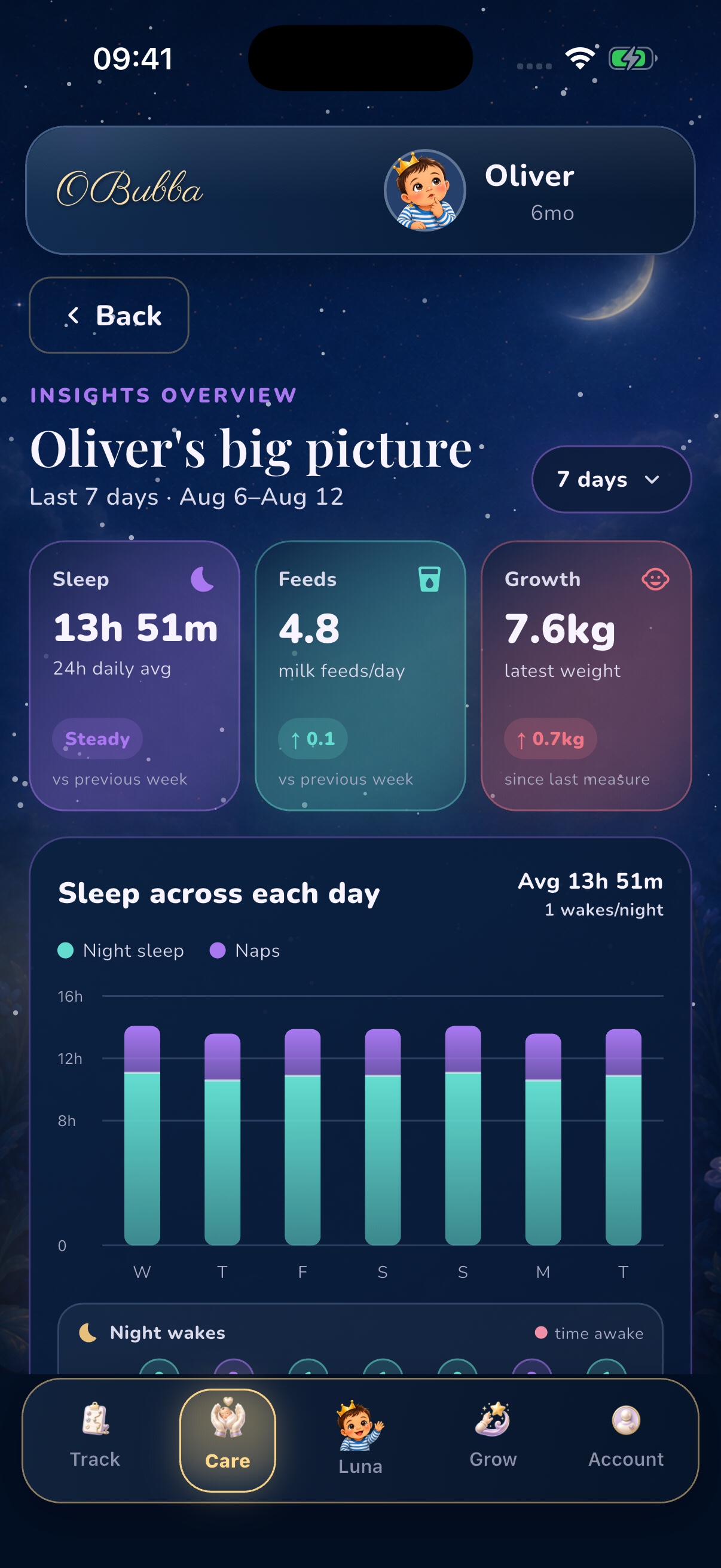
The Reports screen calculates a seven-night schedule-consistency score from the spread of bedtime and morning-wake times. If bedtime varies more than morning wake, it can identify bedtime as the clearer anchor to test; if mornings vary more, it can point there instead. Times around midnight are handled as neighbouring clock times rather than being mistaken for almost a day apart.
A separate OBubba insight looks across up to 14 recent nights. It needs at least nine nights with a recorded bedtime, then compares the most consistent third with the most variable third. It stays silent unless:
- there is a real timing contrast between those groups
- the more consistent nights average at least one fewer logged wake
If all bedtimes are already steady, or steady and variable nights have similar wakes, the app does not claim that consistency is the answer. When a pattern does appear, OBubba shows the actual average wakes and sample size in plain language. This is an observation from your logs, not a controlled experiment or a promise of fewer wakes.
Tonight's prediction remains flexible. The engine takes account of the final nap, unusual daytime sleep, a skipped nap, recent night patterns and any plan the parent has chosen. That is the distinction OBubba is designed around: learn the family rhythm, protect useful anchors, and adapt when today is different.
Try OBubba free →. Live sleep timers, tomorrow's plan, bedtime predictions, night-wake context and reports are built from your baby's own days.
When consistency is not the problem
Do not keep moving bedtime when the log points elsewhere. Consider other causes if:
- bedtime is already steady but settling remains difficult
- waking suddenly changed alongside fever, breathing difficulty, pain or reduced feeding
- the baby snores loudly, gasps or has pauses in breathing
- daytime sleep changed because a nap transition is underway
- feeding, reflux symptoms, eczema or discomfort regularly interrupts sleep
- the family is so exhausted that safe care is becoming difficult
Speak to your health visitor or GP if sleep problems persist or you are worried about your baby's health. Seek urgent medical advice for serious symptoms. Whatever the clock says, follow safer-sleep guidance: place baby on their back in a clear, flat, separate sleep space, and keep them in the same room as a parent or carer for at least the first six months.
Frequently asked questions
Is 30 minutes late enough to ruin bedtime?
No. One later evening does not erase a routine. Keep the familiar sequence, respond to how the day's naps unfolded and return to the usual rhythm afterwards.
Should bedtime be the same on weekends?
Broadly similar timing can help maintain the rhythm, but babies do not understand weekends and family life will sometimes shift. A flexible window and recognisable routine are more sustainable than policing an exact minute.
Is the same routine more important than the same time?
Both can be useful, but the repeatable sequence is often easier to preserve when naps or events move the clock. Use your baby's log to see whether timing changes appear to affect settling or wakes.
What if my baby's bedtime changes every day because naps change?
That is common, especially while nap number and length are still changing. Anchor the wind-down, watch the final nap and use a bedtime range. Our wake-windows-without-stress guide and nap-transition guide can help untangle the day.
Can OBubba prove that bedtime caused fewer wakes?
No. It can show a within-baby association across logged nights and stay quiet when the evidence is weak. Illness, feeds, development and other changes can still explain the result.
Sources and further reading
- NHS: Helping your baby to sleep
- NHS: Sleep and young children
- Newcastle Hospitals NHS Foundation Trust: Sleep in young children
- The Lullaby Trust: Safer sleep advice
OBubba provides tracking and educational guidance, not medical advice or a guarantee that a schedule change will improve sleep. Follow current safer-sleep guidance and seek professional advice if you are concerned about your baby.
Ready to try OBubba?
Use OBubba to track feeds, sleep, naps, nappies, growth, milestones and family handovers in one calm baby tracker app.