Starting solids opens the door to an enormous range of tastes. It also produces a strangely confusing list of exceptions: milk is fine in porridge but not as the main drink; peanuts are worth introducing but whole nuts are dangerous; rice is fine but rice drinks are not recommended.
This guide separates three different ideas that often get bundled together:
- foods babies should not have yet
- foods that are safe only when prepared differently
- foods that are technically edible but best kept low because of salt, sugar or food-poisoning risk
Here is the quick UK list.
| Food or drink | What to do | Why | |---|---|---| | Honey | Avoid until after 12 months, including cooked honey | Infant botulism risk | | Whole nuts and popcorn | Avoid under 5 | Choking risk | | Thick spoonfuls of nut butter | Do not offer alone; thin or spread it | Sticky choking risk | | Whole grapes, cherry tomatoes and round sausage pieces | Quarter lengthways or cut into thin strips | Round shape can block the airway | | Raw hard apple, carrot or pear chunks | Grate or cook until soft | Hard choking hazard | | Added salt, stock cubes and salty processed foods | Avoid or keep very low | Babies' kidneys cannot handle much salt | | Added sugar and sugary drinks | Avoid | Tooth decay and little nutritional value | | Cow's milk as the main drink | Wait until 12 months; cooking is fine from around 6 months | Does not have the right nutritional balance | | Rice drinks | Avoid under 5 | Arsenic exposure | | Raw shellfish | Avoid; cook thoroughly | Food-poisoning risk | | Shark, swordfish and marlin | Avoid for children under 16 | High mercury levels | | Unpasteurised and mould-ripened soft cheese | Avoid for babies | Listeria risk | | Unpasteurised or raw milk | Avoid | Food-poisoning risk | | Fresh pâté made from meat, fish or vegetables | Avoid | Food-poisoning risk | | Plant-based drinks | Do not use as a main drink before 12 months | They do not replace breast milk or first infant formula | | Raw jelly cubes, hard sweets and marshmallows | Avoid | Choking risk |
The NHS foods-and-drinks-to-avoid guide is the primary reference behind this list. Individual advice from your health visitor, GP or dietitian takes priority.
Honey: never before the first birthday
Do not give honey to a baby under 12 months. This includes:
- honey stirred into yoghurt or porridge
- honey on toast
- honey in sauces or marinades
- baked goods made with honey
- cooked or pasteurised honey
- honey marketed as raw, organic or local
Honey can contain spores that cause infant botulism. Cooking at home does not make it suitable for an infant.
This is an age restriction, not an allergy-introduction rule. Honey does not need to be introduced early. After the first birthday, it can be offered occasionally, although it remains a free sugar and is not needed for nutrition.
Check ingredient labels on cereal bars, breakfast products, flavoured yoghurt, sauces and bakery items. “Only a tiny amount” is still honey.
Whole nuts: avoid under 5, but introduce nuts safely
Whole nuts and peanuts are choking hazards and should not be given to children under five.
That does not mean avoiding the allergen. From around six months, nuts can be introduced in an age-appropriate form such as:
- smooth peanut or nut butter spread thinly on toast
- smooth nut butter thinned with warm water, breast milk or formula
- a small amount stirred into porridge or familiar purée
- finely ground nuts mixed into soft food
Do not give a thick spoonful of peanut butter by itself. The sticky texture can form a difficult mass in the mouth and throat.
If your baby has severe eczema, an existing food allergy or has already reacted, ask a health professional about introducing peanut and other allergens. Once tolerated, keep the food in the family's regular rotation. Read How to Introduce Baby Allergens Without Losing Track for a calmer step-by-step approach.
Round foods: change the shape
Some healthy foods become dangerous because their round shape is close to the diameter of a young child's airway.
Grapes, cherries and cherry tomatoes
Cut small round fruit lengthways into quarters. Remove stones or pips where relevant. A grape cut only in half can remain a rounded plug, so quartering lengthways matters.
Blueberries and other firm berries can be squashed flat.
Sausages and hot dogs
Remove the skin where possible and cut lengthways into narrow strips. Do not slice into round coins.
Processed meats can also be high in salt, so they are not an ideal regular baby food even when cut safely.
Olives
Remove the stone and cut lengthways into small strips. Olives can be salty, so use sparingly.
The NHS food-preparation guide has current photographic examples of safer shapes.
Hard raw fruit and vegetables: soften or grate
Raw apple chunks, carrot sticks and hard pear can break into rigid pieces that are difficult for a baby to manage.
Safer preparation includes:
- steaming, boiling or roasting until the food squashes easily
- grating raw apple, carrot or pear
- offering a very ripe, peeled soft pear
- using soft-cooked vegetable batons long enough for a baby to grip
Use the finger-and-thumb test: if you cannot squash the food easily, it may be too hard for an early eater.
“Finger food” does not mean every food cut into a finger shape is safe. Texture matters as much as shape.
Popcorn, sweets, jelly cubes and marshmallows
Avoid foods that are hard, sticky, rubbery or difficult to break down, including:
- popcorn
- boiled or hard sweets
- marshmallows
- chewing gum
- raw jelly cubes
- ice cubes
- cough sweets
These foods offer little nutritional benefit and present a choking risk. Jelly is only suitable when prepared according to the packet instructions and set into an age-appropriate texture; never give raw concentrated jelly cubes.
Knowing the difference between noisy gagging and silent choking helps parents stay calm and act quickly. Read Gagging vs Choking and consider a practical baby first-aid course.
Salt: do not add it to baby food
Babies should not eat much salt because their kidneys are still developing.
Do not add salt to:
- cooking water
- purées or mashed food
- homemade baby meals
- the baby's portion of a family meal
Common hidden sources include:
- stock cubes and ready-made stock
- gravy granules
- soy sauce
- bacon, ham, chorizo and sausages
- crisps and salted crackers
- jarred sauces
- ready meals and takeaways
- some bread, cheese and breakfast products
The easiest family-meal habit is to remove the baby's portion before adding salt, stock, gravy or a salty finishing sauce. Adults can season their own plates afterwards.
“Reduced salt” does not always mean low enough for frequent infant meals. Compare labels and use naturally flavourful ingredients such as garlic, herbs, mild spices, lemon or roasted vegetables instead.
Sugar, juice and sweet drinks
Babies do not need added sugar. Avoid adding it to food and limit products such as biscuits, sweets, sweet puddings and heavily sweetened yoghurt.
Also avoid:
- fruit juice and juice drinks
- squash and flavoured water
- fizzy drinks
- diet or reduced-sugar drinks
- tea and coffee
- energy drinks
Whole fruit is different from juice: it comes with fibre and a texture the baby learns to manage. At around six months, offer small sips of plain water from an open or free-flow cup with meals while breast milk or first infant formula remains the main drink.
Cow's milk: fine in food, not the main drink yet
Pasteurised whole cow's milk can be used in cooking from around six months. It can go into:
- porridge
- mashed potato
- sauces
- pancakes
- family meals
Full-fat pasteurised yoghurt and suitable cheese can also be introduced from around six months.
Cow's milk should not replace breast milk or first infant formula as the main drink before 12 months because it does not provide the right balance of nutrients for an infant.
This distinction is easy to remember:
> Milk in the meal: yes from around six months. Cow's milk replacing infant milk: wait until one.
If your baby has suspected cow's-milk allergy, do not use goat or sheep milk as an assumed substitute; speak to a clinician or paediatric dietitian.
Cheese: check pasteurisation and type
Babies can have many pasteurised full-fat cheeses from around six months. Avoid:
- unpasteurised cheese
- mould-ripened soft cheese such as brie or camembert
- ripened goat's cheese such as chèvre
- soft blue-veined cheese such as roquefort
These can carry a higher listeria risk. Check the label rather than assuming every cheese sold in a supermarket is baby-suitable.
Cheese can also be salty. Grate it or cut it into short narrow strips and use it as one part of a varied diet rather than adding large amounts to every meal.
Eggs: the UK Lion-mark distinction
In the UK, hen eggs carrying the British Lion mark can be eaten by infants even when lightly cooked because they are produced under a specific food-safety scheme. Hen eggs without the Lion mark, and duck, goose or quail eggs, should be cooked thoroughly until the white and yolk are solid.
Avoid raw egg mixtures when you cannot confirm the egg source, including uncooked cake batter, some homemade mayonnaise, mousse or homemade ice cream.
Egg is a common allergen and can be introduced from around six months in a safe form. Food-poisoning preparation and allergy introduction are separate considerations.
Shellfish and high-mercury fish
Shellfish can be a nutritious allergen food once thoroughly cooked and prepared without shell fragments. Do not give raw or lightly cooked shellfish such as raw oysters, clams or mussels because of food-poisoning risk.
Shark, swordfish and marlin should be avoided by babies and all children under 16 because their mercury levels can affect the developing nervous system.
Other fish can be valuable sources of protein, iodine and omega-3 fats. Cook thoroughly, remove every bone and flake carefully. The restriction is about specific high-mercury species, not a reason to avoid all fish.
Rice drinks: not for children under 5
Children under five should not have rice drinks or rice milk because they may contain too much arsenic.
This does not mean rice itself is banned. Cooked rice, baby rice and rice used within a varied diet are permitted. UK limits for arsenic are stricter for foods made for young children.
If your child has already had a rice drink, the NHS says there is no immediate risk; switch to a suitable alternative and ask a health professional if you need help replacing milk.
Four rules that make almost every meal safer
1. Sit the baby upright
Use a stable highchair with the baby upright, not reclined. Their head and neck should be well controlled before solids begin.
2. Stay within arm's reach
Always supervise eating. Do not leave a baby eating in a highchair while you answer the door, cook in another room or drive.
3. Check shape and texture
Ask:
- Is it round like an airway?
- Is it hard, sticky or slippery?
- Can I squash it easily?
- Are there bones, pips, stones, skin or tough casing?
4. Prepare for choking without expecting it
Learn infant choking first aid before weaning. Keep emergency numbers accessible. Do not put fingers into a baby's mouth during gagging or perform blind finger sweeps.
Baby First Aid Before Weaning explains what to learn and how to choose practical training.
How OBubba checks food safety while you log
OBubba does more than store “lunch.” Its weaning tools connect food ideas, preparation and the actual meal record.
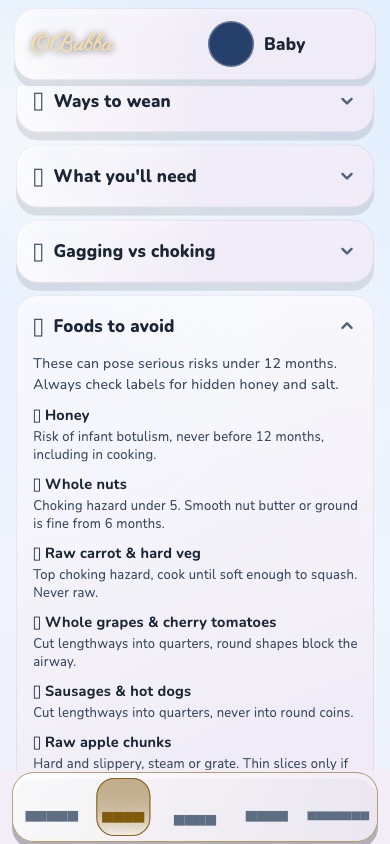
The Before first tastes guide includes:
- readiness signs
- gagging versus choking
- foods to avoid
- allergen introduction
- iron-rich choices
- water and the milk–solids balance
The searchable First Foods garden then shows how to serve individual foods, their key nutrient and whether they contain a major allergen.
Most usefully, OBubba's solids logger runs live safety checks against the food name a parent types. It recognizes risks such as:
- honey under 12 months
- whole nuts
- unquartered round foods
- raw hard apple or carrot
- popcorn and sticky sweets
- raw shellfish
- shark, swordfish and marlin
- rice drinks
- added salt, stock, gravy and salty meats
The checks understand preparation language too. “Mashed banana and quartered grapes” should not produce the same warning as “whole grapes,” and “no-salt homemade stock” should not be treated like a stock cube.
That is the value of joining guidance to a tracker: safety information appears at the moment a real meal is being recorded, not only in an article a parent read three weeks ago.
OBubba also remembers allergens already tried, flags recorded reactions, notices whether iron-rich foods are appearing and keeps the feeding story alongside milk, nappies, sleep and growth.
The checker is a text-based prompt, not a food inspection or nutrition-label reader. It cannot see whether a grape was really quartered, find a fish bone, confirm pasteurisation or decide that a packaged product is safe. Parents still need to read the label, prepare food for their baby's stage and supervise every meal.
The Before first tastes guide, First Foods catalogue and solids logging are available without Premium. The full recipe garden is a Premium feature after OBubba's early-free period; the app shows current eligibility and storefront options before purchase.
Keep the safety list beside the meal log →
A screenshot-friendly kitchen checklist
Before serving, ask:
- Age: Is there a specific age restriction?
- Shape: Could it plug the airway?
- Texture: Can it squash between finger and thumb?
- Preparation: Is it cooked, grated, thinned or quartered as needed?
- Ingredients: Any hidden honey, salt or allergens?
- Position: Is baby upright and alert?
- Supervision: Am I staying within arm's reach?
You do not need to fear food. A small number of clear rules makes room for a very wide, enjoyable diet.
The bottom line
Before one, avoid honey completely, keep breast milk or first infant formula as the main milk, avoid added salt and sugar, and prepare choking-risk foods differently. Whole nuts and popcorn wait until at least five; rice drinks wait until five; shark, swordfish and marlin wait until 16.
Most everyday family foods can be adapted by removing the baby's portion before seasoning, cooking until soft and changing the shape. The goal is not a bland, anxious weaning journey. It is safe preparation plus variety, one calm taste at a time.
This article provides general UK information and does not replace advice from your health visitor, GP, dietitian or allergy team.
Ready to try OBubba?
Use OBubba to track feeds, sleep, naps, nappies, growth, milestones and family handovers in one calm baby tracker app.