One terrible Tuesday can make a whole month feel broken. One unusually long nap can make a new routine look solved.
OBubba’s current app now lets parents open Care → Reports and choose 1 week, 2 weeks, 1 month or 2 months. The tempting assumption is that the longest view must be the wisest. It is not.
The useful rule is: choose the shortest range that is long enough to contain the change you are trying to understand. Use one week for a quick check after a disrupted night; two weeks for a routine experiment; one month for a developing nap transition or nursery pattern; and two months only for broad context when enough recent data is actually available.
Longer ranges smooth out noise, but they also mix together different ages, illnesses, travel, childcare days and routines. A cleaner graph is not automatically a more relevant answer.
The quick decision table
| Choose | Best for | What it compares | Calendar history needed for a full comparison | Main weakness | |---|---|---|---:|---| | 1 week | “Was this week really different?” | latest 7 days vs the 7 before | 14 days | one unusual week can dominate | | 2 weeks | testing one routine change | latest 14 vs previous 14 | 28 days | can blend the experiment with unrelated days | | 1 month | nap transitions, nursery or a broader settling pattern | latest 30 vs previous 30 | 60 days | older records may be incomplete on this screen | | 2 months | a broad retrospective | latest 60 vs previous 60 | 120 days | the current Reports screen does not load archived days |
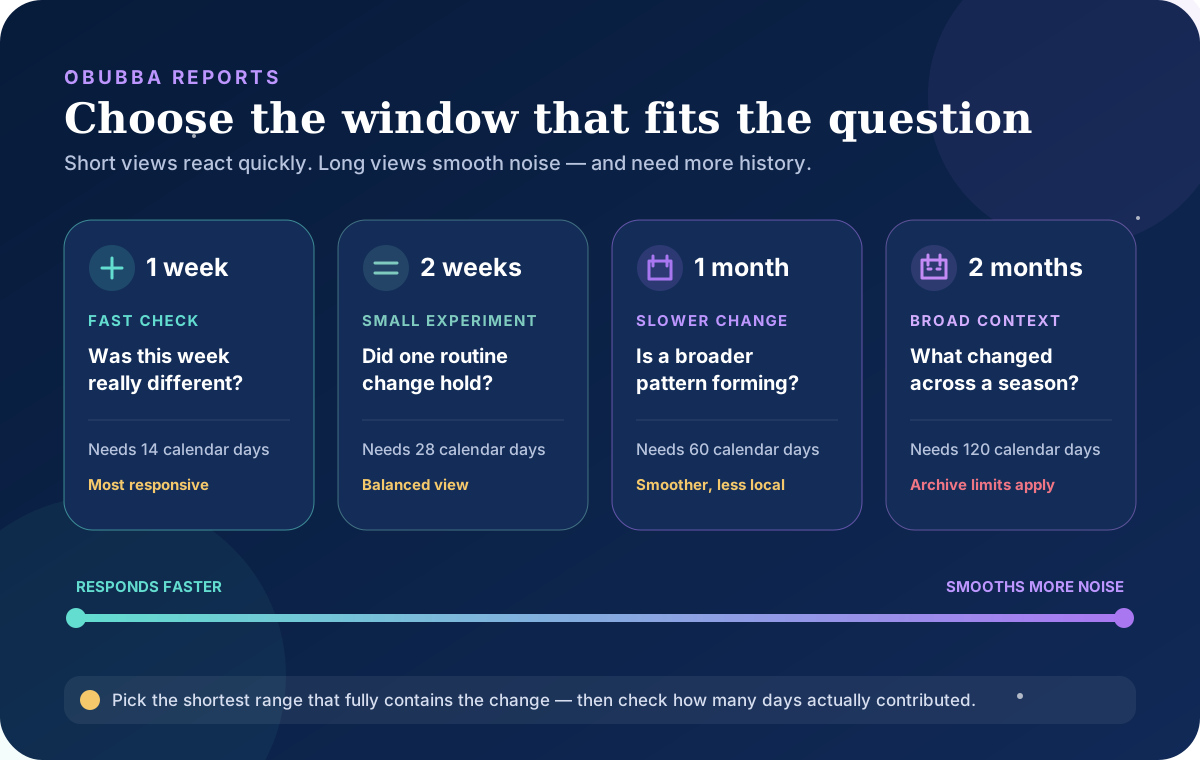
The history number is twice the selected range because OBubba compares two adjacent blocks of the same nominal length. A two-week view is not “the last two weeks against a random baseline”; it is days 0–13 against days 14–27.
That is the right comparison shape. It prevents a large recent window being judged against a tiny earlier sample. However, the current screen averages only days with relevant logs, so equal calendar windows do not guarantee equal contributing days. Check completeness before treating a delta as a verdict.
Choose 1 week when the question is recent
The one-week view is the best default for questions such as:
- Did the last seven days feel worse than the seven before?
- Did night wakes settle after the cold passed?
- Has the new bedtime been workable this week?
- Are feeds broadly as frequent as last week?
It responds quickly and matches how many families naturally review a routine. It also limits the chance that a much older developmental stage will dilute what is happening now.
Its weakness is volatility. A weekend away, immunisation day, heatwave, illness or two incomplete logging days can move an average sharply. Do not hide the outlier; label it mentally and ask whether the surrounding days move in the same direction.
The NHS says babies have individual sleep patterns and that those patterns change as babies grow; growth spurts, teething and illnesses can all affect sleep. A week is therefore a useful observation window, not a pass-or-fail score.
Choose 2 weeks for a small routine experiment
Two weeks is usually the most informative middle ground when a family has changed one thing and wants to know whether it helped.
Examples include:
- moving bedtime slightly earlier;
- protecting the final nap;
- changing how a parent responds to a false start;
- starting nursery on set days;
- sharing settling differently between carers;
- making one part of the bedtime routine more consistent.
Fourteen days can include weekdays, weekends and enough repetition to stop one night deciding the story. The comparison needs the prior 14 days too, so the cleanest read requires 28 calendar days in view and reasonably similar logging on both sides.
Do not keep an unhelpful or unsafe experiment going merely to complete the chart. The baby in front of you takes priority over the sample size.
Choose 1 month when the change itself takes weeks
A month can help when the question develops slowly:
- Is the third nap disappearing repeatedly?
- Has nursery created a different weekday rhythm?
- Are bedtimes gradually becoming more predictable?
- Did a period of travel settle back towards the family baseline?
- Is a pattern present across several cycles of good and difficult nights?
The benefit is stability. The danger is mixing different stories. A 30-day average can contain an illness, recovery, clock change and nap transition at once. If the number barely moves, those changes may have cancelled each other out rather than nothing having happened.
Use the Track history alongside Reports. Locate when the real change began, then interpret the average around that date. A monthly view is good at saying “the overall level shifted”; it is less good at saying why.
There is also a current technical limit. OBubba keeps approximately 45 days in the app’s immediately readable “hot” history before older days may be archived when a large family record is compacted. Reports builds its selected comparison from that synchronous recent store; it does not fetch archived day shards for the chart.
That means a 30-day current period can be well populated while part of the previous 30-day block is absent from this screen. Because the averages use logged days rather than treating missing days as zero, the result is not automatically dragged down—but the earlier average may be based on fewer contributing days. The UI should show those sample counts beside every delta.
Choose 2 months for context, not precision
The two-month option sounds reassuring because it is the widest. In the current implementation, it is the least likely to produce a complete current-versus-previous comparison.
A full calculation needs 120 calendar days: 60 current and 60 previous. Yet Reports reads the recent in-memory history, while older compacted days live in an archive that this screen does not hydrate. On a compacted record, much of the selected current block—and normally the entire previous block—can therefore be empty here even though the family has older data elsewhere.
The app’s honest behaviour is to omit a headline delta when the earlier period has no usable data. That is preferable to inventing improvement. But the selected label can still suggest a broader evidence base than the cards actually contain.
Use two months as a high-level retrospective only when you can see that the relevant weeks were logged and represented. Do not use it as the deciding view for a change that began five days ago; the other 55 days will mostly blur the question.
What changes when you tap a range in OBubba
The current Reports screen shows four chips above Insights overview.
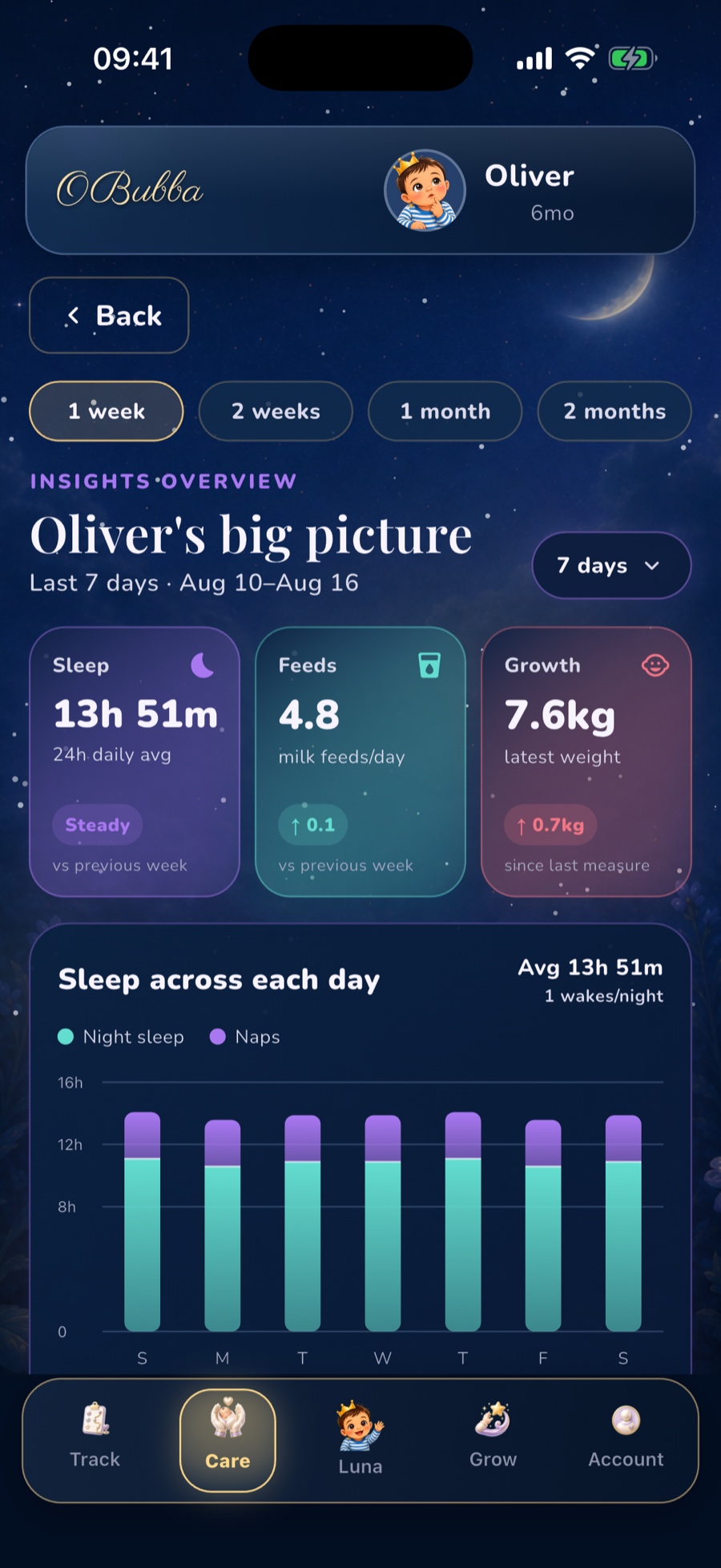
Selecting a chip rebuilds the headline period and these calculations:
- Sleep value: average 24-hour sleep on qualifying days with both night sleep and at least one nap. If no complete 24-hour days qualify, the card falls back to average night sleep.
- Sleep delta: current average 24-hour sleep minus the previous period’s average, only when both are available.
- Feeds value: average milk feeds per logged day. Solids are deliberately excluded from this milk-feed number.
- Feed delta: current average milk feeds per day minus the previous period’s average when both periods contain data.
- Date label: “Last 7 days”, “Last 2 weeks”, “Last month” or “Last 2 months”, with calendar dates.
Today is excluded from per-day feed, nap and day-sleep averages when other logged days exist, because a half-finished morning would otherwise make the selected period look artificially low. Last night can still contribute as a completed night.
Empty calendar days are not counted as zero. That is an important safeguard: not opening the app on Wednesday must not become “zero feeds” or “zero sleep”.
What does not change with the range
This is the most important product detail hidden by a very simple selector.
The current app gives different report components their own fixed evidence windows:
| Reports component | Current basis | |---|---| | headline sleep and feed cards | selected 7, 14, 30 or 60 days | | growth card | latest weight vs previous weight measurement | | “Sleep across each day” chart | latest 7 points passed to the overview | | sleep-quality score and band | latest 7 nights | | longest stretch | best complete night in the latest 7 | | weekly digest | its own weekly rules | | nap rhythm | last 35 complete days, excluding today | | consistency | last 7 nights | | copied GP / health-visitor summary | last 7 days | | clinic PDF | its own 4-week summary |
This design is not inherently wrong. A schedule-consistency score can be more useful over seven recent nights than across two developmental months. A clinical PDF should not silently change meaning because somebody tapped a chip above it.
The problem is visual scope. The range control appears above the whole overview, so a parent can reasonably assume every card follows it. The app needs a small scope label on fixed-window cards: 7-night quality, 35-day nap rhythm, latest measurement, 4-week PDF.
There is also a visible inconsistency in the current source: the pill beside the “big picture” heading is hard-coded to 7 days, even after the parent selects 2 weeks, 1 month or 2 months. The chips and date line update, but that pill does not. Until it is wired to the selected range, trust the highlighted chip and date line—not the pill.
Why your comparison may disappear
No delta is often the most honest answer. It can mean:
- the earlier period contains no relevant logs;
- night and nap data were not both present for a 24-hour sleep average;
- the selected range reaches beyond the recent history loaded by Reports;
- feeds were logged on one side but not the other;
- old days have been archived from the immediately readable store.
It does not mean sleep was steady. “No comparison” and “no change” are different statements.
The feed card helps slightly by showing a logged-day count when it cannot show a delta. The sleep card does not expose how many days backed its average. For a parent-facing comparison tool, every average should show its denominator: 13 complete days, 6 logged nights, feeds logged on 9/14 days.
A better five-minute review
Use this sequence before changing the routine:
- Name the question. “Did bedtime move earlier?” is better than “Is sleep better?”
- Choose the shortest relevant window. Start with one week; widen only if the change genuinely spans longer.
- Check both periods for comparable logging. Look for missing nights, unfinished timers and days where only feeds were recorded.
- Read more than the delta. Pair total sleep with night wakes, longest stretch, naps and real-life context.
- Find the change date in Track. Averages can show movement; the timeline helps explain it.
- Keep one useful constant. Avoid changing bedtime, nap structure and settling method all at once if you want to learn what mattered.
- Write the conclusion in plain language. For example: “Across two weeks, total sleep was similar, but wakes became shorter after the cold cleared.”
This method protects against two common mistakes: reacting to one awful night and accepting one smooth average without asking what was combined inside it.
For a deeper weekly method, read Is my baby’s sleep actually improving? Compare weeks, not nights.
What OBubba should improve next
The range selector is a useful foundation. To become the report parents trust first, it should now:
- replace the hard-coded 7 days pill with the selected range;
- label every fixed-window section with its actual evidence period;
- show the contributing-day count beside every average and delta;
- distinguish missing, not enough history and no meaningful change;
- warn when the selected range reaches into archived history;
- load archived days on demand for 30- and 60-day comparisons;
- compare only when both sides meet a clear completeness threshold;
- let parents mark illness, travel, nursery and routine-change dates on the trend;
- offer a “since this change” comparison instead of calendar blocks alone;
- keep the share report and PDF labels explicit when they remain 7 days and 4 weeks;
- remember the selected range only if the parent wants it remembered;
- let Luna answer, “What changed between these two periods?” using the same visible evidence and sample counts.
The differentiator is not having the longest chart. It is telling parents what the chart can honestly support.
The verdict
OBubba’s four ranges solve different jobs:
- 1 week notices recent movement;
- 2 weeks reviews a contained experiment;
- 1 month reveals a broader routine shift;
- 2 months supplies context when the data is truly available.
Start short. Widen with a reason. Check how many days contributed. Remember that only the headline sleep and feed comparisons currently follow the selector, while the rest of Reports uses purpose-specific windows.
That is less magical than “AI knows whether sleep is improving”. It is much more useful: a calm way to turn family logs into a question you can actually answer.
Try OBubba free → — track sleep, feeds, growth and weaning in one shared family record, then review the range that fits the change you are living through.
Frequently asked questions
Which OBubba Reports range should I use first?
Start with 1 week. Move to 2 weeks or 1 month when the question itself spans longer or one unusual week is dominating the result.
Does the 2-month option compare four months of data?
Yes in nominal calendar shape: the latest 60 days versus the 60 before, requiring 120 days for a full comparison. In the current app, Reports does not fetch archived days into that view, so a complete four-month comparison may not be available.
Does changing the range change the sleep-quality score?
No. The current score and longest-stretch highlight use the latest seven nights. The selected range changes the headline sleep/feed comparison and the period label.
Why does the feed card say 4.8 rather than 5 feeds?
It is an average number of milk feeds per contributing day. Solids meals are excluded from that headline feed average.
Are days with no logs counted as zero sleep or zero feeds?
No. Empty days are excluded from the averages. That protects against false zeros, but it also means two periods can have different numbers of contributing days.
Does the selected range stay after I close the app?
Not currently. The provider is session-scoped and defaults to 1 week when rebuilt after relaunch.
Can Reports diagnose a sleep regression or nap transition?
No. It can reveal a repeated pattern worth interpreting. Age, illness, feeding, development, environment and logging completeness still need human context.
Source and safety note
OBubba is a tracking and education tool, not medical advice or a diagnostic sleep study. Follow current safer-sleep guidance and seek professional help when you are worried about feeding, breathing, growth, pain, development or your baby’s wellbeing.
Ready to try OBubba?
Use OBubba to track feeds, sleep, naps, nappies, growth, milestones and family handovers in one calm baby tracker app.