Your baby wakes four times on Tuesday after waking only once on Monday. By 3am it feels as though every bit of progress has disappeared.
The short answer: one night is a story, not a trend. Compare a reasonably complete week with the week before, using the same definitions for bedtime, morning wake and meaningful night wakes. Then add context such as illness, teething, travel or a nap transition. Look for movement across several measures rather than asking whether every night was “good”.
Baby sleep changes as babies grow. Progress is rarely a straight line, and the NHS reminds parents that every baby has an individual pattern.
Why one night gives such a distorted picture
A single night can be changed by:
- a late or missed nap
- hunger or an unusual feeding day
- teething discomfort
- fever, congestion or illness
- a developmental burst
- travel, nursery or a different caregiver
- room temperature, noise or light
- an ordinary run of brief arousals
That does not mean the night should be ignored. It means the question should change from “Did the plan fail?” to “Does this repeat often enough to be a pattern?”
The NHS says babies' sleep patterns vary and change with growth spurts, teething and illness. A rough night may need comfort or medical attention; it does not automatically need a new schedule.
What does “sleep improving” actually mean?
Improvement is not limited to sleeping through. Depending on age and family goals, it might look like:
- fewer meaningful wakes on average
- a longer first or longest stretch
- less time awake during wakes
- settling becoming calmer or faster
- total sleep holding steady while a nap transition develops
- bedtime and morning wake becoming easier to anticipate
- parents needing fewer unsustainable settling steps
- recovery becoming faster after an illness or disrupted week
A baby can still wake and be improving. A baby can also log fewer wakes because a parent was too exhausted to record them. That is why completeness and context matter alongside the headline number.
Use a seven-day view, then compare like with like
A useful home review is simple:
| Question | What to compare | |---|---| | Are nights becoming less interrupted? | Average meaningful wakes per logged night and, if recorded reliably, time awake. | | Is sleep becoming more consolidated? | Longest sleep stretch and total night sleep. | | Has the day changed? | Average nap count and daytime sleep on days when naps were actually logged. | | Is total sleep shifting? | Night sleep plus naps only on days where both parts are complete enough to compare. | | Could another change explain it? | Illness, teething, feeds, travel, nursery, clocks or a developing nap transition. |
Use the same seven-day boundaries for both weeks. Compare bedtime with bedtime and meaningful wakes with meaningful wakes. Do not compare seven carefully logged nights with a previous week where the app was opened twice.
Missing data is not zero
This is the most common tracking mistake.
- No wake logged does not necessarily mean zero wakes.
- No nap logged does not mean the baby took no naps.
- No feed logged does not mean the baby had no feeds.
If a week was only partly recorded, say so. A trustworthy tracker should omit the comparison or show the number of contributing days rather than turning absence into a dramatic improvement.
You do not need perfect data. You need enough comparable data to answer the specific question. If nights are the concern, consistently record bedtime, morning wake and the wakes you consider meaningful. Feeds and nappies can stay optional unless they are relevant to the problem you are exploring.
A five-minute weekly review
Once a week, ask:
- What clearly improved? Name one measured change, not a feeling alone.
- What changed in the day? Notice naps, feeds, nursery or unusual events.
- What is repeated? A third similar night is more informative than one outlier.
- What can stay the same? Protect helpful parts of the routine before changing anything.
- What is the smallest useful experiment? Change one lever for several nights, then review again.
For example: “Wakes fell from about three to two per logged night, but daytime sleep also dropped and the last nap disappeared.” That is a more useful picture than “sleep training worked” or “the regression is back”.
How to recognise a possible nap transition
Fewer naps alone do not prove readiness to drop one. Look at the whole week:
- Is the final nap being refused repeatedly rather than once?
- Is total sleep holding reasonably steady?
- Can bedtime move earlier without a very long, distressed final wake window?
- Are nights stable or becoming more disrupted?
- Does the new pattern persist beyond illness, travel or nursery disruption?
If nap count falls while total sleep also drops and nights become rougher, the baby may need help protecting sleep rather than a permanent new schedule. Our nap-transition guide explains the decision in more detail.
How OBubba builds an honest week-over-week picture
The current app turns the family's actual logs into Care → Reports → Insights overview. It brings sleep, feeds and growth into one visual view, then compares the latest seven days with the seven before.
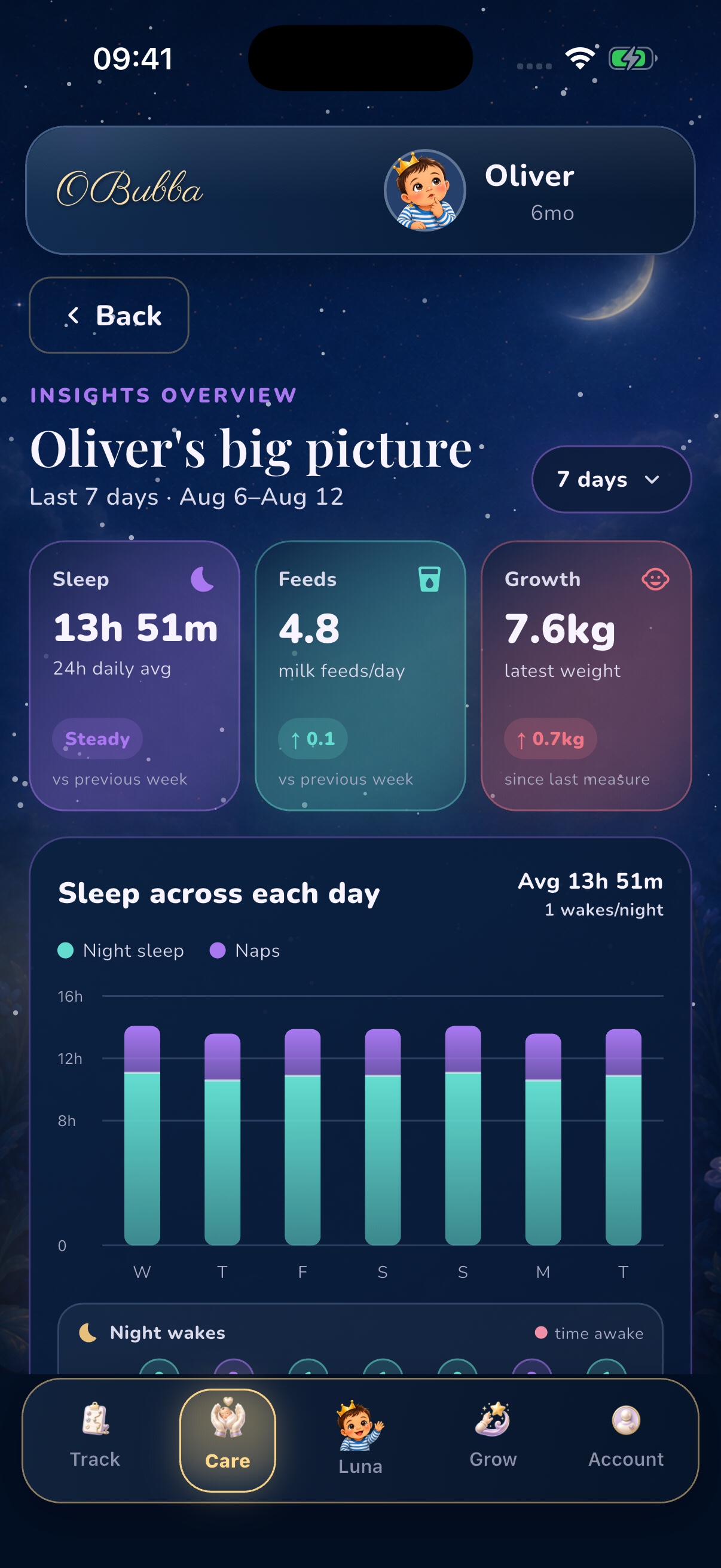
The weekly digest has several deliberate safeguards:
- it needs at least two logged days in the current week before producing a digest
- night-wake changes are only compared when both weeks contain at least two nights of real night data
- nap count and daytime sleep are only compared when both weeks contain at least two nap days
- total 24-hour sleep needs at least five qualifying days in each week, with both night sleep and naps represented
- a week with no night data does not display “zero wakes”, and nap or feed figures are omitted when those logs are absent
Small fluctuations stay quiet. A wake change needs to be at least half a wake per night; daytime sleep needs to move by about 20 minutes per day; and total sleep needs to shift by about 30 minutes per day before the digest calls it out. A fall of at least half a nap per day can be labelled as a possible nap transition, not a diagnosis.
OBubba also de-duplicates near-simultaneous wake and feed entries so one waking logged in two ways does not become two wakes. Overlapping sleep arcs are merged instead of doubling the total. If a parent has switched off feed or nappy tracking, those categories do not appear as nudges or “missing” achievements.
When there is a genuine improvement, the app can surface it as Your wins this week in the Parent Room. When the week is bumpier, the language remains observational. It does not grade the parent or call the baby a bad sleeper.
Try OBubba free → and see nights, naps, feeds and growth together, with comparisons that know the difference between zero and not logged.
How long should you test one sleep change?
If the change is safe, appropriate and your baby is well, several nights usually tell you more than one. Keep the rest of the routine broadly stable, record the result and stop if the change clearly makes family life worse.
Do not continue an experiment through pain, illness or feeding concerns just to complete a chart. Pause, care for the baby in front of you and label the disrupted period. Our guide to tracking sleep during illness, travel or nursery shows how to keep those nights from distorting the baseline.
When a sleep change needs health advice
Tracking is not triage. Speak to your health visitor or GP if sleep problems persist or you are worried about feeding, growth, breathing, pain or development.
Seek urgent help for concerning symptoms such as difficulty breathing, blue, grey or unusually pale colour, a baby who is hard to wake, feeding that is markedly reduced, signs of dehydration, a seizure or a non-fading rash. Follow current NHS guidance for the situation rather than waiting to see what the weekly graph does.
Whatever the trend, safer sleep does not change: place baby on their back for every sleep in a clear, flat, firm, separate sleep space, and room-share for at least the first six months.
Frequently asked questions
How many nights do I need before judging progress?
There is no universal magic number. A full week is a practical review window because it includes different family days. OBubba requires matching data in both seven-day periods before it claims a comparison.
What if this week has fewer wakes but less total sleep?
Neither number wins automatically. Check bedtime, morning wake, naps, time awake overnight and how your baby seems during the day. A calm longer stretch can be encouraging, while a large total-sleep drop deserves context and possibly professional advice.
Should I log every tiny stir?
Not necessarily. Choose a definition you can use consistently, such as wakes that needed parental help or a feed, and keep it the same across both weeks. OBubba can combine duplicate entries around the same waking, but consistent logging still produces a clearer picture.
Does one bad night erase progress?
No. Keep it in the record and add the context. An outlier belongs in the week without being allowed to define the entire week.
Can a weekly report diagnose a sleep regression?
No. It can show changes and help distinguish an outlier from a repeated pattern. Developmental phases, illness, feeding and environmental changes still need human interpretation.
Sources and further reading
- NHS: Helping your baby to sleep
- NHS: When to get urgent medical help for babies and children under 5
- NHS: Sudden infant death syndrome (SIDS)
- The Lullaby Trust: Keeping a clear cot
OBubba is a tracking and education tool, not medical advice or a diagnostic sleep study. Follow current safer-sleep guidance and seek professional help when you are concerned about your baby.
Ready to try OBubba?
Use OBubba to track feeds, sleep, naps, nappies, growth, milestones and family handovers in one calm baby tracker app.