Baby slept for three hours in the car on a travel day. Nursery wrote “about 45 minutes” for the afternoon nap. A cold led to four broken naps and an early bedtime. Should those days go into the sleep tracker, or will they ruin the pattern?
Log what genuinely happened, but label why the day was unusual. The record can still help with care and handovers. It should not automatically become the new definition of your baby's normal routine.
> Keep the history; separate the context. A sick, travel, nursery or grandparents day is information, not a failed home day.
The quick answer by day type
| Day | What is worth logging? | What not to conclude from one day | |---|---|---| | Baby is unwell | Approximate sleep, feeds, nappies, temperature, medicines and symptoms when relevant | That the normal schedule needs fixing | | Travel or time-zone change | Sleep in local clock time, journey naps, arrival bedtime and a short travel note | That a car-seat nap is the new ideal nap length | | Nursery or childminder | The times and estimates provided at handover, plus mood and bedtime | That an approximate nap report is exact to the minute | | Grandparents or family care | Real naps, feeds and anything that differed from home | That a calmer or rougher night was caused by one visit | | Normal home day | Usual sleep, feeds and meaningful notes | That every ordinary variation needs an explanation |
The goal is a truthful record with enough context to stop unlike days being compared as though they were identical.
Why unusual days are still worth recording
Skipping every messy day creates its own distortion. If the tracker shows only calm home days, it cannot help you reconstruct what happened during an illness, explain a nursery handover or remember when the travel disruption began.
A light record may answer practical questions:
- When did baby last sleep or feed?
- Were wet nappies noticeably different?
- When was a temperature taken or medicine given?
- Did the long journey nap push bedtime later?
- Was the difficult night after nursery a one-off or a recurring pattern?
- What should the next carer know?
The distinction is between recording an event and using that event to learn a normal baseline. You can keep the first without allowing an exceptional day to dominate the second.
What is a sleep baseline?
A baseline is a rough picture of what usually happens when conditions are reasonably ordinary: typical wake time, nap count, nap length, bedtime and night waking.
It is not a perfect schedule. Babies change quickly, and even home days vary. A useful baseline simply makes it easier to notice a meaningful shift without overreacting to noise.
Imagine five recent home naps lasted 55, 62, 58, 65 and 60 minutes. Then a journey produced a 150-minute car nap. If all six are averaged without context, the apparent typical nap jumps from 60 minutes to 75 minutes. Nothing about the baby's ordinary cot nap changed; the comparison changed.
That is why a context label can be more useful than deleting the long nap or pretending it was normal.
When baby is ill: care first, routine second
Illness is not a sleep-training data point. A baby with a fever, breathing difficulty, poor feeding, unusual sleepiness or another concerning symptom needs assessment based on the baby, not an optimisation suggestion from a chart.
The NHS guidance on looking after a sick child says sick children often need plenty of rest and advises giving fluids, comfort and quiet activities. It also warns never to fall asleep with a sick baby on a sofa, even when everyone is exhausted.
During illness, log only what reduces mental load or helps a professional understand the timeline:
- when sleep started and ended, approximately
- feeds and wet nappies if intake or hydration worries you
- temperature readings, including the time and method used
- medicine name, dose and time exactly as given
- symptoms or changes that prompted concern
- advice received and when to seek help again
Do not wake a sick baby merely to make the log align with the usual nap plan unless a clinician has told you to wake them for feeds, medicines or another reason. Do not delay urgent help to complete an entry.
Contact your GP, NHS 111 or the service named in your baby's care plan when concerned. Call 999 in an emergency. Current NHS guidance lists being difficult to wake, struggling to breathe, not feeding and having no wet nappy for 12 hours among signs that need urgent medical help.
What should happen to the schedule afterwards?
Expect the first few recovery days to be untidy. Baby may tire sooner, need extra reassurance or return to the normal rhythm gradually. Keep familiar morning light and bedtime cues when they are comfortable, but follow the baby's state rather than forcing yesterday's wake window.
The NHS Understanding your baby guidance encourages parents to notice whether a baby is ready to sleep, feed, play, cuddle or take a break. That responsive observation matters more than making a recovering day match a prediction.
For a gentle reset, use our baby sleep after illness guide.
Nursery days: use the handover, not imagined precision
Nursery nap records are often estimates. The room may be busy, a baby may stir before a carer records the wake, or the system may round to the nearest five or ten minutes. An honest estimate is better than adding a precise time that nobody observed.
At pickup, four questions usually give enough context:
- When did the last nap roughly end?
- How much total sleep did baby seem to get?
- Did they settle differently from usual?
- How were feeds, nappies and mood?
Use that information to make the evening gentler, not to audit the nursery. A baby may sleep less because the room is stimulating, more because the day is tiring, or almost exactly as they do at home.
One nursery day cannot prove a pattern. If you have several comparable days, look for repeatable differences: perhaps bedtime needs a longer wind-down, or the first home day afterwards benefits from a quieter morning. Keep the conclusion modest and practical.
Read our nursery naps and bedtime plan for the handover-to-evening steps.
Grandparents and other family care: record the exception first
A useful family handover does not require grandparents to mirror every tap you make. Agree on the essentials before you leave:
- safer-sleep setup and how baby is placed down
- feeds, allergies and medicine instructions
- the baby's usual tired cues
- the approximate last nap time
- how to contact you and what needs urgent help
Ask for actual events rather than a reconstruction of the plan. “Slept in the travel cot from roughly 1:10 to 2:00” is useful. “Had the usual nap” may not be.
If a night is consistently calmer or rougher after family-care days, explore what differs without blaming the carer. Activity, fresh air, feed timing, stimulation and nap opportunities may all contribute. Association is a clue, not proof of cause.
Travel days: change the setting, not the safety rules
Travel can alter light exposure, feeds, movement and sleep opportunity before a time-zone change is even involved. Record journey naps and use one clock convention consistently, usually local destination time once you arrive. Add the original time zone in a note if it will prevent confusion.
Keep the entry simple:
- nap start and end in the chosen local time
- whether it happened in transit
- arrival time and local bedtime
- a short note such as “eastbound, +2 hours”
Do not treat sleep in a moving car seat as evidence that the car seat is a suitable destination sleep space. The Lullaby Trust's safer-sleep guidance for staying away says to continue safer-sleep practice away from home and to move a baby from the car seat to a clear, firm, flat sleep surface when the journey ends.
Follow safer-sleep guidance for every nap and night, including at hotels, relatives' homes and nursery. Check the travel cot before use; do not add extra padding or improvised bedding.
For time-zone adjustment rather than ordinary travel disruption, use our baby jet-lag plan.
The one-minute context note
You do not need a diary entry explaining the whole day. Use a repeatable one-line format:
Day type + what changed + what matters next
Examples:
- “Sick day: slept on and off; fewer feeds; temperature and medicine logged separately.”
- “Nursery: last nap ended about 3:05pm; very tired at pickup; start wind-down early.”
- “Grandparents: two short travel-cot naps; cheerful; normal feeds.”
- “Travel: long car nap 12:20 to 2:05pm; arrived 5pm; local time.”
Avoid diagnostic shorthand such as “overtired caused four wakes” unless a professional established the cause. Record observation separately from interpretation.
How the actual OBubba app handles day context
OBubba's current Track day view contains a Today type card below the log details. It can label the viewed date as Home, Daycare, Grand, Travel or Sick. Because it works on the date being viewed, a parent can also correct a past day rather than needing to remember the tag in real time.
The implementation keeps two ideas separate:
- The events remain in the baby's history. Naps, wakes, feeds and notes are not erased.
- Contextual days are kept out of normal-day calibration. Sick, travel, daycare/nursery and grandparents days do not teach the app that an exceptional wake window or nap length is the new ordinary baseline. A plausibly logged fever can also exclude the day even without a manual tag.
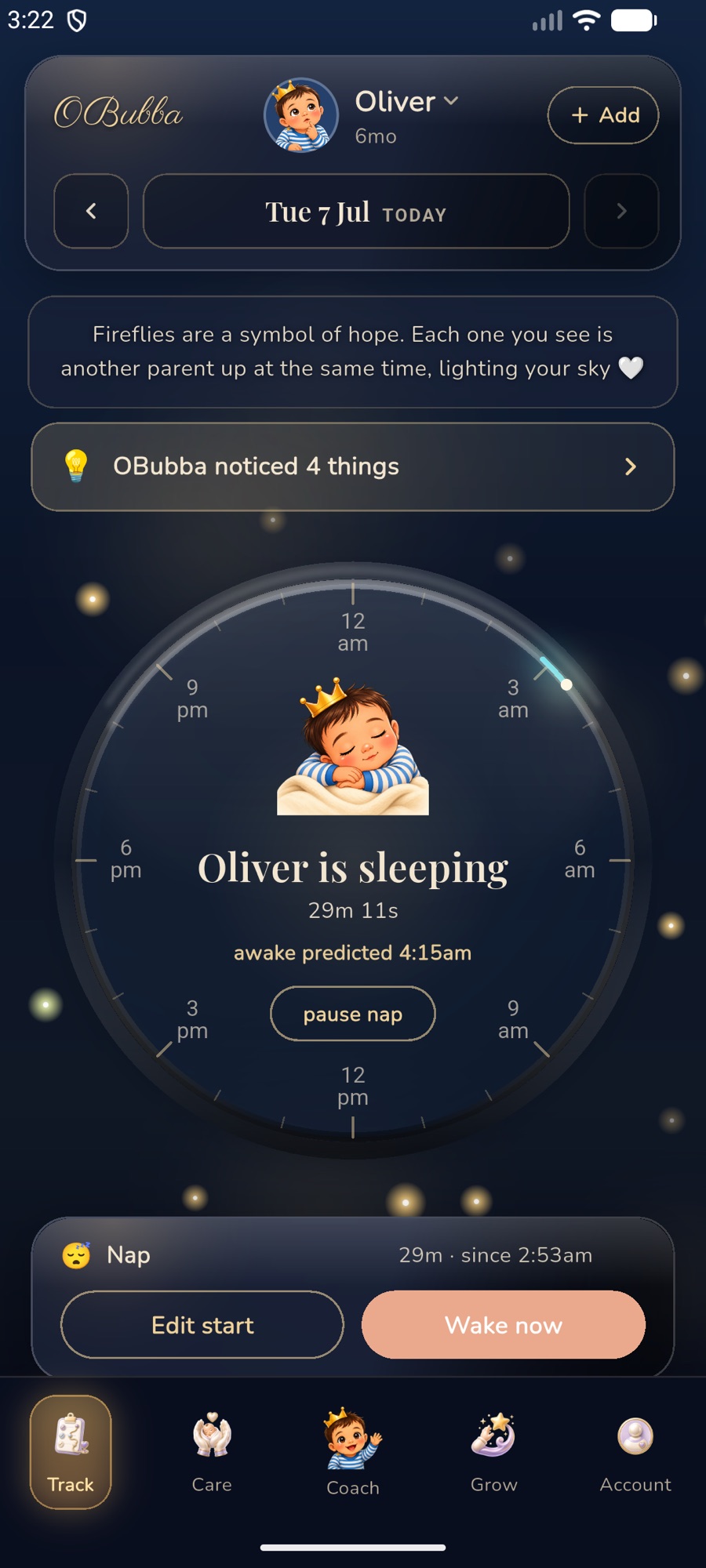
OBubba may use a Daycare, Grand or Travel tag in a separate comparison of away days versus home days. That comparison stays silent until there are at least four usable nights of each kind and the average differs by at least one waking. A sick day is deliberately excluded from this comparison because illness is a health confounder, not a lifestyle pattern.
The day context can also soften short-term sleep guidance and reminder timing during disruption and recovery. It does not diagnose why baby is tired, promise a nap or create a medical plan.
Important limits in the current app
- Day types are stored per baby, so a sibling does not inherit the wrong “sick” or “travel” day.
- Day types are saved to the baby's shared family data as well as a local offline copy. Sync is best effort, so critical care context should still be included in the handover.
- Home is the default and does not need to be saved repeatedly.
- The tag does not verify nursery times, safe-sleep conditions, illness or medicine doses.
- Today type adds interpretation context; it is not the same as deliberately changing the day's schedule.
That last boundary matters. If a travel or sick day really requires a different plan, follow the baby and any professional advice. A label does not make the decision for you.
Keep unusual days in context with OBubba. Track real sleep, feeds and nappies, then label the day so one messy day does not rewrite the story.
A seven-day review without overanalysing
At the end of a disrupted week, sort days into three buckets:
- ordinary home days for the clearest current baseline
- repeatable away days such as nursery, which may deserve their own comparison
- health or travel disruption, which explains context but should not drive routine conclusions
Then ask only:
- Has the ordinary home pattern genuinely shifted?
- Is there a repeatable difference after the same kind of away day?
- Is baby well, feeding, growing and behaving broadly as expected?
- Is one small evening adjustment enough?
Do not redesign the routine because one fever day produced extra sleep, one nursery day produced no nap or one family visit led to a late bedtime. Look for repeated, comparable evidence.
Frequently asked questions
Will logging a sick day ruin my baby's averages?
It can distort a simple unfiltered average, which is why context matters. In OBubba, a Sick day is retained in history but excluded from several normal-day learning paths. The record remains available without teaching the engine that illness sleep is ordinary.
Should I stop tracking when baby is ill?
You can stop if tracking adds stress. If a record helps, focus on care-relevant facts such as feeds, nappies, temperatures, medicines and approximate sleep. Health advice always takes priority.
Should I enter nursery's estimated nap times?
Yes, if they are useful. Keep them as honest estimates. Do not invent minute-level precision, and add a short nursery context label so they are not confused with directly observed home naps.
Can one grandparents day tell me why the night changed?
No. It can suggest a question, but one night cannot identify the cause. Look across several comparable days and consider the whole routine.
Do day tags sync to my partner in OBubba?
Yes. Today type tags are stored per baby and written to the baby's shared family data, with a local copy kept for offline use. Because a sync can still be delayed by connectivity, put critical care context in the handover as well.
Does the Sick tag diagnose illness?
No. It is a parent-selected context label. It cannot assess a baby, interpret a symptom or decide when care is urgent.
Sources and support
- NHS: Looking after a sick child
- NHS Best Start in Life: Understanding your baby
- Lullaby Trust: Safer sleep on holiday
- Lullaby Trust: Car seats
- Lullaby Trust: Safer sleep for childminders, nannies and nursery settings
This UK-oriented article provides general information, not medical advice or a sleep prescription. Follow your baby's individual care plan and current safer-sleep guidance. Contact your midwife, health visitor, GP or NHS 111 when concerned; call 999 in an emergency.
Ready to try OBubba?
Use OBubba to track feeds, sleep, naps, nappies, growth, milestones and family handovers in one calm baby tracker app.