You logged bedtime, two wakes and the morning start. The next day you recorded three naps. OBubba already knows more than an empty app—but does it know enough to help?
The honest answer is not one magic number.
OBubba’s current app can give a small, clearly labelled early read from as few as three useful logs. A complete-night progress card can appear from four to eleven logged nights. Deeper comparisons need their own samples—often five usable days, eight comparable nights or roughly a fortnight of consistent history.
That staggered approach matters. A parent should not have to enter two weeks of data before receiving any value, but the app should not call three entries a proven pattern either.
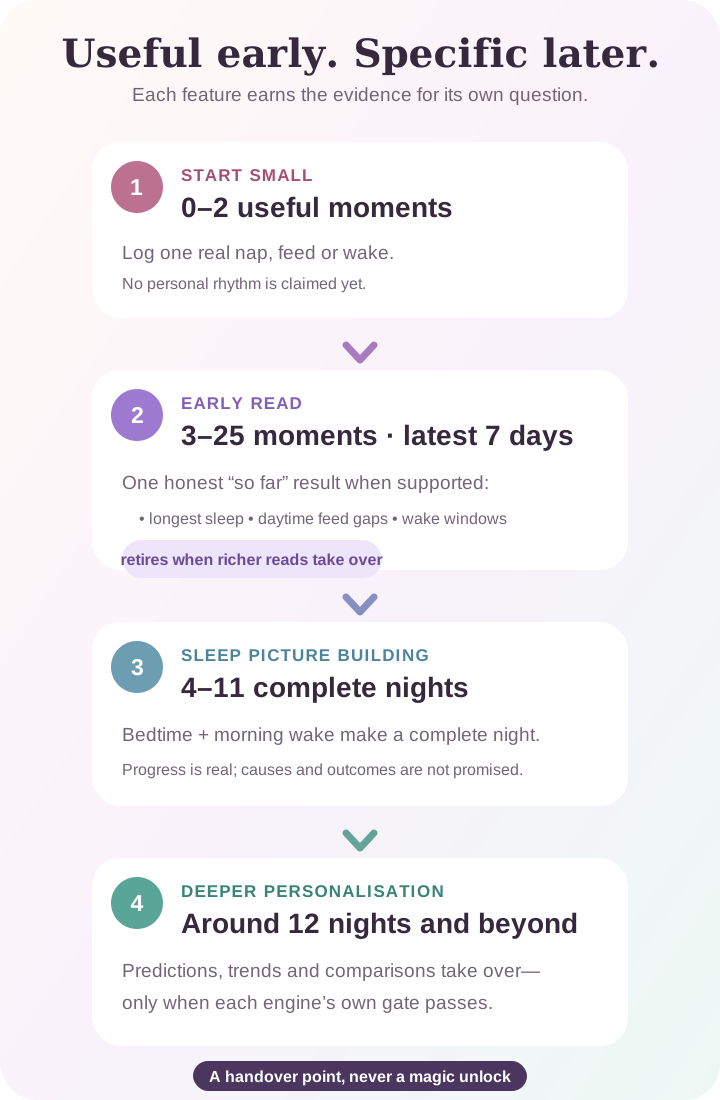
The short answer
| What you have logged | What OBubba may do | What it cannot responsibly claim yet | |---|---|---| | 0–2 useful moments | help you start with one nap, feed or wake | a personal rhythm | | 3–25 useful moments across the latest 7 days | show one early read when the data supports it | a stable trend or cause | | 4–11 complete nights in the latest 14 | acknowledge that a real sleep picture is building | that any one change will improve sleep | | Around 12 complete nights and beyond | let mature prediction, trend and comparison engines take over when their own gates pass | a diagnosis, guarantee or universal schedule |
A useful moment is a real feed, nap, sleep, wake, nappy, solids or pump record. A complete night needs both a reconstructed bedtime and a morning wake. An app full of feeds but no sleep boundaries may know feeding rhythm while still knowing little about nights.
Stage 1: one real log is better than a perfect imaginary day
For a new profile, OBubba’s small setup nudge asks for a nap, feed or wake. If the baby has no more than three logged days and today contains fewer than three useful moments, the wording shows how many more moments are needed before the app can start learning.
The target is three—not thirty.
This is an activation aid, not an evidence claim. It does not say the baby has a three-entry pattern. It helps a tired parent cross the blank-page problem with a manageable next step.
Good first-day boundaries are:
- the actual morning wake
- one or more nap starts and ends
- milk feeds at their real times
- bedtime or the first night-sleep start
- night wakes that genuinely occurred
Do not backfill the day from memory just to reach a number. One accurate nap is more useful than three guessed naps, because guessed times can create a false wake window that later predictions treat as real.
Stage 2: the first personal read can begin at three logs
The early-read engine looks across the latest seven calendar days and counts these log types:
- feed
- nap
- sleep
- wake
- nappy
- solids
- pump
It only runs while the total is between 3 and 25. That range is deliberate. Below three, there is too little to personalise. Above 25, the starter read retires so it does not compete with more specific engines.
Within that window, OBubba tries three early reads in a fixed order.
1. A notable longest sleep so far
If the recent record contains a completed sleep or nap lasting at least 2 hours 30 minutes—and no longer than 16 hours—the app may celebrate the longest one it can actually calculate.
The wording says so far. It is a measurement from the available entries, not the baby’s lifetime record and not a promise that the stretch will repeat.
Read why OBubba celebrates the longest sleep so far for the exact timer rules and limitations.
2. An early daytime milk rhythm
If there is no qualifying long sleep, the engine can look at daytime milk-feed gaps.
It excludes solids and night feeds. It keeps consecutive gaps longer than 30 minutes and shorter than 8 hours, then needs two to four valid gaps. With five or more, the mature feed predictor owns the question and the starter card stays quiet.
The early result is a simple average: “so far, daytime feeds are about…” It cannot measure breast-milk transfer, decide whether a feed was nutritionally complete or tell a parent to delay responsive feeding.
3. An early daytime wake-window read
If the feed read does not qualify, OBubba can calculate the gap from one completed daytime sleep ending to the next daytime sleep starting.
It keeps plausible intervals from just over 20 minutes to under 6 hours and needs at least two. The result is another early average, not an appointment for the next nap.
Sleepy cues, illness, hunger, corrected age and the actual day still matter. The NHS notes that every baby has their own sleep pattern and that those patterns change as babies grow.
Why an early read may not appear after three logs
Three useful moments unlock the possibility of an early read. They do not guarantee that the entries answer one of its questions.
For example:
- three nappies contain no sleep or feed interval
- three night feeds are excluded from the daytime-feed read
- two naps create only one between-nap wake window
- a running timer has no completed duration yet
- feeds on different calendar days do not become same-day consecutive gaps
Silence is better than filling the screen with a statistic that the data cannot support.
Stage 3: four complete nights begin a different kind of progress
Once the early read has nothing useful to add, OBubba checks the latest 14 physical nights.
A night counts as complete for this progress step only when the night analyser can find both:
- a bedtime boundary; and
- a morning-wake boundary.
From 4 through 11 complete nights, the app can show “You’re building [baby’s] sleep picture” and name the number actually logged. The message explains that clearer reads often need about a fortnight of nights and asks the family to keep recording bedtime and morning wake.
At 12 complete nights, that bridge retires. This does not mean night 12 flips every feature on. It means the app should stop congratulating a parent for merely approaching the useful-history range and let the relevant mature engines speak for themselves.
That distinction protects trust:
> Four nights can prove that a family is building a record. They cannot prove why a baby woke.
What does “complete night” mean in real life?
It does not mean a good night, an uninterrupted night or a night when every stir was recorded.
A rough night can be complete. A calm night can be incomplete if the morning wake is missing.
For useful night history, record:
- Bedtime or night-sleep start. Use what actually happened, not the planned time.
- Meaningful wakes. Record the wakes relevant to the question, especially feeds and longer awake periods.
- The final morning wake. A 4:45am feed followed by another sleep is not automatically the start of the day.
- Context when it matters. Illness, travel, nursery, teething or an unusual day can help an engine avoid treating disruption as ordinary baseline.
You do not need to tap the app for every sigh. Consistent boundaries matter more than exhaustive surveillance.
Stage 4: deeper features each earn their own evidence
There is no single “OBubba has learnt the baby” flag. The app asks different questions with different data.
| Feature question | Example minimum in the current logic | |---|---:| | Is there enough for a longer sleep consultation? | 5 usable day profiles | | Does a day factor line up with rougher nights? | 8 usable nights for that factor, with at least 3 on each side of a real split | | Is a particular nap length becoming personal? | 3 valid recent samples for that nap position | | Are night wakes changing week to week? | enough comparable nights in each window, depending on the detector | | Is an experiment helping? | checkpoints after 3, 7 and 14 nights, with enough outcome data |
The same family can therefore see a personalised next-nap time while a bedtime correlation remains silent. The nap engine may have enough completed Nap 1 examples; the correlation engine may not have eight comparable day-to-night pairs.
Read how OBubba decides a baby sleep pattern is real for the full correlation gates.
What the finished insight surface can look like
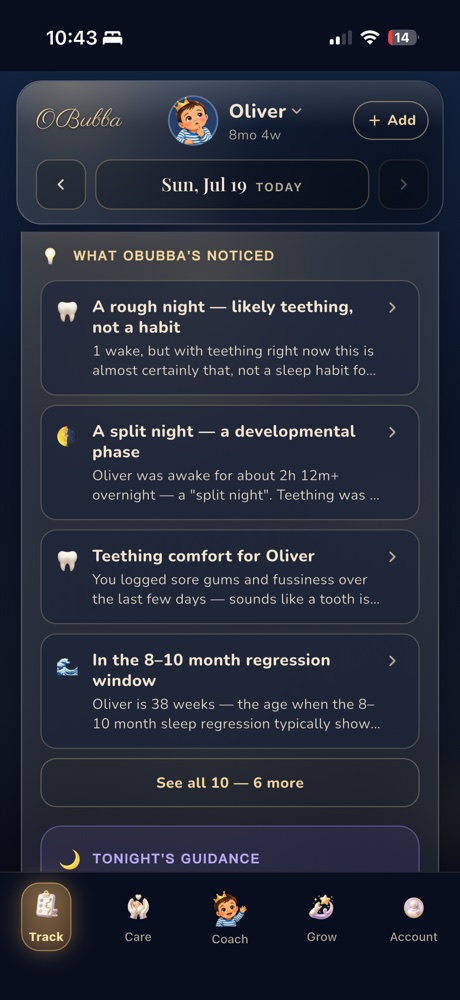
The current What OBubba’s noticed feed can hold several kinds of result: a recent event interpretation, a developmental context card, a multi-night pattern and Tonight’s Guidance.
They share one calm surface, but they are not produced by one generic “AI confidence” score. Each detector has its own inputs, minimums and reasons to remain quiet.
That is why the first useful week may feel uneven. One feature knows enough; another is still learning. A responsible interface should reveal that unevenness rather than applying a glossy “fully personalised” label to the whole account.
The minimum useful sleep log for busy parents
If tracking everything increases stress, log the boundaries behind the question you want answered.
“When might the next nap be?”
Record:
- actual morning wake
- completed nap starts and ends
- how the baby woke when that prompt is available
The app can learn more from three accurately timed Nap 1s than from a detailed food diary with missing sleep ends.
“Are nights getting better?”
Record:
- bedtime
- meaningful night wakes
- morning wake
- context tags for disrupted nights
Use the same definition of a wake across the comparison. Changing the logging rule halfway through can manufacture improvement.
“Does the last nap affect bedtime?”
Record:
- final nap start and end
- bedtime or sleep onset
- early false starts when they happen
- enough ordinary days for contrast
“Is feeding linked to waking?”
Record feeds honestly, including whether they happened at night. Never delay or remove a needed feed merely to make the dataset cleaner.
The best tracker is not the one with the most fields completed. It is the one that answers the family’s current question with the least necessary effort.
What resets learning—and what does not
A missed day does not erase the baby.
Recent engines naturally give newer data more relevance, and rolling windows eventually drop old examples. That is useful: a nine-month-old should not be governed forever by a four-month-old pattern.
Expect the app to need fresh evidence after:
- a nap transition
- illness or recovery
- travel or a clock change
- starting nursery
- a major feeding change
- a developmental shift
Do not create a perfect-looking replacement history. Resume with the next real wake, feed or nap. The app can cope with missing data more honestly than with invented data.
Newborns are not a prediction project
The NHS explains that newborn sleep can range widely and happen in short or long bursts. Newborns wake in the night because they need frequent feeds, and their pattern is unlikely to resemble an older baby’s routine.
Use tracking in the early weeks for continuity—feeds, nappies, medicines when relevant and clear handovers—not to force a schedule.
Seek health advice when feeding, wet nappies, breathing, temperature, alertness or your instincts concern you. An app waiting for more data is never a reason to wait for medical help.
Safer sleep does not need a learning period. For at least the first six months, NHS guidance says the baby should sleep in the same room as a parent, day and night. Place the baby on their back in a clear, separate, firm and flat sleep space every time.
Frequently asked questions
How many days before OBubba predicts naps?
There is no fixed day count. A starter wake-window read can use two valid intervals while personalised nap-position learning needs at least three valid recent samples. Age-based guidance can fill the gap until the baby’s own history is stronger.
Why does OBubba still say it is learning after a week?
The week may contain many logs but few completed boundaries for the feature you are viewing. A nap without an end, a night without a morning wake or a sporadically logged factor cannot form the same comparison as complete examples.
Is 12 nights enough for accurate sleep advice?
Twelve complete nights is where the progress bridge retires, not a universal accuracy guarantee. Each detector still applies its own sample and effect gates, and normal development can change the pattern later.
Should I add old nights from memory?
Only add a past event when you genuinely know its time and meaning. Approximate history can be labelled clearly, but guessed precision is more damaging than an honest blank.
Does OBubba learn from nappy and solids logs too?
They count towards the early activation window and support their own care insights. They do not substitute for bedtime, morning wake and completed naps when the question is sleep timing.
What if I stop tracking once the answer is useful?
That is allowed. Track for a purpose, simplify when the routine is clear and return temporarily when the pattern changes or a handover needs evidence. OBubba should support family attention, not compete for it.
Start small enough to continue
Tonight, do not promise yourself a perfect fortnight.
Record the real bedtime. Add meaningful wakes if they happen. Mark the morning start. Repeat the boundaries that answer your question.
OBubba’s learning ladder is designed to give something honest back early, then get quieter and more specific as the record grows. The goal is not to turn parenting into data entry. It is to turn a few accurate moments into less guesswork tomorrow.
Try OBubba free → — begin with three real moments, build complete nights at your own pace and see each personalised feature earn its evidence rather than pretending to know your baby instantly.
Sources and further reading
- NHS Best Start in Life: Your baby’s sleep patterns
- NHS: Helping your baby to sleep
- The Lullaby Trust: Safer sleep advice
This article gives general information for UK families and describes the OBubba implementation reviewed on 21 March 2027. OBubba cannot diagnose illness, assess a baby in person or guarantee that a particular amount of logging will reveal a useful pattern.
Ready to try OBubba?
Use OBubba to track feeds, sleep, naps, nappies, growth, milestones and family handovers in one calm baby tracker app.