Your baby went to sleep at 7:30pm and woke for the day at 6:30am. That looks like an 11-hour night.
But there was a 20-minute wake at 11pm, 35 minutes awake around 2am and another 10-minute resettle before morning. Did the baby sleep 11 hours—or 9 hours 55 minutes?
For a sleep total, 9 hours 55 minutes is the better estimate: the full bedtime-to-morning span minus the 65 minutes you know baby was awake. The 11 hours still matters, but it describes the night's outer span rather than time asleep.
Those are different measurements:
- night span: first actual sleep to final morning wake
- known awake time: timed periods baby was properly awake inside that span
- estimated night sleep: night span minus known awake time
- longest stretch: the longest continuous block between meaningful wakes
> The short answer: calculate from actual sleep onset to the genuine morning wake, then subtract awake intervals you observed and timed. Do not subtract an invented duration for a wake you only vaguely remember. A parent-held log is an estimate, not a sleep laboratory.
The simplest calculation
Estimated night sleep = night span − known awake time
For the example above:
| Part of the night | Duration | |---|---:| | 7:30pm to 6:30am night span | 11h 00m | | Wake 1 | −20m | | Wake 2 | −35m | | Wake 3 | −10m | | Estimated time asleep | 9h 55m |
This is not proof that the baby spent exactly 9 hours 55 minutes asleep. They may have had brief arousals that nobody noticed, and a parent may estimate resettling times. It is the most honest result the observed record supports.
Night span is useful—but it is not sleep
Suppose two babies both have a 7pm-to-7am night:
| Night | Known awake periods | Estimated night sleep | What the span alone hides | |---|---:|---:|---| | A | one 10-minute feed | 11h 50m | almost the whole span was sleep | | B | three wakes totalling 1h 20m | 10h 40m | a substantial amount of awake time | | C | one 90-minute split night | 10h 30m | one long, disruptive awake block |
All three nights occupy 12 clock hours. They do not contain the same amount or shape of sleep.
This is why “baby was down for 12 hours” can be true while “baby slept 12 hours” is not. Neither description is dishonest; they answer different questions.
Start with actual sleep, not the routine
Bath at 6:40pm, feed at 7pm, into the cot at 7:20pm and asleep at 7:42pm are four different moments.
For night-sleep arithmetic, begin when sleep actually started. The routine and cot time are helpful context, especially when settling is difficult, but counting them as sleep inflates the total before the night has even begun.
If the exact moment is uncertain, use a reasonable estimate and stay consistent. “Asleep around 7:40” is more useful than pretending the baby slept from the first page of the bedtime story.
Our guide to what time counts as bedtime separates routine start, put-down and sleep onset.
End at the genuine morning wake
The last feed is not automatically the morning. A baby may feed at 5:20am, return to sleep and wake for the day at 6:45am.
Use the point when the overnight sleep genuinely ended:
- baby is awake and stays awake
- lights and interaction change to daytime
- the next awake period begins
- the family is no longer trying to continue the night
A brief early stir followed by another hour of sleep belongs inside the night. A 5am wake followed by breakfast and play is the morning, even if the clock looks painfully early.
Which wakes should be subtracted?
Subtract awake time when you have evidence that baby was meaningfully awake and you know roughly how long it lasted.
Usually subtract
- a wake that needed feeding, changing or active resettling
- a long alert period in the cot
- a split night with a clear start and return to sleep
- a pause that was started when baby woke and ended when sleep resumed
Usually do not invent a subtraction
- one noise heard through the monitor
- a brief movement when baby may still have been asleep
- a wake you know occurred but cannot time
- an assumed number of sleep-cycle transitions
- time the parent remained awake after baby resettled
An untimed wake can still count as a wake. It simply cannot support a precise awake-minutes deduction.
What about night feeds?
A night feed is not automatically equal to its full start-to-finish clock span.
Some babies wake clearly, feed and need resettling. Others remain drowsy and return to sleep almost immediately. A parent-initiated dream feed may happen without a signalled waking at all.
If you are timing sleep, record what you observed:
- clearly woke at 1:10, asleep again at 1:32: 22 minutes known awake
- dream feed at 10:30, no signalled wake: log the feed; do not invent a wake
- fed sometime around 3am, duration unknown: record the wake/feed without making up minutes
The purpose is not to make feeding disappear from the night. It is to avoid converting every feed into either zero awake time or an arbitrary fixed number.
The parent's night is a separate measurement
Baby slept again at 2:35am. You put the bottle away, used the bathroom, checked the monitor twice and finally fell asleep at 3:10am.
The baby's awake interval may have been 35 minutes. The parent's lost sleep was longer.
That distinction matters because a baby-sleep graph can improve while the adult remains exhausted. If you are judging family wellbeing, also consider:
- how often the parent had to become fully awake
- whether feeds or resettling can be shared
- how long the parent takes to return to sleep
- whether worry is keeping the parent alert after baby settles
- whether there is any protected recovery sleep
Do not use the baby's total to dismiss adult exhaustion. If you cannot sleep even when baby sleeps, or feel persistently low, anxious or unable to cope, speak to your GP, health visitor or another qualified professional.
How much sleep is “enough”?
There is no single perfect total for every baby.
The NHS Best Start in Life sleep-pattern guide emphasises that babies differ and sleep changes with age. It describes broad averages across 24 hours, including naps—not a pass mark that must be hit every night.
Newcastle Hospitals' young-child sleep guidance gives 12 to 16 hours across 24 hours for babies aged 4 to 12 months and notes that brief night waking is normal. That range is general population guidance, not an individual prescription.
Look at the whole baby and the direction over time:
- mood and alertness when awake
- feeding and wet nappies
- growth and development
- whether sleep is changing suddenly
- whether the family can function safely
- any health or breathing concerns
A total slightly outside a chart on one day is not a diagnosis.
One night is arithmetic; a week is a pattern
The total becomes useful when it answers a decision.
| Question | Better signal than one raw total | |---|---| | Is the night becoming more consolidated? | longest stretch and total awake time | | Is baby sleeping less overall? | night sleep plus naps across several days | | Are wakes shorter even if the count is unchanged? | wake duration by night | | Did bedtime move but sleep stay stable? | actual sleep onset and final wake | | Is the family getting more rest? | parent interventions and parent sleep, not baby total alone |
Compare like with like. A night with complete bedtime, wake and morning anchors should not be compared as equal-quality data with a night where somebody forgot to stop the timer.
What the actual OBubba app calculates
The current app deliberately reports actual night sleep rather than raw bedtime-to-morning span when the evidence is available.
It reconstructs one physical night across midnight
Bedtime may be stored on Monday and a 2am wake on Tuesday. OBubba's `nightFor` logic brings the relevant entries together around the morning they belong to. Midnight does not split one real night into unrelated calendar fragments.
It merges overlapping sleep arcs
If partner sync or an import creates duplicate or nested sleep records, adding every arc would double-count the overlap. OBubba unions overlapping sleep periods first so a duplicate 7pm-to-7am record cannot become 24 hours of sleep.
It subtracts timed wakes inside the sleep arc
When a night wake has a known duration, that awake time is deducted from the containing sleep span. A 12-hour night with a 30-minute timed wake becomes 11 hours 30 minutes of recorded night sleep.
If the night is stored as two genuinely separate sleep arcs with an awake gap between them, the gap is already absent from the sleep total. OBubba does not subtract it a second time.
It does not guess an untimed wake
A wake without a duration remains part of the wake count, but the sleep calculation does not invent 5, 20 or 60 minutes to subtract. That means the result may be a slight overestimate, but it is traceable to known data rather than hidden assumptions.
A live Pause freezes the current sleep total
During a running night, Pause marks that baby is awake without ending the whole night. The live total stops growing while the pause is open. On Resume, OBubba stores the observed wake duration and asks how baby was resettled.
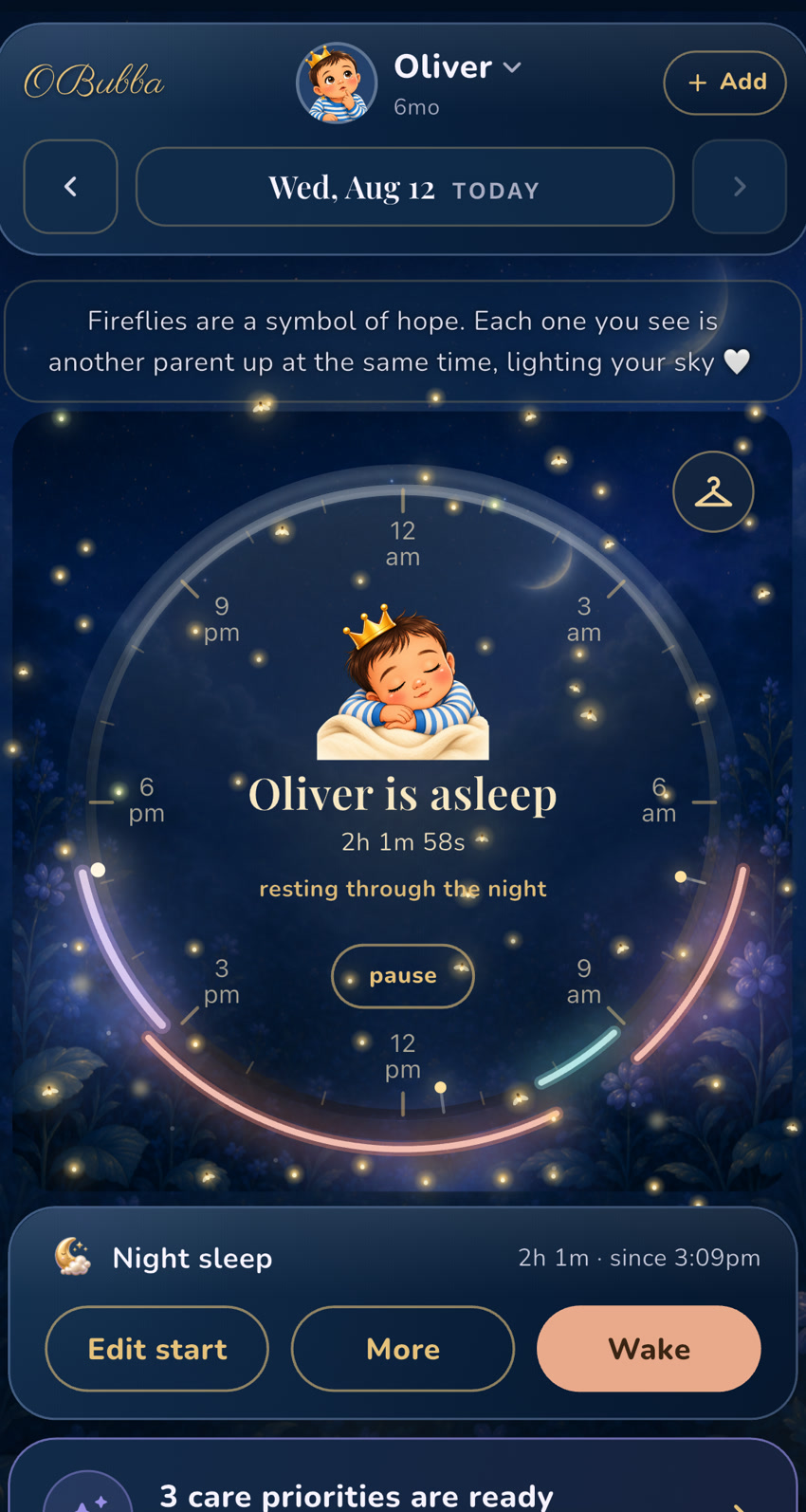
An abandoned pause is not allowed to become a fabricated multi-hour split night. The app closes implausible stale intervals without trusting the whole gap as measured awake time.
Duplicate partner wakes are deducted once
If two carers log the same 2am waking within a few minutes, OBubba keeps the longer recorded duration for that event rather than subtracting both copies. Wake count and sleep minutes stay consistent.
Reports use complete nights
The current Reports screen only treats a night as logged for trend purposes when it has both a bedtime and a morning wake. Its Night sleep bars use the reconstructed sleep arcs minus logged awake time, then sit beside wake count and awake minutes.
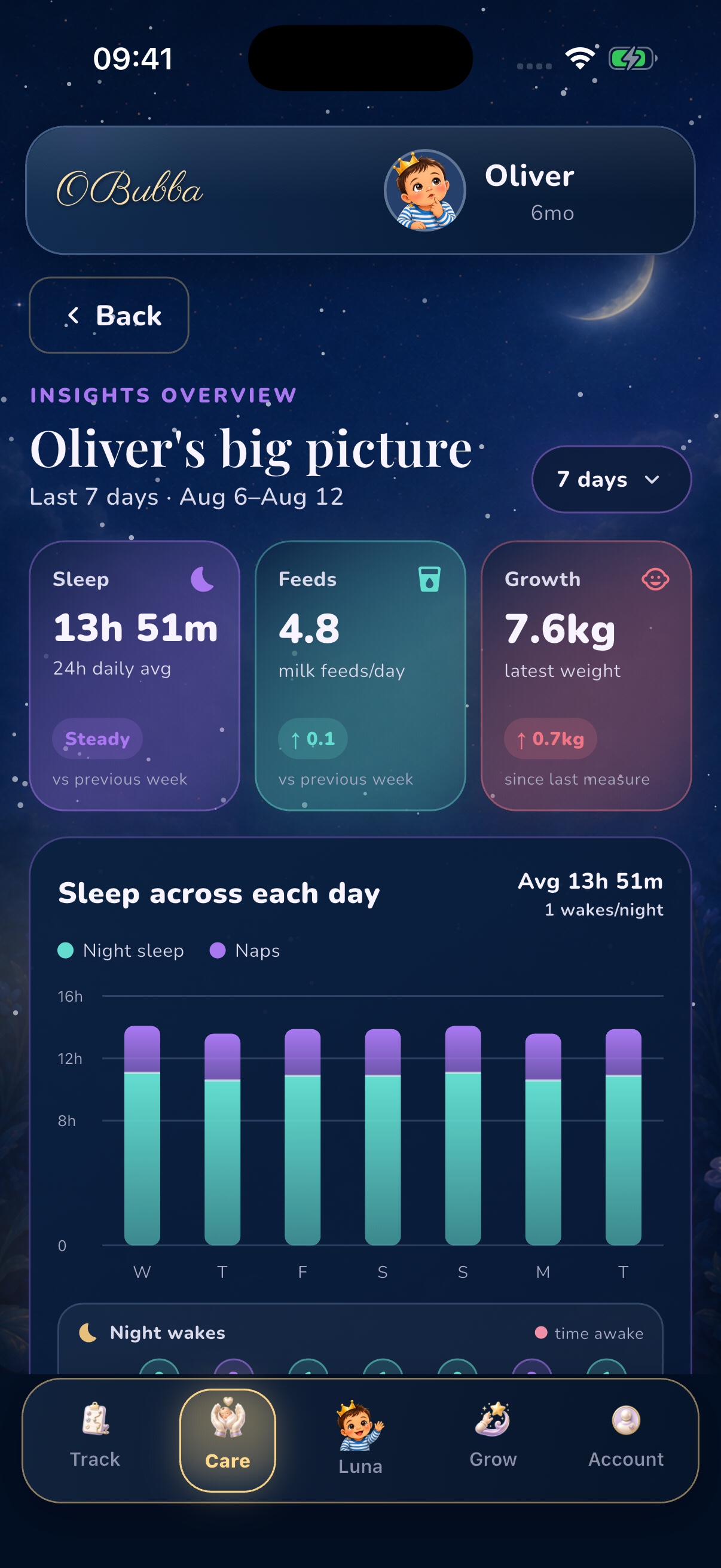
That restraint matters. A bedtime with no morning end is an unfinished record, not evidence of a perfect night.
Try OBubba free → — time the night once, pause meaningful wakes and let the app keep bedtime span, actual sleep, awake minutes, longest stretch and daily naps as separate signals.
A two-minute morning reconstruction
If you did not run a timer, you can still make a useful estimate.
- Write the approximate actual sleep onset.
- Write the genuine morning wake.
- List only wakes you remember.
- Add durations where you have a reasonable estimate.
- Subtract the known awake minutes from the night span.
- Label the result “estimated” if parts are uncertain.
Example:
> Asleep about 8:05pm. Woke for the day 6:20am. Two wakes: roughly 15 minutes and 25 minutes. Estimated night sleep: 9h 35m.
That one sentence is enough for most pattern tracking. You do not need to reconstruct every second at breakfast.
When a low total needs attention
One low night often reflects illness, travel, development, teething or an ordinary difficult night. Seek individual advice when poor sleep is persistent, the baby seems unwell or the wider picture concerns you.
Talk to your health visitor or GP if:
- sleep has changed suddenly and remains very different
- baby is unusually sleepy, difficult to wake or not feeding normally
- growth, feeding or wet nappies concern you
- frequent vomiting, pain, itching or another symptom is disturbing sleep
- loud snoring, gasping or repeated breathing pauses occur
- exhaustion is making it hard for the family to care safely
Call 999 if your baby stops breathing, turns blue or grey, will not wake or has another life-threatening symptom.
Safer sleep is not changed by the total
A short night does not make an unsafe product safer, and a long night does not mean safer-sleep guidance can be relaxed.
The NHS safer-sleep guide says the safest place for the first six months is a cot or Moses basket in the same room as you, with baby placed on their back. Use a firm, flat mattress and keep the space clear of pillows, cot bumpers, loose bedding, nests and positioners.
Never fall asleep with a baby on a sofa or chair. If a night feed happens in bed, plan for tiredness and return baby to their safer sleep space before you sleep.
Frequently asked questions
Does 7pm to 7am mean my baby slept 12 hours?
Only if baby was asleep for essentially the whole span. Subtract known awake periods to estimate actual night sleep. Keep “12-hour night span” as a separate useful fact.
Do brief wakes count against total sleep?
Known awake time does. A movement or sound that may have occurred during sleep should not automatically be assigned a made-up duration.
What if I forgot how long a wake lasted?
Log the wake without a duration or add an honest approximate note. OBubba does not deduct a guessed default from untimed wakes.
Does feeding time count as awake time?
Count the period baby was clearly awake, not automatically the entire feed event. A dream feed without a signalled waking is different from a fully alert feed and long resettle.
Why is OBubba's total lower than bedtime-to-morning?
Because the report subtracts timed awake intervals from the overnight sleep arc. That is intentional: “Night sleep” should not silently include an hour baby was awake.
Why can a monitor show a different number?
Consumer monitors may infer sleep from movement or sound, while a parent log records observed events. Neither is the same as a clinical sleep study. Compare method with method and avoid treating small differences as a medical finding.
Should I wake my baby to meet a chart?
Not solely because one night total looks high. Age, feeding, health, naps and individual advice matter. Follow any neonatal or clinical feeding plan, and ask a health professional if unusually long sleep or difficulty waking concerns you.
Is longest stretch the same as total sleep?
No. A baby might have a 6-hour longest stretch and 10 hours total night sleep across several blocks. Both measurements describe something useful.
Measure the night you had—not an ideal one
Bedtime to morning tells you how large the container was. Awake intervals tell you how much of that container was not sleep. Longest stretch tells you how consolidated the sleep became.
Keep those signals separate, estimate only what you observed and compare complete nights over time. The most helpful sleep total is not the most impressive number. It is the one whose meaning you can explain.
This article provides general sleep-tracking information, not medical advice. Seek qualified help for concerns about breathing, unusual sleepiness, feeding, growth, illness or family safety, and follow your baby's individual clinical plan.
Ready to try OBubba?
Use OBubba to track feeds, sleep, naps, nappies, growth, milestones and family handovers in one calm baby tracker app.