The bath began at 6:40pm. The book closed at 7:05. Your baby went into the cot at 7:12, needed another cuddle at 7:20 and finally became quiet at about 7:34.
So what was bedtime?
The short answer: in ordinary family conversation, any of those times might be called bedtime. For a useful sleep log, separate three moments: routine start, settling or put-down, and estimated sleep onset. If you record only one, use the time your baby actually fell asleep—or your best calm estimate. You do not need to watch for an exact second.
The gap between beginning to settle and falling asleep is often called sleep-onset latency. It can help explain a repeated bedtime struggle, but one long settle is not a diagnosis and it does not mean the routine failed.
> Bedtime is a transition, not a single perfect timestamp.
The three bedtime clocks
| Moment | What it means | What it can tell you | |---|---|---| | Routine start | lights dim, nappy, feed, story or other wind-down begins | whether the lead-in is realistic and repeatable | | Settling start / put-down | active attempt to help baby sleep begins, whether in arms or in the sleep space | how long settling appears to take | | Sleep onset | baby seems to have fallen asleep | the best anchor for sleep duration, wake windows and the first night stretch |
These times answer different questions. Treating the start of a 35-minute routine as if sleep began then can make the night look longer than it was. Treating cot placement as sleep onset can hide a regular 40-minute settle. Recording only the moment of sleep, meanwhile, does not show whether the wind-down itself has become exhausting.
You rarely need all three every night. Use extra detail only while it answers a real question.
If I record one time, which should it be?
Record when your baby was asleep, as best you can tell.
That might be:
- when their eyes stayed closed and their body became still
- the end of the feed or rocking that led into sleep
- the time you last checked and reasonably believed they had settled
- a rounded estimate such as “about 7:30pm”
Do not repeatedly touch, reposition or wake a baby to verify the log. Do not stay beside the cot watching a clock if leaving is safe and appropriate for your setup. A five- or ten-minute estimate is usually more useful than an exact-looking time built on guesswork.
If one caregiver says “down at seven” and another means “asleep at seven”, agree on a family definition. Consistent approximate data is easier to interpret than precise-looking data that changes meaning from night to night.
Does the bedtime routine count as sleep?
No. Feeding, bathing, reading and cuddling are awake time unless the baby actually falls asleep during them.
That distinction matters most when parents are looking at:
- total sleep over 24 hours
- the final wake window
- how long the first stretch lasted
- whether bedtime resistance repeats
- whether a schedule change helped
But the routine still matters. NHS guidance says a simple, soothing routine may help a baby settle, and observational studies have found associations between consistent bedtime routines and better reported sleep outcomes. Those studies do not prove that a particular sequence makes every baby sleep, nor that longer is better.
Keep the routine as its own event: a familiar bridge towards sleep, not bonus minutes to add to the night.
What if my baby falls asleep while feeding or rocking?
Then sleep onset is approximately when they fell asleep during the feed or rocking—not when they were later transferred.
You can record both facts without judging either one:
- asleep: about 7:18pm
- settled by: feeding and holding
- cot transfer: about 7:32pm
Feeding, rocking or holding to sleep can be normal, especially for younger babies. The transfer time becomes useful only if you are trying to understand repeated wake-ups during transfer. It should not erase the sleep that already began in your arms.
If you do not know when sleep started because you were feeding in the dark, choose a sensible estimate and move on. Never risk falling asleep with a baby on a sofa or armchair for the sake of finishing a timer. Put the baby in their safer sleep space before you sleep.
How do I estimate sleep onset when I leave the room?
Use a range rather than inventing certainty.
For example:
- put down calm and awake at 7:10pm
- heard brief babbling until roughly 7:22pm
- quiet when checked at 7:30pm
- log sleep at about 7:25pm, or record “5–15 minutes to settle”
You do not need a camera, wearable or constant monitoring to make the log worthwhile. Consumer devices infer sleep in different ways and can be wrong. A parent estimate is still useful when the method stays broadly consistent.
If your baby cries or needs you, respond according to their age, needs and your chosen approach. A clean dataset is never more important than comfort, feeding or safety.
How long should it take a baby to fall asleep?
There is no universal minute at which a normal settle becomes a problem. Age, the final nap, hunger, discomfort, illness, separation awareness, stimulation and the kind of support being used can all change the evening.
Instead of scoring one night, ask:
- Is settling calm, or distressing for baby or parent?
- Has the same long gap appeared on several comparable nights?
- Was the final nap or awake period different?
- Does the baby seem bright and ready to play, or frantic and exhausted?
- Are pain, breathing, reflux, eczema, teething or illness signs present?
A study following 468 children across the first two years found that routine consistency was associated with some better sleep outcomes over time, but associations are not guarantees for an individual baby. Another large study of young children found a consistent routine was associated with shorter reported sleep-onset latency. Neither result gives parents a compulsory “normal” cut-off.
The useful signal is repetition plus context, not one number.
A low-effort seven-night bedtime check
If bedtime has become difficult, collect only four things for one week:
| Log | Example | |---|---| | final nap ended | 4:12pm | | routine began | 6:55pm | | asleep | about 7:32pm | | settling felt | calm / needed support / distressed |
Add one short note only when something unusual happened: nursery day, illness, travel, missed feed, teething discomfort or an unexpectedly late nap.
After seven nights, look for a repeated shape:
- routine is long but settling is brief: shorten optional steps if the adults need relief; the sleep timing may be fine
- routine begins early and baby stays cheerful for a long time: the attempted sleep time may be arriving before enough sleep pressure
- baby becomes frantic before the routine ends: begin a little earlier or strip the routine back
- latency is long only after late naps: adjust from the sleep that actually happened rather than enforcing the old clock time
- every night is different: keep gathering gently; there may not yet be a stable pattern
Change one thing in small steps and compare several nights. Do not cut needed daytime sleep, delay a hungry baby’s feed or withhold comfort to create a tidier chart.
When should I ask for help?
Speak to a health visitor or GP if settling is persistently very difficult, your baby seems in pain, sleep problems are affecting feeding or growth, or exhaustion is making it hard for your family to cope.
Seek urgent medical help if your baby is struggling to breathe, blue or grey, unusually floppy, very difficult to wake, having a seizure or seriously unwell. Stop timing and respond to the baby in front of you.
For every sleep, use a clear, firm, flat, separate sleep space and place your baby on their back. In the first six months, NHS advice is for the baby to sleep in the same room as a parent or carer, day and night. A log does not make an unsafe sleep setup safe.
How OBubba’s actual app separates the evening
We checked the current implementation rather than relying on a feature list.
Near the app’s predicted bedtime, the Track screen offers Start wind-down. That opens OBubba’s editable Bedtime ritual, which shows one step at a time and keeps the routine separate from the sleep record.
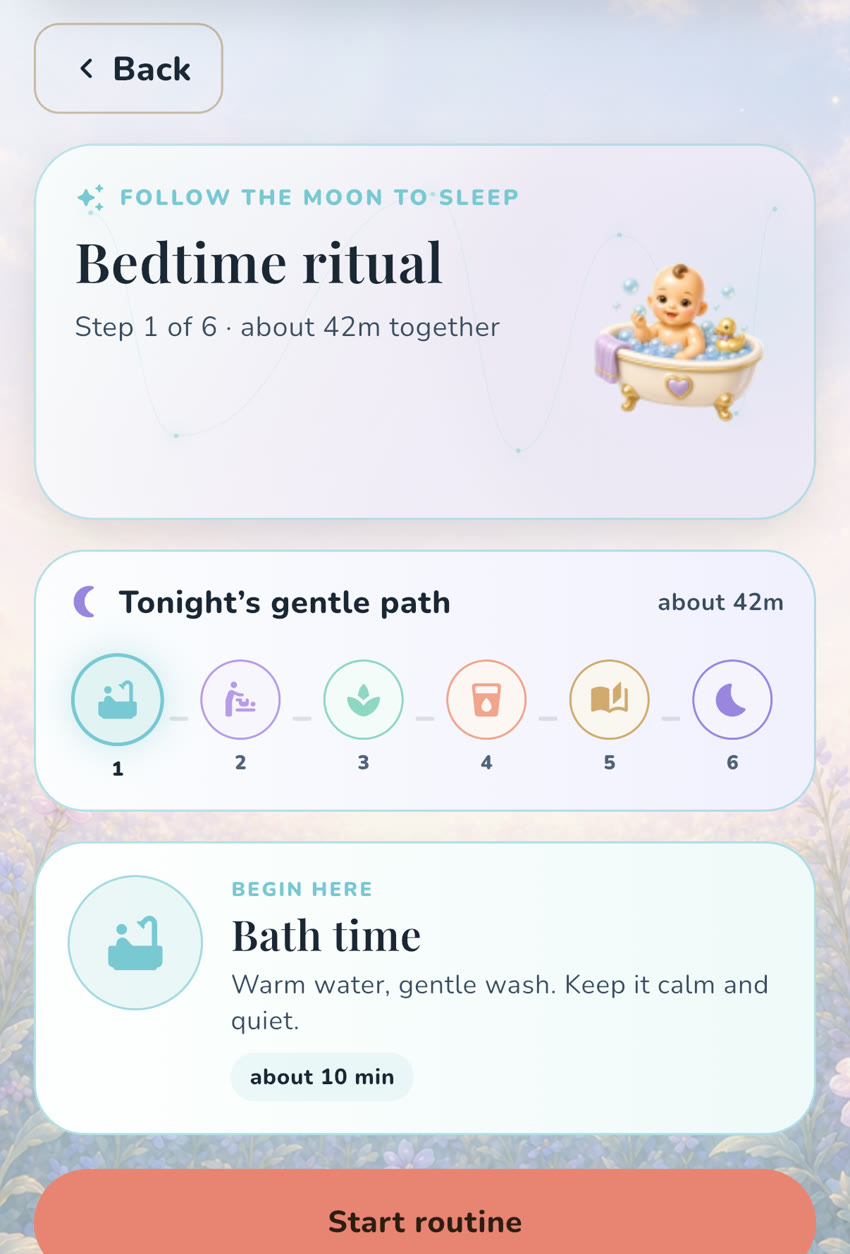
The built-in example includes bath, nappy and pyjamas, optional massage, final feed, story or song, and into bed. It totals about 42 minutes, but that is an editable example—not a recommended length. Parents can reorder, rename, remove or add steps, and each child keeps a separate routine.
When the ritual finishes, OBubba does not automatically claim the baby is asleep. It asks the parent to start the live bedtime record from the Track clock when the baby is down. A retrospective bedtime entry is labelled Asleep at, and the same log can separately record:
- how the baby settled: self-settled, fed, rocked, held, patted or dummy
- a representative time-to-sleep band: under 5, 5–15, 15–30 or 30+ minutes
- broad room conditions such as dark, dim or light and quiet, white noise or noisy
That separation lets OBubba use sleep onset as the night anchor while retaining the settling context. Its bedtime-resistance detector stays silent unless a longer settle is actually recorded on at least two recent nights; it does not diagnose a fight from clock timing alone.
The Tonight’s Story view can then describe the evening in plain language, using the logged bedtime, recent pattern and settling time where available. Missing detail remains missing. OBubba cannot watch the baby, know the exact moment sleep begins, diagnose a sleep disorder or prove what caused a better night.
Try OBubba free → — a guided wind-down, honest sleep timing and pattern-aware bedtime support in one calm place.
For help making the wind-down itself realistic, read A Simple Baby Bedtime Routine You Can Actually Repeat. If the cot transfer is the difficult moment, use our guide to why babies wake when put down.
Frequently asked questions
Is bedtime when the baby goes into the cot?
It can be a useful settling-start time, but it is not necessarily sleep onset. If the baby remains awake for 20 minutes, record the estimated asleep time separately when that distinction matters.
Do I start the sleep timer while rocking?
If your baby has already fallen asleep while rocking, yes: sleep has begun. If rocking is still part of the awake wind-down, wait. Use a rounded estimate when the boundary is unclear.
Should I correct old sleep logs?
Usually not. Keep using the same definition from now on. Correct a record only when the difference is large enough to mislead you—for example, a timer accidentally included an hour of awake routine time.
Does a long routine mean my baby takes a long time to settle?
No. A 30-minute bath-feed-book routine followed by five minutes of settling is different from five minutes of routine followed by 30 minutes of distress. Keep those intervals separate.
What if my partner logs bedtime differently?
Choose one simple household rule, such as “log when baby seems asleep; add the settling band if we know it”. Write it in the handover so both records mean the same thing.
The bottom line
Call the whole evening “bedtime” if that is natural at home. In the log, keep the meanings clearer: routine starts the transition, put-down starts the settling opportunity, and estimated sleep onset starts the sleep.
Round the time. Record context only when it helps. Then put the phone down—the goal is a more understandable pattern, not a perfectly observed baby.
Sources
- NHS: Helping your baby to sleep
- NHS: Sleep and young children
- NHS Best Start in Life: Safer sleep advice for babies
- SLEEP: Bedtimes, bedtime routines, and children’s sleep across the first 2 years of life
- Sleep: Bedtime routines for young children and sleep outcomes
OBubba supports tracking, routines and parent education. It cannot observe sleep, diagnose a sleep disorder, replace professional care or make an unsafe sleep space safe.
Ready to try OBubba?
Use OBubba to track feeds, sleep, naps, nappies, growth, milestones and family handovers in one calm baby tracker app.