Starting solids creates a strange new maths problem. Your baby eats three spoonfuls of porridge, drops one bottle feed and suddenly you are wondering whether milk is disappearing too quickly, or whether this is exactly what is meant to happen.
The reassuring answer is that milk stays central while solids build gradually. At the beginning, most of a baby's energy and nutrients still come from breast milk or first infant formula. There is no useful millilitre target for a breastfed baby, and formula figures are guides rather than quotas.
For formula-fed babies, the NHS says they may need around 600ml a day at 7 to 9 months and around 400ml a day at 10 to 12 months. Those numbers are not targets for breast milk, not a minimum every healthy baby must finish, and not a reason to pressure a baby through a bottle.
> The short version: keep offering breast milk or first infant formula responsively, let solids grow from tastes towards meals, and judge the transition from the whole picture: feeding cues, wet nappies, growth, energy and what has changed, not one bottle total.
Milk and solids by stage
| Stage | What solids may look like | What milk may look like | The useful focus | |---|---|---|---| | Just starting, around 6 months | One small, relaxed food opportunity; quantity matters less than learning | Usual responsive breastfeeds or first infant formula continue | Taste, texture, sitting upright and stopping on fullness cues | | 7 to 9 months | Gradually moving towards 3 meals | Breastfeeds adapt naturally; formula-fed babies may need around 600ml/day as a guide, often across about 4 feeds | Milk remains the main drink; include varied, iron-rich foods | | 10 to 12 months | Usually 3 meals with more variety and texture | Often about 3 milk feeds; formula-fed babies may need around 400ml/day as a guide | A gradual handover, not an abrupt swap | | From 12 months | 3 family meals and usually 2 healthy snacks | Breastfeeding can continue; first infant formula is no longer needed | Whole pasteurised cow's milk can now be a main drink if used |
The NHS 7-to-9-month guide and 10-to-12-month guide repeatedly describe those formula amounts as guides. Appetite changes between babies and from one day to the next.
If your baby was premature, has faltering growth, swallowing difficulty, food allergy, a medical condition or an individual feeding plan, use advice from their dietitian, paediatrician, health visitor or feeding team instead of a general table.
Why breastfed babies do not need a millilitre target
You cannot see the amount transferred during a breastfeed, and you do not need to turn feeds into imaginary ounces to make weaning work.
Feed length is not milk volume. A baby may become faster at transferring milk, take a brief comfort feed, feed longer during a growth spurt or switch their pattern as meals become more substantial. Pump output is not a reliable measurement of what a baby removes at the breast either. A pump and a baby stimulate milk differently, and output varies with timing, equipment, stress and many other factors.
For a breastfed baby, look instead at:
- whether feeding remains comfortable and effective
- whether the baby feeds responsively and seems satisfied after at least some feeds
- wet nappies compared with their usual pattern
- alertness, energy and general wellbeing
- growth over time, interpreted by a health professional when needed
- whether any reduction is gradual and makes sense alongside increasingly established meals
The NHS says a breastfed baby will adapt feeds according to how much food they are having. You can continue breastfeeding for as long as you both want.
Formula amounts are a guide, not a pass mark
Measured bottles can feel more certain, but the total is still only one piece of information.
The NHS's approximate 600ml and 400ml figures describe common intake during broad age bands. A baby's intake may move around them because of body size, appetite, illness, teething and how much food is actually swallowed. Some days a baby eats enthusiastically; other days the spoon is rejected and milk rises again.
Use responsive bottle feeding:
- offer when early hunger cues appear
- hold your baby close and keep the bottle mostly horizontal
- allow pauses
- never force the teat back into a closed mouth
- stop when your baby turns away, slows, spills milk, relaxes their hands or loses interest
Make every formula feed exactly as the manufacturer instructs. Never add extra powder to increase calories or extra water to stretch a feed. First infant formula can remain the formula drink throughout the first year; the NHS says there is no need to switch to follow-on formula.
Should milk come before or after solids?
There is no need to build the day around a rigid “milk first” rule forever.
When solids are brand new, choose a time when your baby is awake, upright and not exhausted. Current NHS Best Start in Life guidance says to offer milk feeds after solids because a baby's small stomach fills quickly, while continuing to offer breast milk or first infant formula responsively. This is a useful order, not a reason to make a clearly hungry baby wait until they are distressed.
As meals become established, the NHS's 7-to-9-month guidance suggests milk after solids because a baby's small stomach fills quickly. That supports appetite for food while milk still remains the main drink. Breastfeeds may not fit neatly into this order: they are also comfort, connection and responsive care.
A practical rhythm is:
- Keep the responsive milk routine your baby already knows.
- Place a small food opportunity when baby is calm, alert and not desperately hungry.
- Offer the next milk feed after the food opportunity, following baby's cues.
- Progress towards family mealtimes as interest and skill build.
- Let the baby, not the clock, finish each feed.
Do not delay a clearly hungry baby's milk just to protect a timetable. A feeding pattern should serve the baby, not become a test the family has to pass.
What a normal milk reduction can look like
The transition rarely happens in a straight line. A normal-looking shift may include:
| Often part of a gradual handover | Worth discussing or checking | |---|---| | One feed becomes smaller as a meal becomes reliably substantial | A marked drop before solids are established | | Intake varies from day to day but the baby remains well | Fewer wet nappies than usual, dark urine or a dry mouth | | Breastfeeds become shorter or move to different times | Persistent refusal of breast and bottle feeds | | A feed drops, then returns during illness or teething | Repeated vomiting, diarrhoea or inability to keep fluids down | | Solids variety and texture steadily expand | Unusual sleepiness, floppiness, irritability or difficulty waking | | Growth continues along the baby's expected pattern | Weight or growth concerns, or a clinician has advised a feeding plan |
The left column is not a guarantee that intake is adequate, and the right column is not a diagnosis. It is a way to separate a coherent transition from a change that needs individual assessment.
Milk remains the main drink throughout the first year
The NHS first-foods guidance is clear: breast milk or first infant formula remains the main drink until 12 months.
That does not mean food is nutritionally unimportant. From around six months, babies need a varied diet that includes sources of iron and zinc, and they need practice with increasingly lumpy textures and finger foods. It means solids and milk have different jobs during the transition.
Early food helps a baby learn:
- how tastes and textures feel
- how to move food around the mouth and swallow
- how to bring food to the mouth
- how to join family meals
- how to encounter common allergens safely
- how hunger and fullness feel across different foods
Milk continues to deliver substantial energy, fat, protein, fluid and micronutrients while those skills develop.
Do not replace milk with cow's milk before 12 months
Pasteurised whole cow's milk can be used in cooking or mixed into food from around six months. It should not replace breast milk or first infant formula as the main drink until your baby is 12 months old because it does not have the right nutritional balance for an infant.
From six months, offer sips of plain water in an open or free-flow cup with meals. Water builds a drinking skill; it is not a substitute milk feed. The NHS drinks-and-cups guide explains that milk may naturally reduce once a baby is eating plenty of solids several times a day.
Babies under one do not need snacks. If your baby seems hungry between meals, the NHS advises offering an extra milk feed rather than filling the gap with snack foods.
What about night milk feeds?
Starting solids does not automatically mean a baby is ready to stop feeding at night, and more food does not reliably produce sleeping through.
A night feed may still provide nutrition, comfort or both. Readiness to reduce it depends on age, growth, overall intake, feeding method, health and the baby's individual pattern. Do not remove medically important feeds, concentrate daytime formula or push food in the hope of buying sleep.
If you are considering night weaning, first look at the full 24 hours:
- Is daytime milk easy to access?
- Are meals becoming genuinely substantial, rather than mostly explored?
- Is growth reassuring?
- Is the baby well?
- Does a health professional have any concerns about intake?
Our night-weaning readiness guide separates developmental readiness from the understandable wish for more sleep.
Vitamins while milk and solids overlap
Milk type and amount affect vitamin advice.
The NHS recommends daily vitamin D from birth for breastfed babies. Babies having less than 500ml of infant formula a day also need vitamin supplements because formula is fortified; babies having 500ml or more normally do not need additional vitamins. From six months to five years, NHS guidance generally recommends vitamins A, C and D unless the child is taking at least 500ml of formula daily.
This is one situation where a measured formula total is useful. Ask your health visitor or pharmacist which product and dose suit your baby, particularly if they were premature, have a medical condition or take other supplements.
How the actual OBubba app handles milk and solids
OBubba does not add every feeding-related number together and call it “intake”. The current app's logic deliberately separates milk consumed, milk expressed and solid food eaten because they answer different questions.
In practice:
- breastfeeds are logged as breastfeeds, without inventing a volume
- bottles and combination feeds with an entered amount contribute to measured milk-volume trends
- pumping is excluded from intake because expressed milk is not necessarily milk the baby drank
- solids stay in the weaning journal rather than being converted into millilitres
- milk, solids, wet nappies and growth can still be viewed in context
- no insight is shown when the data is too sparse to support it
The app also changes its interpretation with developmental context. If measured daytime milk gradually eases after solids age, OBubba can frame that as a possible normal handover and remind the parent to keep milk available alongside meals. The same unexplained decline before weaning age is treated more cautiously, especially if wet nappies, mood or growth have changed.
That is a small but important product decision. A tracker should not make a breastfeeding family feel that the unmeasured part of feeding is zero, mistake pumped milk for consumed milk, or label every post-weaning bottle change as a problem.
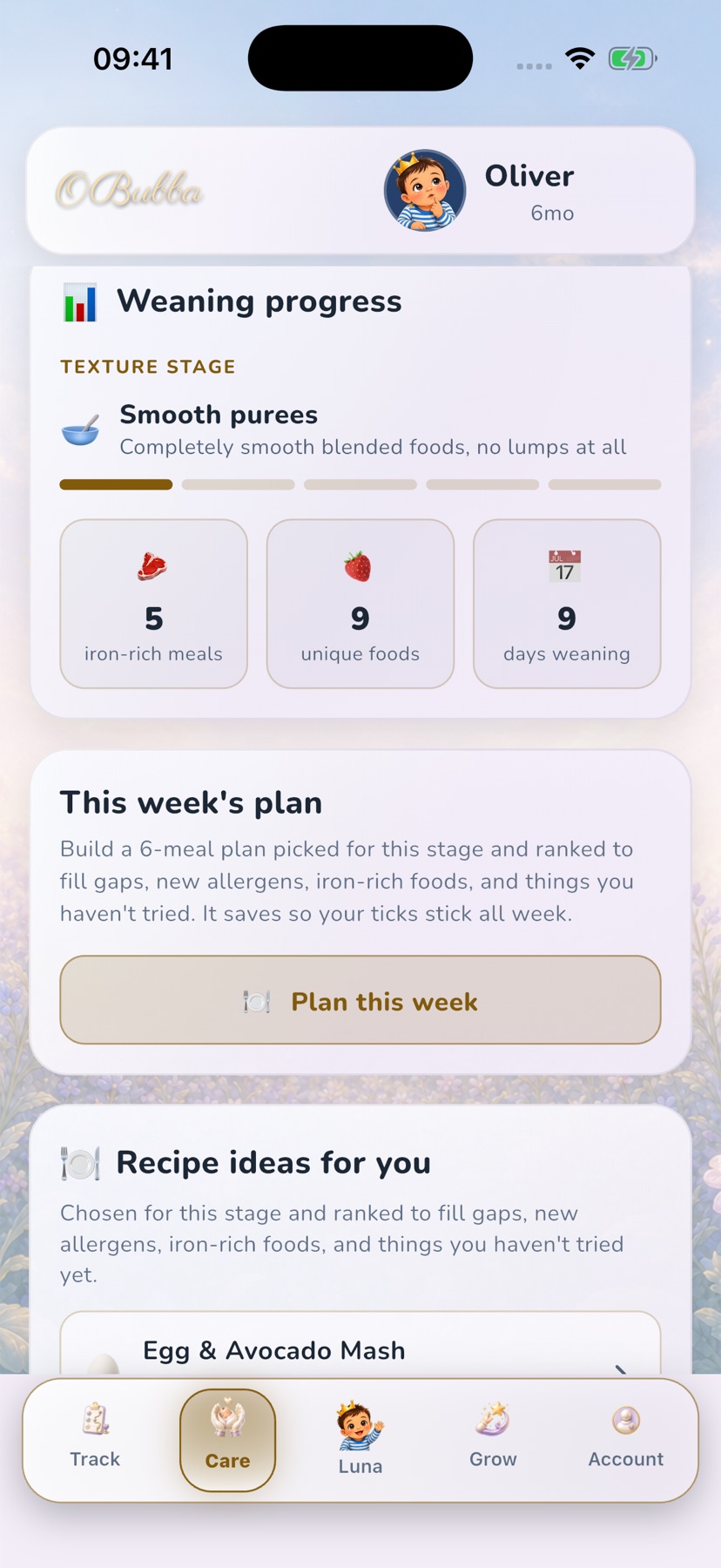
The real Weaning progress screen focuses on what food tracking can genuinely show: texture stage, unique foods, iron-rich meals, allergens and days of practice. It then builds recipe and meal suggestions around gaps in that record. Milk remains in the feeding record, where measured and unmeasured feeds retain their proper meaning.
OBubba cannot assess milk transfer at the breast, diagnose dehydration or decide whether a baby is growing well. Its job is to turn scattered memories into a coherent record that helps a parent notice change and have a more specific conversation:
> “Over the last week, lunch became a full meal and the afternoon bottle became smaller. Wet nappies and mood are unchanged.”
That is more useful than “I think the baby is drinking less, but I cannot remember when it started.”
Keep milk and first tastes in one calm timeline →. Try OBubba free and keep breastfeeds, measured bottles, pumping, first foods, nappies and growth together without flattening them into one misleading total.
A calm three-day check when milk seems lower
If your baby seems well and there are no urgent warning signs, use a short observation window rather than constantly recalculating.
Day 1: record what actually happened
Log breastfeeds by time or duration if that helps your family, measured bottles by amount, and solids as meals. Record wet nappies. Do not estimate breast-milk millilitres or count pumped milk as consumed unless it is later fed.
Day 2: look for the reason, not just the number
Did a meal become larger? Is baby teething, constipated, unwell or too tired at a usual feed? Did a care handover change what was recorded? Is the decline in one daytime bottle while feeds across 24 hours remain responsive?
Day 3: compare the whole baby
Look at nappies, behaviour, feeding comfort and the direction of change. If the pattern is still concerning, share the concise record with your health visitor, GP or feeding specialist. You do not need to wait three days if nappies drop, the baby seems unwell or your instincts say something is wrong.
When to seek help
Contact your health visitor, GP or feeding specialist if:
- milk intake drops markedly or repeatedly without an obvious transition in solids
- your baby is regularly refusing feeds
- breastfeeding is painful or you are concerned about latch or milk transfer
- your baby coughs, chokes or has wet/noisy breathing during feeds
- solids appear to be displacing milk very quickly
- weight or growth is worrying you
- you are considering changing an individual feeding plan
Seek prompt medical advice through your GP or NHS 111 if your baby has fewer wet nappies than usual, dark urine, a dry mouth, no tears, persistent vomiting or diarrhoea, unusual drowsiness or is not feeding normally. Babies can become dehydrated quickly.
Call 999 for serious breathing difficulty, blue or grey colour, a baby who will not wake, a first seizure or another life-threatening emergency.
Frequently asked questions
How many milk feeds should a 7-month-old have?
The NHS describes around four milk feeds a day at 7 to 9 months as a possible pattern while a baby moves towards three meals. Breastfed babies may feed more often, and no schedule fits every baby. Follow cues and look at the whole pattern.
Is 600ml of formula enough for a 7-month-old?
The NHS says formula-fed babies at 7 to 9 months may need around 600ml a day, but explicitly calls this a guide. A baby's individual needs and the amount they actually eat vary. Do not force a baby to finish bottles to reach the number; ask a health professional if intake, nappies or growth concern you.
Is 400ml of formula enough at 10 months?
Around 400ml a day is the NHS guide for formula-fed babies at 10 to 12 months, often alongside three meals and about three milk feeds. It is not a universal minimum. Continue first infant formula until 12 months unless your baby's clinician advises otherwise.
Can solids replace a bottle at 6 months?
Not as the goal when solids are just beginning. Start with small tastes and continue usual milk feeds. A feed may naturally reduce or drop later as meals become established, but early purée or finger-food practice is not nutritionally equivalent to a milk feed.
How do I know a breastfed baby gets enough milk after starting solids?
Do not judge from minutes at the breast or pump output. Look at effective feeding, wet nappies, alertness, satisfaction after some feeds and growth over time. Ask a health visitor or breastfeeding specialist to observe a feed if you are worried.
Should I give a bottle so I can measure milk?
Not solely to create a number. If breastfeeding is going well, visible millilitres are not required to prove intake. A bottle may be part of your family's chosen feeding method, but switching for measurement alone can introduce new feeding and supply considerations.
Will more solids help my baby sleep through?
There is no guarantee. The NHS says starting solids does not make a baby more likely to sleep through the night. Offer food for nutrition and skill development, not as a sleep treatment.
This article provides general information, not medical advice. Follow your baby's individual feeding plan and seek qualified help for concerns about milk intake, feeding, swallowing, wet nappies, growth, dehydration or illness.
Ready to try OBubba?
Use OBubba to track feeds, sleep, naps, nappies, growth, milestones and family handovers in one calm baby tracker app.