The first purée is ready, the highchair is covered and a tiny cup is sitting beside the plate. How much water are you supposed to put in it: 10ml, 60ml, a full cup? And how do you know whether your baby actually drank any rather than wearing it?
For a healthy baby starting solids at around six months, the practical goal is cup practice and small sips with meals, not reaching a universal millilitre target. The NHS recommends introducing a cup from around six months and offering sips of water with meals. Breast milk or first infant formula should remain the main drink throughout the first year.
Offer a small amount of plain water in an open or non-valved free-flow cup at each meal. Let your baby decide whether and how much to sip, keep normal milk feeds going and refill only if they want more. Do not replace milk with water, force a cup target or dilute formula.
The quick answer by stage
| Baby's stage | Water approach | What still matters most | |---|---|---| | Fully breastfed and under six months, not on solids | No additional water is normally needed, including in hot weather; offer the breast more often | Responsive breastfeeds | | Formula-fed and under six months | Usual formula feeds; small amounts of cooled boiled water may be advised in very hot weather | Correctly prepared formula; never dilute it | | Starting solids at around six months | Offer a few sips of tap water with meals from an open or free-flow cup | Breast milk or first infant formula remains the main drink | | Eating two or three meals | Keep offering water at each meal; let skill and interest build | Milk feeds, varied food and the baby's overall wellbeing | | Hot weather, six months or older | Offer water more often as well as normal milk feeds | Shade, cool clothing and watching for dehydration | | Vomiting, diarrhoea or possible dehydration | Follow NHS 111, GP, pharmacist or clinician advice; an oral rehydration solution may be needed | Medical assessment and replacing fluids safely |
These are starting principles, not a drinking schedule. A baby who takes one curious sip is learning. A baby who drinks more after a dry meal may also be responding normally.
Why there is no single “right” number of millilitres
The NHS guidance for babies starting solids says sips, not a fixed daily water volume. That is sensible because total fluid intake varies with:
- how much breast milk or formula the baby takes
- whether solids are just beginning or established
- the water content of food
- weather and activity
- illness, fever, vomiting or diarrhoea
- the baby's size and individual needs
A breastfed baby's milk volume is not directly visible. A formula-fed baby's bottle volume still does not tell you exactly how much additional water they require. Giving every baby the same cup target can create two problems: unnecessary anxiety when most water lands on the bib, or too much water displacing nutrient-rich milk in a small stomach.
Use the cup as an offer, not a prescription. Put in enough for safe sipping without filling a heavy cup to the brim. If your baby empties it and wants more, add more. If they only mouth the rim, try again at the next meal.
When can a baby start drinking water?
From around six months, alongside solids
The NHS drinks-and-cups guidance says that once a baby has started solid foods, usually around six months, you can offer sips of water in a cup or beaker with meals. Drinking water for babies over six months does not need to be boiled first in the UK when the mains supply is safe.
Starting water and starting solids belong together because the aim is learning a new mealtime skill. It does not mean milk has become optional.
Fully breastfed babies under six months
Fully breastfed babies normally do not need extra water before solids. In hot weather, offer the breast more often. Breast milk provides fluid as well as nutrition.
Adding water can fill a young baby's small stomach without supplying the energy and nutrients in milk. If your baby has a medical condition or an individual feeding plan, follow the clinical advice rather than a general article.
Formula-fed babies under six months
In very hot weather, the NHS says formula-fed babies under six months may need small sips of cooled boiled water in addition to their usual milk feeds. This is an exception, not permission to weaken bottles.
Make formula exactly as the manufacturer instructs. The NHS dehydration guidance says not to make formula weaker. Too much or too little powder changes the balance and can be dangerous. Ask your health visitor or NHS 111 for individual guidance if you are unsure.
What kind of cup should I use?
An open cup or a free-flow beaker without a valve is the NHS-preferred starting point. These help a baby learn to sip rather than keep the sucking pattern used for a bottle, and they are better for teeth.
Choose a cup that is:
- small and light enough for baby hands
- open at the rim, or free-flowing without a non-spill valve
- easy to clean, with no complicated hidden parts
- unbreakable
- filled only with a small amount while your baby learns
You do not need a special branded “weaning water” cup. A tiny open cup works. A free-flow lid can be useful away from home, but it should let water flow without strong sucking.
Avoid making a teat bottle the default water container. The goal is a new drinking skill. Prolonged bottle sucking, especially with sweet drinks, keeps liquid against the teeth.
How to teach open-cup drinking without forcing it
1. Sit your baby fully upright
Use a stable highchair with the harness secured. Drinking while reclined is harder to control. Stay within arm's reach for the whole meal.
2. Start with very little water
A shallow amount makes the cup lighter and limits the flood when it tips. Hold it together at first: your baby can place both hands on the cup while you guide the base.
3. Touch the rim to the lower lip
Pause and let your baby lean in. Do not pour water into an unready mouth. Tip just enough for the water to reach the rim, then return the cup upright after a tiny sip.
4. Expect coughing, dribbling and spills while learning
A small cough after an over-enthusiastic sip can happen during skill practice. Stop, let the baby recover fully and offer less next time. Repeated coughing, choking, wet or noisy breathing, colour change or obvious difficulty swallowing needs professional assessment.
5. Let the baby finish
Turning away, pushing the cup, sealing the lips or losing interest are reasons to stop. A mealtime does not fail because the cup comes back full.
6. Model it
Take a sip from your own cup. Babies learn by watching. Keep the tone ordinary rather than cheering every swallow so the cup does not become a performance test.
A gentle progression that does not use targets
Think in skills rather than ounces:
| Early cup practice | Emerging skill | More established drinking | |---|---|---| | Accepts the rim; tastes or dribbles one sip | Takes several coordinated sips with support | Lifts the cup with help and pauses independently | | Most water lands on the bib | Some water is clearly swallowed | Requests or reaches for water with meals | | One meal a day may be enough practice | Offer with each meal now being eaten | Water becomes routinely available with meals and in hot weather |
Progress is rarely linear. Teething, tiredness, a new cup or an unfamiliar setting can temporarily reduce interest.
If a baby consistently refuses water but continues normal milk feeds, has usual wet nappies and seems well, keep offering calmly. If swallowing looks difficult, feeds are dropping, nappies are drier or you are worried about growth or hydration, seek individual advice.
Will water replace a milk feed?
Not when weaning is beginning.
The NHS says breast milk or first infant formula should remain the main drink during the first year, while solids gradually become more varied and substantial. Early tastes are learning, and milk still supplies most energy and nutrients.
Practical ways to protect milk intake:
- continue feeding responsively rather than dropping a milk feed because one meal was eaten
- offer water with the meal, not a large cup immediately before milk
- do not use water to stretch the gap between feeds
- do not assume a full bowl of purée contains the same nutrition as a milk feed
- look at feeding, growth, nappies and wellbeing together
As solids become established, babies may naturally adjust milk. Let that happen gradually and follow your health visitor's advice if intake or growth is a concern.
Can a baby drink too much water?
Yes. Water is healthy, but more is not always better for an infant.
A baby's stomach is small. Large volumes can displace breast milk or formula, reducing energy and nutrient intake. The answer is not to calculate a maximum at home. Follow the NHS pattern of small sips with meals and keep milk central.
Never:
- dilute infant formula beyond the packet instructions
- add extra water to a ready-made formula feed
- replace an advised milk feed with water
- make a baby finish a cup
- use water as a sleep-stretching or appetite-suppressing tool
- give a young baby a large bottle of plain water without professional advice
If you think your baby has consumed an unusually large amount of water or seems unwell, contact NHS 111 or an appropriate clinician for advice.
Tap, boiled, filtered or bottled water?
For babies over six months in the UK, ordinary mains tap water does not normally need to be boiled before drinking.
For formula-fed babies under six months when extra water is advised during hot weather, the NHS says to use cooled boiled water and keep usual milk feeds going.
Bottled water is not automatically safer. The NHS notes that bottled water is not usually recommended for preparing formula because it is not sterile and may contain too much sodium or sulphate.
When travelling, during a local water advisory or if you use a private supply, check the advice for that location. UK tap-water guidance cannot be carried unchanged to every country.
What should babies drink and avoid?
Best everyday choices
- breast milk
- correctly prepared first infant formula
- plain water once solids begin
Not needed for a baby
- squash, including “no added sugar” varieties
- fizzy drinks
- flavoured water
- tea, coffee or herbal “baby” drinks
- milkshakes
- sports or electrolyte drinks unless a clinician prescribes an appropriate product
The NHS safer-weaning guidance recommends avoiding sweet drinks and offering water with meals instead. Fruit juice and smoothies are best avoided before 12 months; sugar and acid can contribute to tooth decay.
Cow's milk can be used in food from around six months but should not be the main drink before 12 months. Rice drinks should not be given to children under five because of arsenic levels.
Water, constipation and starting solids
Some babies pass firmer stools when food replaces part of a milk-only diet. Offering water with meals can help support normal hydration, but water alone does not fix every case.
Also check:
- normal milk feeds are continuing
- formula is mixed exactly as directed
- meals include fibre-rich foods such as pear, prune, peas, lentils or soft vegetables
- the poo is actually hard, dry and painful rather than simply less frequent
The constipation-after-solids guide explains the difference and when to seek help. Do not pour extra water into formula or force repeated cups as a home treatment.
How do I know my baby is hydrated?
No single app number or cup measurement can diagnose hydration. Look at the whole baby:
- wet nappies are broadly consistent with their usual pattern
- mouth and lips are moist
- tears appear when crying
- the baby is alert and behaving normally for them
- milk feeds remain effective
- urine is not unusually dark or scant
Disposable nappies can make small wees difficult to judge, and nappy frequency changes with age. A change from your baby's normal can be more useful than comparing an older baby with a newborn chart.
The NHS dehydration page lists signs including fewer wet nappies, dark yellow urine, a dry mouth, few or no tears, sunken eyes, drowsiness and unusual irritability. Babies and young children can become unwell quickly.
Seek urgent advice from your GP or NHS 111 if you think your baby is dehydrated, is not feeding normally, cannot keep fluids down or has noticeably fewer wet nappies. The current NHS urgent-help guidance says to call 999 or go to A&E if a baby is difficult to wake, has difficulty breathing, becomes blue or grey, has not had a wee for 12 hours, has a seizure or has another listed emergency sign. Call NHS 111 if you are worried or do not know what to do.
During vomiting or diarrhoea, continue breast milk or formula in small, frequent amounts as advised. Plain water may not replace the salts lost; a pharmacist or clinician may recommend an oral rehydration solution. Do not improvise one or use adult sports drinks.
What if my baby refuses water?
Refusal is common when the cup, texture and flavour are all new.
Try:
- offering at the same point in each meal without pressure
- letting your baby hold the cup with you
- switching between a tiny open cup and a non-valved free-flow cup
- modelling a sip
- offering water at room temperature or slightly cool
- keeping the cup visible even when little is drunk
Do not sweeten the water to make it more attractive. That teaches a preference the baby does not need and is worse for teeth.
If your baby drinks milk normally and is well, skill can build slowly. If they refuse all fluids, cough repeatedly with drinks, have wet-sounding breathing, lose weight or show dehydration signs, get professional help.
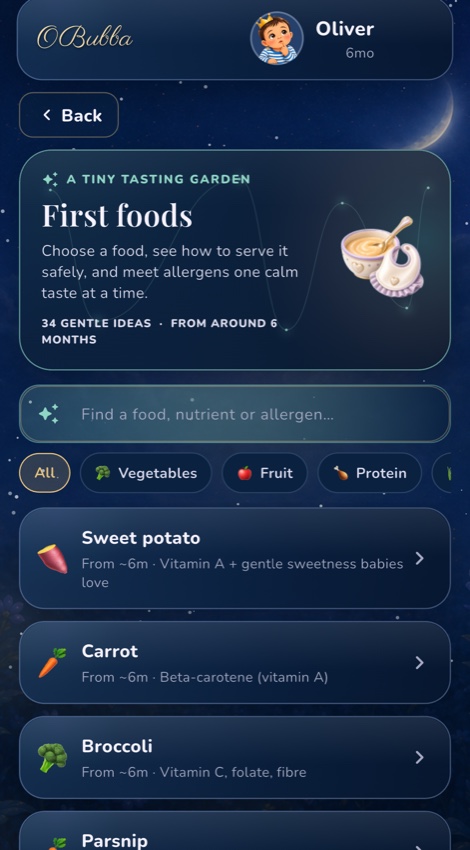
How the current OBubba app supports this stage
OBubba's Care → Weaning & First Foods area includes a “Before you start” guide that names an open or free-flow cup for sips of water with meals. The First Foods screen then offers 34 searchable ideas with age guidance, nutrients, allergens and safer serving instructions.
The tracking model deliberately keeps unlike quantities separate:
- breast and bottle feeds remain milk entries
- solids meals remain solids entries
- a solids amount is treated as food, not silently added to millilitres of fluid
- pumping is milk expressed, not automatically counted as milk the baby drank
- wet-nappy context is read over time only when the family logs nappies reliably
- no nappy data produces no dehydration alarm
- sparse logging is not treated as proof of low output
That last safeguard matters. Two recorded nappies could mean the baby had only two, or that the parent stopped opening the app after lunch. OBubba waits for a consistent recent nappy record and until later in the day before it can surface a low-wet-nappy warning. More immediate logged health signs take priority.
OBubba does not claim that cup sips equal a hydration percentage. It cannot see what spilled, measure breast-milk transfer, assess a baby's mouth or responsiveness, or diagnose dehydration. The app's role is to keep milk, meals, nappies and growth in one timeline so a parent can notice what changed and explain it clearly to a health professional.
The 34-food reference, the pre-weaning guide, Track logging and the six-meal weekly plan are free. Premium expands the personalised recipe selection and full recipe garden. The whole app is unlocked during pregnancy and through your baby's first two corrected-age months.
Keep milk, meals and nappies in one useful picture →
A simple first-week cup plan
Days 1–2
Place a tiny open cup beside one relaxed meal. Add a shallow amount of water. Help your baby touch the rim and accept any outcome, including no swallowed water.
Days 3–4
Repeat at the same meal. Let your baby put both hands on the cup while you guide the base. Stop when they turn away.
Days 5–7
Offer water with each meal your baby now eats. Keep milk feeds unchanged. Notice skill, not volume: better lip seal, a smaller spill, a deliberate pause or reaching for the cup.
At the end of the week, the win may be three swallowed sips and a soaked bib. That is still progress. The purpose is to make plain water and a cup ordinary parts of family meals while milk continues doing the nutritional heavy lifting.
This article provides general information, not medical advice. Follow your baby's individual feeding plan and seek qualified help for concerns about swallowing, milk intake, growth, wet nappies, hydration, vomiting, diarrhoea or illness.
Ready to try OBubba?
Use OBubba to track feeds, sleep, naps, nappies, growth, milestones and family handovers in one calm baby tracker app.