Your baby sleeps for 75 minutes in your arms but wakes furious. The pram nap lasts only 42 minutes, yet they open their eyes smiling. A cot nap lands somewhere between the two.
Which one was the “best” nap?
Duration matters, but it is not the whole outcome. A nap can rescue the day without being long. A long nap can end because hunger, discomfort or noise arrived at waking. Location can also be tangled with time of day: the cot gets the first nap while the pram gets the difficult final one.
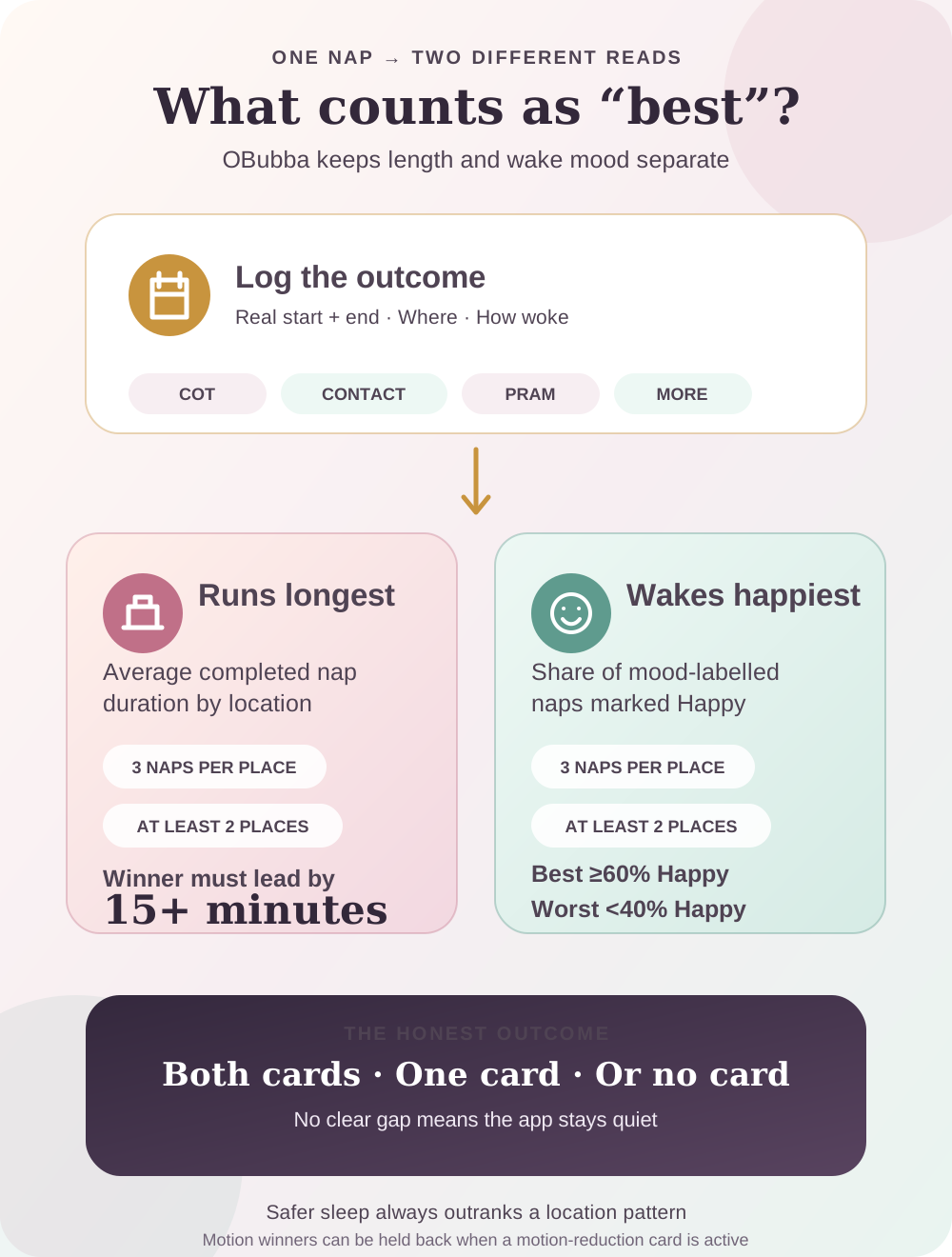
OBubba’s current app keeps two separate reads: where naps run longest and where the baby wakes happiest. It needs repeated naps in at least two places and a clear difference before either card appears. The result is a personal pattern—not permission to use an unsafe sleep place and not a verdict that every nap must happen there.
The short answer
The best nap place is the one that is:
- safe for that sleep and situation;
- workable for the family;
- restorative enough for what the baby needs; and
- repeatably associated with a useful outcome.
That outcome may be length, a calm wake, easy settling or simply making the day possible.
| What you need from this nap | Useful signal | What not to assume | |---|---|---| | A solid restorative nap | Average duration by location | Longer always means better quality | | A calm transition into the next part of the day | How baby wakes in each place | A fussy wake proves the location was wrong | | A practical on-the-go top-up | Enough sleep to bridge the next stretch | Every short pram or carrier nap has failed | | A break from holding or motion naps | A repeatable cot opportunity | Contact naps have “spoilt” the baby | | Safer sleep | The surface, position, airway and supervision | An app result can override safer-sleep guidance |
Length and mood answer different questions
“Cot naps run longest”
This card asks a practical duration question: when naps happen in different logged places, does one location repeatedly produce a meaningfully longer nap?
A longer average can be useful when you need one dependable restorative sleep. It does not prove the surface caused the length. First naps often run longer than late naps; home naps may happen on quieter days; and contact naps may be used mainly when a nap has already gone wrong.
“Ava wakes happiest from cot naps”
This card asks a different question: in which logged location is the highest share of wakes marked Happy?
A happy wake can suggest that the nap ended comfortably. It can also reflect personality, hunger, timing, who greeted the baby or what happened immediately afterwards. Sleepy is not necessarily bad; the baby may simply have woken between cycles or still need more rest. Fussy is a clue to review, not a score for parental performance.
The two findings can disagree without either being broken:
- contact naps may run longest while cot naps produce the happiest wakes;
- pram naps may be shorter but reliably bridge the afternoon;
- cot and pram duration may be similar, so only the mood card appears; or
- no difference may be clear enough, so the app says nothing.
Silence means the records do not support a useful distinction yet—not that the logging was wasted.
What to record after a nap
In the current nap logger, the optional outcome fields include:
- How woke: Happy, Sleepy or Fussy;
- Nap quality: Good, OK or Rough;
- Where: Cot, Contact, Pram, Carrier, Car or Other; and
- Moved to: an optional second location when the nap changed place partway.
For the location insights, the most important facts are the real start and end, the place and—if you want the happiness comparison—how the baby woke.
Use the labels consistently:
- Cot for the cot or Moses basket you normally use for a clear, flat sleep;
- Contact when the baby slept on an awake, attentive adult;
- Pram for the pram or carrycot setup actually used;
- Carrier for a sling or baby carrier;
- Car for sleep in the correctly fitted car seat while travelling; and
- Other when none fits, with a factual note when safety or interpretation may matter.
Do not change Fussy to Happy because the nap was long. Record what happened. The point is to preserve two outcomes rather than make the history look tidy.
A worked example
Suppose six recent naps look like this:
| Location | Length | How baby woke | |---|---:|---| | Cot | 82 min | Happy | | Cot | 88 min | Happy | | Cot | 91 min | Sleepy | | Pram | 46 min | Fussy | | Pram | 52 min | Fussy | | Pram | 44 min | Sleepy |
The cot average is 87 minutes and the pram average is about 47 minutes—a 40-minute gap. Two of three cot wakes were Happy, while none of the three pram wakes were.
Both detectors have enough evidence to speak:
- the duration card can identify cot naps as longer; and
- the mood card can identify cot naps as the happier-wake location.
Now change the pram moods to Happy, Happy and Sleepy. Cot naps still run longer, but the pram can become the happier-wake winner. That is a useful distinction: choose the cot when you most need length and the pram when a shorter, cheerful on-the-go nap suits the day—provided the setup is appropriate and safe.
What the real detectors require
We traced the nap logger, the 14-day training window, both location detectors and the contradiction guard in the current app.
The duration detector
`napLocationInsight`:
- uses completed daytime naps with a start location;
- rejects implausible durations below 5 minutes or above 4 hours;
- needs at least three naps in each of two locations;
- compares average duration by location; and
- stays quiet unless the best location beats the worst by at least 15 minutes.
When it qualifies, the card reports the two averages, the gap and the total number of eligible naps behind the finding.
The wake-mood detector
`napLocationMoodInsight`:
- uses daytime naps with both a start location and a wake mood;
- ignores naps where How woke was left blank;
- needs at least three mood-labelled naps in each of two locations;
- treats Happy as the positive outcome while Sleepy and Fussy are both non-Happy for this calculation;
- requires the winning place to be at least 60% Happy; and
- requires the lowest place to be below 40% Happy.
That wide gap prevents a card based on 67% versus 50%, which would look more certain than a tiny sample deserves.
Unusual days do not train the comparison
The brain gathers up to 14 recent days but excludes days labelled Sick, Travel, Daycare, Nursery, Grand or Grandparents, as well as days carrying a plausible fever reading.
This keeps a fever week or one unusual nursery timetable from silently defining “normal”. It also means nursery naps are not part of this particular personal location baseline, even though they remain in the day history and can support other day-type insights.
The contradiction guard matters
OBubba also has a separate Most naps need holding or movement insight. It can appear when at least eight located naps exist and 70% or more happened through contact, pram, carrier or car.
If that card is actively helping a family move towards one cot nap, the app suppresses a motion location from being crowned the “longest” or “happiest” winner at the same time. Otherwise a parent could see:
> “Try the first cot nap”
and:
> “The pram is the best place to sleep”
in the same set of advice.
This suppression is about coherent guidance, not a claim that the motion nap suddenly stopped working. Contact and on-the-go naps remain valid parts of many families’ days.
An important current limitation: moved naps
The logger correctly lets a parent keep one nap as one event when it starts in the cot and finishes in arms. The optional Moved to field preserves that second location.
However, the current duration and mood detectors group the whole nap by its starting `napLocation`; they do not yet split or reattribute the result using `napLocationEnd`.
So a 25-minute cot nap rescued for another 50 minutes in arms currently contributes 75 minutes to the Cot average. The happy wake is also attributed to Cot.
That does not make the log wrong—the nap really was one continuous event—but it can make the location comparison look cleaner than reality. If many naps are rescued or transferred:
- keep logging Moved to so the history remains honest;
- read the insight as “naps that started here”, not “all sleep happened here”; and
- compare a few naps that stayed in one place before changing the routine.
Trustworthy tracking includes knowing where the model is simplified.
How to use the finding without rearranging every nap
Choose one nap that matters most.
If one location runs longest
Use it for the nap where consolidation helps the day most—often the first or middle nap—rather than forcing every sleep into that place.
Keep top-up naps flexible. A 25-minute carrier nap can be the right outcome when it prevents a long, overtired run to bedtime.
If one location produces happier wakes
Look for the mechanism before declaring a winner:
- Does that nap happen at a better time of day?
- Is the baby fed before it?
- Is the room darker or quieter?
- Does the baby wake naturally rather than being transferred?
- Is the adult present immediately at waking?
- Are the “worse” naps mostly on disrupted days?
Borrow the helpful ingredient when practical. You may not need to copy the entire location.
If the cards disagree
Match the place to the goal:
- longest for a restorative anchor nap;
- happiest for a smoother outing or afternoon;
- easiest for a difficult family day; and
- safest appropriate sleep space every time.
No baby needs a perfectly optimised nap portfolio.
A seven-nap experiment
Try this only when changing a nap would help the family.
- Pick one comparable nap. The first nap is often easier to compare than mixing first and final naps.
- Keep the lead-up similar. Use roughly the same feed gap, wind-down and awake stretch.
- Alternate two appropriate locations. Aim for at least three completed naps in each.
- Record the actual outcome. Start, end, place, move and wake mood.
- Do not rescue for the sake of clean data. Meet the baby’s need; note the move.
- Review the family outcome. Length, mood, settling effort and practicality all count.
- Stop if the experiment creates stress or compromises safer sleep. The dataset is never more important than the baby.
This is an observation exercise, not sleep training.
Safer sleep outranks the winning location
For every sleep, place a baby on their back in their own clear, flat, separate sleep space whenever possible. The Lullaby Trust’s clear-cot guidance recommends a firm, flat mattress and no pillows, duvets, bumpers, pods, positioners, soft toys or loose bedding.
Contact naps
Stay awake and attentive. If you may drift off on a sofa or armchair, move the baby to a safer sleep space first. The Lullaby Trust warns never to fall asleep with a baby on a sofa or armchair.
Carrier or sling naps
Follow the TICKS guidance described by the Lullaby Trust: Tight, In view at all times, Close enough to kiss, Keep chin off the chest, Supported back. The mouth and nose must stay clear.
Car naps
A correctly fitted car seat is essential for travel, but it is not a main sleep space. The NHS advises taking a sleeping baby out of the car seat when you reach the destination.
Pram naps
“Pram” covers very different products. A completely flat carrycot with a firm mattress is not the same as a reclined seat or a car seat clipped to a pram frame. Follow the manufacturer’s sleep guidance, keep the airway clear and watch temperature. Do not treat an OBubba location result as product approval.
When waking fussy needs more than a nap adjustment
Review feeding, temperature, clothing, illness, teething and discomfort when the wake is suddenly or repeatedly distressed.
Seek appropriate medical advice when a baby is difficult to wake, breathing differently, feeding poorly, producing fewer wet nappies, vomiting repeatedly, feverish or unlike themselves. Call 999 in an emergency.
The app cannot observe colour, breathing, muscle tone or the sleep surface. A Happy chip is optional pattern data, not a health assessment.
The useful conclusion may be freedom
After enough records, OBubba may show:
- the cot is worth protecting for one long nap;
- pram naps are short but end cheerfully;
- contact naps remain the reliable rescue;
- location makes no meaningful difference; or
- the evidence is too mixed to speak.
All five are useful. The goal is not to crown one perfect nap place. It is to know which safe option tends to serve which family need—and stop feeling that a different-looking nap automatically failed.
Try OBubba’s nap tracker free → — log where the nap started, where it moved and how the baby woke, then let repeated outcomes reveal a pattern without forcing every nap into the same place.
Frequently asked questions
Are cot naps always better than contact naps?
No. A cot can provide a clear, flat, separate sleep space, while contact naps can be comforting and practical when the adult remains awake and attentive. “Better” depends on safety, the baby’s need and the family outcome.
Why did my baby wake crying after a long nap?
They may still be tired, hungry, uncomfortable, startled or waking between cycles. One fussy wake does not prove the nap was poor or the location was wrong. Look for repetition and assess the baby.
Does Sleepy count as a happy wake in OBubba?
No. In the current happiness calculation only Happy is positive; Sleepy and Fussy are both non-Happy. The original label remains in the log.
How many naps does OBubba need?
Each location needs at least three qualifying naps, and at least two locations must be eligible. The duration gap must reach 15 minutes. For mood, the best place must be at least 60% Happy and the worst below 40%.
What if a nap starts in the cot and finishes as a contact nap?
Keep it as one nap and use Moved to. Currently, the location insights attribute the whole outcome to the starting place, so interpret repeated rescued naps cautiously.
Can a car nap be the “winner”?
The engine can group Car as a location, but that does not make a car seat a recommended main sleep space. Car seats are for safe travel; transfer the baby at the destination in line with current guidance.
Why did no nap-location card appear?
There may be too few labelled naps, fewer than three in one place, no second eligible location, a small duration or mood gap, unusual days may have been excluded, or a motion-reduction card may be suppressing a contradictory motion winner.
Reliable UK sources
- NHS: Helping your baby to sleep
- NHS: Sudden infant death syndrome—reducing the risk
- The Lullaby Trust: Keeping a clear cot
- The Lullaby Trust: Baby slings and carriers
- The Lullaby Trust: Co-sleeping and sofa safety
This article provides general information for UK families. It is not a medical or product-safety assessment, and OBubba is not a medical device. Follow current safer-sleep guidance, the equipment manufacturer’s instructions and your baby’s individual healthcare advice.
Ready to try OBubba?
Use OBubba to track feeds, sleep, naps, nappies, growth, milestones and family handovers in one calm baby tracker app.