You stir a few soft lumps into a familiar purée. Your baby opens their mouth, feels the new texture, gags and pushes everything back out. The next spoon is refused before it reaches their lips.
It can look like failure—or danger. Often it is a baby learning that food no longer moves around the mouth in exactly the same way.
Move texture forward in small, safe steps: blend for less time, fork-mash a familiar food, offer soft finger foods alongside it and let your baby decide whether to touch, taste or stop. Gagging can be a normal part of learning; choking is an emergency. If there is repeated coughing, breathing difficulty or concern about swallowing, pause and seek professional feeding advice.
Start with readiness, not the calendar alone
Most babies begin complementary feeding at around six months, when they can:
- stay in a sitting position and hold their head steady
- coordinate their eyes, hands and mouth to look at food, pick it up and bring it to their mouth
- swallow food rather than pushing most of it back out
Age helps frame the journey, but it does not prove that an individual baby can manage a particular texture. A baby born prematurely, a baby with developmental differences or a child with an eating, drinking or swallowing difficulty may need individual advice.
The NHS first-solid-food guide says starting around six months gives babies time to develop the skills needed to move food around the mouth, chew and swallow. Some babies can begin with mashed or finger foods and may not need a smooth-only stage at all.
A practical texture ladder
The stages overlap. You do not need to finish every smooth meal before offering a finger food, and you do not have to choose between spoon feeding and baby-led weaning.
| Texture | What it looks like | A small next step | |---|---|---| | Smooth | Completely blended and uniform | Blend the same food for slightly less time | | Thick smooth | Holds shape on the spoon | Add less liquid or stir in a little fork-mashed food | | Fork-mashed | Soft, uneven texture with tiny squashable lumps | Leave a few slightly larger soft pieces | | Soft finger food | Adult-finger-sized piece baby can grip; soft enough to squash | Offer beside the mash for self-feeding exploration | | Chopped or minced | Small soft pieces for improving pincer grip and chewing | Vary shape and combine with familiar sauces | | Adapted family food | The family's meal without added salt, prepared to a safe size and texture | Increase variety while retaining safe preparation |
The NHS guide for 7- to 9-month-olds advises moving towards mashed, lumpy foods and finger foods as soon as a baby can manage them. It also makes clear that babies take different amounts of time and that repeated, patient offering matters.
Treat this table as a direction of travel, not a race. A child can eat yoghurt at lunch and soft toast fingers at tea. Smooth food does not become forbidden when they learn to chew.
A seven-meal transition that changes one thing at a time
Use a food your baby already accepts. The goal is to make the texture predictable enough to learn from.
Meal 1: keep the food familiar
Serve the familiar smooth purée. Let your baby settle into the highchair, touch the spoon and lead the pace. This gives you a calm baseline.
Meal 2: blend for less time
Use the same ingredients and recipe but stop blending slightly sooner. The change should be small enough that you can describe it, not hide it.
Meal 3: fork-mash one spoonful
Keep most of the meal familiar and offer one spoonful with tiny, very soft lumps. Wait for an open mouth. If your baby turns away or closes their mouth, pause.
Meal 4: offer two textures side by side
Put the familiar purée and fork-mashed version in separate parts of the bowl or on separate spoons. This lets your baby experience the difference without every bite becoming a surprise.
Meal 5: add a soft finger food
Offer a suitably prepared soft piece that your baby can pick up, such as a tender broccoli floret or a soft roasted vegetable baton. It should squash easily between your fingers.
Meal 6: let your baby control more of the bite
Use a preloaded spoon or let them bring the finger food to their own mouth. Self-feeding gives the baby more control over timing and the amount entering the mouth.
Meal 7: repeat, do not escalate automatically
Repeat the texture that produced calm exploration. Progress is not “bigger lumps every day”. Familiarity is part of learning.
If your baby becomes distressed, step back to a manageable texture for a few days while keeping safe exploration available. A pause is different from abandoning texture forever.
Why a baby may reject lumps
The reaction does not always mean they dislike the food.
The jump was too large
A spoon containing smooth liquid plus a few firm, unexpected pieces can be harder to organise than a consistently fork-mashed texture. Make every part soft and keep the variation gradual.
The texture is unsafe or difficult
Hard, round, sticky or slippery foods require different preparation. The NHS food-preparation guide advises considering size, shape and texture, avoiding firm round forms and preparing suitable narrow batons.
They are too tired or hungry to practise
Learning is harder when a baby is exhausted, ravenous or already upset. Choose an alert moment and keep normal milk feeds going. Breast milk or first infant formula remains the main drink until 12 months.
The spoon is moving too quickly
Scraping food into a closed mouth or loading another spoon before the baby has swallowed can make texture feel overwhelming. Wait for an open-mouth invitation and stop at refusal cues.
They prefer finger foods
Some babies dislike mixed lumpy purées but happily explore a soft piece they control. That is a valid route. Spoon feeding and finger foods can sit together.
Teething or illness changed what feels comfortable
Sore gums, a blocked nose or feeling unwell can temporarily reduce appetite and tolerance. Offer comfortable textures, keep milk intake and hydration central, and return to the previous step when they feel better.
There may be an oral-motor or swallowing difficulty
Repeated coughing, choking, a wet or gurgly voice after swallowing, long stressful meals, recurrent chest infections, food remaining in the mouth or poor growth deserve professional assessment. Do not keep increasing texture to “make them learn” when swallowing safety is uncertain.
Gagging is not choking
The distinction matters because the response is different.
Gagging is usually noisy. A baby may retch, push the tongue forward, go red, water at the eyes or bring food back towards the front of the mouth. It is a protective reflex while they learn how much food they can manage.
Choking can be quiet because the airway is blocked. A baby may be unable to cry, cough or breathe effectively, and their colour may change. This needs immediate first aid.
The NHS choking-and-gagging guide explains the signs and first-aid response. Consider completing a baby first-aid course before or during weaning.
During every meal:
- sit your baby safely upright in a highchair with the harness fitted
- keep them alert rather than feeding while reclined, crawling or in a buggy
- stay within arm's reach and actively supervise
- remove bones, stones, pips and hard skin where appropriate
- prepare round foods such as grapes and cherry tomatoes according to current guidance
- avoid whole nuts and spoonfuls of thick nut butter
- learn what choking looks like and what to do
Do not put your fingers into a gagging baby's mouth to scoop food you cannot see. That can push it farther back.
Read gagging versus choking for the full emergency distinction.
How to make lumps easier to understand
These small adjustments preserve the new skill without forcing it.
Keep the whole texture consistently soft
Cook vegetables, pasta, beans and meat until appropriate for the form you are serving. A tiny hard cube inside a thin purée is not a useful “lump”.
Let babies use their hands
Touching, squeezing and smearing food teaches temperature, resistance and shape before it reaches the mouth. Mess is sensory information.
Model chewing
Eat together when possible. Exaggerate slow chewing without turning the meal into a performance. Babies learn from watching faces and mouths.
Keep portions small
One or two practice spoonfuls can be enough. A full bowl creates an adult target that the baby never agreed to.
Repeat without disguising
It may take 10 tries or more for a baby to become familiar with a food, flavour or texture. Repeated exposure is not the same as repeated pressure.
Preserve a reliable food
Pair the new texture with something familiar, but do not secretly hide firm pieces in an otherwise smooth mouthful. Predictability builds trust.
The current Somerset NHS guidance for coping with lumpy food also suggests gradually reducing blending time, making pasta or vegetables softer and responding to the child's open-mouth and turning-away cues.
What to track—and the wording that matters
You do not need grams, percentages or a photograph of every plate. Record enough detail to distinguish flavour refusal from texture difficulty.
Useful descriptions include:
- “fork-mashed banana; small soft lumps; accepted”
- “smooth yoghurt; no issue”
- “soft broccoli finger food; touched and licked”
- “minced lentil sauce; gagged twice, recovered, continued calmly”
- “mixed hard pieces in thin purée; coughed and stopped”
- “teething; returned to softer mash today”
“Ate carrot” contains no texture information. “Refused dinner” cannot tell you whether the food was new, the texture was difficult or the baby was simply finished.
Track the baby's response honestly:
- explored or touched
- accepted
- unsure
- turned away
- gagged
- coughed
- vomited
- possible reaction symptoms
Do not use the log as a scorecard. A lick can be a useful exposure. A clean bowl does not prove the texture was appropriate.
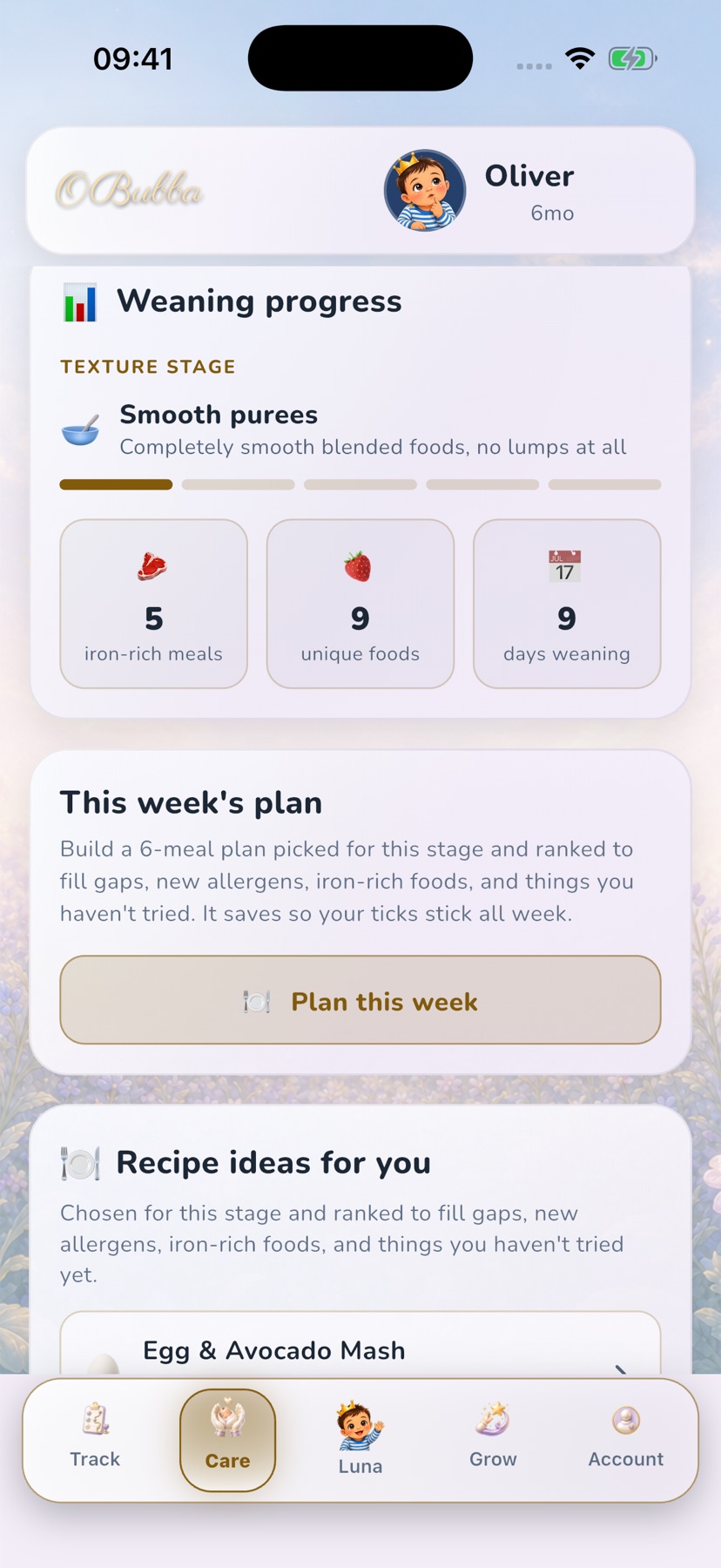
How OBubba handles texture progression
The current app has two different texture reads, and they should not be confused.
First, Care → Weaning Progress shows an age-stage texture guide: smooth purées, mashed with lumps, soft finger foods, chopped and minced foods, then adapted family meals. That card is orientation based on age. It does not observe chewing, inspect a meal or certify that the displayed texture is safe for a particular baby.
Second, OBubba can analyse texture words that the parent actually types into solids entries. Phrases such as “smooth purée”, “fork-mashed”, “lumpy”, “finger food”, “soft pieces”, “chopped” and “family meal” map to broad stages. A plain entry such as “banana” contains no texture clue and is deliberately left unclassified.
The Ready to move past purées insight requires at least five recent solids entries with recognisable texture wording. It only appears when the age-stage guide has moved beyond smooth and at least 60% of those classified meals are still smooth purées. Sparse or vague logging stays silent.
For refusal, the app looks for at least three recent refused meals clustered within seven days, with the latest no more than four days old. When the notes repeatedly mention lumps, chunkiness or gagging, it can suggest that texture—rather than the food itself—may be the sticking point. It recommends stepping slightly softer and rebuilding gradually, not forcing the same bite.
OBubba also compares the dominant texture across two seven-day windows when each has enough classified meals. If a baby was managing chunkier food but recently returned to softer textures, it may show Back to softer foods this week and mention common temporary context such as teething or a cold. It does not diagnose the reason, and it stays silent if the newest solids record is stale.
The app's food logger also performs live wording-based checks for certain choking and food-safety hazards. Those warnings depend on what was typed and cannot see the food, its softness, cut, temperature, bones or the baby's seating.
Use specific food descriptions, then bring concerning patterns to a health visitor, dietitian, GP or feeding professional. The app is a memory and pattern tool—not a swallowing assessment.
Food logging and the age-stage Care → Weaning Progress guide are available without Premium. Personalised texture-pattern Guidance is a Premium feature. OBubba unlocks Premium during pregnancy and through the first two corrected-age months; plan options follow after that early-free period.
Track the texture, not the clean bowl →
Keep foods, textures, reactions, iron-rich meals, allergens, milk feeds and temporary step-backs in one calm weaning timeline.
When to get help
Speak to your health visitor, GP, dietitian or an eating, drinking and swallowing professional if your baby:
- repeatedly coughs or chokes during meals
- has noisy, wet or gurgly breathing or voice after swallowing
- struggles with even very soft textures
- stores food in the cheeks or mouth
- has very long, distressing meals
- refuses an increasingly narrow range of textures
- vomits repeatedly with texture progression
- has recurrent chest infections
- is not gaining weight as expected
- has a developmental or medical condition that may affect feeding
- previously managed a texture and has a persistent unexplained loss of skill
Call 999 if your baby is choking and cannot breathe properly. Follow current infant first-aid guidance rather than waiting for an app or internet search.
Possible allergy symptoms—such as hives, swelling, repeated vomiting, wheeze or breathing change—need a separate response. Texture and allergy are different questions even when they happen during the same meal. Use OBubba's allergen-introduction guide for a structured approach.
Frequently asked questions
What age should babies stop eating smooth purées?
There is no single deadline. NHS guidance encourages moving to mashed, lumpy and finger foods as soon as a baby can manage them. Readiness, safe preparation and individual development matter alongside age.
What if my baby gags every time there is a lump?
Some gagging can be normal, but repeated gagging at every attempt—especially with coughing, distress or no progress—deserves advice from your health visitor or a feeding professional. Make the step smaller and ensure the food is uniformly soft.
Can I offer finger foods if my baby rejects lumpy purée?
Yes, if your baby is developmentally ready and the food is prepared safely. Some babies prefer controlling a soft finger food to receiving mixed texture from a spoon.
Does my baby need teeth to eat lumpy food?
No. Babies can use their gums and developing jaw movements on appropriately soft food. Preparation and supervision remain essential.
Should I mix lumps secretly into a favourite purée?
A very gradual, visible change is usually kinder than a surprising hard piece in a smooth mouthful. Keep the texture consistently soft and let your baby explore it without pressure.
Does OBubba record texture in a dedicated field?
No. In the current app, texture intelligence comes from descriptive words in the food name and notes. Write “fork-mashed carrot” rather than only “carrot” when the texture matters.
Why is OBubba's texture stage different from what my baby eats?
The Weaning Progress stage is an age-based guide, not an assessment. Your typed meal descriptions provide separate evidence for texture insights. Follow your baby's skills and professional advice rather than treating the stage bar as a target.
Texture is a skill, not a portion target
A baby can learn from squeezing one broccoli floret, mouthing a loaded spoon or managing three tiny soft lumps. The value is in coordinated practice, not volume.
Keep the step safe, small and repeatable. Your baby does not need to be brave; they need enough control to learn.
Sources
- NHS: Your baby's first solid foods
- NHS Best Start in Life: Feeding from 7 to 9 months
- NHS Best Start in Life: Preparing food safely
- NHS Best Start in Life: Choking and gagging on food
- Somerset NHS Foundation Trust: Coping with lumpy food
OBubba supports feeding records, age-stage education, pattern summaries and safety reminders. It cannot see food preparation, supervise meals, assess chewing or swallowing, diagnose a feeding disorder or replace individual advice from a health visitor, dietitian, GP, speech and language therapist or emergency services.
Ready to try OBubba?
Use OBubba to track feeds, sleep, naps, nappies, growth, milestones and family handovers in one calm baby tracker app.