You prepare a tiny bowl, sit your baby upright and then hesitate: should the food come before milk, or milk before food?
The current NHS answer is straightforward. From around six months, offer the solid-food opportunity first and the milk feed afterwards, because a baby's stomach is small and fills quickly. At the same time, breast milk or first infant formula remains the main drink throughout the first year and should continue responsively.
Those two ideas belong together. “Solids first” is a gentle order for a meal—not a licence to delay milk until a baby is frantic, force food, or replace milk feeds before eating skills and meals are established.
> The short answer: try solids when your baby is calm, alert and a little hungry; stop on fullness cues; then offer breast milk or first infant formula. If baby is already distressed with hunger, settle that hunger with milk and try food at another calm point. There is no medically useful 30-, 60- or 90-minute gap every baby must follow.
The practical order by stage
| Stage | A helpful starting sequence | What matters more than the clock | |---|---|---| | Around 6 months, first tastes | One small food opportunity, then the usual responsive milk feed | Upright posture, readiness, calm exploration and stopping when baby has had enough | | 7 to 9 months | Gradually move towards breakfast, lunch and tea; offer milk after meals and responsively at other times | Variety, iron-rich foods, advancing textures and continued milk intake | | 10 to 12 months | Three meals alongside about three milk feeds for many babies | A gradual handover; breast milk or first infant formula remains the main drink until 12 months | | A hungry, tired or unwell day | Milk first if that is what baby clearly needs; move or simplify the food opportunity | Feeding the baby in front of you, not defending a perfect timetable |
The NHS around-six-month guide says a baby initially needs only a small amount of food once a day, at a time that suits you both. It also says to offer milk feeds after solids while continuing milk on demand. At 7 to 9 months, babies gradually move towards three meals, with milk still important for energy and nutrients.
This is general guidance for babies who are developmentally ready to start solids. If your baby was premature, has swallowing or growth concerns, a food allergy, a medical condition or an individual feeding plan, follow their health visitor, dietitian, paediatrician or feeding team.
Why “solids first” does not mean “milk matters less”
The order solves one small practical problem: a full stomach may leave no room or interest for learning to eat. It does not change the nutritional hierarchy overnight.
At the start, food intake may be a lick, a smear or half a teaspoon. Breast milk or first infant formula still supplies most energy and nutrients. Over the following months, food variety, texture and quantity grow while milk changes gradually. That is why the NHS can reasonably say both:
- offer milk after the meal
- keep offering milk responsively as the main drink in the first year
Think of solids first as making space for practice, not withholding milk.
There is no perfect gap between food and milk
Parents often search for an exact interval: “Should I wait 30 minutes?” The NHS guidance does not prescribe one.
For a first taste, the milk feed may follow immediately because almost nothing was swallowed. After an established lunch, a baby may play for a few minutes before wanting milk. A breastfed baby may ask to feed both before and after a family meal. None of those patterns automatically means the routine is wrong.
A more useful sequence is:
- Choose a point when baby is awake, securely upright and not overtired.
- Offer a small amount of suitable food.
- Let baby decide whether and how much to eat.
- End when baby closes their mouth, turns away or loses interest.
- Offer the breast or bottle without forcing a feed or bottle finish.
The NHS how-to-start guide says the best time is one that suits both of you, when you are not rushed and baby is not too tired. That is a better anchor than counting minutes.
The “calm hunger” window
There is a middle ground between completely full and desperately hungry.
Signs the timing may be useful
- baby is awake and interested in the table
- they can sit safely upright with steady head control
- they reach, open their mouth or lean towards food
- they are patient enough to explore a new skill
- you have time to supervise without rushing
Signs baby may be too hungry
- crying escalates as soon as the highchair appears
- they cannot pause to look at or touch food
- they root strongly or reach only for breast or bottle
- frustration rises rather than settles
Give milk responsively if baby clearly needs it. You can try the solids again later, perhaps with a smaller gap from the previous milk feed.
Signs baby may be too full or tired
- they turn away before the food arrives
- their mouth stays firmly closed
- they slump, rub their eyes or become upset in the chair
- they play briefly but show no appetite over repeated attempts at that time
Stop rather than coax. Moving the opportunity earlier in the wake period often helps more than inventing entertainment for every spoonful.
Three flexible example routines
These are sequences, not prescriptions. Wake times, breastfeeding frequency, bottle size, naps and family meals all vary.
First tastes around 6 months
| Event | Example | |---|---| | Morning milk | Responsive breastfeed or usual formula feed | | Calm awake time | Play, then sit upright when baby is alert | | Food opportunity | A few tastes of soft food or suitable finger food | | After food | Offer the breast or bottle responsively | | Rest of day | Keep the familiar milk pattern |
At this stage, succeeding means practising safely—not clearing a bowl.
Building meals at 7 to 9 months
| Part of day | Example rhythm | |---|---| | On waking | Milk | | Breakfast | Food, water in an open or free-flow cup, then milk if wanted | | After a nap | Milk may fit naturally here | | Lunch | Food first, then milk | | Afternoon and bedtime | Responsive milk feeds around the family's existing routine |
The NHS says formula-fed babies in this band may need around 600ml a day, but calls it a guide. Breastfeeds cannot and need not be converted into imaginary millilitres.
Three meals at 10 to 12 months
Many babies now have breakfast, lunch and tea plus roughly three milk feeds. A common rhythm is milk on waking, meals through the day and milk around later rest or bedtime—but breastfeeding can remain more frequent and responsive.
Babies under 12 months do not need snacks. If they seem hungry between meals, NHS guidance says to offer extra milk instead.
What if baby eats less milk after solids?
A gradual reduction can be part of weaning as meals become substantial. A sudden or unexplained drop deserves a wider look.
Ask:
- Did food intake genuinely increase, or was most of it explored and dropped?
- Are wet nappies and energy close to baby's usual pattern?
- Is baby teething, constipated, unwell or uncomfortable when feeding?
- Is the reduction one smaller daytime bottle, or milk refusal across the day?
- Is growth following the expected pattern?
Our guide to how much milk babies may drink while starting solids gives NHS age guides and explains why bottle totals cannot be applied to breastfed babies.
Do not pressure a baby to finish a bottle after food. Do not add extra formula powder, dilute feeds, or use food to deliberately remove milk feeds. Let the handover develop with the baby.
Breastfeeding does not have to fit into neat boxes
Breastfeeding is food, fluid, comfort and connection. A breastfed baby may have a short feed before joining the family at breakfast, taste some food, then breastfeed again. Responsive feeds during illness, teething or a developmental leap may temporarily increase even after meals are established.
That does not make “solids before milk” useless. It means the guidance is an organising principle, not a restriction. You do not need to refuse the breast to manufacture appetite, count every feed, or measure pump output as proof of intake.
Bottle feeding: keep the response, lose the target pressure
After the meal, offer the bottle responsively:
- hold baby close and semi-upright
- keep the bottle mostly horizontal and allow pauses
- watch for slowing, turning away, relaxed hands or a closed mouth
- never force the teat back in or insist the bottle is finished
A measured amount is a record, not a score. Formula must always be made exactly to the manufacturer's instructions.
What the actual OBubba app does
The current OBubba app treats milk and solids as connected parts of the day without pretending they are interchangeable.
When logging a feed, a parent chooses Bottle, Breast or Solids. A solids entry can include the food and whether baby Loved it, was Unsure or had a Reaction. The food field runs live safety checks for hazards such as honey or choking-risk descriptions and recognises common allergens where it can.
Milk and solids remain separate in the underlying record. A solids log does not inflate milk totals, and a meal immediately before a breastfeed is not misread as cluster feeding. This matters because offering milk after solids is normal weaning, not evidence of a supply problem.
Over time, OBubba's weaning logic can use the food history to surface useful gaps and patterns, including:
- no recent iron-rich foods in logged meals
- common allergens that have not yet appeared in the record
- a clustered run of refused meals
- whether refusals look more like new-food hesitation or a texture mismatch
- the number of unique foods, iron-rich meals and days of weaning practice
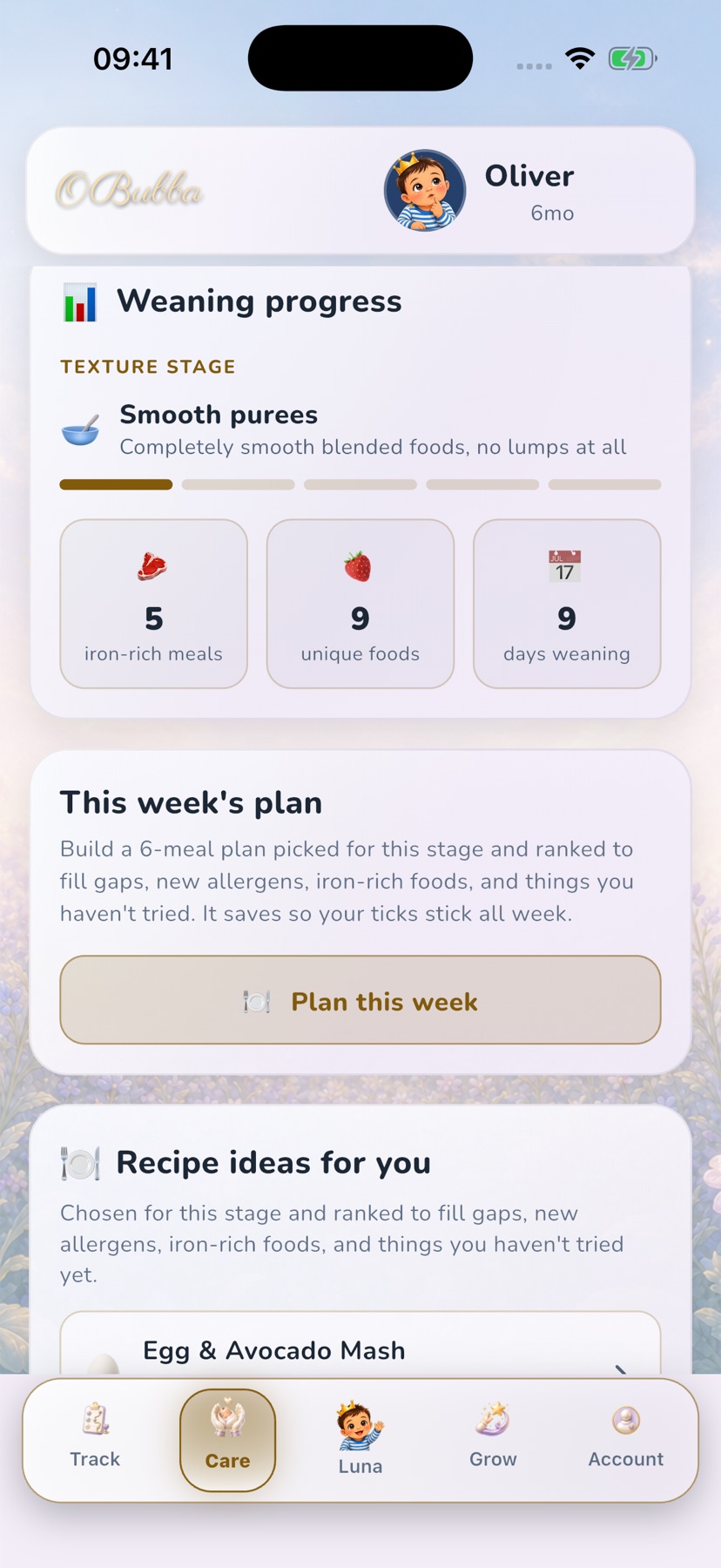
The app can also build a weekly plan and recipe suggestions from developmental stage and gaps in the logged food history. What it does not do is prescribe an automatic milk-and-meal timetable or decide that a baby is safely ready to drop a feed. Parents still follow cues and any individual clinical plan.
That boundary makes the tracker more useful. Instead of saying “the algorithm says lunch is due,” it helps a parent notice:
> “Lunch works when we offer it halfway through this wake period. Milk follows, and the baby usually takes less than at the morning feed. Wet nappies and energy are unchanged.”
That is a pattern you can act on or share with a health visitor.
Try OBubba free → — keep breastfeeds, bottles, first foods, reactions, nappies, sleep and growth in one calm timeline without turning responsive feeding into a rigid schedule.
A simple three-day timing experiment
If food is repeatedly refused and baby is otherwise well, change only the timing for three days.
Day 1: observe
Keep the usual routine. Note the last milk feed, the food opportunity, baby's mood and what happened. “Touched broccoli and turned away” is more useful than “failed lunch.”
Day 2: move food a little earlier
Try before tired signs begin, while keeping the next milk available. Do not change the food, chair and timing all at once.
Day 3: compare the cue, not the quantity
Was baby calmer? Did they explore for longer? Did milk still follow normally? If nothing improves, try a different family mealtime or consider texture, discomfort and illness rather than stretching the milk gap further.
The purpose is not to make a baby eat a target amount. It is to find a repeatable moment when learning feels easier.
Safety still comes before sequence
- wait until the three readiness signs appear together from around six months
- seat baby upright and securely strapped in a highchair
- supervise continuously and stay within reach
- prepare food in an age-appropriate texture and shape
- introduce allergenic foods one at a time in small amounts so a reaction is easier to identify, then keep tolerated allergens in the usual diet
- avoid honey before 12 months and whole nuts; modify round and hard foods to reduce choking risk
- offer sips of water in an open or free-flow cup with meals, but keep breast milk or first infant formula as the main drink until 12 months
If your baby is choking and cannot breathe, cry or cough effectively, treat it as an emergency and call 999. Gagging is usually noisy; choking may be silent. A first-aid course is one of the most useful preparations for weaning.
When to ask for help
Contact your health visitor, GP or feeding professional if:
- baby repeatedly coughs, chokes or has wet/noisy breathing during feeds
- feeding appears painful or difficult
- milk intake falls markedly before meals are established
- there are fewer wet nappies, poor energy or growth concerns
- vomiting, diarrhoea or constipation is persistent
- you are worried about an allergic reaction or a food repeatedly causes symptoms
- mealtimes are consistently distressing despite lowering pressure and adjusting timing
Call 999 for breathing difficulty, swelling of the tongue or throat, blue or grey colour, collapse or another life-threatening reaction.
Frequently asked questions
Should a 6-month-old have milk before or after solids?
Current NHS Best Start in Life guidance says milk feeds can follow solids because a baby's stomach fills quickly. Keep milk responsive and remember that breast milk or first infant formula still provides most energy and nutrients when weaning begins.
What if my baby is too hungry to eat solids?
Offer milk. A crying, frantic baby is unlikely to enjoy practising a new skill. Try food at a calmer point next time rather than withholding milk to protect the order.
How long after solids should I offer milk?
There is no required interval. Offer it when the food opportunity ends or when baby shows milk cues. The useful order is food opportunity followed by responsive milk, not a stopwatch rule.
Can I breastfeed before and after a meal?
Yes. Breastfeeding can remain responsive and may not fit a fixed sequence. A short feed before food does not “ruin” weaning, particularly if it helps baby become calm enough to participate.
When should solids replace a milk feed?
Do not set out to replace a feed when first tastes begin. As meals become established, a baby may naturally take less milk or drop a feed. Milk remains the main drink through the first year, and an abrupt reduction should be discussed if nappies, wellbeing or growth are concerning.
Should I give more solids to help baby sleep?
No. The NHS says starting solids does not make a baby more likely to sleep through the night. Offer food for nutrition and eating skills, not as a treatment for night waking.
Follow the sequence, then follow the baby
Food first and milk after is a useful default. It gives a small stomach room to practise solids while keeping milk reliably available.
But the best routine is still responsive: calm baby, safe posture, suitable food, no pressure, milk when needed. A good weaning rhythm feels less like enforcing a schedule and more like making the next helpful opportunity easy to recognise.
This article provides general information, not medical advice. Follow your baby's individual feeding plan and seek qualified help for concerns about feeding, swallowing, allergy, hydration, growth or illness.
Ready to try OBubba?
Use OBubba to track feeds, sleep, naps, nappies, growth, milestones and family handovers in one calm baby tracker app.