The family plate has turkey, roast potatoes, carrots, sprouts, stuffing, gravy and three things nobody can identify without asking the cook. Can your baby simply have some?
If your baby has started solids from around six months and is ready for the textures offered, much of a Christmas roast can become baby food. Take their portion before adding salt, stock or gravy; cook everything thoroughly; remove bones, skin and tough fat; and change the size and texture for the child in front of you.
A simple first Christmas plate could be:
- moist, finely shredded turkey
- very soft carrot or parsnip
- plain mashed potato or the soft inside of a roast potato
- well-cooked broccoli or sprout, mashed, shredded or offered in a safely manageable form
Milk remains important throughout the first year. Christmas lunch does not need to become a bigger-than-usual meal, a first-food challenge or a replacement for the baby’s familiar milk feed.
> Cook one meal; create the baby portion at the safe fork in the recipe—before salt, gravy and adult finishing touches.
The Christmas dinner plate: serve, adapt or skip?
| Christmas food | Baby-friendly decision | How to adapt it | |---|---|---| | Turkey | Serve | cook thoroughly; remove every bone, skin and tough piece; shred very finely or cut into thin moist strips suited to the baby’s skills | | Potato | Serve | offer plain mash, a soft wedge or the squashable middle of a roast potato; avoid a hard, crisp piece for an early eater | | Carrot or parsnip | Serve | steam, boil or roast until it squashes easily; mash or offer a soft narrow baton | | Broccoli | Serve | cook until very soft; a floret with a handle may suit a confident self-feeder, while mash suits an earlier stage | | Brussels sprouts | Adapt | cook very soft, then shred, flatten or mash; do not put a firm whole round sprout on the baby’s plate | | Stuffing | Check carefully | ingredients may include salty stock, sausage meat, wheat, egg or nuts; use only a fully cooked, low-salt, soft version with known ingredients | | Gravy | Usually skip | stock cubes, gravy granules and meat juices can make it very salty; loosen baby’s food with water or their usual milk instead | | Pigs in blankets | Better swapped | processed sausage and bacon are salty; plain turkey is the easier protein. If sausage is offered to an older, experienced eater, remove skin and cut into short thin strips lengthways | | Yorkshire pudding | Occasional small taste | only when its egg, milk and wheat ingredients have been considered; choose a soft piece rather than a hard crisp edge | | Bread sauce | Check carefully | often contains milk, wheat and salt; use a small amount only if the recipe suits the baby and relevant allergens are already understood | | Cranberry sauce | Skip or use very little | commercial versions are often high in added sugar; plain soft fruit is simpler | | Christmas pudding or mince pie | Skip for a baby | may combine added sugar, dried fruit, alcohol, honey, nuts and several allergens; it offers complexity rather than a useful first taste |
This table is a starting point, not clearance for a particular recipe. Read labels and ask the cook what went into homemade dishes. “Turkey” may mean plain roast meat on one table and a salty glazed, stuffed or processed product on another.
Before solids: the Christmas meal is still milk
If your baby is younger than around six months or does not yet show all the readiness signs, do not start solids because the family is together or because a relative wants to offer “just a taste”.
Readiness means the baby can stay in a sitting position and hold their head steady, coordinate eyes, hands and mouth to bring food to themselves, and swallow food rather than pushing it straight back out. Waking more, chewing fists or wanting extra milk are not readiness signs by themselves.
Breast milk or first infant formula is the meal. Your baby can still sit with the family in a safe, age-appropriate place, watch faces and be part of lunch without eating from the table.
Around six months: make a small tasting plate
At the beginning, quantity is not the target. A few tastes alongside the usual milk routine are enough.
Choose two or three simple components:
- One iron-containing food: fully cooked turkey, chicken, lentils or beans prepared safely
- One soft vegetable: carrot, parsnip, broccoli or sprout
- One starchy food: plain potato or another familiar soft starch
For spoon feeding, mash turkey very finely into potato or vegetables and add enough water or usual milk to make it moist. Dry shreds of meat can be difficult to manage.
For baby-led weaning, the principle is the same even when the shape changes: the food should be soft enough to break down in the mouth and sized for the baby’s current grip and eating skill. The NHS advises considering size, shape and texture, seating babies alert and upright in a highchair, and supervising them throughout the meal (NHS food-preparation guidance).
There is no prize for putting every roast component on the tray. A calm plate with turkey, potato and carrot is a complete Christmas experience for a new eater.
For a more experienced eater: keep the food familiar in form
A baby who already manages mashed, lumpy and finger foods may share more of the deconstructed family meal. Offer a range of soft textures rather than blending everything into one festive-coloured purée.
You might serve:
- thin, moist turkey strips or smaller soft pieces appropriate to their established skill
- soft potato pieces or mash on a preloaded spoon
- shredded sprout mixed into potato
- very soft broccoli florets
- a little soft Yorkshire pudding if its allergens are already tolerated
Do not advance texture only because it is Christmas. Use what your baby manages comfortably on ordinary days. If they are tired, distracted or overwhelmed by a crowded table, an easier familiar texture is a sensible adjustment—not a backward step.
The salt trap: remove the baby portion early
Christmas dishes can accumulate salt in layers: bacon around the sausage, stock in the stuffing, seasoning on the vegetables and gravy over everything.
NHS guidance says not to add salt to a baby’s food or cooking water and to avoid stock cubes and gravy because they are often high in salt (NHS foods to avoid).
The easiest workflow is:
- Cook the plain turkey, potatoes and vegetables thoroughly.
- Lift out a small baby portion with clean utensils.
- Adapt its texture on a separate clean board or plate.
- Add salt, gravy, bacon or adult sauces to the family food afterwards.
Do not try to wash gravy off a roast potato or pick bacon away from a sausage and assume the salt has gone. Use the plain fork in the recipe.
What about allergens at Christmas dinner?
Turkey, potato and plain vegetables are relatively simple. Stuffing, Yorkshire pudding, bread sauce and desserts can combine egg, milk, wheat, nuts and other allergens in one bite.
The NHS advises introducing foods that can trigger allergic reactions one at a time and in very small amounts from around six months, so a reaction is easier to identify. Once a food is introduced and tolerated, it should remain part of the usual diet (NHS baby food-allergy guidance).
Christmas lunch is not automatically the best time for a brand-new multi-ingredient food. If you are away from home, the cook cannot confirm ingredients or every adult is distracted, serve familiar foods and introduce the new allergen on another calm day.
If your baby has a diagnosed allergy, has reacted before or has an individual plan from a clinician, follow that plan rather than a general Christmas guide. Do not rely on removing a visible ingredient from a mixed dish; cross-contact and hidden ingredients still matter.
Honey, nuts, cheese and festive extras
Four seasonal details deserve a direct check:
- Honey: avoid completely until 12 months, including cooked honey and honey in baked food.
- Whole nuts: do not give to children under five because of choking risk. For a weaning baby, use only an appropriate smooth, thinned or finely ground form when introducing nuts.
- Cheese: choose pasteurised full-fat cheese and lower-salt options. Avoid mould-ripened soft cheeses such as brie or camembert, soft blue cheese and unpasteurised cheese for babies.
- Dried fruit: whole raisins and dried fruits are not suitable for babies under one; dried fruit also brings concentrated sugars and often appears inside mixed desserts.
The current NHS safe-weaning list covers these foods in more detail.
Milk, water and the pressure to “eat Christmas dinner”
Continue breast milk or first infant formula through the first year. Cows’ milk can be used in food from around six months but should not become the main drink before 12 months. Once solids have started, you can offer sips of water in an open or free-flow cup with meals (NHS drinks and cups guidance).
Try not to withhold milk so the baby arrives “hungry enough” for the roast. An extremely hungry or tired baby may struggle to explore food calmly. Follow the rhythm that usually works for your family, accept a small intake and let the baby decide when they have had enough.
Christmas dinner still counts if the baby tastes one carrot and then asks for milk.
How OBubba’s real weaning tools help
The current app does not inspect the plate, confirm that turkey is cooked or certify a family recipe as safe. It gives parents a connected set of planning and memory tools around the decisions they still make.
Look up the building blocks
Open Care → Weaning → First foods to search OBubba’s current catalogue of 34 foods by name, nutrient or allergen. Each card includes a suggested serving form, standout nutrient, major-allergen note where relevant and live keyword safety warnings.
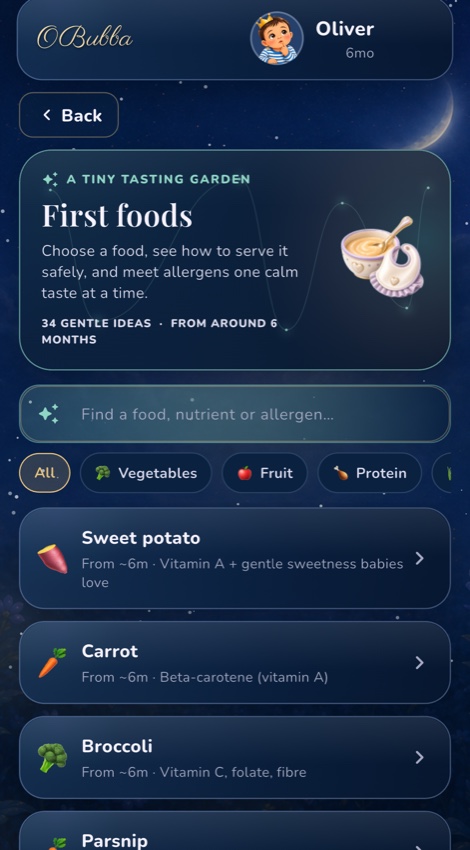
Searching turkey, potato, carrot or broccoli can turn a complicated roast into individual decisions. This is more useful than asking one vague question—“is Christmas dinner safe?”—because safety depends on each ingredient and how it was prepared.
Log what was actually offered
In the food log, parents can record the food, texture, allergens and whether a reaction was observed. The current safety engine looks for terms linked with honey under 12 months, whole nuts, round foods, hard raw fruit and vegetables, added salt, gravy, stock and several other hazards.
Those are keyword prompts, not food recognition. “Turkey dinner” is too vague for the app to know whether it contained gravy, stuffing, bacon or a new allergen. A useful entry is factual: “shredded turkey, plain mash, soft carrot—lumpy—no reaction observed”. Do not use “no reaction” as proof that an allergy cannot exist.
Plan beyond one festive meal
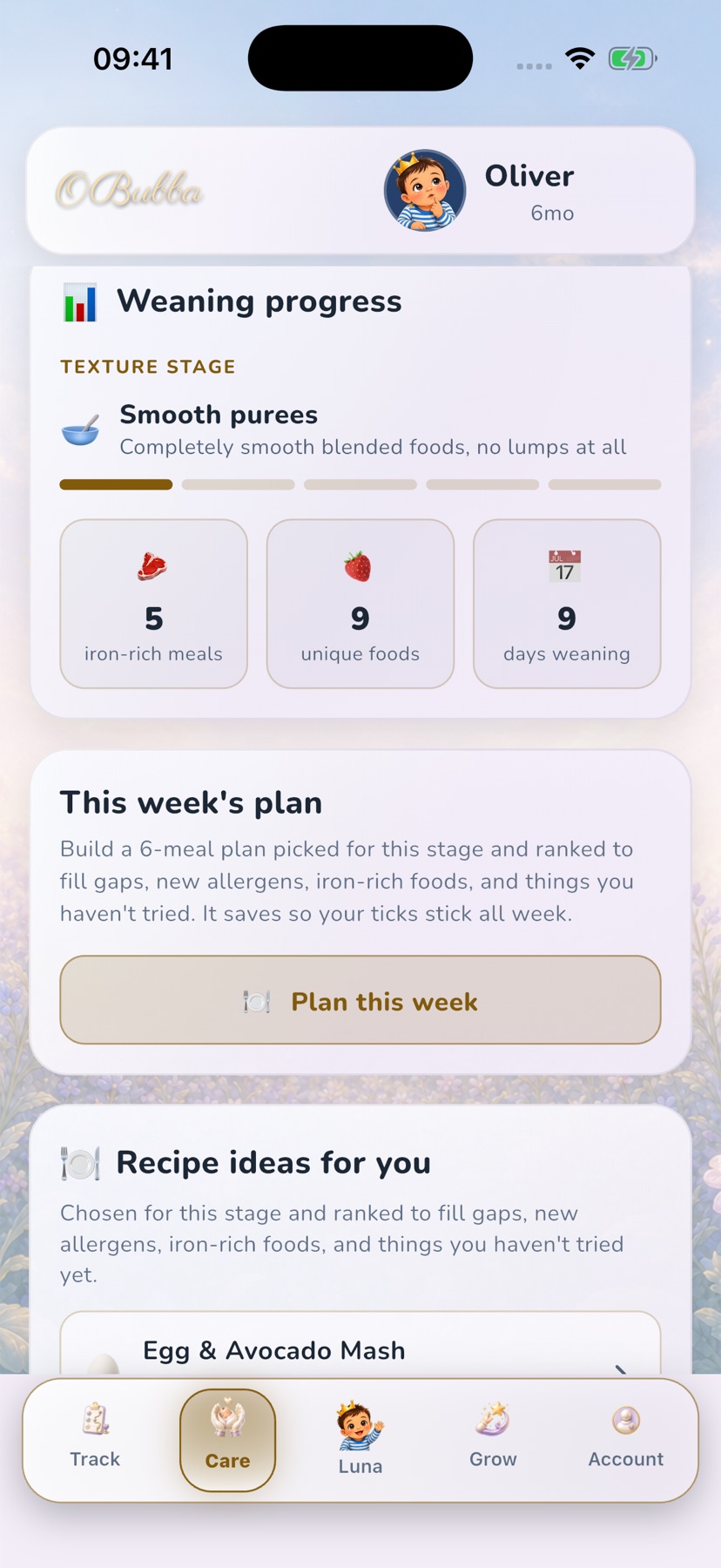
OBubba’s current recipe engine contains 77 stage-gated recipes. It ranks suitable ideas using the child’s recorded food history, including foods not yet tried, iron-rich options and carefully paced new allergens. Recipes containing an allergen recorded as previously reacted-to are filtered from suggestions, including allergens detected in ingredients and serving notes.
The weekly planner turns those recommendations into a saved six-meal plan and derives a shopping list. Ticks persist for the current week. It is designed to answer “what might we offer next?” after Christmas—not to prescribe what the baby must finish.
Always read the full recipe and product labels, apply the baby’s clinical advice and judge the food in front of you. No recommendation engine can know about cross-contact in a relative’s kitchen or a substitute ingredient added during cooking.
Try OBubba free → — keep first foods, safe-serving references, allergens, reactions, textures, recipes and the weekly plan beside the baby’s wider milk, sleep and care history.
Christmas leftovers for baby
Only save untouched food that was separated with clean utensils before the baby ate. Food from the baby’s bowl or tray has contacted hands, saliva or a used spoon and should be discarded.
Cool suitable leftovers promptly, cover and refrigerate or freeze them safely. Reheat only once until steaming hot throughout, stir and then cool to a safe serving temperature. Turkey must have been cooked thoroughly in the first place.
For exact chilling, freezing and reheating timings, use the baby-food leftovers guide. The Food Standards Agency’s current festive advice also says to cool leftovers and refrigerate or freeze them within one to two hours (FSA festive food safety).
Quick answers
Can a six-month-old have Christmas dinner?
Yes, if they have started solids and are developmentally ready, but offer a small, simply prepared plate. Plain moist turkey, soft vegetables and potato can work. Take the portion before salt, stock and gravy, and use a texture the baby already manages.
Can a baby eat turkey?
Yes. Cook it thoroughly, remove bones, skin and tough fat, and serve it moist. Finely shred or mash it for an early eater; use thin soft strips or appropriate small pieces only when they match the baby’s established skills.
Can a baby have gravy?
It is usually easiest to skip it because stock cubes, granules and prepared gravy can be high in salt. Loosen the baby’s turkey and potato with water or their usual milk instead.
Can a baby have stuffing?
Possibly, but check every ingredient and the salt level. Stuffing may contain sausage meat, salty stock, wheat, egg, milk or nuts. A fully cooked, soft, low-salt homemade version with understood allergens is different from an unknown packet or restaurant stuffing.
What Christmas dessert can a baby have?
Offer soft fruit or plain unsweetened full-fat yoghurt when suitable and tolerated. A baby does not need Christmas pudding, mince pie, sweets or a special sugary dessert. Never give honey before 12 months or whole nuts under five.
What if my baby eats almost nothing?
That can be normal, especially in a noisy unfamiliar setting. Keep milk feeds available, offer familiar food without pressure and end the meal when the baby shows they are finished. One Christmas lunch is not a nutrition test.
OBubba supports family organisation and weaning records. It cannot inspect food, assess swallowing, diagnose allergy or replace individual advice from a health visitor, GP, dietitian or allergy team. Always supervise eating and seek urgent help if a baby is choking or has signs of a severe allergic reaction.
Ready to try OBubba?
Use OBubba to track feeds, sleep, naps, nappies, growth, milestones and family handovers in one calm baby tracker app.