At 3am, “put your baby down drowsy but awake” can feel less like advice and more like a riddle.
You may have already tried an earlier bedtime, a later bedtime, more naps, fewer naps, white noise, rocking, feeding and three different wake-window charts. The problem is not always a lack of tips. It is knowing which problem your family actually has and which one change is worth trying first.
That is the useful part of a baby sleep consultation.
A good sleep consultant should:
- learn your baby's age, health, feeding and development
- look at several days and nights rather than judging one difficult evening
- separate normal waking from a pattern that might respond to change
- check timing, sleep environment, hunger, discomfort and settling, rather than blame everything on “bad habits”
- protect responsive care and safer sleep
- give you a small, realistic plan your family can actually follow
- review what happened and adapt instead of declaring that you failed
The goal is not a perfectly compliant baby. It is a safer, calmer and more understandable night.
What information does a sleep consultant need?
Useful advice begins with context. Before suggesting a schedule or settling method, a consultant should want to know:
- your baby's age, using corrected age if they were premature
- where and how they sleep
- usual morning wake time
- nap times and lengths
- bedtime and how long settling takes
- when night wakes happen
- whether your baby feeds at those wakes
- what helps them return to sleep
- milk and solids intake across the day
- recent illness, teething, travel or developmental changes
- what you are comfortable doing
- what is hardest for you right now
One isolated night rarely explains the pattern. Three to seven reasonably typical days can reveal much more; a longer run helps when nights vary widely.
You should not need a flawless spreadsheet. Approximate times are still useful. The job of the support is to reduce your mental load, not create a second job.
What patterns are they looking for?
The same symptom can have several causes. “My baby wakes constantly” is a real experience, but it is not yet a diagnosis.
A thoughtful review may ask:
- Is bedtime landing after too much awake time, creating an overtired false start?
- Is bedtime too early after a long or late nap, leaving too little sleep pressure?
- Are wakes clustered around feeds because daytime milk intake is low?
- Are brief grunts and stirs being counted as full wakes?
- Does the baby wake at almost the same time each night?
- Is a 30-minute nap one normal sleep cycle for this developmental stage?
- Has an illness, new skill, separation anxiety or travel temporarily disrupted a previously workable rhythm?
- Is the settling help still working for the family, or has it become exhausting?
This is why generic advice often contradicts itself. An earlier bedtime may help an overtired baby and worsen a split night caused by too much time in bed. More daytime sleep may protect one baby from exhaustion while leaving another undertired at bedtime.
The pattern comes before the prescription.
What a good baby sleep plan should contain
A useful plan is more than a timetable. It should explain:
1. What the consultant noticed
The findings should be ranked, not presented as a wall of possible problems.
For example:
- The final wake window is consistently much longer than the earlier ones.
- Bedtime false starts happen on those longest days.
- Night feeds remain full feeds, so removing them is not the first step.
That tells a parent where to begin and what not to change yet.
2. A realistic day shape
This might include an anchor for morning, a likely nap range and a bedtime window. It should flex around the baby's actual sleep rather than demand naps at exact clock times regardless of what happened.
Think in ranges:
- morning begins around the same general time
- the next sleep is guided by age, cues and the last wake
- bedtime moves within a window after the final nap
A schedule is a map, not a moral standard.
3. One settling approach
Changing the method every twenty minutes makes it hard for both parent and baby to understand what comes next. A plan should choose one responsive approach for several nights, with clear permission to comfort, pause or stop.
Options might include:
- gradually reducing one layer of help
- settling in the cot with touch, voice and pick-ups when needed
- moving a chair or parent presence away in small stages
- keeping the current settling method while fixing timing first
Feeding or rocking to sleep is not automatically a bad habit. It only needs changing if it has stopped working for your family or if you want a different path.
4. A review point
The plan should say what improvement would look like and when to reassess.
Useful measures include:
- settling becomes calmer or shorter
- the first sleep stretch becomes longer
- false starts happen less often
- fewer wakes require the most intensive form of help
- a nap begins to extend
- the parent feels more confident and less overwhelmed
“Slept through” is not the only success, and for many babies it is not a realistic immediate target.
What should happen before sleep training?
Before choosing a formal method, check the foundations.
Age and readiness
Newborn sleep is biologically irregular. Young babies wake frequently for feeding and regulation, and they often need hands-on help to settle. OBubba holds formal sleep methods until around four months, using corrected age, and concentrates on feeding, day–night cues and a calm rhythm before then.
Even after four months, age alone does not make a family ready. A plan should wait if:
- the baby is unwell or recovering
- feeding or weight gain needs attention
- the schedule is so mismatched that settling practice is likely to fail
- the family is travelling or facing a major disruption
- the parent does not want a formal method
Feeding
Night feeds are normal in infancy. Do not remove feeds simply because a sleep chart says a baby of that age can sleep longer.
Look at the whole day: milk intake, growth, whether wakes involve meaningful feeds, and advice from your health visitor or doctor. Night weaning is a separate decision from improving bedtime. Read Is My Baby Ready to Night Wean? before treating every wake as a habit.
Timing
A settling technique cannot make an undertired baby need sleep or erase an overtired stress response. Often the first plan is simply:
- move bedtime by 15–20 minutes
- protect or trim one nap
- stabilize the morning anchor
- repeat for several days before changing anything else
For a deeper timing check, see Baby Wake Windows Without Stress.
Safer sleep
No sleep plan should weaken safer-sleep guidance.
The NHS safer-sleep guidance says the safest place for a baby during the first six months is in a cot or Moses basket, on their back, in the same room as you. The surface should be firm, flat and clear, without pillows, bumpers, pods, nests, toys or loose bedding around the baby.
A consultant should never recommend unsafe positioning, weighted sleep products, an inclined sleep surface or leaving a baby to cry because checking them would “break the method.” Safety and responsiveness are not optional extras.
Does a sleep consultant make babies sleep through the night?
No ethical consultant can promise that.
Babies wake because of hunger, discomfort, temperature, development, illness, separation, noise and normal movement between sleep cycles. A plan can improve timing, consistency and settling skills. It cannot remove every biological need or guarantee a particular number of uninterrupted hours.
The NHS baby-sleep guide emphasizes that babies have individual sleep patterns and that some sleep in long periods while others sleep in short bursts. Growth spurts, teething and illness can all temporarily change sleep.
Better goals are:
- understand what is happening
- reduce avoidable timing problems
- respond consistently
- make nights more manageable
- protect feeding and attachment
- notice when the plan needs to pause
How long should you try one change?
Small timing changes often need several days before the pattern is clear. A settling approach may take longer because the baby is learning what to expect and the parent is learning how to deliver it consistently.
A sensible review rhythm is:
- Choose one main change.
- Keep everything else reasonably stable.
- Observe for three to five typical days, unless the plan is upsetting, unsuitable or unsafe.
- Compare with the starting pattern.
- Continue, adjust or stop based on evidence, not guilt.
Illness, travel and unusual disruption should be marked rather than treated as proof the plan failed.
Red flags in baby sleep advice
Be cautious if a consultant or app:
- guarantees sleeping through by a deadline
- prescribes the same clock schedule to every baby
- recommends dropping feeds without considering age, intake or growth
- says responding will spoil your baby
- treats every waking as a behavioural problem
- ignores corrected age or developmental readiness
- asks you to continue when you feel distressed or unsafe
- changes several variables at once
- offers no safe-sleep guidance
- blames the parent when the plan does not fit
Good support explains its reasoning and preserves your authority as the parent.
When should you speak to a health professional instead?
A sleep consultant is not a doctor and a tracker cannot diagnose illness.
Speak to your health visitor or GP if you are concerned about your baby's breathing, feeding, growth, pain, persistent vomiting, unusual sleepiness or any significant change from their normal behaviour. Seek urgent medical help for breathing difficulty, blue or grey colour, a baby who is difficult to wake, or another emergency symptom.
The NHS specifically recommends speaking to a health visitor when you need more advice about sleep or establishing a routine. Support for the parent matters too: persistent low mood, anger, anxiety or being unable to cope deserves help, not another optimization task.
How OBubba's Sleep Consultant works
OBubba turns the consultation process into a living part of the baby tracker rather than a one-off questionnaire. It is software, not a human clinician, and it cannot diagnose a medical or feeding problem.
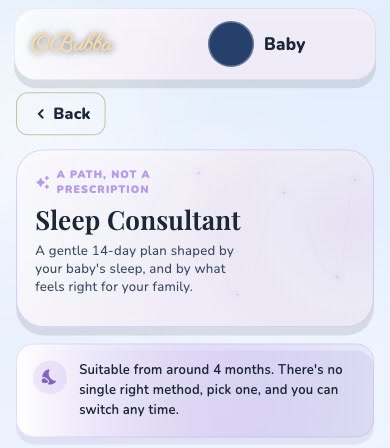
The real feature:
- reads recent sleep, wake, feed and settling logs
- uses corrected age when deciding readiness
- requires at least five logged day profiles before it can produce a full consultation read, while the interface encourages roughly two weeks of nights and naps for a clearer picture
- ranks findings under what OBubba noticed
- turns the day into realistic timing ranges
- recommends one focus for tonight
- offers No-cry / Gentle, Chair shuffle and Parent-led rhythm approaches
- holds every structured plan until at least 17 corrected weeks
- keeps timed check-ins behind both a six-month corrected-age gate and an explicit parenting-style choice
- pauses or redirects when illness, disruption or poor timing makes a formal plan a bad fit
- follows progress for 14 nights and adapts from what actually happened
The opening message is deliberate: “A path, not a prescription.”
That means the app can say, “Timing first,” “Keep gathering,” or “Nothing to fix tonight” instead of forcing every family into a programme. It also remembers the plan alongside the original logs, so a change can be compared with the baby's real baseline.
OBubba does not ask parents to choose between a useful tracker and supportive guidance. The same record that captures naps, feeds and wakes becomes the evidence for the plan, while the live clock, bedtime routine, sound machine, night-weaning support and parent wellbeing tools remain in the same calm home.
The Sleep Consultant is a Premium feature after OBubba's early-free period. Core sleep, feed, wake and nappy logging remains free. Pregnancy and the first two months by corrected age have the wider app unlocked, but a structured sleep plan is deliberately unavailable until around four months. Storefront eligibility and pricing are always shown in the app before purchase.
Start building the sleep picture OBubba can turn into a plan.
What should you log before opening the consultant?
For the clearest read, log these for several typical days:
- morning wake time
- each nap start and end
- bedtime
- meaningful night wakes
- feeds overnight
- how the baby settled at bedtime and after wakes
Do not log every sigh or wriggle. If your baby fusses briefly in light sleep and settles again, that may be a normal stir rather than a full wake. The goal is a useful pattern, not surveillance.
If detailed tracking increases anxiety, use less. A good plan should serve family wellbeing.
Questions to ask any sleep consultant
Before paying for or following support, ask:
- How will you account for age, feeding and development?
- What safer-sleep standard do you follow?
- Do I have to use a method that involves leaving my baby?
- What happens if my baby becomes ill or the plan feels wrong?
- How many things will we change at once?
- How will we measure improvement?
- When should I contact a health professional instead?
- Will you adapt the plan to our family, or expect our family to adapt to a template?
The answers should make you feel informed, not pressured.
The bottom line
A baby sleep consultant should turn a confusing pile of nights into a clear hypothesis, one manageable experiment and a review point. They should protect feeding, safer sleep, responsiveness and parental choice at every step.
The most valuable sentence is rarely “Put the baby to bed at 7:03.” It is more like: “Here is the pattern we can see, here is the gentlest useful change, and here is how we will know whether it helped.”
That is what personalised support should feel like, and what a genuinely helpful baby app should make available when the house is quiet and everyone else is asleep.
This article provides general information and does not replace advice from your health visitor, GP or another qualified health professional.
Ready to try OBubba?
Use OBubba to track feeds, sleep, naps, nappies, growth, milestones and family handovers in one calm baby tracker app.