Your baby has started reaching across the play mat, waking happily at 3am and staring when you leave the room. OBubba’s Development Map says a chapter called People, Places & Distance is unfolding.
Did the app detect a leap? Does the map know why the nights changed? Is the next skill now due?
No. The current app combines two different kinds of information: a broad age-based development window and, only when the logs genuinely support one, a separate personalised signal. It can help a parent connect observations, choose one gentle activity and remember what changed. It cannot see the baby, test a skill, diagnose delay or prove that development caused a difficult night.
The healthiest way to read the map is:
> Here is where we might be, what I actually recorded and one small invitation we could enjoy.
Not:
> Here is what my baby must do next.
The short answer
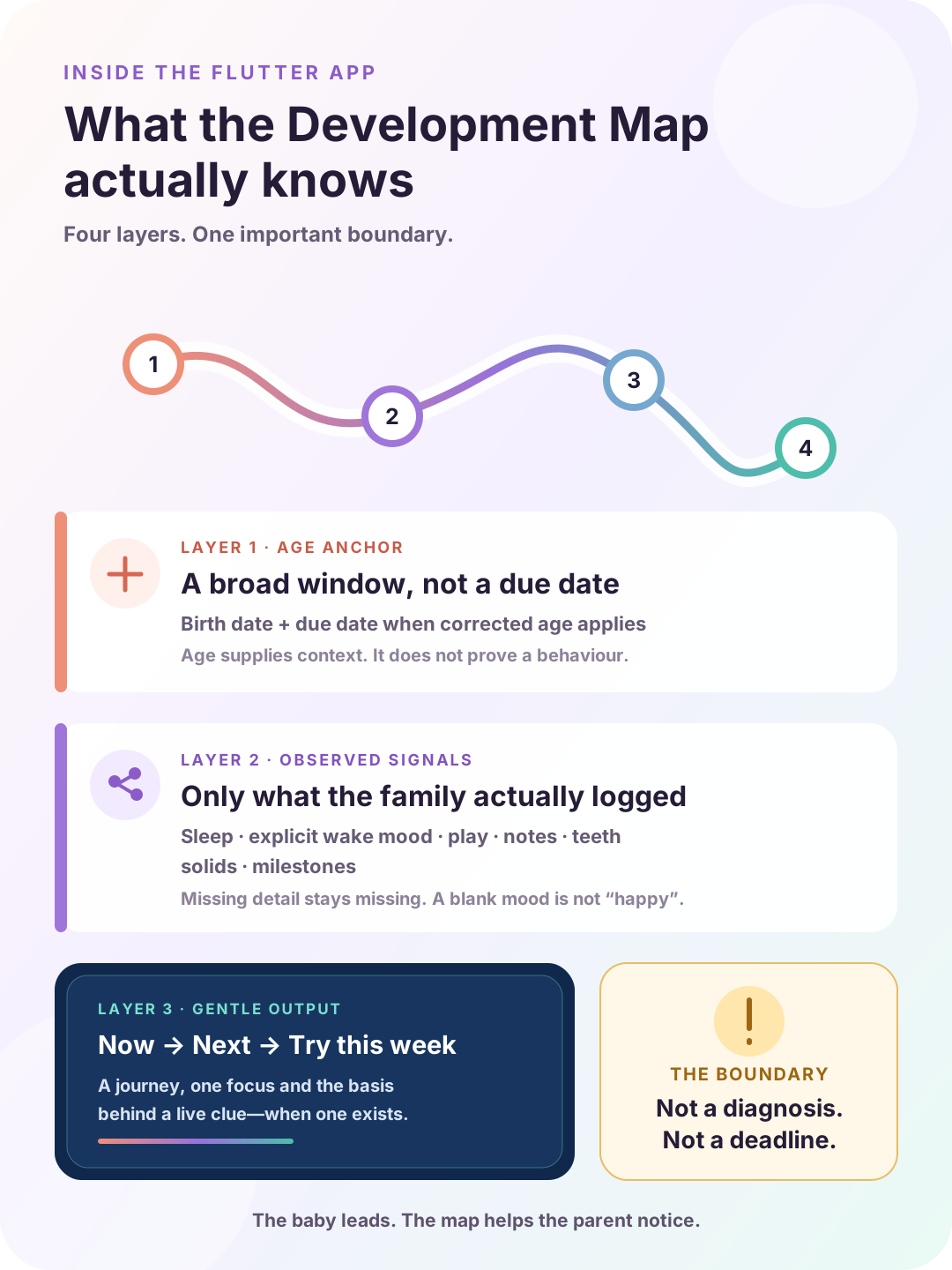
The live Development Map has four layers:
| Layer | What the app uses | What it can honestly say | |---|---|---| | Age anchor | Date of birth and, when applicable, due date | A broad current, previous or upcoming development window | | Family observations | Explicit sleep, wake-mood, play, notes, teething, solids and milestone logs | A ranked clue only when a specific rule has enough supporting signals | | Weekly reflection | Recent night-wake counts and dated milestones | A warm summary and one low-pressure focus | | Routes to explore | The same saved child record | Emerging skills, the Wave timeline, milestone memories and a separate Skill Forecast |
Age-based context is still age-based context. A parent logging nothing does not make the window personalised. A baby matching none of the description has not failed it.
What opens on the real screen
The current app opens with “A little map of what’s unfolding” and the child’s development journey. A curved ribbon places Now beside Next, followed by a single Try this week card.
That visual hierarchy matters. The parent does not land on forty empty checkboxes or a red score. The first job is orientation: what broad chapter might make the day feel more understandable?
The page can then show:
- the current or most recently completed broad window;
- the next window, if one exists;
- a short weekly reflection;
- one live “how does it know?” clue when the app genuinely detected one;
- skills that may be emerging in the current window; and
- routes to What’s next, Why right now?, Wave timeline and Skills & progress.
The screen also says that OBubba reads sleep, feeds, play and notes to spot possible developmental surges. The important word is possible. Those logs can strengthen a hypothesis, not inspect a brain.
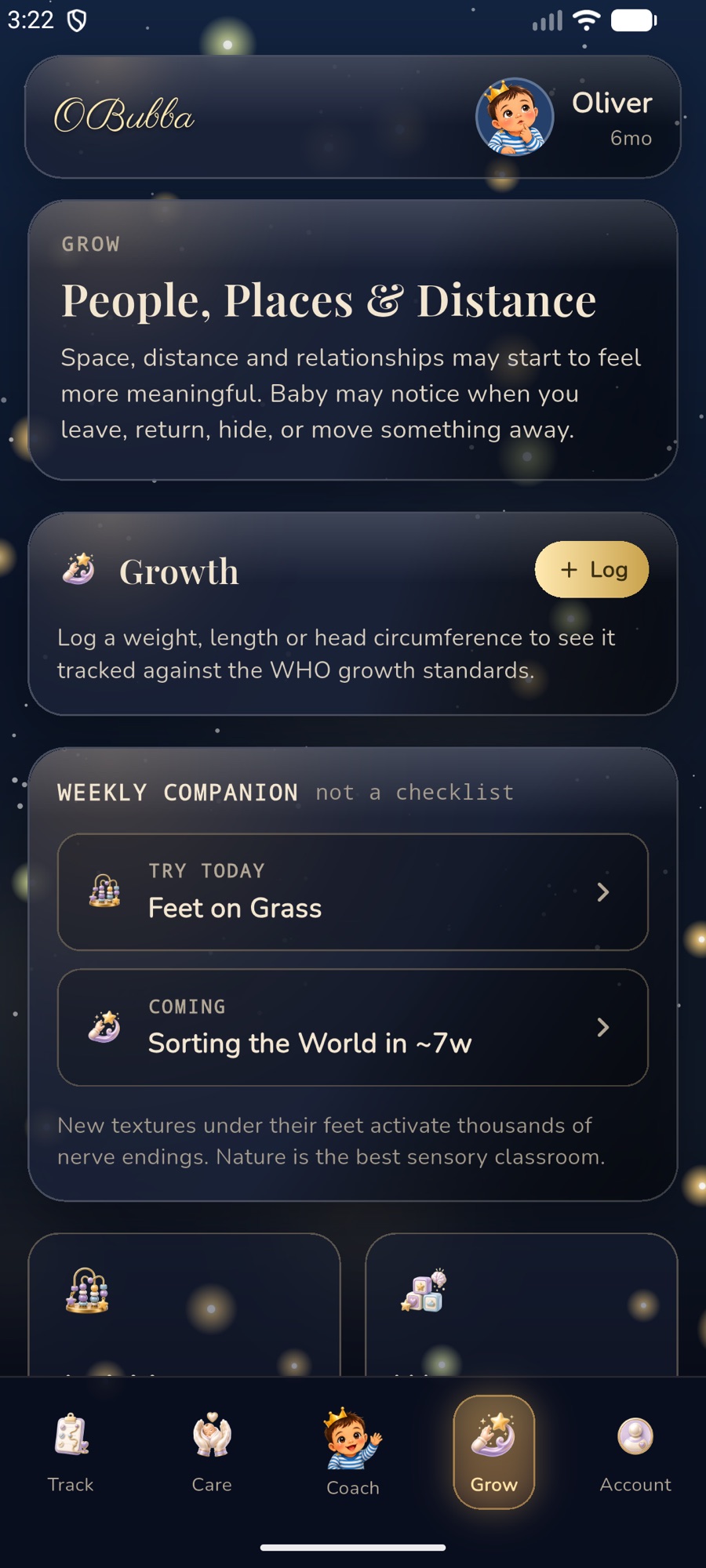
This capture is useful product history, not a mock-up. The current code has since reorganised the same chapter into the journey layout described above; the native capture environment could not produce a fresh simulator image during this review, so we are labelling the distinction rather than passing an older interface off as current.
Layer one: a broad age window
The map first calculates age in completed weeks. If the child was born prematurely and the profile contains the information needed for correction, the app uses corrected age for its development position rather than pretending chronological age is always the fairest comparison.
The NHS says a prematurely born baby’s developmental age is calculated from the original due date until age two. That is clinical context, not a precision upgrade for leap predictions. Correcting the age can make a broad comparison fairer; it cannot tell an app what the child learned on Tuesday.
The engine then places the age into one of its named windows. Each has a start, end, common themes, possible skills, a reframe and one activity idea.
Inside an active window, the map uses a fraction through the range, not “day 10 of a seven-day leap”. It also widens the displayed normal band by roughly two weeks before and three after. That is a deliberate reminder that development varies.
Between windows, the screen calls the period a calm time for practising or consolidation. Quiet weeks count. A forecast does not need a storm to be useful.
Layer two: only explicit observations can personalise the clue
The separate predictive engine reads up to roughly 14 days of the family’s saved record. Depending on the possible signal, it can consider:
- the child’s corrected age;
- recorded night-wake counts;
- wakes specifically marked happy rather than merely lacking a distress note;
- parent notes containing a relevant behaviour, such as new movement or babbling;
- recent tummy time, play, reading or music logs;
- recent teething records;
- recent complete-day nap totals compared with an age-aware range;
- saved milestones; and
- whether solids have begun.
That distinction between happy and not described is small but meaningful. The app does not turn a one-tap wake with no mood into evidence that a baby was calmly practising crawling.
Likewise, the nap comparison skips today. A partial morning would almost always look short against a full day and could wrongly suppress a development signal as overtiredness.
A worked example: movement practice
The app can consider its movement-practice clue between roughly 26 and 44 corrected weeks. It still needs more than age. At least one of these must be present:
- two or more explicitly happy wakes across the recent record; or
- a parent note mentioning movement such as rocking on all fours, pulling up or crawling.
Repeated tummy or play logs can add supporting context. The resulting card carries a confidence value and a human-readable Based on list.
Even then, “these wakes look like practice” remains an interpretation. A happy wake can coincide with a new skill without being caused by it. The map cannot rule out hunger, temperature, a schedule change or something the parent did not log.
The app sometimes chooses an ordinary explanation first
Before surfacing several development stories, the prediction engine checks two competing contexts:
- Recent teething: a tooth or teething record within the last few days can hold back certain leap-style claims.
- Markedly low recent day sleep: when the average of logged sleep across recent complete days falls below 70% of the app’s age-aware target, it treats overtiredness as the more practical explanation and suppresses several development branches.
This is a useful product principle: do not call every hard week a leap.
It is not a full clinical rule-out. The Development Map does not assess pain, infection, feeding adequacy, breathing, reflux or the countless other reasons behaviour can change. A parent should still check the baby in front of them and use health advice when something feels wrong.
What happens when there is no personalised signal
Silence is allowed.
If no rule has enough evidence, the engine can show only broad window context. If the child is between windows and the next one is not close, it can show no predictive card at all.
That is better than manufacturing insight from an empty log. It also means:
- no card does not prove development is typical;
- a card does not prove its suggested cause;
- a low confidence label is not a probability of correctness; and
- two families at the same age can see different supporting evidence—or none.
The map is a reflection surface, not a developmental screening result.
The weekly reflection is not a report card
The journey card can weave together the age window, milestones dated in the last seven days and the recent average number of recorded night wakes.
If a milestone was logged, the headline celebrates it. During an active window, the focus can suggest practising one emerging skill. Between windows, it can explicitly value consolidation.
This layer should be read as supportive copy. The current engine may connect a rougher week with a busy developmental period, but wake counts alone cannot establish that the brain caused the wobble. The safer translation is:
> The timing overlaps with an active window; keep the day predictable and notice what else is happening.
Not:
> Development definitely explains the wakes.
Development Map, Skill Forecast and milestones do different jobs
These tools share a home, but they do not make the same claim.
Development Map
Answers: What broad chapter might help us make sense of this week?
It combines age position, possible live signals, a weekly reflection and one gentle activity.
Skill Forecast
Answers: Which unlogged skills may be nearest their shifted typical points?
That separate deterministic engine starts with age-typical timing. Only after at least two credible dated milestones can it learn a median early-or-late shift from the child’s own record. Its “around N weeks” wording is a forecast, not a deadline. Read the full explanation in Why Does OBubba Forecast My Baby’s Next Skill?.
Skills & progress
Answers: What did we actually notice and want to remember?
The milestone record belongs to the family story. It can support a conversation with a health visitor, but ticking boxes is not developmental screening.
A calmer way to use the map in under two minutes
1. Read the chapter as a possibility
Replace “this is happening” with “this may be a useful lens”. If the description does not fit, leave it.
2. Open the basis
When a live clue appears, read Based on. Age alone, a parent note and several explicit observations are not equivalent evidence.
3. Choose one invitation
Try the suggested floor game, peekaboo, sound-copying or simple container play only while the baby is interested. Stop when they turn away, stiffen, fuss or need something else.
4. Log the observation, not the theory
“Rocked on hands and knees twice” is more useful than “entered crawling leap”. Concrete notes preserve uncertainty and help another caregiver understand what happened.
5. Keep concerns outside the forecast
The NHS offers development reviews around 9 to 12 months and again at 2 to 2-and-a-half years. Parents can contact their health visitor, GP or baby clinic between reviews whenever they have a concern.
Do not wait for OBubba to agree if a child loses a skill, seems unusually stiff or floppy, consistently uses one side differently, or you are worried about hearing, vision, interaction, feeding or movement.
Why this is more useful than a milestone countdown
A countdown gives a date. A good map gives orientation, evidence and permission to adapt.
OBubba’s advantage is not pretending it can predict a baby perfectly. It is that sleep, feeds, weaning, play, teeth, growth, milestones and parent notes can live in the same family record. A parent can see a new pattern without exporting the child into seven disconnected apps.
That connected record can turn:
- a happy wake plus movement notes into a cautious practice clue;
- a dated first into a family memory and better future context;
- a premature baby’s due date into a fairer age anchor;
- an active window into one relevant play invitation; and
- a vague worry into concrete observations to bring to a professional.
Try OBubba free → — keep development beside sleep, feeds, weaning and the rest of family life, while letting your baby set the pace.
Frequently asked questions
Is OBubba watching my baby through the camera?
No. The current Development Map is calculated from profile age information and the entries the family saves. It does not observe or verify a skill.
Does the map use AI to diagnose a developmental leap?
No. The reviewed path is deterministic: explicit rules rank possible signals from saved data. The result is not a diagnosis.
Why does the map show a chapter when I barely logged anything?
The broad window comes from age. Personalised live clues require their own evidence. The interface should be read with that distinction in mind.
Can sleep logs prove a new skill is coming?
No. Certain patterns can support a cautious clue, but night waking is non-specific. It can change for many developmental, health, feeding, environmental and schedule reasons.
What if my baby does not match the skills listed?
The list describes possible emerging interests across a broad range. It is not a test. Follow the child’s real abilities and ask a health professional about specific concerns.
How does corrected age work in the app?
Where the child profile supports it, the map uses age adjusted from the due date for eligible premature babies. NHS development reviews also use the original due date when calculating developmental age until age two.
Does recording a milestone make the map say my baby is ahead?
No. A dated milestone may influence the separate Skill Forecast once there are enough credible dates, but the app does not award an overall “advanced” score.
The bottom line
OBubba’s Development Map does not know what your baby’s brain is doing. It knows the age anchor you provided, the observations your family chose to record and the boundaries built into its rules.
That is enough to do something valuable: turn scattered moments into a gentle question, show why a clue appeared and offer one small way to connect.
The map should make a parent more curious about the child—not more obedient to the map.
Sources and further reading
- NHS: Your baby’s health and development reviews
- CDC: Key points about developmental milestone checklists
- Bedfordshire Hospitals NHS Foundation Trust: Neurodevelopment and corrected age
- OBubba source reviewed: `development_map_screen.dart`, `dev_position.dart`, `dev_predict_adapter.dart`, `dev_predict.dart`, `dev_weekly_review.dart`, `grow_data.dart` and their focused tests
OBubba is a tracking, planning and education tool, not a medical device, developmental screen or diagnostic assessment. Development windows, confidence labels and skill forecasts are interpretations of age and parent-entered records. They cannot diagnose delay, determine the cause of changed behaviour or replace a health visitor, GP, neonatal team or other qualified professional.
Ready to try OBubba?
Use OBubba to track feeds, sleep, naps, nappies, growth, milestones and family handovers in one calm baby tracker app.