The weather app says 8°C. The nursery thermometer says 19°C. Your baby’s hands feel cool, the sleeping bag label says 2.5 TOG, and you are standing beside the cot wondering whether one more layer would be sensible or too much.
The answer starts with the room, not the season. For a room between 16°C and 20°C, a lightweight, well-fitting baby sleeping bag or light bedding is usually comfortable. Choose the clothing underneath according to the room temperature and the sleeping bag manufacturer’s instructions, then check your baby's chest or the back of their neck.
The Lullaby Trust recommends a room temperature of 16–20°C and warns that babies who become too hot have a higher risk of sudden infant death syndrome (SIDS). A room thermometer and a direct check of your baby are more useful than guessing from the month, outdoor temperature or your own cold feet.
The quick room-temperature guide
This is a starting point for a healthy baby. Always check the instructions for the exact sleeping bag because products and fabric weights differ.
| Room temperature | Common sleeping-bag starting point | What to consider underneath | |---|---|---| | 24–27°C | 0.5 TOG | A nappy, short-sleeve bodysuit or another very light layer, depending on the exact temperature | | 20–24°C | 1.0 TOG | A light bodysuit or sleepsuit; go lighter at the warm end | | 16–20°C | 2.5 TOG | A fitted sleepsuit or bodysuit combination guided by the bag manufacturer | | Below 16°C | A higher-TOG bag or an extra fitted clothing layer may be needed | Warm the room safely if possible; do not pile loose blankets over a sleeping bag | | Above 27°C | The lightest safe option | A nappy or very light vest may be enough; actively cool the room where possible |
The NHS safer-sleep guide uses the same commercial sleeping-bag ranges: 2.5 TOG for 16–20°C, 1.0 TOG for 20–24°C and 0.5 TOG for 24–27°C.
Do not treat the table as an equation that overrides your baby. TOG describes thermal insulation, not whether one particular baby is comfortable. Fabric, clothing, illness, sleep space and individual warmth all matter.
Use the room temperature, not the weather forecast
A cold night outside does not automatically mean a cold nursery. Central heating, insulation, closed doors, sunlight from the afternoon and another person in the room can all change the indoor temperature.
Likewise, a mild outdoor reading can hide a warm upstairs bedroom. Heat rises, loft rooms hold warmth and nurseries can remain hot after the rest of the home cools.
Place a simple room thermometer near the sleep space but away from:
- a radiator or heater
- direct sunlight
- an open window or strong draught
- a fan’s direct airflow
- the warmth of your own bed
You are measuring the air around the cot, not the coldest corner or the temperature at the ceiling.
Check it before sleep and again when you go to bed if your home changes significantly overnight. You do not need to watch it minute by minute.
What does TOG actually mean?
TOG is a measure of how much warmth a product holds. A higher number means more insulation.
It is not a universal recipe for everything worn underneath. One brand may test a thick cotton sleepsuit differently from another; some sleeping bags use unusual fabrics or give their own clothing combinations. Use the product’s age, weight, size and temperature guidance.
Three useful rules:
- Choose the bag for the room temperature. Do not choose 2.5 TOG simply because it is winter.
- Adjust fitted clothing underneath. A vest plus sleepsuit is warmer than either item alone.
- Do not add a blanket over a sleeping bag. A sleeping bag replaces other bedding.
Avoid weighted sleeping bags and weighted swaddles. Extra weight on a baby’s chest or body is not part of safer-sleep guidance.
How should a baby sleeping bag fit?
A suitable bag should fit well around the shoulders and neck so the baby's head cannot slip inside. The armholes should not be so large that the baby can slide down, and the bag should allow healthy hip and leg movement.
Before first use:
- check the manufacturer’s minimum weight, not age alone
- confirm the neck opening cannot pass over the baby's head
- make sure fastenings close securely
- check that the fabric is undamaged
- choose the correct length rather than folding excess material
- keep the face and head completely uncovered
The sleep bag sits over normal fitted sleepwear. Remove bibs, hats, hooded clothing, outdoor coats and bulky layers before sleep.
If your baby is too small for the bag to fit safely, use appropriate light bedding or suitable fitted sleepwear until they meet the product’s minimum size.
The best temperature check is your baby’s chest
Hands and feet are often cooler than the centre of a baby's body. They are not a reliable reason to add another layer.
Feel your baby’s chest or the back of their neck. You are looking for comfortably warm skin, not hot, clammy or sweaty.
Signs your baby may be too warm
- a hot or sweaty chest or neck
- damp hair
- flushed skin
- unusual heat under the clothing
Remove a layer and improve the room conditions if you can. Recheck after your baby has had time to settle.
Signs your baby may need more warmth
A cool chest, rather than merely cool hands, suggests reviewing the room temperature and fitted layers. Add one safe clothing layer or use a suitable higher-TOG bag; do not put a hot-water bottle, electric blanket or loose duvet in the cot.
Skin colour, alertness, breathing and feeding matter too. If your baby is unusually cold, floppy, difficult to wake, breathing abnormally or otherwise unwell, seek urgent medical advice rather than trying layer after layer.
What should baby wear at 16–20°C?
This is the commonly recommended room range. A well-fitting 2.5 TOG sleeping bag is a standard commercial option, with fitted clothing underneath according to the label.
Depending on the exact temperature and product guide, that might mean:
- a long-sleeve sleepsuit
- a short- or long-sleeve bodysuit
- a bodysuit and sleepsuit at the cooler end
There is no prize for using more layers. Start with the manufacturer’s guide, check the chest or neck, and make one change at a time.
If you use a blanket instead of a sleeping bag, the NHS recommends placing baby on their back with their feet at the foot of the cot. Use a lightweight cellular blanket, firmly tucked in and no higher than the shoulders. Do not fold a blanket over, because doubling it adds warmth.
What should baby wear above 20°C?
As the room warms, use a lighter TOG and fewer clothes underneath.
At 20–24°C, a 1.0 TOG bag is a common option. At 24–27°C, guidance typically moves to 0.5 TOG. In very hot rooms, a short-sleeve vest or just a nappy may be enough.
Reduce heat before adding gadgets:
- close curtains or blinds before direct sun reaches the room
- open a door and, if safe, a window to create airflow
- use a fan to circulate air, but do not aim it directly at baby
- move the cot away from direct sunlight
- use fewer and lighter layers
Do not drape a muslin over a cot, pram or fan-facing sleep space; it can reduce airflow and trap heat.
The hot-weather sleep guide covers heatwaves, fans, hydration and travel in more detail.
What should baby wear below 16°C?
First check whether the thermometer is accurate and sensibly placed. If the room really is cold, warm it safely where possible and keep the cot away from a radiator, portable heater or direct heat source.
The Lullaby Trust advises an extra clothing layer or a higher-TOG sleeping bag if the baby feels cold. Use fitted layers, not a hat indoors and not a loose blanket over a sleeping bag.
A cardigan, fleece suit or outdoor snowsuit is not a good improvised sleep layer. Bulky clothing can overheat a baby and may not fit safely inside a sleeping bag.
Families cannot always hold a room at exactly 16–20°C. The goal is to make sensible changes, check the baby directly and avoid dangerous heating or bedding. If keeping the home warm is difficult, ask your health visitor, local council or energy supplier about available support.
Can a baby wear a hat to sleep?
No hat is needed indoors for routine sleep. Babies release excess heat through their heads, so keep the head and face uncovered.
Remove outdoor hats, hoods and coats when you come inside, including if your baby has fallen asleep in the pram or car seat. Move them to a safer flat sleep space as soon as practical and dress them for the indoor temperature.
There are clinical exceptions immediately after birth or during hospital care, but those are directed by healthcare professionals and are not a home sleepwear rule.
Sleeping bag or blanket?
Both can be used safely when the guidance is followed, but do not combine them.
A sleeping bag can help because:
- it cannot easily ride over the face when correctly fitted
- the warmth stays more consistent as baby moves
- the TOG gives a useful starting point
- there is no loose blanket to kick off
If using a blanket:
- use a lightweight cellular blanket
- put baby on their back
- place feet at the foot of the cot
- tuck the blanket firmly under the mattress
- keep it below shoulder height
- do not fold it double
Never use a duvet or pillow for a baby under one. Keep the cot clear of toys, bumpers, nests, wedges and loose bedding.
What about swaddling?
If you choose to swaddle a young baby, use thin material, keep the head uncovered and place them on their back. Leave room for the hips and legs to move.
Swaddling adds insulation, so use minimal clothing underneath and check for overheating. Stop swaddling as soon as your baby shows signs of trying to roll. Never use a weighted swaddle, and never swaddle a baby who is sharing an adult bed.
If the swaddle comes loose, it becomes loose bedding. Secure technique and an age-appropriate transition matter more than creating a very tight wrap.
Should I add a layer when my baby has a fever?
No. An unwell baby does not need to be bundled up to “sweat it out”. Extra bedding can make overheating worse.
If your baby feels unusually hot, measure their body temperature with an appropriate thermometer and look for illness signs. A room-temperature guide cannot distinguish warm clothing from fever.
Babies under three months with a temperature of 38°C or higher need urgent medical advice. Follow current NHS fever guidance, and seek help sooner if your baby is difficult to wake, breathing abnormally, feeding poorly, has a concerning rash or you are worried.
Why does the room feel different at 3am?
The coldest part of the night is often later than bedtime. Heating may switch off, a window may remain open, or a hot room may gradually cool.
Rather than waking your baby repeatedly to change clothes:
- Check how the nursery normally changes overnight for a few nights.
- Choose sleepwear for the likely room range, not just the bedtime reading.
- Recheck when you naturally enter for a feed or before your own bedtime.
- Adjust one fitted layer if the chest or neck check supports it.
A slightly cool hand at 3am is not evidence that the whole baby is cold.
Common sleepwear mistakes
Dressing for the calendar
“Winter bag” and “summer bag” are shortcuts. The actual nursery temperature is the better guide.
Counting layers but ignoring TOG
A bodysuit, sleepsuit and 2.5 TOG bag are not simply “three layers”. The insulation of each item matters.
Trusting a cool hand
Check the chest or back of the neck instead.
Adding a blanket over the bag
Sleeping bags are designed to replace other bedding. Use the correct bag and fitted clothing rather than stacking loose covers.
Putting the cot beside a heat source
A thermometer across the room may read 19°C while the cot beside a radiator is much warmer.
Assuming expensive “smart” products make sleep safe
No monitor, wearable or app replaces a clear, firm, flat sleep space and regular checks by a caregiver.
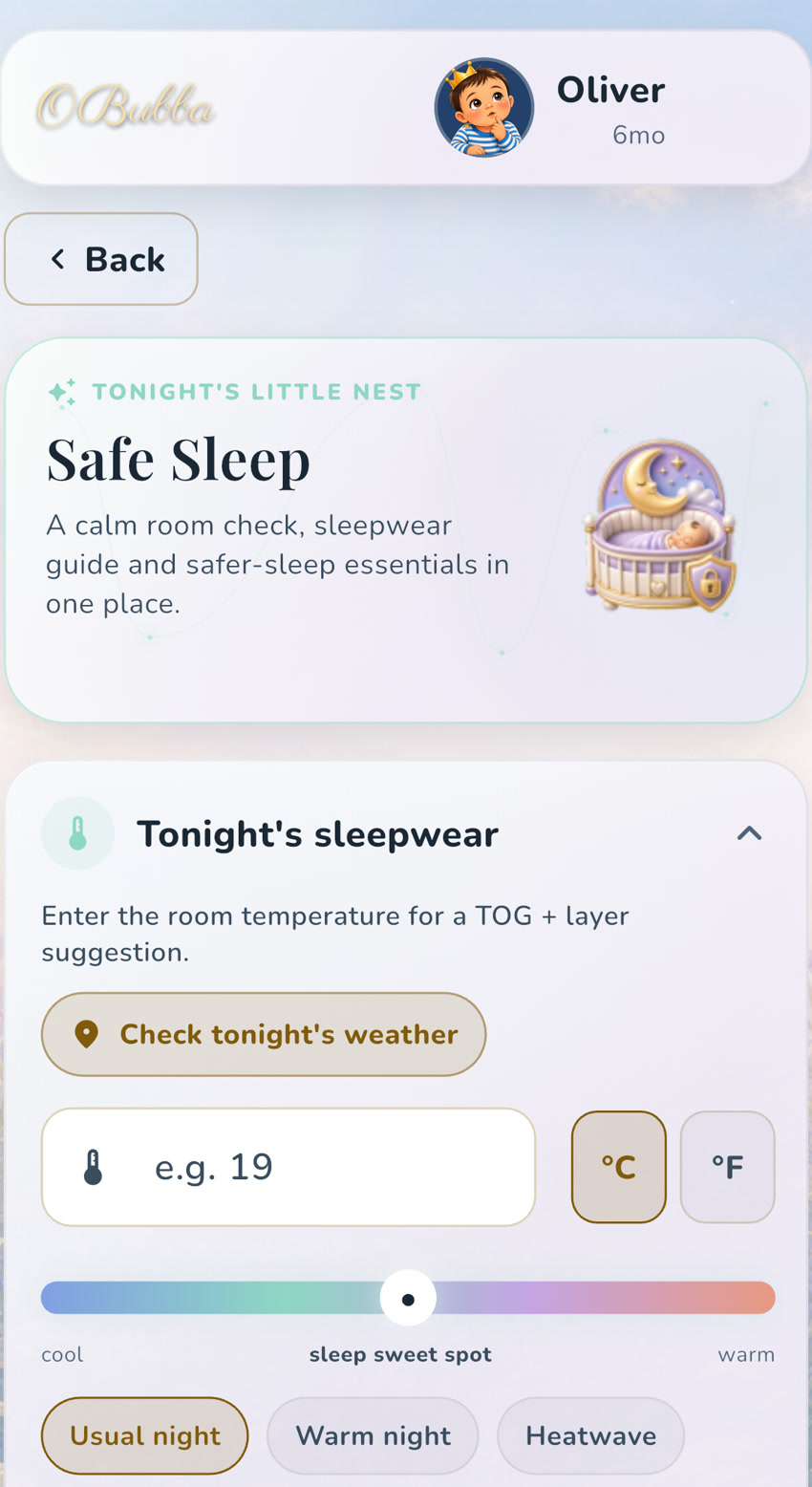
How the current OBubba app helps
OBubba’s Care → Safe Sleep screen brings the room check, sleepwear guide and safer-sleep essentials into one place.
The current implementation:
- accepts the nursery temperature in Celsius or Fahrenheit
- remembers the last entered room temperature and unit on that device
- offers contexts such as a usual night, warm night, heatwave, open window or cold snap
- suggests a TOG range and fitted clothing as a starting point
- displays the full temperature reference table
- reminds parents to check the chest or back of the neck rather than hands and feet
- warns against loose bedding, hats indoors, hot-water bottles and adding blankets over a sleeping bag
- can check local outdoor weather when the parent asks
One implementation detail matters: OBubba never pre-fills the indoor temperature from the outdoor forecast. The app code treats local weather only as context because a 7°C street and a heated 20°C nursery require completely different sleepwear.
The tool also does not claim to sense your baby's body temperature, know a sleeping bag’s exact construction or diagnose illness. It cannot see whether the neck opening fits. The parent still enters the room reading, checks the product label and feels the baby directly.
That combination is the useful part: fewer frantic searches across contradictory TOG charts, without pretending an app can make the final safety check.
The Safe Sleep guide and its room-temperature tool are free. Premium adds deeper personalised sleep analysis and planning after the early-free period. The whole app is unlocked during pregnancy and through your baby's first two corrected-age months.
Dress for the room, not the season → Keep tonight’s sleep guidance beside naps, feeds, health notes and the wider routine, with the actual room temperature, not the season, driving the starting suggestion.
A two-minute bedtime clothing check
Before placing your baby down:
- Read the room thermometer near the cot.
- Choose either a correctly fitted sleeping bag or light tucked bedding.
- Follow the sleeping bag manufacturer’s temperature and clothing guide.
- Remove the hat, bib, hood and outdoor clothing.
- Place baby on their back in a clear, firm, flat sleep space.
- Feel the chest or back of the neck after they settle.
Then let the check be finished. Safe sleepwear should reduce mental load, not create a new hourly ritual.
The most dependable rule is wonderfully ordinary: measure the room, start with light fitted layers, keep the head clear, and check the baby rather than the weather icon.
This article provides general safer-sleep information, not individual medical advice. Follow the instructions for your baby's sleeping bag and ask your midwife, health visitor or GP about prematurity, low birth weight, illness, temperature regulation or any concern about your baby.
Ready to try OBubba?
Use OBubba to track feeds, sleep, naps, nappies, growth, milestones and family handovers in one calm baby tracker app.