At breakfast, the next nap looked likely around 9:35am. Your baby slept from 9:28 to 9:54, woke cheerful and refused every attempt to extend it. A few minutes later, the next target no longer says 12:15. It has moved.
Is the app changing its mind—or did the day change?
A useful next-nap prediction should move when the evidence moves. The end of the last sleep creates a new awake anchor. Nap length changes how much sleep pressure may remain. A rough night, illness or an unusual day can change what is realistic. Later in the afternoon, the safer and more workable answer may become an earlier bedtime rather than squeezing in another full nap.
The prediction is a planning window, not an appointment and not a medical instruction. Use it alongside your baby's alertness, sleepy cues, feeding needs and health.
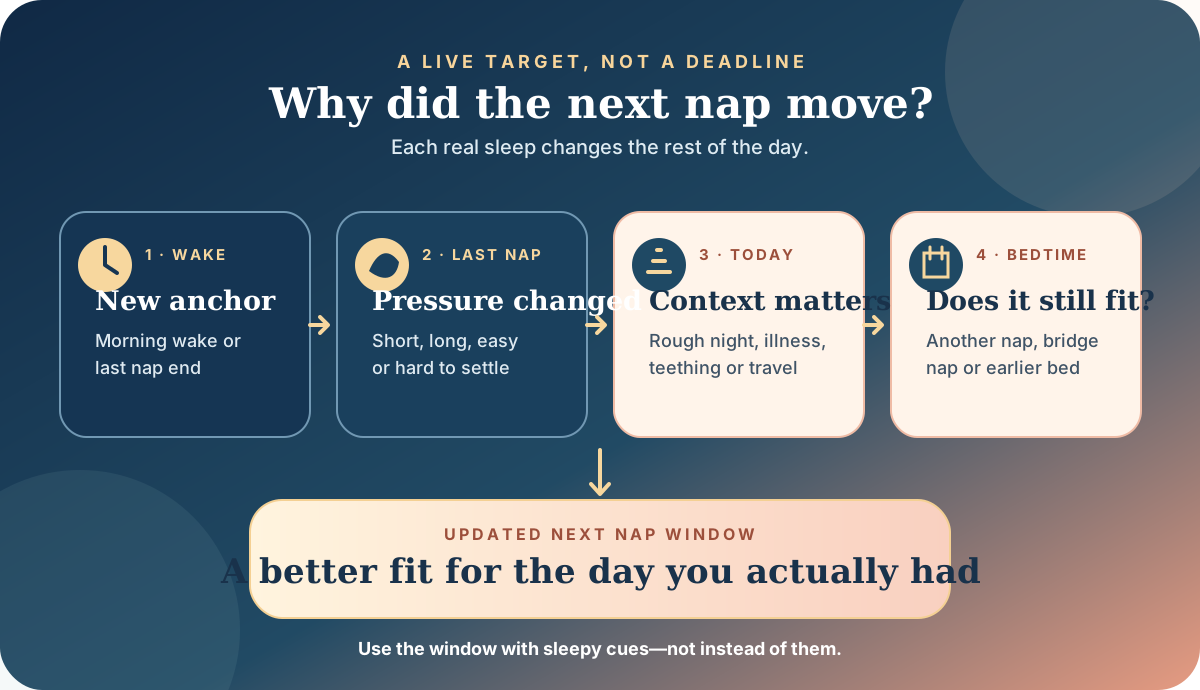
The short answer: the last wake changed the calculation
A next nap cannot be calculated honestly from the morning schedule alone. It has to begin from the latest real point at which baby became awake:
- the final morning wake, before any nap
- the actual end of the most recent nap
- a corrected end time if the timer was left running
- the end of a resumed nap if there was a genuine awake gap
If a nap ends at 10:00 instead of 10:45, the rest of the day has a different starting point. Keeping every later sleep at the original clock time may create a much longer awake stretch than intended.
That is why “the prediction moved” is often evidence that the tracker is listening—not evidence that it is unreliable.
Six reasons a next nap can move
| What changed | What may happen to the next target | Why | |---|---|---| | Morning wake was 30 minutes later | It usually moves later | the whole nap day has a later anchor | | A genuinely short nap ended early | It may move earlier | some sleep pressure remains and the next awake stretch may need shortening | | A short nap followed a clearly too-short awake stretch | It may move later, not earlier | baby may have gone down before enough sleep pressure built | | A long, restorative nap ended later | It may move later—or remove a later nap | more sleep pressure was cleared and more day sleep is already banked | | Last night was highly fragmented | The first one or two targets may move slightly earlier | the day may need gentler awake stretches while baby recovers | | The final nap no longer fits before bedtime | The app may prefer a bridge nap or earlier bedtime | a full late nap can leave too little awake time before night sleep |
The important word is may. A short nap does not always mean “next nap earlier”, because the wake window before that nap matters too.
The counter-intuitive case: a short nap can move the next nap later
Imagine a nine-month-old wakes at 7am and is put down at 8:45—much earlier than their recent successful first naps. They take 20 minutes to fall asleep, sleep for 30 minutes and wake happy.
That short nap may reflect low sleep pressure: the nap was attempted before the baby was ready. Automatically shortening the next awake stretch would risk a spiral of earlier attempts and more short naps.
Now imagine the same 30-minute nap after a long, difficult awake period. Baby falls asleep almost instantly and wakes upset. In that context, remaining sleep pressure or overtiredness is more plausible, so an earlier next opportunity may fit better.
This is why one duration cannot diagnose a nap. Useful clues include:
- how long baby had been awake beforehand
- whether settling was quick or prolonged
- whether baby woke happy, sleepy or distressed
- whether the room, feed and health context were ordinary
- whether the pattern repeats across comparable days
Our guide to 30-minute naps explores those clues in more detail.
What the actual OBubba app recalculates
The current engine is not a static wake-window chart. Its `predictNextNap` path rebuilds the next window from the baby's current day, recent baseline days and the context the family has logged.
1. It looks for a trustworthy awake anchor
OBubba first uses a logged morning wake or the end of the latest completed nap. If the night ended in the previous calendar bucket, the Track screen can resolve the actual morning wake across midnight.
If no real wake exists, the app only falls back to a typical recent morning wake when that baby has genuine wake history. It does not invent a blanket 7am wake for a family who has never tracked sleep. Without an anchor or history, no confident next nap is shown.
For a premature baby, the Track screen feeds corrected age into the timing engine when a due date is available.
2. It begins with an age-aware, progressive range
On a new account, the prediction starts from an age baseline rather than pretending it already knows the baby. The range generally progresses across the day: earlier windows may be shorter and later ones longer, while remaining bounded by the engine's age guardrails.
That baseline is a planning aid. The NHS sleep guidance cited here does not set a universal minute-by-minute wake-window prescription, and it emphasises that babies have individual sleep patterns that change as they grow.
3. It learns which windows preceded better naps
With enough comparable history, OBubba looks at the wake window before the same nap position—first nap, second nap and so on. Recent samples matter more, and windows followed by more restorative naps carry more weight than those followed by a tiny catnap.
The adaptive layer also groups patterns by the time of day at which the awake stretch began. That helps when nap counts vary: a midday pattern can remain informative even if yesterday's “Nap 2” becomes today's “Nap 1”.
The app requires repeated samples before these layers influence the target. Thin data stays closer to the age baseline.
4. It reads what the last nap did
The live engine changes the next wake-window range according to the latest completed nap:
- a very short, high-pressure nap can shorten the next window
- a below-target nap can produce a smaller earlier shift
- an unusually long nap can extend the next window
- a short nap after a too-short preceding window can stretch the next window instead
- optional nap-review details—settling time, wake mood and quality—can add a small nudge
The code deliberately prevents the “short nap → always earlier” spiral. It also caps shifts inside the contextual range so one odd nap cannot send the prediction wildly away from age expectations.
5. It can soften the day after disruption
The Track prediction currently receives context from plausible temperature logs, teething history, recent motor milestones, growth information, reflux, a manual off-day adjustment and day tags such as sick, travel or daycare. Recovery after a tagged disruption can taper back toward normal over following days.
These signals do not diagnose illness or prove why a baby is tired. They tell the scheduling engine to be less rigid on a day already marked as different.
If your baby is unwell, assess and care for the baby—not the timetable. Seek professional advice when symptoms, feeding, breathing, alertness or wet nappies concern you.
6. It checks whether another nap still fits
The prediction and bedtime engines share the decision about how many naps remain. Before offering another nap, OBubba checks day-sleep totals, the likely gap to bedtime and whether a late nap would leave a workable final awake stretch.
Possible outcomes include:
- the next normal nap remains appropriate
- a short bridge nap helps baby reach bedtime
- naps are done and bedtime becomes the next event
- an earlier bedtime is more coherent than a late full nap
The engine also protects young two-nap babies from being collapsed to one nap merely because the first nap was long. A tidy daily total is not useful if it strands the baby awake for an unrealistic stretch.
A plan can be overruled by real life
OBubba's Sleep Consultant can provide a planned nap time. The current engine honours that slot while the day remains reasonably on track.
But suppose the plan expected a solid morning nap, and baby instead slept for 25 minutes. If the next fixed slot is now far beyond the live wake-window range, the engine rejects that stale slot and re-anchors from the real nap end.
That is the right hierarchy:
- the baby's actual sleep and wake history
- today's health and disruption context
- the personalised pattern
- the prospective plan
A plan should support the baby in front of you, not force the baby to support yesterday's plan.
Why a prediction can disappear completely
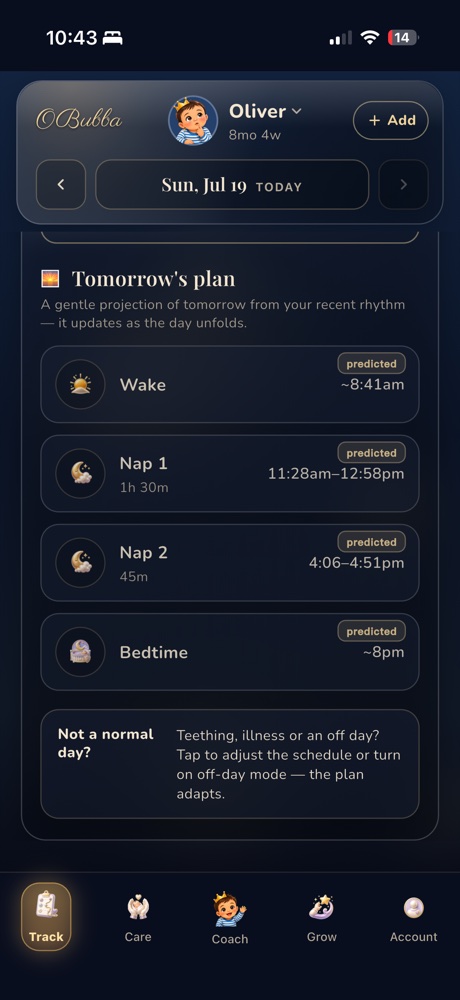
Sometimes the clock stops showing a nap and begins counting toward bedtime. That can be correct when:
- the expected naps are complete
- day sleep has reached the baby's current range
- another nap would begin too near bedtime
- the projected final awake stretch after a late nap would become too short
- a parent has explicitly selected a napless day or schedule override
- night sleep has already begun
It can also disappear because data is missing. Check whether the morning wake or latest nap end was logged. An open nap timer means the baby is still recorded as asleep, so there is no new awake anchor yet.
How to use a moving nap window without chasing the clock
Treat the target as a preparation cue.
- Log the real morning wake. This gives the day an honest anchor.
- End the nap when sleep genuinely ends. Fix a forgotten timer rather than letting an extra hour rewrite the afternoon.
- Watch the window, then watch your baby. Begin winding down when the target and sleepy behaviour start to agree.
- Use the optional nap review when a pattern is confusing. “Happy”, “sleepy”, “fussy”, settling time and quality can distinguish two naps with the same duration.
- Mark unusual days. A sick, travel or daycare day should not masquerade as an ordinary baseline day.
- Do not optimise every five-minute move. Compare several similar days before changing the routine.
In Account → Preferences → Wake windows, parents can also tell OBubba that the current windows seem too long, about right or too short. The preference changes the next prediction while remaining bounded by the engine's range.
Try OBubba free → — log the wake and nap once, then let the next target respond to the day instead of rebuilding the schedule yourself.
What the prediction cannot know
No app can see every factor from timestamps alone.
OBubba may not know that:
- the baby dozed for 12 minutes in the car without being logged
- nursery recorded an approximate rather than exact nap end
- the room was bright, noisy or unusually warm
- hunger, pain or discomfort interrupted settling
- the baby is becoming ill before a temperature is logged
- a parent chose a contact nap and does not want to change it
Use notes and day tags when they will help, but do not turn family life into data entry. The purpose of the prediction is to reduce calculation, not demand perfect evidence.
Wake windows are not a pass–fail test
“Wake window” is useful shorthand for time awake between sleeps. It is not a diagnosis, and the exact minute does not determine whether a nap will succeed.
The NHS says babies vary in how much and how long they sleep, that patterns change with growth, teething and illness, and that parents can learn to recognise states such as drowsy, quietly alert and needing a break. Those observations belong beside the clock.
For healthy infants aged 4–12 months, the American Academy of Sleep Medicine recommends 12–16 hours of sleep across 24 hours, including naps. That broad total is not a prescription for a particular number of naps or a precise awake interval.
If sleep, feeding, growth, breathing, alertness or development concerns you, ask your health visitor, GP or another qualified professional rather than trying to solve the concern by moving a nap target.
Safer sleep does not move with the prediction
However the schedule changes, the sleep setup should remain safer.
The NHS advises that the safest place for the first six months is a cot or Moses basket in the same room as you. Put baby on their back on a firm, flat mattress and keep the sleep space clear of pillows, loose bedding, bumpers, nests and positioners.
Contact, carrier, pram and travel sleep need their own safety considerations. A convenient predicted time never makes an unsafe position or product appropriate.
Frequently asked questions
Why did the next nap move earlier after a short nap?
The nap ended earlier and may have left sleep pressure behind. OBubba re-anchors from the actual wake and may shorten the next awake stretch. Look at how long baby was awake before the nap and how they woke before assuming overtiredness.
Why did it move later after a short nap?
If the short nap followed an unusually short awake stretch, the engine may read low sleep pressure and gently extend the next window. This prevents an ever-earlier short-nap spiral.
Why did a nap disappear and bedtime appear?
The expected nap count or day-sleep budget may be complete, or another nap may no longer fit before bedtime with enough final awake time. The app can prefer an earlier bedtime over a late full nap.
Why is there no prediction this morning?
Check that a morning wake is logged. OBubba needs a real awake anchor or genuine recent wake history; it does not fabricate a default wake for a sleep-untracked family.
How many naps does OBubba need before it personalises?
The engine needs at least three comparable samples for key personal and time-of-day layers to influence a target. Broader confidence improves as more ordinary days are logged. The app describes roughly the first week or around eight naps as a common learning period, not a guarantee.
Should I put baby down exactly at the predicted minute?
No. Treat the displayed range as a wind-down cue. Use it with your baby's behaviour, feeding needs and the practical day. If baby is ill, unusually sleepy or difficult to wake, seek appropriate medical advice.
Does the app use corrected age for a premature baby?
Yes, the current Track prediction uses corrected weeks when the baby's due date is available. Keep the profile information accurate, and follow individual neonatal or paediatric guidance where it differs.
Can I tell OBubba the windows feel wrong?
Yes. In Preferences, choose Too long, About right or Too short. That feedback nudges the next window rather than forcing an unlimited change.
Let the target move so the parent does not have to recalculate
A static schedule is easy to print and hard to live.
A useful prediction remembers when the baby actually woke, notices what the last nap did, respects an unusual day and checks whether the rest of the afternoon still fits. Then it gives the parent one updated window—not another spreadsheet to rebuild.
The goal is not to make every nap happen on time. It is to make the next decision calmer when the day refuses to stay on paper.
Sources and further reading
- NHS: Helping your baby to sleep
- NHS Best Start in Life: Understanding your baby
- NHS Best Start in Life: Safer sleep advice for babies
- American Academy of Sleep Medicine: Child sleep-duration health advisory
OBubba is a tracking and education tool, not medical advice. Seek qualified help for concerns about unusual sleepiness, breathing, illness, feeding, growth, wet nappies or development, and follow your baby's individual clinical plan.
Ready to try OBubba?
Use OBubba to track feeds, sleep, naps, nappies, growth, milestones and family handovers in one calm baby tracker app.