OBubba has found a contrast in your own records and says: “Bedtime consistency is your biggest lever.”
That sounds more certain than most baby sleep advice. It can also sound like a demand to hit 7:00pm every night, whatever happened at nursery, in the buggy or during a difficult feed.
The useful interpretation is gentler: among the recent nights you logged, the bedtimes closest to your baby’s usual time were followed by fewer recorded wakes than the bedtimes that drifted most. The current detector needs at least nine nights, a meaningful timing contrast and at least one fewer wake on average before it speaks.
That is a personalised correlation—not proof that the clock caused the wakes, and not a rule that bedtime must never move.
The short answer
When this card appears:
- Treat the number as a pattern worth testing, not a diagnosis.
- Aim for a bedtime range, usually about 30 to 60 minutes wide, rather than one perfect minute.
- Keep the wind-down sequence familiar while letting bedtime respond to the final nap and the baby in front of you.
- Test one small change across seven reasonably ordinary nights.
- Keep logging wakes, feeds, illness, travel, nursery and unusual naps so the next comparison has context.
The NHS says a simple, soothing bedtime routine may help babies settle and reminds parents that babies have individual sleep patterns. A controlled study of 405 families with children aged 7 to 36 months found improvements after a consistent nightly routine, including fewer and shorter night wakings—but that study tested a routine, not OBubba’s exact “closest versus furthest bedtime” calculation.
| What the card means | What it does not mean | |---|---| | Your logged steady-bedtime group averaged at least one fewer wake | Every late bedtime caused a bad night | | There were at least nine nights with a recorded bedtime | Every night was fully or perfectly logged | | The steady and variable groups differed enough in timing to compare | 7:00pm is biologically correct for every baby | | This pattern may be a useful first experiment | Night feeds should be removed or distress ignored |
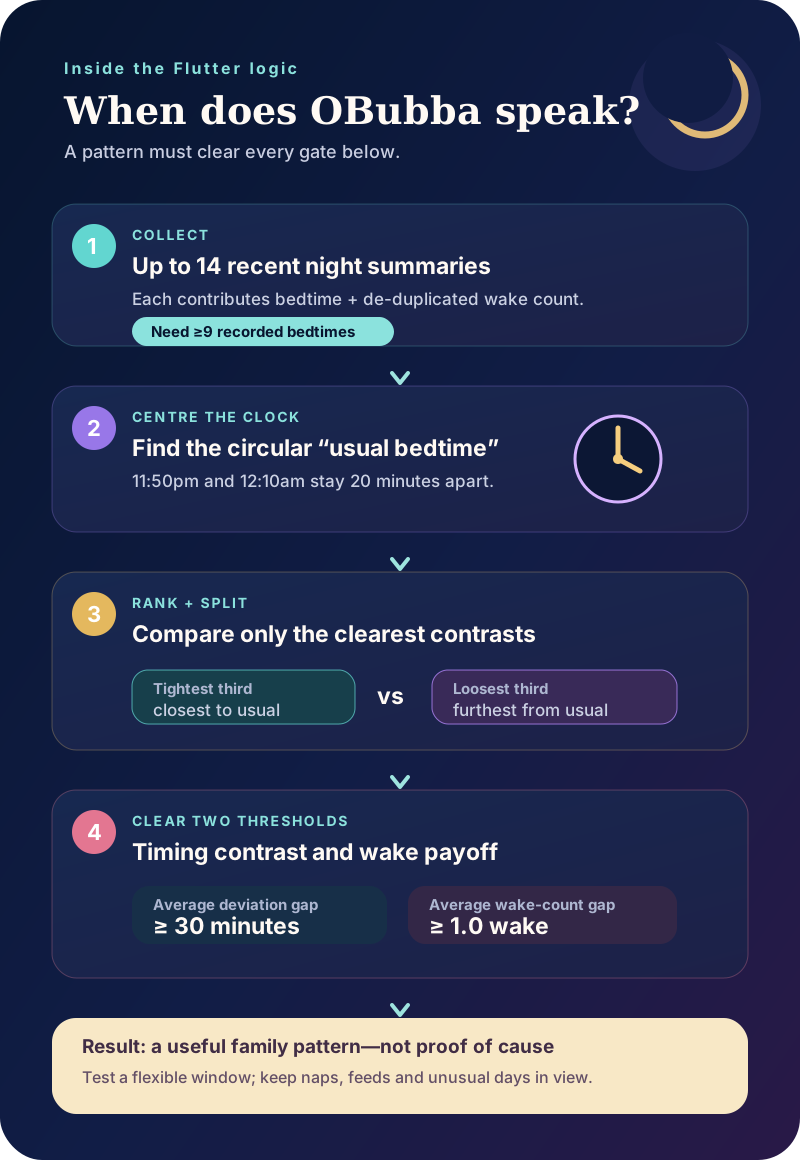
What the app actually compares
The current engine builds a list from 14 calendar mornings, most recent first. For each one, it resolves the physical night across midnight and asks `analyzeNight` for two values:
- `bedtimeMin`: the start of the earliest valid evening sleep arc; and
- `wakeCount`: the de-duplicated count of night wakes and qualifying non-dream night feeds.
The night resolver is doing more work than a simple tally. It can join a bedtime logged before midnight to wakes logged after midnight, ignore some overlapping camera duplicates, fold near-simultaneous partner logs together and count a gap between two sleep arcs as a wake when no wake was separately logged inside it.
That matters because “three wakes” should mean three physical wakings, not three taps made by two tired adults.
Nights without a bedtime are discarded. At least nine nights with a bedtime must remain, so the card cannot be produced from a lucky weekend.
Why midnight does not break the average
A normal arithmetic average treats 11:50pm and 12:10am as almost twelve hours apart. On a clock, they are only 20 minutes apart.
OBubba maps each bedtime around a 24-hour circle and calculates a circular mean. It then finds the shortest distance from every bedtime to that centre. A household with bedtimes either side of midnight can therefore look appropriately steady instead of wildly inconsistent.
The detector ranks the usable nights from closest to furthest from that circular usual bedtime. It does not compare “before 8pm” with “after 8pm”, and it does not impose a universal baby bedtime.
The two thirds that matter
After ranking, OBubba compares only the extremes:
- the most-consistent third, whose bedtimes sit closest to usual; and
- the most-variable third, whose bedtimes sit furthest away.
With nine to eleven usable nights, that is three nights in each group. With twelve to fourteen, it is four. The middle nights are deliberately left out of the wake comparison.
This makes a clear contrast easier to see. It also means the result is based on smaller groups than the headline’s full sample label may suggest. “13 nights” can mean a four-night steady group compared with a four-night variable group, with five middle nights helping define the usual bedtime but not the final wake averages.
The card stays silent unless both thresholds pass:
- The variable group’s average distance from usual must be at least 30 minutes greater than the steady group’s.
- The variable group must average at least 1.0 more recorded wake per night.
If every bedtime is already close to usual, there is no contrast to credit. If some bedtimes drift but wake counts remain similar, there is no payoff to report. If steady nights are worse, this particular positive card does not appear.
That restraint is one reason the insight is more useful than generic “consistency is key” advice.
Reading the number in the card
The body might say that your baby wakes about 1.5 fewer times when bedtime stays closest to usual, followed by something like 0.5 vs 2.0 wakes.
Those are simple group averages. They are not a prediction that tonight will contain exactly half a wake. They summarise the tightest and loosest thirds of the current window.
The app also shows a sample-size confidence label, but sample size is not the same as causal confidence. Four tidy nights and four drifted nights can reveal a useful family pattern while still leaving many other explanations open.
“Biggest lever” is a headline, not a causal verdict
The code measures bedtime timing and recorded wake count. It does not control for:
- whether a late final nap pushed bedtime later;
- whether a missed nap made bedtime both early and difficult;
- illness, vaccination, teething discomfort or reflux symptoms;
- nursery, travel, guests, fireworks or a different carer;
- a growth-related change in feeding;
- bedroom temperature, light or noise;
- a developmental disruption; or
- whether one parent logged more completely on some nights.
A late bedtime may travel with a disrupted day. The disrupted day—not the clock time alone—may explain part of the waking. Likewise, a calm home day may produce both an on-time bedtime and a calmer night.
So read “biggest lever” as: this is the clearest positive bedtime-versus-wakes contrast that this detector found in the available records. It is not a comparison against every other possible intervention, and the engine does not run a clinical causal model.
That distinction protects parents from turning an encouraging pattern into blame. You did not “ruin the night” because a family meal ran late.
A flexible bedtime window beats minute-perfect pressure
The card copy recommends keeping bedtime within roughly ±15 to 30 minutes. In daily life, that means choosing an anchor range.
If the usual sleep onset is around 7:30pm, a workable target might be 7:15 to 7:45pm, with the wind-down beginning before it. Some families need a wider window. Newborns and young babies often do not yet have a settled clock bedtime, while naps and feeding remain highly variable.
The range should bend when the day does.
| What happened today | A sensible bedtime response | |---|---| | Naps and morning wake were close to usual | Use the familiar wind-down and usual bedtime range | | Final nap ended later | Allow enough awake time for genuine sleepiness; do not force the early edge of the range | | A nap was missed or very short | Begin the routine modestly earlier rather than stretching an exhausted baby | | Baby is ill, in pain or feeding differently | Prioritise responsive care, comfort and medical advice where needed | | Nursery, travel or an event changed everything | Preserve one or two familiar cues and return gradually over the next days |
This is the same principle explored in Does My Baby Need the Same Bedtime Every Night?: consistency can be an anchor without becoming rigidity.
A seven-night test inside OBubba
1. Choose the smallest useful change
Do not redesign naps, night feeds, settling and bedtime at once. Pick a realistic bedtime window close to the times that already preceded calmer nights.
If the steady group clustered around 7:20pm and the drifted group around 8:30pm, begin with a 15- to 20-minute move—not a sudden 70-minute jump. Start the familiar routine correspondingly earlier.
2. Keep the sequence recognisable
Use a short series of repeatable cues: lower lights, fresh nappy, sleepwear, feed if due, a book or song, then the family’s normal settling response. The NHS lists calm options such as a bath, night clothes, a story, dimmed lights, a cuddle and a lullaby.
The exact ingredients matter less than making the transition understandable and practical. A bath that energises your baby does not deserve a place merely because it looks like a bedtime routine.
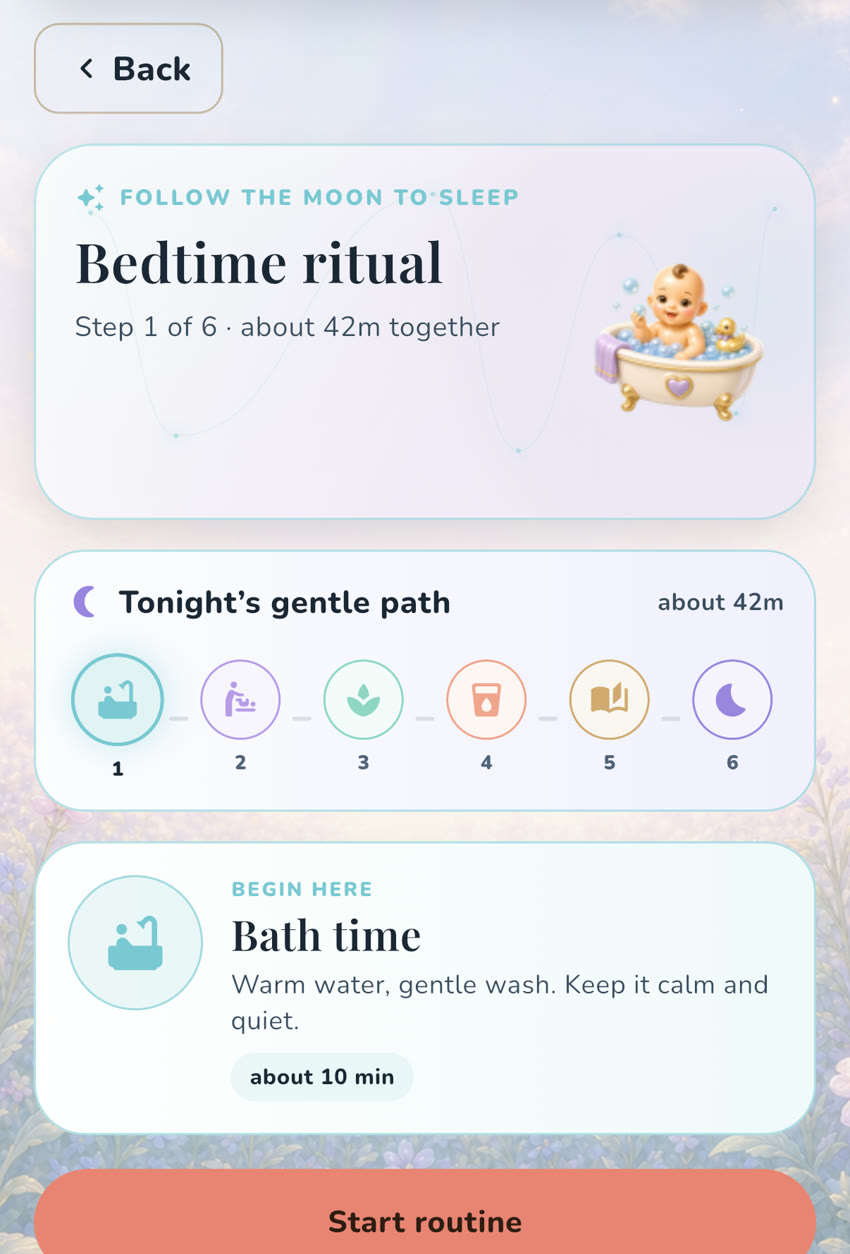
OBubba’s Bedtime ritual screen can turn chosen steps into one repeatable path instead of asking a tired parent to remember the plan.
3. Log the physical night, not your impression of it
Start the sleep record at actual bedtime. Log wakes when they happen, and use Pause/Resume when the baby is genuinely awake for a stretch. Add a reason or settling method only when you know it; uncertainty is better than a guess.
If a partner also logs, avoid duplicating the same event. OBubba de-duplicates close matches, but clean shared records produce a clearer family history.
4. Mark the obvious confounders
Use day type or notes for nursery, travel, sickness and other unusual circumstances. Log the real final nap and meaningful feeds. A bedtime-only experiment is easier to interpret when the rest of the day remains visible.
Do not withhold a needed feed to make wake counts look better. Normal waking and feeding needs vary widely, especially in younger babies.
5. Review the run, not the worst night
After seven ordinary nights, ask:
- Was settling calmer or simply earlier?
- Did wakes fall across several nights?
- Did the longest unbroken stretch change?
- Was the window realistic for family life?
- Did any improvement persist when nursery or naps varied?
One poor night does not disprove the pattern. One perfect night does not prove it.
Where to find this insight
The UI classifies bedtime-consistency impact as a longer-term pattern insight. It belongs in the “What OBubba noticed” analysis feed rather than repeating as a daily instruction.
If you dismiss it, the key is tied to the stable title rather than the moving decimal in the body. A rolling average changing from 1.4 to 1.5 fewer wakes should not make the same card nag you again the next morning.
That is small product behaviour, but it reflects the right philosophy: insight should reduce mental load, not create another notification to manage.
When the card stays quiet
You may never see it, even after logging sleep, because:
- fewer than nine of the last 14 nights have a bedtime;
- bedtimes are already uniformly steady, leaving no contrasting group;
- the tightest and loosest groups differ by less than 30 minutes in average deviation;
- the wake-count advantage is smaller than one wake per night;
- steady nights do not have fewer wakes; or
- a bedtime is missing from enough resolved nights.
Silence is not a judgement that consistency does not matter. It means this particular detector lacks the contrast needed to make a personalised claim.
One important logging limitation
The detector requires a bedtime, but it does not require a recorded morning wake before admitting that night. A bedtime-only or still-open night can therefore carry a zero wake count at the moment the analysis runs.
That can make an incomplete night look calmer than it ultimately was. The broader night engine has strong cross-midnight and duplicate-log handling, but this gate does not explicitly filter for complete nights.
Practical response: close or finish the night record in the morning before treating the decimal as settled. If the pattern looks surprising, inspect the underlying nights rather than forcing a schedule around a possibly incomplete comparison.
This is also why OBubba should remain a decision-support tool, not an authority over a tired parent who knows the record is patchy.
Routine is not the same as sleep training
Keeping bedtime in a familiar range does not require leaving a baby to cry, removing responsive feeds or ending contact settling before a family is ready.
A bedtime routine can coexist with feeding to sleep, rocking, cuddling, gradual changes or no sleep-training plan at all. If a settling method has become unsustainable, OBubba can help build a song-and-cot routine gradually, but that is a separate choice from testing bedtime timing.
For babies under six months, safer-sleep guidance remains central. The NHS advises that a baby sleeps in the same room as a parent for at least the first six months. The Lullaby Trust recommends a clear, flat, separate sleep space with unnecessary items kept out.
Frequently asked questions
Does my baby need exactly the same bedtime every night?
No. The detector itself measures closeness to your baby’s recent usual time, not compliance with a universal clock time. Use a range and respond to naps, feeding, illness and cues.
Why does OBubba need nine nights?
It splits nights into thirds and needs at least three in each extreme group. Nine usable bedtimes are the minimum that makes that possible.
Why use only the tightest and loosest thirds?
The contrast makes a relationship easier to detect when middle nights are ambiguous. The trade-off is that the final wake averages use only part of the displayed sample.
Does one fewer wake mean bedtime caused it?
No. It is a correlation in your records. Naps, illness, feeds, environment and daily disruption may influence both bedtime and wakes.
What if our usual bedtime is after midnight?
The circular calculation is designed for clock times that straddle midnight. 11:50pm and 12:10am are treated as neighbours, not opposite ends of a number line.
Should I wake a sleeping baby to protect bedtime?
Not automatically. Nap decisions depend on age, health, total sleep, feeding and the time remaining before bed. Make one modest change and use individual professional advice where sleep or growth is a concern.
Should I remove night feeds during the test?
No. Continue responsive feeding and follow medical or health-visitor guidance. A lower wake count is not a reason to ignore hunger or distress.
Is this card medical advice?
No. It is a low-urgency pattern read from logged data. Persistent sleep difficulty, breathing concerns, unusual lethargy, feeding problems, pain or parental exhaustion deserve appropriate professional support.
The takeaway
“Bedtime consistency is your biggest lever” is most useful when translated into ordinary language:
> In the nights recorded here, bedtime staying near its usual range travelled with fewer wakes. Try a small, flexible repeatable change and see whether the pattern holds.
That is what a thoughtful baby app should do: turn scattered 2am taps into one testable idea, show enough of the calculation to earn trust and leave the final decision with the family.
Try OBubba’s baby sleep tracker free → — see bedtime, wakes, feeds, naps and day context together, then let the app look for patterns without demanding a perfect routine.
Sources
- NHS: Helping your baby to sleep
- NHS: Sleep and young children
- Mindell et al., Sleep (2009): A nightly bedtime routine—impact on sleep in young children and maternal mood
- The Lullaby Trust: Keeping a clear cot
- OBubba source reviewed: `bedtime_consistency_impact.dart`, `brain.dart`, `night_analysis.dart`, `day_metrics.dart`, `brain_insight.dart`, `track_home.dart`, `bedtime_consistency_impact_test.dart`, `night_analysis_test.dart` and `day_metrics_test.dart`.
OBubba is a record, pattern and education tool. It cannot diagnose the cause of night waking or assess a baby’s health, feeding needs or sleep safety. It does not replace advice from a health visitor, GP, paediatrician, NHS 111 or emergency services.
Ready to try OBubba?
Use OBubba to track feeds, sleep, naps, nappies, growth, milestones and family handovers in one calm baby tracker app.