Monday’s nappy looked a little slimy. Thursday’s did too. On Saturday you chose Mucousy again, and OBubba said:
> Mucousy nappies are hanging around
Is the app saying your baby has an allergy? Was it the yoghurt you introduced, a tummy bug or teething? Should you cut dairy out today?
No. The card means one narrow thing: a Mucousy texture was logged on at least three different days in the app’s latest seven-day window. It does not inspect the nappy, diagnose a cause or prove that a new food was responsible.
The useful question is not “What diagnosis did the app find?” It is “Is this a repeated pattern, what else happened alongside it, and does my baby need advice now?”
The short answer
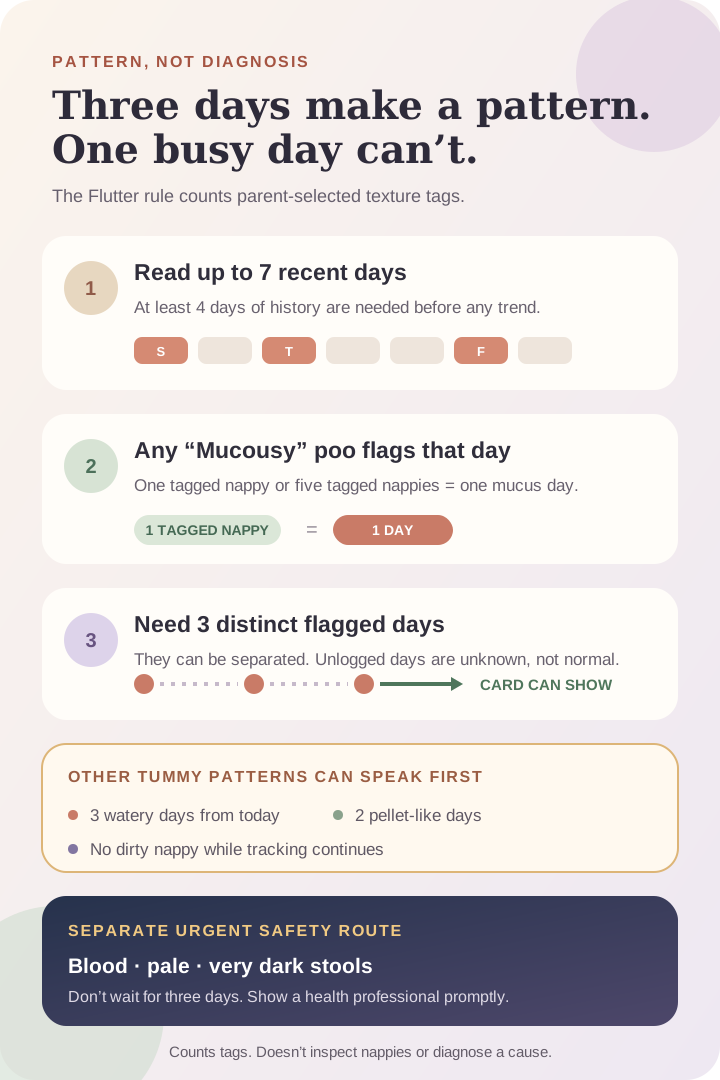
The current `giHealthTrend` engine:
- needs at least four days of history before it says anything;
- reads up to the seven most recent calendar days, newest first;
- marks a day when any poo entry contains the exact texture tag Mucousy;
- counts marked days, not individual nappies;
- shows the card when at least three distinct days are marked; and
- stays quiet if a higher-priority tummy pattern wins first.
The three days do not have to be consecutive. Three mucousy nappies on Tuesday still make Tuesday only one flagged day. And an unlogged day does not mean “normal”—it simply contributes no mucus flag.
The card is deliberately low urgency. A separate same-day safety layer handles logged blood, pale stools, very dark stools after the newborn period and watery diarrhoea. That separation is the most important part of the design: a slow pattern reminder must not blur an acute warning sign.
A worked seven-day example
Imagine today is Sunday and the log looks like this:
| Day | What was logged | Mucus-day count | |---|---|---:| | Sunday | one ordinary poo | 0 | | Saturday | one poo tagged Mucousy | 1 | | Friday | no nappy entry | 0 | | Thursday | two poos; one tagged Mucousy | 1 | | Wednesday | one ordinary poo | 0 | | Tuesday | three poos, all tagged Mucousy | 1 | | Monday | one ordinary poo | 0 |
Saturday, Thursday and Tuesday make three flagged days, so the detector can speak. Tuesday does not count three times, even though three nappies carried the tag.
Now change the record:
- three tagged nappies on Saturday only: one flagged day, so no mucus-trend card;
- Saturday and Thursday only: two flagged days, so the branch stays quiet;
- Saturday, Thursday and the previous Sunday: the previous Sunday has fallen outside the latest seven days, so it does not count;
- three tagged days but watery nappies today, yesterday and the day before: the higher-priority loose-stool run speaks first;
- three tagged days plus pellet-like stools on two days: the hard-stool branch speaks first;
- only three days of history: the whole rolling tummy detector stays quiet.
This is why the card may appear later than expected, disappear as the window moves, or not appear even though you remember several mucousy nappies.
What does “Mucousy” mean inside OBubba?
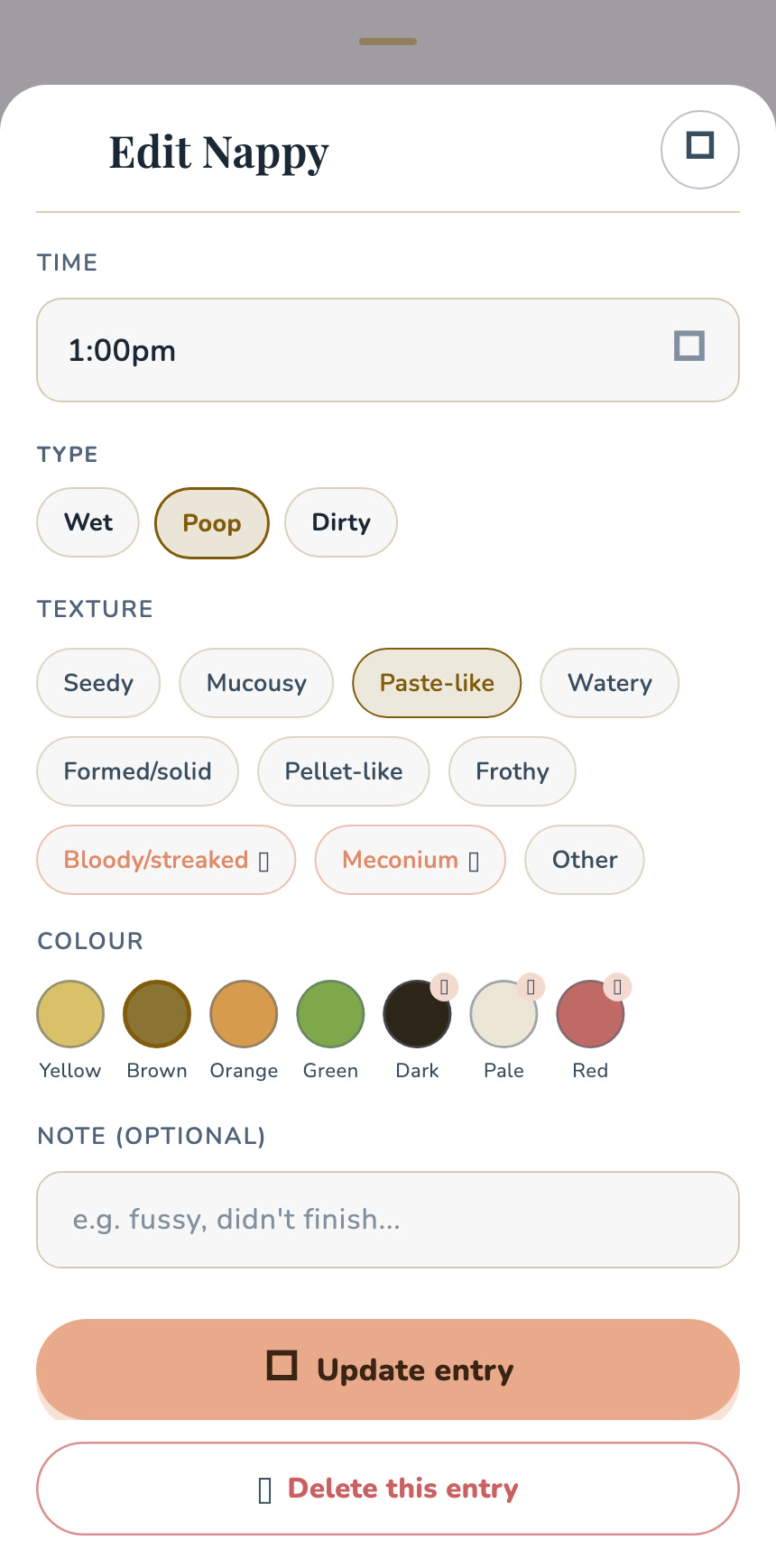
It means the parent selected that texture while logging a poo. The app is counting structured tags.
OBubba does not currently analyse a photograph or look inside a nappy. It cannot decide whether what you saw was mucus, undigested food, a change in normal breastfed-baby stool, or something else. The quality of the insight depends on consistent, honest logging—not perfect certainty.
Mucus is often described as a slippery, stringy or jelly-like coating or streak. Baby poo varies enormously with age, breast or formula feeding, illness and the start of solids, so a difficult-to-classify nappy is not unusual. If you are unsure, note what you saw in your own words rather than trying to satisfy the app’s label.
Try OBubba free → — keep nappy texture, colour, feeds, new foods, symptoms and wet nappies in one calm timeline you can actually use.
Why three days rather than three nappies?
One busy bowel day can contain several similar nappies. Counting every nappy as an independent signal would make a short-lived episode look like a week-long pattern.
The day-based rule asks a more useful question: did this observation recur across time? It reduces the chance that a cluster from one afternoon dominates the picture, while still giving a parent a prompt when the tag keeps returning.
It is not a medical threshold. Three days is the app’s speaking rule, not a published boundary between harmless and concerning mucus. A clinician may want to know about one nappy if blood is present or the baby is unwell; conversely, three isolated tags in a thriving baby do not establish disease.
The tummy patterns that speak first
`giHealthTrend` returns one card, so its order matters.
Three watery days from today
If today, yesterday and the day before all contain a Watery tag, A few loose days in a row wins with medium urgency. This branch cares about a consecutive streak from today, because diarrhoea can create a hydration problem.
NICE advises continuing breastfeeding and other milk feeds during gastroenteritis and watching for reduced urine output, altered responsiveness, dry mouth, sunken eyes, pale or mottled skin and cold hands or feet. Babies under one—especially under six months—are at greater risk of dehydration.
Pellet-like stools on two days
Two or more days with a Pellet-like tag produce Stools looking a little hard before the mucus branch. Frequency alone does not define constipation; hard, dry, pellet-like stools and painful straining are more informative.
No dirty nappy while logging continues
If there is no dirty nappy for at least three days but other nappy entries show that tracking continued, OBubba may raise No dirty nappy for a few days. Empty days alone do not count as constipation. The app also softens the message for a young breastfed baby, because gaps can be normal.
The mucus pattern
Only after those checks does the app count Mucousy-tagged days. A lower branch also watches for a sustained dip in wet-nappy counts, but the mucus card wins before that softer trend when both qualify.
This priority order is helpful, but it is not triage. Read the baby, not just the winning card.
The acute stool safety layer is separate
The rolling mucus card should never be used to “wait seven days” when a nappy contains a warning sign.
Elsewhere in the engine, OBubba examines structured colour and texture entries from today and yesterday. A logged pale colour, very dark stool after the early newborn period, or blood-streaked texture can produce the high-urgency card A nappy worth showing someone. A watery nappy today can also produce a same-day hydration warning.
Those rules are separate from the three-day mucus count. In the health detector, the structured pale/blood/dark warning ranks above the routine fever and watery-stool branches; only more immediately life-threatening signals such as a very high temperature or hypothermia can outrank it.
The practical translation is simple:
- mucus only, baby otherwise well: record the pattern and seek advice if it persists or worries you;
- blood, pale/white/chalky poo, or black/tarry poo outside the first meconium nappies: contact a health professional promptly;
- repeated watery stools or vomiting: protect hydration and seek advice according to age and symptoms;
- baby looks seriously unwell: do not wait for another nappy or another app card.
NICE lists blood and/or mucus in stool as a reason to consider diagnoses other than straightforward gastroenteritis and recommends stool microbiology when either is present in that clinical context. That does not mean every mucousy nappy needs a test; it means the symptom belongs in the clinical history rather than being dismissed.
Is it teething?
Do not let teething become the explanation for every bowel change.
The current OBubba card says a little mucus “can come with teething or a passing bug”. The careful interpretation is that teething may coincide with more dribbling, mouthing and other changes; the tag does not prove causation. The NHS explicitly says there is no evidence that teething causes diarrhoea.
If a baby has watery diarrhoea, blood, repeated mucus, fever, poor feeding or seems unwell, use the relevant health guidance. Do not assume teething makes those signs harmless.
Is it a food allergy?
Mucus can appear among the gastrointestinal symptoms considered in cow’s-milk protein allergy, particularly when it sits beside blood, diarrhoea, vomiting, feeding discomfort, eczema or faltering growth. But mucus on its own is non-specific.
The NHS describes food-allergy reactions as a pattern of symptoms and timing. Immediate reactions usually happen within minutes to two hours and can include swelling, wheeze, cough, hives or vomiting. Some reactions, including cow’s-milk allergy, can take up to three days and may involve digestive symptoms.
That is exactly why a seven-day log can help a clinician—and why it cannot make the diagnosis. The app does not know whether food caused the symptom, whether milk protein exposure occurred through formula, solids or a breastfeeding parent’s diet, or whether infection or another condition fits better.
Do not remove major foods from a baby’s or breastfeeding parent’s diet solely because the card appeared. Unsupervised restriction can make nutrition harder and can muddy the diagnostic picture. Ask a GP, health visitor or paediatric dietitian about a structured assessment, especially when symptoms repeat.
For new foods, record what was offered, approximate amount, time, and any skin, breathing, vomiting, bowel or behaviour changes. Our baby food-allergy reaction guide explains what to log and when to escalate.
What should I log next?
Good logging is brief enough to keep doing. Capture:
- the poo time, colour and closest texture;
- whether mucus was a small streak, a coating or throughout;
- blood, unusual paleness or black/tarry appearance as a warning sign, not merely in a free-text diary;
- watery frequency and vomiting;
- breastfeeds, bottles and whether feeding is normal for this baby;
- new foods and allergens, with times rather than guesses about cause;
- wet nappies;
- temperature, eczema or rash, swollen lips or face, cough, wheeze and breathing changes;
- pain, unusual crying, sleepiness, alertness and general behaviour.
If appropriate, a clear photo can help you show a clinician what you saw. Store and share it privately; OBubba’s current detector does not inspect it.
Do not delay care to produce a complete week or a perfect diary. A partial timeline plus “this is different from normal” is useful information.
Feeding and hydration while you watch the pattern
Keep offering normal milk feeds responsively. During diarrhoea or vomiting, NHS and NICE guidance says to continue breast or bottle feeding; smaller, more frequent feeds may be easier if a baby is being sick. A pharmacist or clinician can advise whether oral rehydration solution is appropriate.
Watch the whole baby. Drier or fewer nappies than usual, a dry mouth, sunken eyes, unusual drowsiness or irritability, pale or mottled skin, cold hands and feet, or a baby who is not feeding normally deserve advice. Our fewer wet nappies guide explains how OBubba separates a soft personal dip from the acute dehydration floor.
Starting solids can change colour, smell, frequency and texture without meaning something is wrong. Keep breast milk or first infant formula as the main drink during the first year, offer age-appropriate sips of water with meals from around six months, and follow the baby’s appetite. See our baby poo after starting solids guide for the broader normal-change picture.
When to get medical help
Contact your GP or NHS 111 promptly if there is blood or mucus in diarrhoea, repeated mucus with poor feeding, vomiting, tummy pain, fever, worsening eczema, faltering growth, or if the pattern persists and you are concerned. A baby under six months is harder to assess remotely, so have a low threshold for seeking help.
Seek urgent help if your baby is hard to wake, floppy or confused; is struggling to breathe; has blue, grey, very pale, blotchy or ashen skin; has green vomit; has a non-fading rash; is not feeding normally and you are worried; or has markedly drier nappies. Call 999 for life-threatening breathing difficulty, collapse, a severe allergic reaction or another immediate emergency.
Use your local service if you are outside the UK. An app cannot examine circulation, hydration, abdominal tenderness, growth or breathing.
Turning the log into a useful conversation
Instead of arriving with “the app thinks it is dairy”, bring observations:
> “I logged a mucousy texture on Tuesday, Thursday and Saturday. There was no blood. Saturday’s was also watery. Feeding is normal, but wet nappies dropped from six to four. We introduced yoghurt on Wednesday and the eczema worsened on Friday.”
That summary separates facts, timing and interpretation. A clinician can ask better questions and decide whether reassurance, examination, a stool sample, an allergy assessment or another step is appropriate.
OBubba’s real value is not naming a disease. It is reducing the 3am mental load and preserving the sequence you would otherwise have to reconstruct from memory.
Frequently asked questions
Why did three mucousy nappies not trigger the card?
They may all have happened on one or two days, fallen outside the latest seven-day window, or been preceded by a higher-priority watery, pellet-like or no-dirty-nappy trend. The engine also needs at least four days of history.
Do the three days need to be consecutive?
No. The mucus branch totals flagged days across the latest seven. Only the watery branch requires a streak running back from today.
Does an unlogged day count as a normal day?
No. It contributes no mucus flag, but the app does not know what happened. Missing data can make a pattern look quieter than it was.
Does OBubba diagnose cow’s-milk allergy?
No. Mucus can appear in allergy guidance, but it is not specific enough to diagnose an allergy. Timing, other symptoms, feeding, growth and clinician-led elimination and reintroduction may all matter.
Should I stop dairy while I wait?
Not solely because of this card. Speak to a GP, health visitor or dietitian before a significant exclusion, unless you are following an existing allergy plan. For breathing difficulty, throat or tongue swelling, collapse or another severe immediate reaction, call 999.
Why is Mucousy low urgency if NICE mentions mucus?
Because the app’s tag alone has no clinical context and the rolling rule is designed as a gentle pattern prompt. NICE’s recommendation applies within assessment of suspected gastroenteritis. Symptoms, age and how well the baby looks determine the response; the app cannot perform that assessment.
The takeaway
Mucousy nappies are hanging around means OBubba counted a parent-selected Mucousy tag on at least three distinct days within the latest seven-day window. It does not mean three nappies, three consecutive days, an image-based finding or a diagnosis.
Use the card to make the pattern visible. Keep feeding responsive, watch hydration and the whole baby, and record foods and symptoms without assigning blame. Blood, pale or black stools, repeated watery diarrhoea, poor feeding or an unwell baby belong on a faster safety route.
The goal is not to make parents stare harder at every nappy. It is to turn scattered observations into a calm, useful history—and to know when the history should become a conversation with a professional.
Sources and further reading
NICE: Diarrhoea and vomiting caused by gastroenteritis in under-5s — blood or mucus in stool, dehydration risk and signs, continuing milk feeds and when clinical investigation is considered.
NHS: Food allergies in babies and young children — immediate and delayed reaction timing, symptoms and safe introduction of allergenic foods.
NHS: Baby teething symptoms — recognised teething symptoms and the lack of evidence that teething causes diarrhoea.
NHS: Is your baby or toddler seriously ill? — poor feeding, drier nappies, breathing, responsiveness, colour and routes to urgent help.
NHS: Dehydration — dehydration signs and urgent advice.
Birmingham Women’s and Children’s NHS Foundation Trust: How a dirty-nappy photo could help detect liver disease — why a pale stool in a young baby deserves prompt attention.
OBubba source reviewed for this article: `lib/core/engine/gi_health.dart`, `lib/core/engine/health_insights.dart`, `lib/core/engine/brain.dart`, `test/gi_health_test.dart` and `test/health_insights_test.dart`.
Ready to try OBubba?
Use OBubba to track feeds, sleep, naps, nappies, growth, milestones and family handovers in one calm baby tracker app.