The baby is finally asleep. Nobody needs a feed, a nappy or a song. The house is quiet, and instead of going to bed, you reach for your phone.
One reel becomes twenty. You know tomorrow will begin early, but this is the first part of the day that feels entirely yours.
The short answer: you may be delaying sleep to reclaim choice, pleasure and uninterrupted time. Researchers call the pattern bedtime procrastination: not going to bed when you intended even though no external circumstance is preventing it. It is not a formal diagnosis, and the popular phrase “revenge bedtime procrastination” should not become another way to shame an exhausted parent.
A better aim is not “never scroll”. Protect a small, deliberate piece of evening for yourself, decide where it ends, then make the move to bed easy. If you put the phone down and still cannot sleep, that is a different problem and deserves a different response.
Is this bedtime procrastination, insomnia or simply interrupted sleep?
These can overlap. A baby who may wake at any moment also makes “no external barrier” less clear than it is in a research questionnaire.
| What is happening | More likely explanation | What may help first | |---|---|---| | “I keep choosing one more video because this is my only quiet time” | bedtime procrastination or an unmet need for autonomy | protect a defined me-time window, then use an end cue | | “I want to sleep, put the phone away, but lie awake tense or alert” | insomnia, anxiety or hyperarousal may be involved | use a gentle wind-down and read our postpartum insomnia guide | | “Every attempt to rest is interrupted by feeding, settling or another child” | too little sleep opportunity | create a specific care handover or protected rest block | | “I suddenly need very little sleep and feel unusually energetic, confused or unlike myself” | not ordinary procrastination or tiredness | seek urgent same-day medical assessment, particularly after birth |
The original study that introduced the term found an association with feeling that sleep was insufficient, but it was a small self-report survey, not proof that delaying bedtime causes every poor night. A later systematic review found links with shorter sleep, poorer sleep quality and fatigue, while rating the certainty of the evidence low. Treat the label as a useful description, not a verdict.
Why does the quiet after bedtime feel so hard to surrender?
The day belonged to everybody else
Baby care is a chain of other people's needs. Even “free” minutes may contain sterilising, washing, planning, ordering nappies and replying to messages. At night, scrolling offers instant choice with almost no setup.
That need is real. Going straight from unpaid labour to unconsciousness can feel as though the day contained no self at all. The answer cannot be another lecture about discipline; it is to make room for a small amount of genuinely chosen time before exhaustion is making the decisions.
The phone asks almost nothing of you
A hobby may require materials, concentration or two free hands. A conversation can require emotional energy. A phone offers novelty, company and entertainment while you sit still.
This is why replacing scrolling with “be more productive” often fails. Evening chores are not restorative me-time. Choose an alternative only if it gives you something you actually want: a familiar podcast, ten pages of a novel, a shower, tea on the sofa, a gentle game or a conversation with somebody safe.
You do not trust the sleep window
When a baby has woken after 22 minutes three nights running, going to bed can feel pointless. Staying awake creates the illusion that the interruption will cost less.
But quiet rest still counts, and a short sleep opportunity can be worth taking. If another adult is available, make the handover explicit: who responds, what would genuinely require waking you, and when your shift begins again. “We are both listening” often means nobody fully rests.
The day finally catches up with you
Once the practical noise stops, worries can arrive: feeding, work, money, tomorrow's appointments, whether the baby is okay. Scrolling can keep those thoughts at arm's length.
The NHS suggests writing worries or tomorrow's tasks down before bed. Keep it tiny: one worry, one next action, one person who can help. The goal is not to solve family life at midnight; it is to let your brain know the thought will not be lost.
A no-shame 20-minute me-time contract
Twenty minutes is an example, not a rule. A parent with a newborn may choose ten; somebody with reliable cover may choose an episode of a programme. What matters is that the time is intentional, enjoyable and bounded.
1. Decide what “enough” means before you start
Choose an endpoint you can notice:
- one episode, not “a bit of TV”
- ten pages, not “until I feel sleepy”
- a 20-minute timer, not “one more scroll”
- one cup of tea, not an open-ended evening on the sofa
A boundary made before the feed refreshes is kinder than a decision made at 12:47am.
2. Do the boring bedtime steps first
Brush your teeth, fill your water, take any prescribed medicine as directed and prepare the bedroom before sitting down. Put the charger where the phone will live overnight.
This removes the little wall of effort between “I should go to bed” and actually going. Do not use this step to start a cleaning sprint.
3. Make the time truly yours
Do not pay for me-time with chores disguised as relaxation. If scrolling is what you choose, choose it without guilt. You may find that a preselected programme, saved article or familiar audio feels more satisfying than an infinite feed because it has a natural ending.
4. Let one cue end the window
Use a quiet alarm, the end credits, the empty mug or a partner's handover time. When it happens, stand up before negotiating with yourself.
If your phone is also the baby monitor, feeding timer or emergency line, keep the notifications and alarms you need. A wind-down plan should never disable an important safety alert.
5. Run a seven-night experiment, not a personality test
For one week, note only:
- intended bedtime
- approximate actual bedtime
- what you were seeking: quiet, fun, connection, avoidance or practical catch-up
- how you felt the next morning
Look for one pattern. Perhaps the hardest nights follow days with no adult conversation. Perhaps a 15-minute partner handover earlier in the evening reduces the late-night pull. You are gathering clues, not scoring obedience.
If the timer rings and you keep scrolling
That is information. Reduce friction rather than increasing blame:
- charge the phone across the room once the me-time window ends
- move the most tempting app off the home screen or use its built-in time limit
- switch from visual content to a familiar audio track with the screen face down
- preselect what you will watch or read so the feed does not choose for you
- avoid anxiety-heavy parenting forums just before bed if they reliably trigger checking
- ask whether you need ten protected minutes earlier in the day, not only less phone at night
The NHS recommends avoiding phones, tablets and computers for an hour before bed where possible, alongside a regular routine, relaxation and a dark, quiet bedroom. With a baby, perfection is unlikely. Moving from 75 unplanned minutes to 20 chosen minutes can still be meaningful.
Protect autonomy before bedtime when you can
Late-night scrolling is sometimes the symptom of a day with no edges. Small daytime changes may work better than a stricter nighttime rule:
- one parent has a guaranteed 15-minute off-duty block, then the other gets the same
- a relative takes the pram while you sit somewhere alone
- one household task is deliberately left undone
- messages are answered in one batch rather than throughout the day
- a partner owns a whole recurring task, including noticing and planning it
If support is scarce, say that plainly to a health visitor, GP, family member or friend. “I need one uninterrupted rest block” is a concrete request. The NHS tiredness guidance for new parents recommends sharing nights where possible and asking friends or relatives for practical support.
A safety note for the very tired nights
If the baby wakes while you are exhausted on a sofa or chair, treat sleepiness as a safety signal. Put the phone down, settle or feed in the safest setup available, and return the baby to their own clear, flat sleep space before you sleep. Never plan to doze with a baby on a sofa or armchair.
If another capable adult can take over, wake them. A lost streak, unfinished video or broken routine does not matter more than a safe handover.
When it is more than a habit
Contact a GP, midwife or health visitor if you repeatedly cannot sleep even when the baby is asleep, poor sleep is affecting safe care, or it comes with persistent low mood, anxiety, panic, irritability, guilt, numbness or loss of enjoyment. The NHS notes that being unable to sleep when the baby sleeps can be a sign of postnatal depression.
Seek urgent same-day assessment after birth for a sudden lack of need for sleep alongside unusually high energy, racing thoughts, severe agitation, confusion, unusual beliefs, hallucinations or markedly out-of-character behaviour. Postpartum psychosis is a medical emergency. Call 999 if somebody may be in immediate danger.
How OBubba's real bedtime wind-down supports the parent
OBubba's production app does something unusual after the first timer tutorial has been seen. When a parent starts the baby's live bedtime timer on later nights, it turns towards the adult.
The bedtime wind-down first acknowledges the day of feeding, keeping safe and loving. Then the sheet says, in effect, this next bit is yours.
Its choices include:
- Parent Room for a private check-in and support
- Just breathe to open a guided breathing moment
- Put kettle on for a warm, low-pressure pause
- Guilt-free scroll because judgement is not a sleep strategy
- I'm okay, goodnight when bed is what you need
That “guilt-free scroll” choice matters. OBubba does not pretend every phone minute is harmful or tell a parent what they must do. It creates a decision point between the baby's bedtime and the rest of the evening, the exact moment when an intentional 20 minutes can otherwise become an invisible two hours. It does not set a screen-time limit or make the scroll bounded for you, so use the phone's own timer if you want an endpoint.
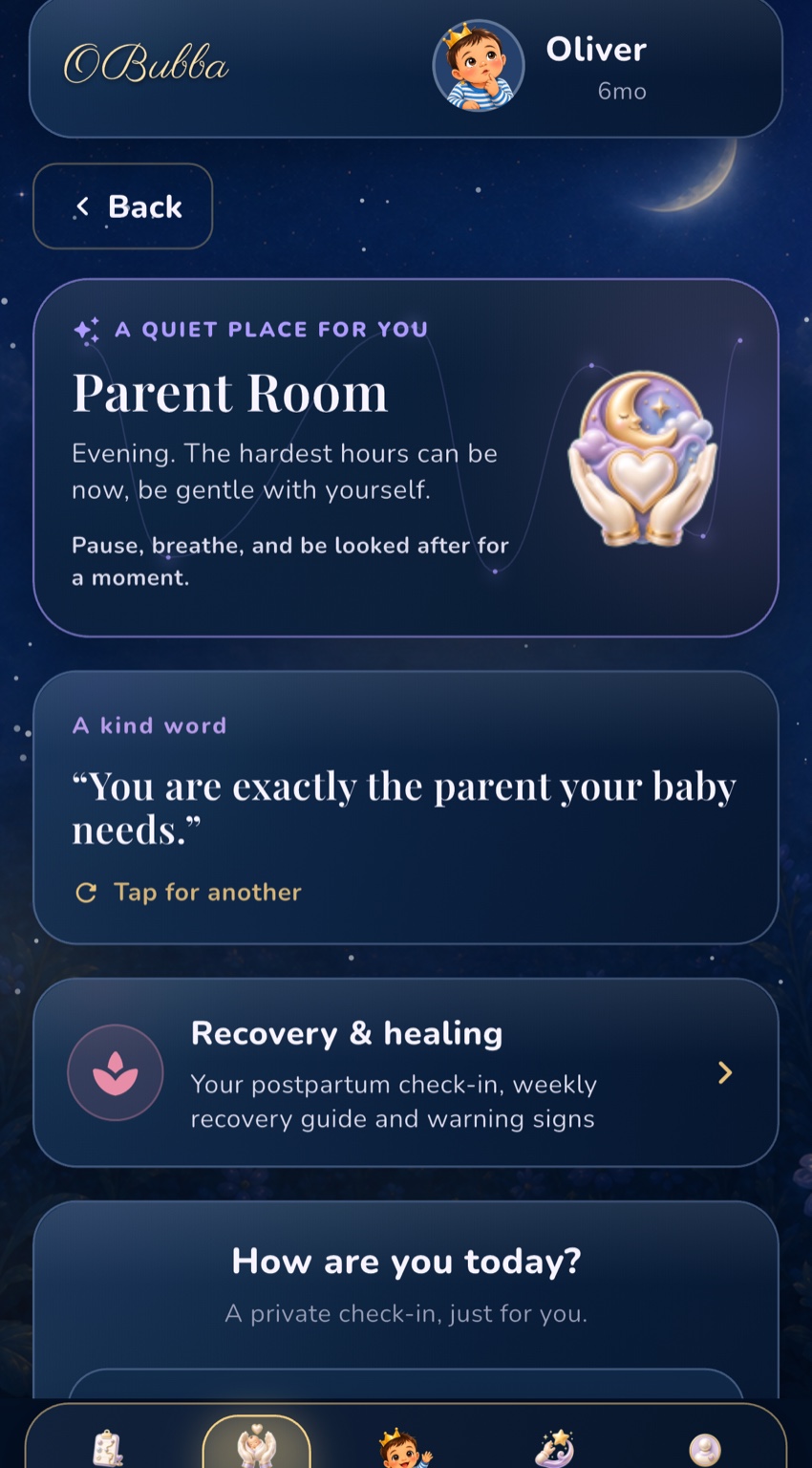
Inside Parent Room, parents can name how the day feels, use short breathing and grounding exercises, read baby-blues and postnatal-depression guidance, find region-aware support contacts and take a private wellbeing check-in. It complements the baby's sleep record: the timeline shows what the night contained; Parent Room asks how the adult is carrying it.
OBubba cannot tell whether tonight's scrolling restored you, track your screen time, diagnose insomnia or assess your safety. It offers a visible pause between the baby's bedtime and the rest of the evening, while Parent Room keeps support contacts close.
Explore OBubba's baby sleep and parent-support tools →
Frequently asked questions
Is revenge bedtime procrastination a medical condition?
No. “Revenge bedtime procrastination” is a popular phrase, not a formal diagnosis. Researchers generally use bedtime procrastination for delaying an intended bedtime without an external circumstance preventing it. Persistent sleep difficulty can still warrant medical advice.
Why do I do this only after the baby goes to bed?
That may be the first time all day when nobody is asking anything of you. Scrolling offers immediate choice and low-effort entertainment. Protecting a small amount of planned autonomy earlier or immediately after bedtime can reduce the urge to stretch it indefinitely.
Should I delete social media?
Only if that is useful to you. Start with a visible endpoint, preselected content, an app limit or charging the phone away from the bed. Keep any baby-monitor, medical, alarm and emergency functions available.
What if I go to bed but cannot sleep?
That is less like choosing to delay bedtime and more like insomnia or hyperarousal. Do not force sleep. Use a dim, quiet activity if lying awake makes you tense, and seek advice if it persists, especially after birth or with mood and anxiety symptoms.
Should I track my own sleep as well as the baby's?
Only if it answers a useful question without increasing clock-watching. A rough note of bedtime, sleep opportunity and how you felt may be enough. The aim is a clearer conversation, not a flawless adult sleep score.
The bottom line
Staying up after the baby sleeps may be your attempt to recover a piece of yourself. That need deserves respect. Give it a name, a protected window and a visible ending, then make bed the easiest next step.
If you want to sleep but cannot, or your mood, energy or behaviour has changed, do not reduce it to a bad phone habit. Ask for human support.
Sources
- Kroese et al., Frontiers in Psychology: Bedtime procrastination
- Hill et al., BMC Psychology: Bedtime procrastination and sleep outcomes systematic review
- NHS Every Mind Matters: Fall asleep faster and sleep better
- NHS: Sleep and tiredness after having a baby
- NHS: Postpartum psychosis
- The Lullaby Trust: Sleep deprivation and safer sleep
OBubba provides records, general education and private wellbeing tools. It cannot diagnose or treat insomnia, anxiety, depression or postpartum psychosis, assess immediate safety, replace professional care or guarantee sleep.
Ready to try OBubba?
Use OBubba to track feeds, sleep, naps, nappies, growth, milestones and family handovers in one calm baby tracker app.