The baby needs soft food with no added salt. One adult wants chilli. Someone else is late home. The fridge contains half a pepper, yesterday's rice and exactly no enthusiasm for cooking two dinners.
You do not need a miniature parallel kitchen for weaning.
> Cook one flexible family base, lift out the baby's portion before adult seasoning, then change the texture, not the whole meal.
That can mean lentil dhal mashed for baby and finished with chilli for adults, pasta sauce served with soft pasta shapes for baby and parmesan at the table, or a tray of vegetables and chicken cut differently for each person.
The goal is not a perfect seven-day menu. It is a small set of safe, adaptable meals that reduces decisions while helping your baby join family food.
The one-base, three-finishes method
Build dinner in three layers:
| Layer | What everyone shares | Baby finish | Adult finish | |---|---|---|---| | Base | Soft-cooked vegetables, carbohydrate and protein | Keep unsalted and thoroughly cooked | Same base | | Texture | The ingredients themselves | Purée, mash, mince or cut into safe soft finger-food shapes | Leave chunky or crisp where wanted | | Flavour | Herbs, garlic, mild spices, tomato, lemon | Use age-appropriate flavour without added salt | Add salt, stock, chilli or salty condiments after baby's portion is removed |
This is not “making baby food.” It is sequencing an ordinary meal so the baby-safe portion leaves the pan at the right moment.
Example: one pan of lentil and sweet potato stew
- Cook onion, garlic, lentils, sweet potato, spinach and mild spices until everything is soft.
- Before adding salty stock, salt or hot chilli, take out the baby's portion.
- Mash it to the texture your baby currently manages, loosening with water if needed.
- Finish the family pan to adult taste.
- Serve the same food at the same table.
The baby sees the family eating something recognisably similar. The adult cooks once. Nobody has to pretend that an untouched cube of purée counts as dinner planning.
What belongs in a flexible family-meal base?
A useful base usually has four jobs:
- energy: potato, sweet potato, pasta, rice, couscous, bread or another suitable carbohydrate
- protein and iron: lentils, beans, chickpeas, tofu, egg, meat or fish
- vegetables or fruit: one is enough; variety can happen across the week
- texture practice: a form your baby can safely manage now, with gradual progression as they become ready
You do not need all four in every spoonful. Look across several meals rather than judging one lunch like a nutrition exam.
Milk also remains important throughout the first year. Family meals are introduced alongside breast milk or first infant formula; they do not need to replace milk feeds quickly.
Six adaptable dinners, not 21 separate baby meals
Planning every breakfast, lunch, dinner and snack creates a grid large enough to fail by Tuesday. Begin with six anchor meals for the week instead.
| Anchor meal | Baby adaptation | Easy adult finish | |---|---|---| | Lentil and vegetable dhal | Mash or serve very soft pieces; offer a soft spoon | Chilli oil, salt and fresh coriander at the table | | Pasta with tomato, veg and beans or mince | Soft pasta in a manageable shape; chop or mash sauce | Parmesan, olives or extra seasoning after portioning | | Fish, potato and peas | Check carefully for bones; mash or flake to a safe texture | Lemon, capers or seasoned butter for adults | | Chicken and vegetable tray bake | Use tender inner pieces; shred or cut appropriately | Crisp adult portions longer; add salty sauce separately | | Omelette with cooked vegetables | Fully cook; offer soft strips or small pieces to suit ability | Season adults' portions and add a side salad | | Bean and sweet potato stew | Mash lightly or serve soft graspable pieces | Add chilli, seasoned yoghurt or crusty bread for adults |
These are meal structures, not a prescription. Swap ingredients for culture, budget, allergies, dietary choices and what your family actually enjoys.
Repeating a reliable dinner is allowed. Variety is built over time; it does not require seven unique meals every week.
Adapt texture without turning dinner into a second recipe
Texture should follow the baby's current skills, not the recipe photograph.
Early exploration
Offer smooth or mashed food on a spoon, or very soft pieces that fit your chosen feeding approach. Start with small amounts and let milk remain familiar.
Moving forward
Gradually leave soft lumps, fork-mash rather than blend, or offer soft finger foods alongside the spoon. The NHS advises moving from puréed or blended foods toward mashed, lumpy and finger foods as soon as the baby can manage them.
Joining more of the family meal
Chop or mince soft family food and keep adapting shape, firmness and size. “Family food” does not mean handing a baby the adult plate unchanged.
Stay within reach, seat your baby upright and supervise the whole meal. Test that cooked pieces are genuinely soft, remove bones and stones, and adapt round, hard or sticky foods. Read our gagging versus choking guide before relying on internet shorthand about food shapes.
The baby portion comes out before these ingredients
The easiest safety habit is a portion-out checkpoint. Put the baby's serving into its own bowl before adding:
- salt, stock cubes, gravy or salty packet sauces
- honey for a child under 12 months
- whole nuts or thick spoonfuls of nut butter
- an adult-level amount of chilli
- a garnish or condiment whose allergens have not been checked
Babies do not need bland food. Herbs, garlic and appropriately mild spices can make family bases interesting. “No added salt” is not the same as “no flavour.”
Check current guidance for foods to avoid, safe preparation and any individual clinical advice. A meal planner cannot see a bone in fish, know whether cheese is pasteurised or confirm that leftovers were stored safely.
How to plan around allergens without making the menu frightening
Family meals often combine several ingredients. That is useful once foods are established, but a complicated new dish makes a first reaction harder to interpret.
For a new allergenic food:
- Introduce it in a safe form and small amount when your baby is well.
- Avoid introducing several new allergens in the same dish.
- Record the exact ingredient and what happened.
- If tolerated, keep it in the baby's usual varied diet.
- If you suspect a reaction, stop and seek medical advice rather than testing it again yourself.
Once egg, dairy, peanut or another allergen has been introduced and tolerated, it can become part of an ordinary family rotation. “New” and “already tolerated” are different planning states.
If your baby has eczema, an existing food allergy or a strong allergy history, get individual advice from your GP, health visitor or allergy team. See our fuller guide to introducing baby allergens without losing track.
A ten-minute weekly planning ritual
Do this before writing a shopping list:
1. Check what actually happened last week
Which meals were eaten? Which were refused? What is already open in the fridge? A plan should learn from real life rather than rolling six abandoned ideas into another week.
2. Choose two iron anchors
Pick at least a couple of meals built around an iron-rich ingredient, such as meat, lentils, beans, egg, tofu, fish or an iron-fortified cereal. This prevents the list from accidentally becoming six variations of fruit and vegetables.
3. Choose one new thing
It might be one new food, one new texture or one new allergen, not all three at once. A small deliberate stretch is easier to understand than a plate full of novelty.
4. Repeat two easy wins
Put familiar meals on the plan on purpose. Familiarity lowers cooking load and gives a new ingredient somewhere comfortable to land.
5. Add one rescue dinner
Keep a freezer portion, low-salt tin of beans, egg meal or other quick family standby. A realistic plan includes the night nobody follows the plan.
6. Shop from ingredients, not aspirations
Turn the six anchors into one deduplicated list. If three recipes use broccoli, buy broccoli once. If an ingredient will be used for a teaspoon and then forgotten, plan where the rest goes.
A fridge-first shopping rule
Before buying anything, make three columns:
| Use first | Reliable staples | Buy for one new meal | |---|---|---| | Open vegetables, cooked grains, ripe fruit, safe leftovers | Lentils, beans, pasta, frozen veg, eggs, suitable yoghurt | The few ingredients needed for this week's new food or texture |
This keeps weaning from turning into a trail of half-used specialist ingredients. Frozen vegetables, tinned pulses without added salt and batch-cooked family bases can be practical tools; check labels and handle, cool, store and reheat food using current food-safety guidance.
What to do when the plan falls apart
A baby may refuse dinner because they are tired, teething, distracted, unwell, learning a texture or simply not hungry. One refused plate does not prove the meal was wrong.
Use a three-part reset:
- Remove pressure: finish the meal calmly; do not chase bites.
- Record the useful clue: food, texture and a short note such as “too tired” or “gagged on larger lumps.”
- Choose the next smallest step: repeat the same food, soften the texture, offer it beside something familiar or try another day.
Do not keep redesigning the entire weekly menu around one refusal. If you see a pattern across several recent meals, that is more useful than a dramatic single data point. Our no-pressure plan for a baby refusing solids helps separate unfamiliarity, texture difficulty and a general off-patch.
How the actual OBubba app builds the week
OBubba's current Care → Weaning screen does not hand every family the same static meal plan. Its recipe engine reads the baby's logged solids and corrected-age stage, then ranks suitable ideas around what the record currently lacks.
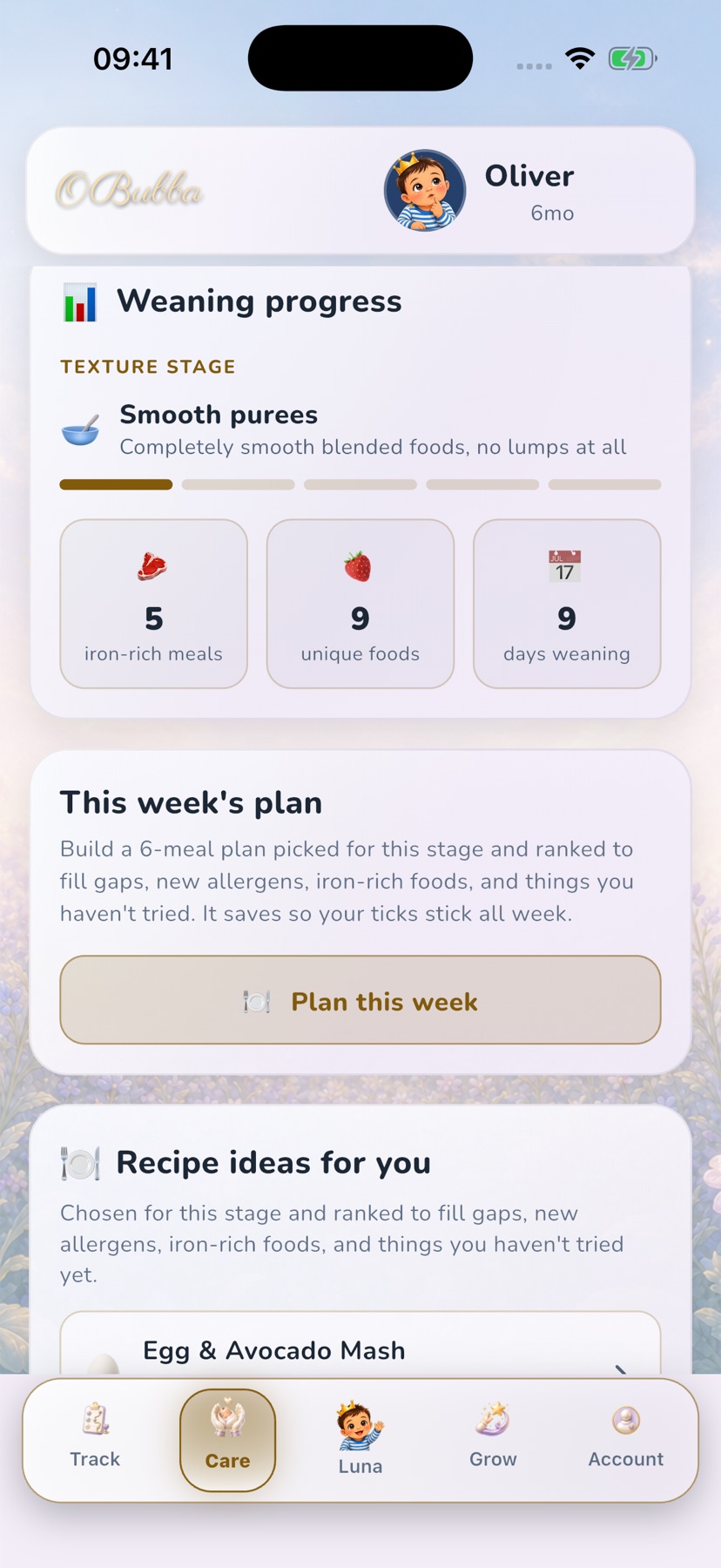
The working flow is:
- Start from the baby's stage. Recipe sections remain hidden before the app's around-six-month window and expand as texture stages progress. Age does not replace the parent's readiness check.
- Read the real journal. Logged food names, allergens and reactions become inputs; the engine also recognises common allergens inside recipe ingredients and serving suggestions.
- Prioritise useful gaps. Iron-rich, not-yet-tried ideas score higher. A recipe with one new allergen can be prioritised, while recipes stacking two or more new allergens are deliberately moved down.
- Respect recorded reactions. Recipes containing a reacted-to allergen are filtered using the baby's long-term record, including older history that has moved out of the recent-day window.
- Generate six meals. This week's plan saves for the current baby and week, so the family can mark meals tried without the list resetting each time the app opens.
- Build the shopping list. Ingredients from the chosen recipes are cleaned and deduplicated into a tickable list; “got” checks persist alongside the meal plan.
The app also shows the current texture stage, number of iron-rich meals, unique foods and days since solids began. Those are context, not grades. Nine unique foods is not automatically better parenting than eight, and the app cannot see how much was swallowed from a food name alone.
The saved six-meal weekly plan and its shopping list are available in the free app. Free accounts see a smaller set of ranked cookbook ideas, while Premium unlocks the full 77-recipe garden.
Turn six adaptable meals into one calmer week →. Keep meals, textures, allergens, reactions, recipe ideas and the week's shopping list beside feeds, sleep, nappies and growth.
What a meal planner can and cannot decide
| It can help with | It cannot decide | |---|---| | Reusing ingredients across several meals | Whether your baby is developmentally ready today | | Remembering foods and allergens already logged | Whether a food is free from cross-contamination | | Suggesting stage-matched recipe ideas | Whether a piece is soft or cut safely in front of you | | Bringing iron-rich foods back into view | How much your baby needs to eat at one sitting | | Filtering recorded reacted allergens from suggestions | Whether a symptom is an allergy or diagnosing its cause | | Creating a practical shopping list | Replacing advice from your baby's health professional |
The best plan is deliberately incomplete. It removes avoidable decisions and leaves room for appetite, milk feeds, leftovers, culture and the evening you serve toast.
Frequently asked questions
Do I need to cook every baby meal from scratch?
No. A family base can be batch-cooked, refrigerated or frozen when prepared and stored safely. Convenience food can also have a place; check ingredients, salt, sugar, allergens and texture rather than treating “homemade” as the only acceptable category.
Should the baby eat exactly what the family eats?
The underlying food can often be shared, but the baby portion may need to leave the pan before salt, be cooked softer, checked more carefully and served in a different shape or texture.
How many meals should I plan?
Plan the number that reduces stress. Six dinner or lunch anchors are often more useful than trying to prescribe every eating opportunity. Babies under 12 months do not generally need planned snacks; if they seem hungry between meals, the NHS advises offering extra milk feeds.
What if adults use stock cubes or salty sauces?
Take the baby's portion out first, then season the family pan. Alternatively, build flavour with herbs, spices, garlic, tomato or lemon and let adults add salty condiments at the table.
Can I serve leftovers to my baby?
Yes, when the original meal is suitable and food has been cooled, stored and reheated safely. Follow current NHS food-safety guidance rather than relying on smell or the meal planner.
Does logging “tried” mean my baby ate a full portion?
No. It means the meal was offered or recorded as tried. Early weaning includes touching, licking, tasting, refusing and learning. Add a short note when the distinction matters.
Sources and further help
- NHS Best Start in Life: Weaning
- NHS Best Start in Life: Recipes and meal ideas
- NHS: Your baby's first solid foods
- NHS: Foods to avoid giving babies and young children
- NHS: Help your baby enjoy new foods
This UK-oriented article provides general information, not medical or dietetic advice. Weaning usually begins from around six months when the readiness signs appear together. Follow current safety guidance and any individual plan from your GP, health visitor, dietitian or allergy team.
Ready to try OBubba?
Use OBubba to track feeds, sleep, naps, nappies, growth, milestones and family handovers in one calm baby tracker app.