The internet can make weaning sound like a referendum: choose baby-led weaning or choose purées, then defend your decision forever.
Your baby does not need a feeding-method identity.
They can hold a soft broccoli floret at lunch, accept lentil mash from a spoon at dinner and grab a preloaded spoon tomorrow. A parent can offer food responsively without handing over every utensil; a baby can practise self-feeding without every meal being finger food.
The NHS position is refreshingly practical: there is no right or wrong way, and some families combine both approaches. What matters is readiness, safe preparation, gradually expanding textures, a varied nutrient-rich diet and respect for the baby’s hunger and fullness cues.
What is the difference?
Baby-led weaning
The NHS guide for feeding from around 6 months defines baby-led weaning as offering only finger foods and letting the baby feed themselves from the start instead of spoon-feeding puréed or mashed food.
In practice, the baby picks up safe pieces, brings food to their own mouth and decides what—and how much—to explore. This gives plenty of hand-to-mouth and texture experience, but it can be messy and it still requires careful food preparation and direct supervision.
Spoon feeding
In spoon-led weaning, an adult offers puréed, mashed or soft lumpy food on a spoon. Spoon feeding does not have to mean pushing food into a closed mouth or counting mouthfuls. Done responsively, the adult offers and waits; the baby opens, turns away, pauses or finishes.
A baby can also hold a second spoon, grab a preloaded spoon or touch the mash. Spoon feeding and self-feeding are not opposites.
Combination or mixed weaning
Combination weaning uses both. You might offer a soft finger-sized piece beside a bowl of mash, alternate methods between meals or change the balance as your baby’s skills and preferences develop.
The method can also change temporarily during teething, illness, travel or a particularly tired evening. Moving to a softer texture for comfort is not “failing” baby-led weaning.
First check readiness—not the calendar alone
Most babies begin complementary foods at around six months, when these three signs appear together:
- they can stay in a sitting position and hold their head steady
- they can coordinate their eyes, hands and mouth to look at food, pick it up and bring it towards their mouth
- they swallow food rather than automatically pushing it back out with the tongue
Chewing fists, waking more often or wanting extra milk are not reliable readiness signs by themselves. See the NHS weaning hub for the current readiness guidance.
If your baby was born prematurely, use advice from your neonatal team, health visitor or GP rather than choosing a start date or method from social media. Babies with swallowing, airway, neurological, developmental or growth concerns may need an individual assessment.
The skill underneath both methods: responsive feeding
Method matters less than the interaction around it.
The World Health Organization describes responsive complementary feeding as giving food in line with a child’s appetite and fullness signals while actively supporting them to eat. In practice, offer suitable food, watch how your baby responds, help without rushing and stop when they clearly show they have had enough.
With finger foods
- sit your baby upright in a securely harnessed highchair
- place one or two safely prepared pieces within reach
- let the baby pick up and bring the food to their mouth
- avoid putting a piece into their mouth for them
- give them time to feel, squash, lick and drop it
With a spoon
- bring the spoon into view and wait
- offer when the baby opens their mouth or leans forward
- pause when they close their mouth, turn away or lose interest
- avoid scraping the spoon across their upper lip to leave food behind
- let them touch the food or hold another spoon if they want
“One more for Mummy” may sound harmless, but a repeated campaign to override “all done” makes the meal about adult reassurance. Trusting appetite cues is useful whether the food arrived by hand or spoon.
What does a simple mixed meal look like?
You do not need to prepare two separate menus. Change the shape of one safely cooked ingredient.
Sweet potato, two ways
Roast or steam until very soft. Offer one large wedge the baby can grip and fork-mash some of the same potato for a spoon. The wedge is for holding; the mash can be adult-offered or placed on a preloaded spoon.
Broccoli, two ways
Steam until the stalk and crown are soft. Offer a large floret with a handle and mash another floret into a familiar food. Check the texture yourself before serving.
Soft pear, two ways
Use a very ripe pear or cook it until soft. Offer a large, easy-to-hold wedge with hard skin and seeds removed, plus a little mash. Firmer pear needs cooking.
Porridge with shared control
Offer porridge on a soft spoon and give your baby a second preloaded spoon to lift. You can alternate turns without steering either spoon into their mouth.
Those examples teach an important principle: baby-led describes who controls the bite, not whether the food looks photogenic on a tray.
Which approach is better for nutrition?
Neither label guarantees a balanced diet.
A tray of fruit and vegetable sticks can look varied while missing iron-rich foods. A bowl of homemade purée can be nutrient-dense but stay too smooth for too long. Focus on the foods and textures offered across time.
From around six months, include:
- iron-rich foods such as meat, fish, eggs, beans, lentils and iron-fortified cereals
- vegetables and fruit with varied flavours, including less-sweet vegetables
- starchy foods such as potato, oats, rice, pasta and bread in suitable forms
- suitable full-fat dairy foods such as plain yoghurt and pasteurised cheese
- age-appropriate exposure to common allergens, one at a time and then kept in the diet if tolerated
Breast milk or first infant formula remains the main drink during the first year. Early meals are part nutrition and part learning; one dropped lunch does not tell you whether the whole week is adequate.
Our guides to whether a baby is eating enough solids and introducing allergens without losing track cover those questions in more depth.
Do babies have to start with smooth purée?
No. Some babies start with mashed, lumpy or finger foods; others prefer smooth food on a spoon at first. The NHS says to move from puréed or blended food towards mashed, lumpy and finger foods as soon as the baby can manage them.
Texture progression is not a race, but it should not disappear behind a method label. Gradually offer:
- smooth or fork-mashed food where helpful
- thicker mash and soft lumps
- soft finger foods and chopped textures appropriate to skill
- modified family foods as ability grows
Your baby does not need teeth to begin managing soft foods; gums can work on suitably soft textures. They do need the food prepared for their current skills.
If your baby repeatedly coughs or chokes, has breathing changes, sounds wet or gurgly after swallowing, develops recurrent chest infections, struggles to gain weight or finds most meals distressing, seek professional assessment rather than repeatedly experimenting with texture at home.
Safety rules are the same for both approaches
Baby-led weaning is not automatically safer because the baby controls the food. Spoon feeding is not automatically safer because the food is smooth.
For every meal:
- sit the baby upright, never reclined
- use the highchair harness correctly
- stay beside them and watch the whole time
- cook hard foods until soft
- remove stones, hard pips and bones
- quarter small round foods such as grapes and cherry tomatoes lengthways
- never offer whole nuts, popcorn, raw hard apple or carrot, thick spoonfuls of nut butter, or other known choking shapes
- learn infant and child first aid before an emergency
Gagging can be noisy and is different from choking, which may be silent. Read Gagging vs Choking: What Parents Need to Know and use the NHS first-solid-food safety guidance for current preparation advice.
How to choose what works for your family
Try asking better questions than “Which camp am I in?”
What can my baby safely manage today?
Use their upright stability, reach, grasp and swallowing experience—not another baby’s Instagram tray—as your starting point.
What food are we already cooking?
Adapt part of a family ingredient before adding salt or unsuitable sauces. A soft-cooked vegetable can become a wedge, mash or both.
What makes supervision easiest?
If you are alone and distracted, simplify the meal. If a nursery or grandparent prefers a spoon, agree on responsive cues and safe texture rather than insisting every carer uses identical equipment.
Is the diet broadening over time?
Look beyond volume. New flavours, iron-rich foods, allergen continuity and growing texture experience all matter.
Common worries
“My baby barely swallows anything with finger foods”
At first, much of the food may be squeezed, sucked or dropped. Keep usual milk feeds and offer small opportunities without pressure. You can add a spoon-fed component if it helps deliver a soft, nutrient-rich food while self-feeding skills develop.
Speak to your health visitor or GP if intake, wet nappies, energy, growth or feeding ability concerns you.
“Using a spoon means my baby is not independent”
Independence can mean opening for a wanted bite, turning away, holding a second spoon, touching the food or choosing between two safe options. Control is shared in responsive feeding.
“My baby only wants the spoon”
Let them hold it when safe. Load one spoon while they explore another. Use a small amount of food and expect it to travel. A spoon is still a self-feeding tool.
“Different carers use different methods”
Consistency in safety and response matters more than matching style. Agree that the baby sits upright, food is prepared appropriately, an adult remains present, nobody forces a bite and “all done” is respected.
How OBubba’s current First Foods guide supports both
Open Care → Weaning & First Foods → First Foods in the current app.
The catalogue contains 34 first-food ideas across Vegetables, Fruit, Protein, Grains and Dairy & eggs. You can search by food, nutrient or allergen, then open a food for:
- How to serve
- Why it’s great
- the usual stage from which it may be offered
- a clear allergen note where relevant
- food-specific cautions and live safety cross-checks
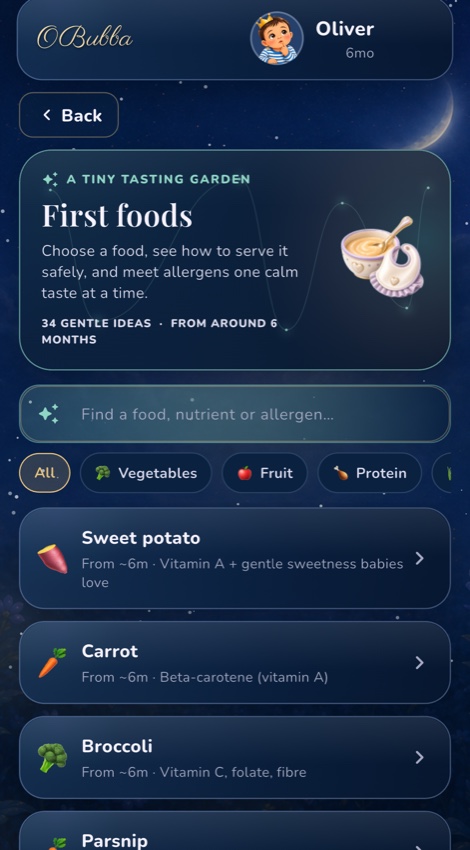
The serving guidance deliberately supports more than one style. Sweet potato can be mashed or puréed and also offered as a soft wedge. Carrot can be mashed or served as a very soft baton. Chicken can be finely shredded, blended with vegetables or offered as a soft strip to gnaw.
OBubba does not decide which method your family should use. It also cannot feel whether a piece is soft, check that a bone has been removed, see your baby’s posture or recognise choking.
When you log food through Track → Feed → Solids, describe what was actually offered—“mashed banana,” “soft broccoli floret” or “lumpy lentils”—and choose Loved it, Unsure or Reaction. The Weaning screen can use recognised wording in recent logs to summarise a texture stage alongside food variety and iron-rich meals. That is a record of your descriptions, not an assessment of chewing or swallowing.
Try OBubba free → — first-food serving guidance, allergens, textures, milk feeds and the rest of your baby’s day in one calm record.
Quick answers
Can I combine baby-led weaning and spoon feeding?
Yes. The NHS says some parents use baby-led weaning, some prefer spoon feeding and others combine both. Keep every bite responsive and every food appropriate for your baby’s skills.
Is baby-led weaning the same as finger foods?
Strictly, baby-led weaning means offering finger foods and letting the baby self-feed from the start. Finger foods can also be part of mixed or spoon-led weaning.
Does spoon feeding cause fussy eating?
Using a spoon is not the same as pressure feeding. Offer varied flavours and gradually advancing textures, wait for the baby’s cues and avoid forcing bites.
Can my baby self-feed purée?
Yes. You can offer a preloaded spoon for your baby to grasp, let them scoop with help or alternate spoons. Supervise and use an age-appropriate utensil.
What if my baby was premature?
Ask your neonatal team, health visitor or GP about readiness, timing and texture. Corrected age, posture, oral skills, medical history and growth may all affect the plan.
Sources and further reading
- NHS Best Start in Life: Weaning
- NHS: Feeding from around 6 months
- NHS: Your baby’s first solid foods
- NHS: Recipes and meal ideas
- WHO: Complementary feeding
- WHO: Guideline for complementary feeding of infants and young children 6–23 months
OBubba provides records, general educational content and food-serving suggestions. It cannot assess readiness, posture, chewing, swallowing, food softness, allergy or choking risk in a real meal, and it does not replace advice from a health visitor, GP, dietitian, feeding specialist or emergency first-aid training.
Ready to try OBubba?
Use OBubba to track feeds, sleep, naps, nappies, growth, milestones and family handovers in one calm baby tracker app.